
















• bitcoinBitcoin(BTC)$61,294.000.59%
  • ethereumEthereum(ETH)$1,720.59-0.08%
  • tetherTether(USDT)$1.000.06%
  • binancecoinBNB(BNB)$558.340.18%
  • usd-coinUSDC(USDC)$1.000.04%
  • rippleXRP(XRP)$0.941.57%
  • solanaSolana(SOL)$72.473.07%
  • tronTRON(TRX)$0.3093871.32%
  • Figure HelocFigure Heloc(FIGR_HELOC)$1.050.00%
  • HyperliquidHyperliquid(HYPE)$64.432.77%
  • zcashZcash(ZEC)$790.39-0.14%
  • moneroMonero(XMR)$493.580.11%
  • dogecoinDogecoin(DOGE)$0.0566892.57%
  • leo-tokenLEO Token(LEO)$9.16-0.12%
  • whitebitWhiteBIT Coin(WBT)$58.42-0.22%
  • chainlinkChainlink(LINK)$9.002.15%
  • USDSUSDS(USDS)$1.000.03%
  • cardanoCardano(ADA)$0.1482972.65%
  • Ethena USDeEthena USDe(USDE)$1.000.06%
  • stellarStellar(XLM)$0.1310692.57%
  • daiDai(DAI)$1.000.01%
  • bitcoin-cashBitcoin Cash(BCH)$201.021.47%
  • nearNEAR Protocol(NEAR)$2.99-0.28%
  • litecoinLitecoin(LTC)$41.343.16%
  • CantonCanton(CC)$0.0775167.64%
  • avalanche-2Avalanche(AVAX)$6.821.97%
  • uniswapUniswap(UNI)$4.842.47%
  • tether-goldTether Gold(XAUT)$3,621.662.29%
  • the-open-networkGram (prev. Toncoin)(GRAM)$1.012.29%
  • USD1USD1(USD1)$1.000.04%
  • Ripple USDRipple USD(RLUSD)$1.000.01%
  • suiSui(SUI)$0.682.99%
  • Global DollarGlobal Dollar(USDG)$1.000.03%
  • Ondo US Dollar YieldOndo US Dollar Yield(USDY)$1.150.05%
  • hedera-hashgraphHedera(HBAR)$0.0528912.48%
  • RainRain(RAIN)$0.003264-1.27%
  • paypal-usdPayPal USD(PYUSD)$1.000.06%
  • quant-networkQuant(QNT)$158.1111.05%
  • BittensorBittensor(TAO)$191.780.45%
  • shiba-inuShiba Inu(SHIB)$0.0000041.77%
  • crypto-com-chainCronos(CRO)$0.0410460.56%
  • Spiko Amundi Overnight Swap Fund (EUR)Spiko Amundi Overnight Swap Fund (EUR)(EURSAFO)$1.11-0.68%
  • Circle USYCCircle USYC(USYC)$1.140.00%
  • MemeCoreMemeCore(M)$0.783.97%
  • okbOKB(OKB)$84.181.58%
  • Falcon USDFalcon USD(USDF)$1.00-0.05%
  • pax-goldPAX Gold(PAXG)$3,622.962.35%
  • United StablesUnited Stables(U)$1.00-0.02%
  • BlackRock USD Institutional Digital Liquidity FundBlackRock USD Institutional Digital Liquidity Fund(BUIDL)$1.000.00%
  • aaveAave(AAVE)$97.37-0.95%
TradePoint.io
  • Main
  • AI & Technology
  • Stock Charts
  • Market & News
  • Business
  • Finance Tips
  • Trade Tube
  • Blog
  • Shop
No Result
View All Result
TradePoint.io
No Result
View All Result

Researchers at Google AI Innovates Privacy-Preserving Cascade Systems for Enhanced Machine Learning Model Performance

April 5, 2024
in AI & Technology
Reading Time: 4 mins read
A A
Researchers at Google AI Innovates Privacy-Preserving Cascade Systems for Enhanced Machine Learning Model Performance
ShareShareShareShareShare

The cascades concept has emerged as a critical mechanism, particularly for large language models (LLMs). These cascades enable a smaller, localized model to seek assistance from a significantly larger, remote model when it encounters challenges in accurately labeling user data. Such systems have gained prominence for their ability to maintain high task performance while substantially lowering inference costs. However, a significant concern arises when these systems handle sensitive data, as the interaction between local and remote models could potentially lead to privacy breaches.

Solving privacy concerns in cascade systems involves navigating the complex challenge of preventing sensitive data from being shared with or exposed to the remote model. Traditional cascade systems lack mechanisms to protect privacy, raising alarms about the potential for sensitive data to be inadvertently forwarded to remote models or incorporated into their training datasets. This exposure compromises user privacy and undermines trust in deploying machine learning models in sensitive applications.

Researchers from Google Research have introduced a novel methodology that leverages privacy-preserving techniques within cascade systems. Integrating the social learning paradigm, where models learn collaboratively through natural language exchanges, ensures that the local model can securely query the remote model without exposing sensitive information. The innovation lies in using data minimization and anonymization techniques, alongside leveraging LLMs’ in-context learning (ICL) capabilities, to create a privacy-conscious bridge between the local and remote models.

The proposed method’s core balances reveal enough information to garner useful assistance from the remote model while ensuring the details remain private. By employing gradient-free learning through natural language, the local model can describe its problem to the remote model without sharing the data. This method preserves privacy and allows the regional model to benefit from the remote model’s capabilities. 

The researchers’ experiments demonstrate the efficacy of their approach across multiple datasets. One notable finding is the improvement in task performance when using privacy-preserving cascades compared to non-cascade baselines. For instance, in one of the experiments, the method that involves generating new, unlabeled examples by the local model (and subsequently labeled by the remote model) achieved a remarkable task success rate of 55.9% for math problem-solving and 94.6% for intent recognition when normalized by the teacher’s performance. These results underscore the method’s potential to maintain high task performance while minimizing privacy risks.
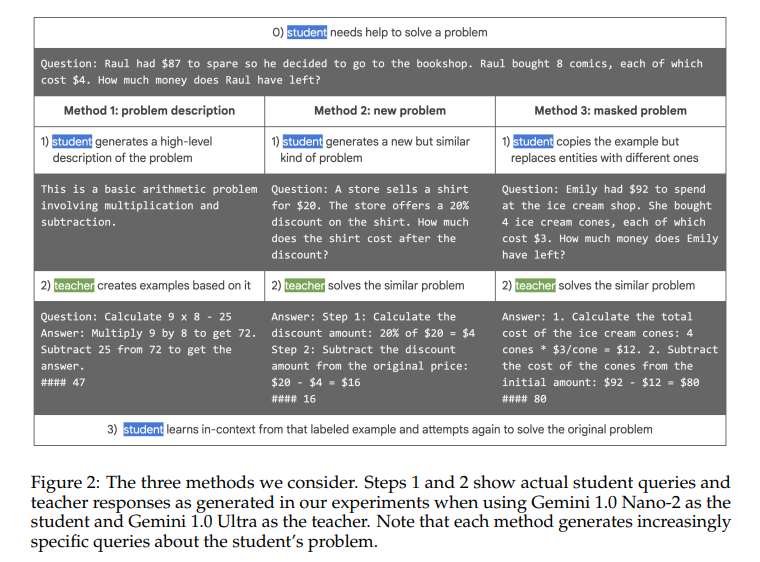
The research delves into privacy metrics to quantitatively assess the effectiveness of their privacy-preserving techniques. The study introduces two concrete metrics: entity leak and mapping leak metrics. These metrics are crucial for understanding and quantifying the privacy implications of the proposed cascade system. Replacing entities in original examples with placeholders demonstrated the most impressive privacy preservation, with the entity leak metric significantly lower than other methods. 

In conclusion, this research encapsulates a groundbreaking approach to leveraging cascade systems in machine learning while addressing the paramount privacy issue. Through integrating social learning paradigms and privacy-preserving techniques, the researchers have demonstrated a pathway to enhancing the capabilities of local models without compromising sensitive data. The results are promising, showing a reduction in privacy risks and an enhancement in task performance, illustrating the potential of this methodology to revolutionize the use of LLMs in privacy-sensitive applications.


Check out the Paper. All credit for this research goes to the researchers of this project. Also, don’t forget to follow us on Twitter. Join our Telegram Channel, Discord Channel, and LinkedIn Group.

If you like our work, you will love our newsletter..

Don’t Forget to join our 39k+ ML SubReddit


YOU MAY ALSO LIKE

Anthropic Shares Jump 17% After $107.3 Billion IPO Breaks Record

Return of Huang to Nvidia Raises More Questions, Says Investor Yoshioka

Sana Hassan, a consulting intern at Marktechpost and dual-degree student at IIT Madras, is passionate about applying technology and AI to address real-world challenges. With a keen interest in solving practical problems, he brings a fresh perspective to the intersection of AI and real-life solutions.


🐝 Join the Fastest Growing AI Research Newsletter Read by Researchers from Google + NVIDIA + Meta + Stanford + MIT + Microsoft and many others…


Credit: Source link

ShareTweetSendSharePin

Related Posts

Anthropic Shares Jump 17% After 7.3 Billion IPO Breaks Record
AI & Technology

Anthropic Shares Jump 17% After $107.3 Billion IPO Breaks Record

November 23, 2026
Return of Huang to Nvidia Raises More Questions, Says Investor Yoshioka
AI & Technology

Return of Huang to Nvidia Raises More Questions, Says Investor Yoshioka

November 23, 2026
Nvidia Rehires Huang in Stunning Comeback
AI & Technology

Nvidia Rehires Huang in Stunning Comeback

November 23, 2026
Marlowe Hits .15B Valuation With Bet Beyond Nvidia
AI & Technology

Marlowe Hits $1.15B Valuation With Bet Beyond Nvidia

November 23, 2026
Next Post
Washington state town outraged by false alarms from emergency dam system

Washington state town outraged by false alarms from emergency dam system

Leave a Reply Cancel reply

Your email address will not be published. Required fields are marked *

Search

No Result
View All Result
U.S. scaling back troops and diplomats at Middle East posts, sources say

U.S. scaling back troops and diplomats at Middle East posts, sources say

November 18, 2026
He’s About To Lose His House

He’s About To Lose His House

November 22, 2026
Are You Holding Too Much Cash?

Are You Holding Too Much Cash?

November 23, 2026

About

Learn more

Our Services

Legal

Privacy Policy

Terms of Use

Bloggers

Learn more

Article Links

Contact

Advertise

Ask us anything

©2020- TradePoint.io - All rights reserved!

Tradepoint.io, being just a publishing and technology platform, is not a registered broker-dealer or investment adviser. So we do not provide investment advice. Rather, brokerage services are provided to clients of Tradepoint.io by independent SEC-registered broker-dealers and members of FINRA/SIPC. Every form of investing carries some risk and past performance is not a guarantee of future results. “Tradepoint.io“, “Instant Investing” and “My Trading Tools” are registered trademarks of Apperbuild, LLC.

This website is operated by Apperbuild, LLC. We have no link to any brokerage firm and we do not provide investment advice. Every information and resource we provide is solely for the education of our readers. © 2020 Apperbuild, LLC. All rights reserved.

No Result
View All Result
  • Main
  • AI & Technology
  • Stock Charts
  • Market & News
  • Business
  • Finance Tips
  • Trade Tube
  • Blog
  • Shop

© 2023 - TradePoint.io - All Rights Reserved!