• bitcoinBitcoin(BTC)$75,574.00-0.98%
  • ethereumEthereum(ETH)$2,390.96-2.28%
  • tetherTether(USDT)$1.00-0.02%
  • binancecoinBNB(BNB)$710.07-1.25%
  • rippleXRP(XRP)$1.27-9.63%
  • usd-coinUSDC(USDC)$1.000.00%
  • solanaSolana(SOL)$97.01-3.21%
  • tronTRON(TRX)$0.334520-0.87%
  • Figure HelocFigure Heloc(FIGR_HELOC)$1.00-2.49%
  • zcashZcash(ZEC)$1,246.2710.03%
  • HyperliquidHyperliquid(HYPE)$78.41-0.41%
  • dogecoinDogecoin(DOGE)$0.079103-4.16%
  • USDSUSDS(USDS)$1.00-0.02%
  • RainRain(RAIN)$0.0131900.97%
  • moneroMonero(XMR)$495.26-4.28%
  • whitebitWhiteBIT Coin(WBT)$77.68-1.55%
  • leo-tokenLEO Token(LEO)$8.881.33%
  • chainlinkChainlink(LINK)$10.68-5.70%
  • cardanoCardano(ADA)$0.191730-6.31%
  • stellarStellar(XLM)$0.174133-10.92%
  • Ethena USDeEthena USDe(USDE)$1.00-0.03%
  • daiDai(DAI)$1.000.00%
  • bitcoin-cashBitcoin Cash(BCH)$217.55-2.67%
  • USD1USD1(USD1)$1.00-0.02%
  • litecoinLitecoin(LTC)$50.30-3.78%
  • uniswapUniswap(UNI)$6.19-2.96%
  • the-open-networkGram (prev. Toncoin)(GRAM)$1.31-2.26%
  • CantonCanton(CC)$0.091111-3.10%
  • Global DollarGlobal Dollar(USDG)$1.000.01%
  • nearNEAR Protocol(NEAR)$2.463.79%
  • avalanche-2Avalanche(AVAX)$7.25-3.58%
  • hedera-hashgraphHedera(HBAR)$0.072930-7.27%
  • shiba-inuShiba Inu(SHIB)$0.000005-7.28%
  • suiSui(SUI)$0.69-2.99%
  • paypal-usdPayPal USD(PYUSD)$1.00-0.01%
  • BlackRock USD Institutional Digital Liquidity FundBlackRock USD Institutional Digital Liquidity Fund(BUIDL)$1.000.00%
  • crypto-com-chainCronos(CRO)$0.055499-2.66%
  • tether-goldTether Gold(XAUT)$4,320.730.52%
  • Circle USYCCircle USYC(USYC)$1.140.01%
  • MemeCoreMemeCore(M)$1.111.06%
  • BittensorBittensor(TAO)$215.81-4.09%
  • Ripple USDRipple USD(RLUSD)$1.000.01%
  • okbOKB(OKB)$109.53-2.32%
  • Ondo US Dollar YieldOndo US Dollar Yield(USDY)$1.150.17%
  • BitwayBitway(BTW)$0.778.72%
  • pax-goldPAX Gold(PAXG)$4,329.150.69%
  • AsterAster(ASTER)$0.68-2.09%
  • World Liberty FinancialWorld Liberty Financial(WLFI)$0.056922-0.32%
  • aaveAave(AAVE)$117.02-7.95%
  • mantleMantle(MNT)$0.55-1.17%
TradePoint.io
  • Main
  • AI & Technology
  • Stock Charts
  • Market & News
  • Business
  • Finance Tips
  • Trade Tube
  • Blog
  • Shop
No Result
View All Result
TradePoint.io
No Result
View All Result

PROSE-PDE: A Foundation Model for Solving and Extrapolating Partial Differential Equations

April 23, 2024
in AI & Technology
Reading Time: 5 mins read
A A
PROSE-PDE: A Foundation Model for Solving and Extrapolating Partial Differential Equations
ShareShareShareShareShare

Have you ever wondered how complex phenomena like fluid flows, heat transfer, or even the formation of patterns in nature can be described mathematically? The answer lies in partial differential equations (PDEs), which are powerful tools used to model and understand intricate spatio-temporal processes across various scientific domains. However, solving these equations analytically can be a daunting task, often requiring computational methods or simulations. This is where machine learning comes into play, offering a novel approach to tackle PDE problems by learning to approximate the solutions directly from data.

Traditionally, solving PDEs involved numerical methods that could be computationally expensive, especially for complex systems or high-dimensional problems. Recently, researchers have been exploring using neural networks to learn the mappings between input conditions and output solutions of PDEs. However, most existing approaches are limited to specific equations or struggle to generalize to unseen systems without fine-tuning.

In a remarkable step forward, a team of researchers has developed PROSE-PDE (Figure 3), a multimodal neural network model designed to be a foundation for solving a wide range of time-dependent PDEs, including nonlinear diffusive, dispersive, conservation laws, and wave equations. The key innovation lies in PROSE-PDE’s ability to learn multiple operators simultaneously and extrapolate physical phenomena across different governing systems. But how does it work?
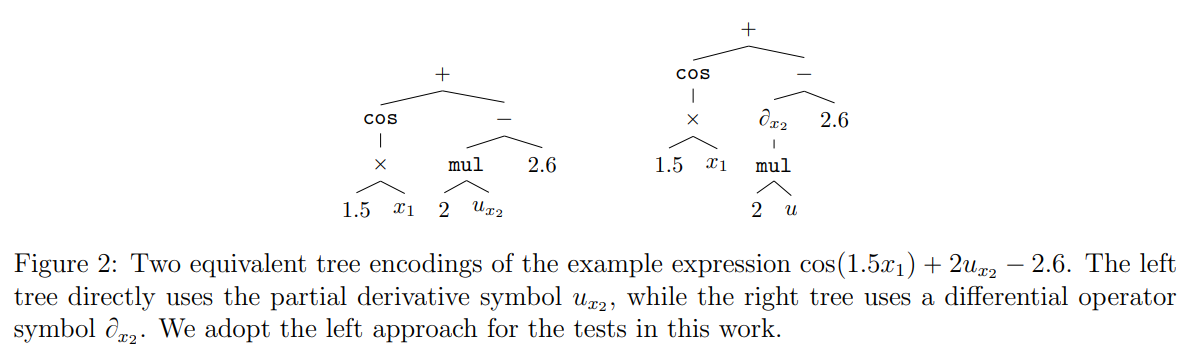
At the core of PROSE-PDE is a novel technique called Multi-Operator Learning (MOL). Unlike traditional approaches that learn a single operator for a specific PDE, MOL trains a unified model to approximate multiple operators simultaneously. This is achieved through symbolic encoding (shown in Figure 2), where equations are represented as trainable tokens in a Polish notation format. The model can then learn to associate these symbolic representations with the corresponding data solutions.

The PROSE-PDE architecture comprises five main components: Data Encoder, Symbol Encoder, Feature Fusion, Data Decoder, and Symbol Decoder. The Data Encoder processes the input data sequence, while the Symbol Encoder handles the symbolic equation guesses. These encoded features are then fused together, allowing information exchange between the data and symbolic representations. The Data Decoder synthesizes the fused features to predict the output solutions, and the Symbol Decoder refines and generates the corresponding symbolic expressions.

However, what sets PROSE-PDE apart is its ability to extrapolate physical features across different systems. Through extensive experiments, the researchers demonstrated that PROSE-PDE could generalize to unseen model parameters, predict variables at future time points, and even handle entirely new physical systems not encountered during training. This remarkable capability is attributed to the model’s ability to abstract and transfer underlying physical laws from the training data.

The evaluation results are promising, with PROSE-PDE achieving low relative prediction errors (< 3.1%) and high R^2 scores on a diverse set of 20 PDEs. Moreover, the model successfully recovered unknown equations with an error of only 0.549%. These findings pave the way for a general-purpose foundation model for scientific applications capable of efficiently solving complex PDE problems and extrapolating physical insights across different systems.

While the current work focuses on one-dimensional time-dependent PDEs, the researchers envision extending PROSE-PDE to multi-dimensional and non-time-dependent equations. As data becomes increasingly abundant in scientific domains, the potential for such foundation models to revolutionize our understanding and modeling of complex physical phenomena is truly exciting. 


Check out the Paper. All credit for this research goes to the researchers of this project. Also, don’t forget to follow us on Twitter. Join our Telegram Channel, Discord Channel, and LinkedIn Group.

If you like our work, you will love our newsletter..

Don’t Forget to join our 40k+ ML SubReddit


YOU MAY ALSO LIKE

NVIDIA, Google and Emerald AI Form AI Energy Management Alliance – Unite.AI

iPhone 18 Pro Review: The Standard Setter

Vineet Kumar is a consulting intern at MarktechPost. He is currently pursuing his BS from the Indian Institute of Technology(IIT), Kanpur. He is a Machine Learning enthusiast. He is passionate about research and the latest advancements in Deep Learning, Computer Vision, and related fields.


🐝 Join the Fastest Growing AI Research Newsletter Read by Researchers from Google + NVIDIA + Meta + Stanford + MIT + Microsoft and many others…


Credit: Source link

ShareTweetSendSharePin

Related Posts

NVIDIA, Google and Emerald AI Form AI Energy Management Alliance – Unite.AI
AI & Technology

NVIDIA, Google and Emerald AI Form AI Energy Management Alliance – Unite.AI

September 16, 2026
iPhone 18 Pro Review: The Standard Setter
AI & Technology

iPhone 18 Pro Review: The Standard Setter

September 16, 2026
A Toaster With A Vision
AI & Technology

A Toaster With A Vision

September 16, 2026
Roblox Pushes Deeper Into AI-Powered Gaming
AI & Technology

Roblox Pushes Deeper Into AI-Powered Gaming

September 16, 2026
Next Post
You might want to sell before this report comes out…

You might want to sell before this report comes out...

Leave a Reply Cancel reply

Your email address will not be published. Required fields are marked *

Search

No Result
View All Result
Clancy’s attorney says he’s not open to a deal requiring jail time

Clancy’s attorney says he’s not open to a deal requiring jail time

September 15, 2026
Inovio Pharmaceuticals, Inc. (INO) Presents at H.C. Wainwright 28th Annual Global Investment Conference Prepared Remarks Transcript

Inovio Pharmaceuticals, Inc. (INO) Presents at H.C. Wainwright 28th Annual Global Investment Conference Prepared Remarks Transcript

September 11, 2026
Trump says war with Iran will end after Election Day

Trump says war with Iran will end after Election Day

September 14, 2026

About

Learn more

Our Services

Legal

Privacy Policy

Terms of Use

Bloggers

Learn more

Article Links

Contact

Advertise

Ask us anything

©2020- TradePoint.io - All rights reserved!

Tradepoint.io, being just a publishing and technology platform, is not a registered broker-dealer or investment adviser. So we do not provide investment advice. Rather, brokerage services are provided to clients of Tradepoint.io by independent SEC-registered broker-dealers and members of FINRA/SIPC. Every form of investing carries some risk and past performance is not a guarantee of future results. “Tradepoint.io“, “Instant Investing” and “My Trading Tools” are registered trademarks of Apperbuild, LLC.

This website is operated by Apperbuild, LLC. We have no link to any brokerage firm and we do not provide investment advice. Every information and resource we provide is solely for the education of our readers. © 2020 Apperbuild, LLC. All rights reserved.

No Result
View All Result
  • Main
  • AI & Technology
  • Stock Charts
  • Market & News
  • Business
  • Finance Tips
  • Trade Tube
  • Blog
  • Shop

© 2023 - TradePoint.io - All Rights Reserved!