

VioletaStoimenova
The Canadian AI-based lending services provider Propel Holdings (TSX:PRL:CA)(OTCPK:PRLPF) has had a great past year at the stock market, with a 125% increase in share price. The rise continues into this year, with a 21% increase year-to-date [YTD].
Underpinning this impressive uptick is the solid growth in its financials. Over the past three years, its compounded annual growth rate [CAGR] is at 67.7% and the diluted earnings per share [EPS] have risen by 36.3%. Here, I take a closer look at the nature of the company’s business and financials to assess what’s making it tick and what lies next for it.
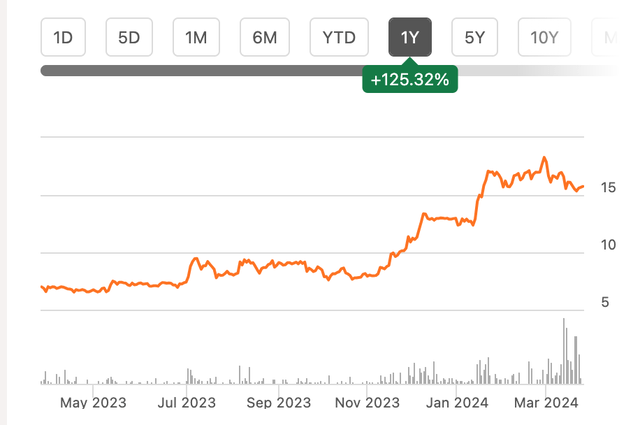
Price Chart (Source: Seeking Alpha)
Loans for underserved customers
Propel has two unique selling points. The first is making credit available to underserved customers. Reasons ranging from chequered credit histories to geographical moves can result in this target market remaining outside the traditional lending ambit. The company estimates that there are 70 million such potential consumers in the US and Canada alone.
Second, it processes 40,000 applications processed daily using over 5,000 data points per applicant with its AI-backed technology. This also distinguishes it from traditional lenders, which use just a few data points. In fact, the data it analyses doesn’t just look at the applicant’s financials but also accounts for constantly evolving macroeconomic dynamics and their implications.
Focus on the US market, growing financials
The company is still quite small with revenues of USD 316 million as of 2023. But it is growing fast, with a 39.5% revenue increase during the year. In fact, it has over quadrupled its revenues since 2020. Its net income grew even faster by 84% during the year as expenses grew at a slower rate than last year. As a result, its net margin improved to 8.8% from 6.7% the year before.
The company might be Canadian, but the US is its big market, which brings in 99% of the revenues. It also has three of its four products directed towards the geography (see chart below). The biggest one is CreditFresh, which provides open-ended lines of credit to customers in the US with its banking partners. Not only does it have a 75% share in revenues as of 2023 but is also fast growing with a 51% increase in the year.
The next biggest is its direct lending business in the US MoneyKey, which accounts for 23.5% of the revenues. It’s followed by Fora Credit the Canadian counterpart of CreditFresh, which became revenue generating only in the past year, with a 0.7% share and its category of “other revenues” presumably from its lending as a partnership service, with a 0.4% share.
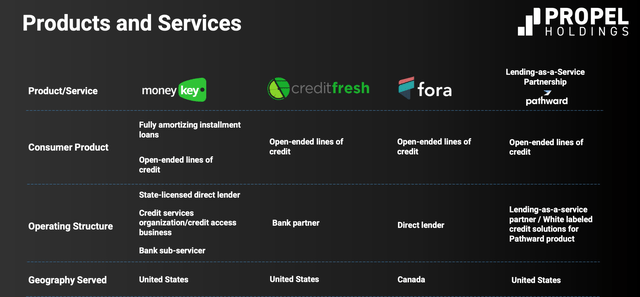
Source: Propel Holdings
The underperforming loans risk
A key number to consider in Propel’s case is also its non-performing loan ratio. It is, after all, lending to customers typically outside of the financial sector ambit. As would be expected it is higher at 4.8% in 2023 compared to the average figure of 1.4% for the US. However, there are two points to note here. First, the figure has declined sharply from the 11.5% level seen in 2022. Second, its biggest revenue generator CreditFresh, actually has an even lower non-performing loan ratio of 3.9% compared to the total.
I am more concerned about its growing underperforming loans ratio, though. From 10.3% in 2022, the figure jumped to 18% in 2023. Of course it’s possible that some of the non-performing loans have improved to underperforming, which is a positive. But even then, the total proportion of non-performing and underperforming loans has risen to 22.8% from 21.9% in 2022. While a better interest rate environment could improve this trend, there is still the risk of a macroeconomic slowdown. How the balance plays out and determine what would be next.
Positive outlook
Nevertheless, the company is optimistic about 2024 (see table below). At the midpoint of its revenue guidance, it would sustain the exact growth from last year. The prospects for its net income margin are also improved from 2023, though net income growth at the midpoint of the forecast range would slow down, which is a relative number in this context, to 70%.
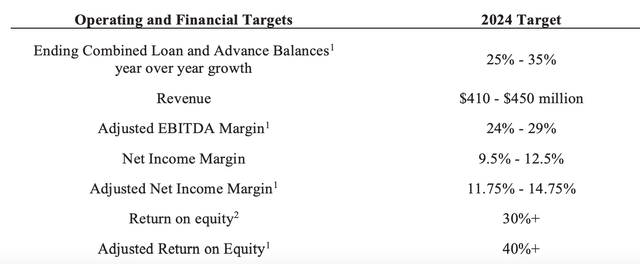
Source: Propel Holdings
Attractive market multiples
This net income forecast results in forward GAAP price-to-earnings (P/E) ratio of 11.3x, which is lower than the trailing twelve months [TTM] GAAP P/E of 15.5x. Further, the non-GAAP forward P/E comes in at 9.4x, also lower than the 14.8x TTM non-GAAP P/E.
The forward GAAP P/E ratios also compare favourably with peers that have a similar market capitalisation to Propel. Consider LendingTree (TREE), which has a forward GAAP P/E of 59.2x and non-GAAP forward P/E of 17x. Or Green Dot (GDOT), for that matter, whose forward GAAP P/E is at 21x, though its non-GAAP forward P/E is lower at 6x. Both these examples show that there’s a good likelihood on the whole of further price increases for Propel.
What next?
Propel Holdings has a lot going for it, in sum. The company’s target customer is underserved and going by its revenue growth, has high potential to sustain future expansion. Its US lending segment is particularly promising as the biggest revenue generator. The company’s massive net income growth in 2023 also stands out. And its continued positive outlook for 2024 also indicates that this will be a good year for the company. The market multiples, at the same time, still look largely attractive, indicating that there’s further upside to the stock.
There is a risk to consider in the current macroeconomic environment, though. And that is non-performing loans. With interest rates still high and the risk of a slowdown in the US economy this year, these can rise. While the relative numbers have declined in the past year, the proportion of underperforming loans has inched up, which may well roll over into non-performing loans if macroeconomic conditions take a turn for the worse. So this is a number to track for the company going forward.
However, the big picture looks good right now and if all goes well, is expected to continue doing so. I’m going with a Buy rating on Propel Holdings.
Editor’s Note: This article discusses one or more securities that do not trade on a major U.S. exchange. Please be aware of the risks associated with these stocks.
Credit: Source link