











• bitcoinBitcoin(BTC)$76,430.000.77%
  • ethereumEthereum(ETH)$2,439.261.78%
  • tetherTether(USDT)$1.00-0.02%
  • binancecoinBNB(BNB)$724.351.61%
  • rippleXRP(XRP)$1.300.40%
  • usd-coinUSDC(USDC)$1.00-0.01%
  • solanaSolana(SOL)$99.612.73%
  • tronTRON(TRX)$0.3354200.23%
  • Figure HelocFigure Heloc(FIGR_HELOC)$1.032.65%
  • zcashZcash(ZEC)$1,355.2815.61%
  • HyperliquidHyperliquid(HYPE)$79.142.49%
  • dogecoinDogecoin(DOGE)$0.0809241.19%
  • USDSUSDS(USDS)$1.000.02%
  • moneroMonero(XMR)$498.61-1.46%
  • whitebitWhiteBIT Coin(WBT)$78.630.94%
  • RainRain(RAIN)$0.012862-8.15%
  • chainlinkChainlink(LINK)$11.153.40%
  • leo-tokenLEO Token(LEO)$8.940.53%
  • cardanoCardano(ADA)$0.1970811.24%
  • stellarStellar(XLM)$0.1822723.42%
  • Ethena USDeEthena USDe(USDE)$1.000.02%
  • daiDai(DAI)$1.000.00%
  • bitcoin-cashBitcoin Cash(BCH)$220.950.52%
  • USD1USD1(USD1)$1.00-0.02%
  • uniswapUniswap(UNI)$6.706.35%
  • litecoinLitecoin(LTC)$52.182.31%
  • CantonCanton(CC)$0.0989608.94%
  • the-open-networkGram (prev. Toncoin)(GRAM)$1.320.23%
  • nearNEAR Protocol(NEAR)$2.7015.46%
  • avalanche-2Avalanche(AVAX)$7.522.93%
  • Global DollarGlobal Dollar(USDG)$1.00-0.01%
  • hedera-hashgraphHedera(HBAR)$0.073741-0.92%
  • suiSui(SUI)$0.724.85%
  • shiba-inuShiba Inu(SHIB)$0.0000051.96%
  • crypto-com-chainCronos(CRO)$0.0584205.46%
  • paypal-usdPayPal USD(PYUSD)$1.00-0.01%
  • tether-goldTether Gold(XAUT)$4,308.80-0.30%
  • BlackRock USD Institutional Digital Liquidity FundBlackRock USD Institutional Digital Liquidity Fund(BUIDL)$1.000.00%
  • Circle USYCCircle USYC(USYC)$1.140.01%
  • BittensorBittensor(TAO)$224.893.87%
  • MemeCoreMemeCore(M)$1.121.73%
  • okbOKB(OKB)$111.640.65%
  • Ripple USDRipple USD(RLUSD)$1.00-0.02%
  • Ondo US Dollar YieldOndo US Dollar Yield(USDY)$1.14-0.27%
  • AsterAster(ASTER)$0.737.64%
  • BitwayBitway(BTW)$0.72-7.56%
  • aaveAave(AAVE)$122.291.66%
  • pax-goldPAX Gold(PAXG)$4,310.33-0.38%
  • World Liberty FinancialWorld Liberty Financial(WLFI)$0.0587903.16%
  • mantleMantle(MNT)$0.562.65%
TradePoint.io
  • Main
  • AI & Technology
  • Stock Charts
  • Market & News
  • Business
  • Finance Tips
  • Trade Tube
  • Blog
  • Shop
No Result
View All Result
TradePoint.io
No Result
View All Result

Privacy-Preserving Training-as-a-Service (PTaaS): A Novel Service Computing Paradigm that Provides Privacy-Friendly and Customized Machine Learning Model Training for End Devices

April 24, 2024
in AI & Technology
Reading Time: 5 mins read
A A
Privacy-Preserving Training-as-a-Service (PTaaS): A Novel Service Computing Paradigm that Provides Privacy-Friendly and Customized Machine Learning Model Training for End Devices
ShareShareShareShareShare

On-device intelligence (ODI) is an emerging technology that combines mobile computing and AI, enabling real-time, customized services without network reliance. ODI holds promise in the Internet of Everything era for applications like medical diagnosis and AI-enhanced motion tracking. Despite ODI’s potential, challenges arise from decentralized user data and privacy concerns. 

Some researchers have proposed methods balancing AI training needs with device limitations to optimize ODI’s potential. Cloud-based paradigms entail uploading data for centralized training but raise privacy concerns as devices share raw data with the cloud. Federated learning (FL) enables collaborative model training without data leaving devices yet faces challenges with intermittent connectivity. Transfer learning (TL) trains base models in the cloud and fine-tunes them on devices, but this process demands substantial device resources. While FL and TL ensure model performance and privacy, they grapple with connectivity and computation efficiency hurdles. Existing paradigms struggle to balance privacy and performance constraints.

The researchers from IEEE introduce Privacy-Preserving Training-as-a-Service (PTaaS), a robust paradigm offering privacy-friendly AI model training for end devices. PTaaS delegates core training to remote servers, generating customized on-device models from anonymous queries to uphold data privacy and alleviate device computation burden. The researchers delve into PTaaS’s definition, objectives, design principles, and supporting technologies. An architectural scheme is outlined, accompanied by unresolved challenges, paving the way for future PTaaS research.

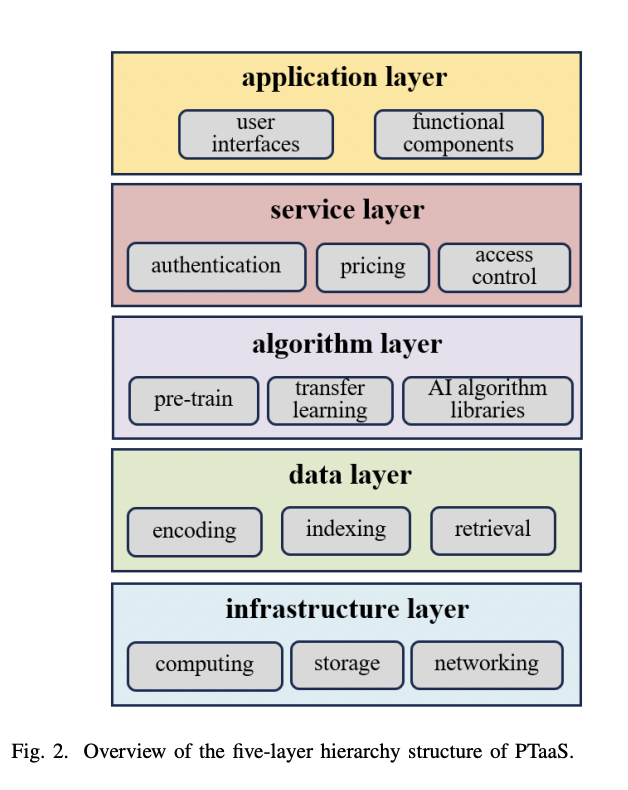
The PTaaS hierarchy comprises five layers: infrastructure, data, algorithm, service, and application. Infrastructure provides physical resources, while the data layer manages remote data. The algorithm layer implements training algorithms, integrating transfer learning. The service layer offers an API and manages tasks, while the application layer serves as the user interface, facilitating model training queries and real-time monitoring. This hierarchical structure enables standardized design, independent evolution, and adaptation to technologies and user needs for PTaaS platforms.
PTaaS offers several advantages:

  1. Privacy preservation: Devices only share anonymous local data, ensuring user privacy without disclosing sensitive information to remote servers.
  2. Centralized training: Utilizing powerful cloud or edge servers for model training improves performance based on device-specific queries, reducing end-side computation and energy consumption.
  3. Simplicity and flexibility: PTaaS simplifies user operations by migrating model training to the cloud, allowing devices to request model updates as needed and adapt to changing application scenarios.
  4. Cost fairness and profit potential: Service costs are based on consumed resources, ensuring fairness and motivating device participation. This pricing model also enables reasonable profits for service providers, promoting PTaaS adoption.

In conclusion, This paper introduces Privacy-Preserving Training-as-a-Service (PTaaS) as an effective paradigm for on-device intelligence (ODI). PTaaS addresses challenges in on-device model training by outsourcing to cloud or edge providers, sharing only anonymous queries with remote servers. It facilitates high-performance, customized on-device AI models, ensuring data privacy and mitigating end-device constraints. Future research focuses on enhancing privacy mechanisms, optimizing cloud-edge resource management, improving model training, and establishing standard specifications for sustainable PTaaS development.


Check out the Paper. All credit for this research goes to the researchers of this project. Also, don’t forget to follow us on Twitter. Join our Telegram Channel, Discord Channel, and LinkedIn Group.

If you like our work, you will love our newsletter..

Don’t Forget to join our 40k+ ML SubReddit


YOU MAY ALSO LIKE

Nunchux AI Introduces VC-Attention: A Training-Free Low-Bit Attention Kernel That Speeds Up Video Diffusion Transformers

House Passes Ratepayer Protection Act on Data Center Power Costs – Unite.AI

Asjad is an intern consultant at Marktechpost. He is persuing B.Tech in mechanical engineering at the Indian Institute of Technology, Kharagpur. Asjad is a Machine learning and deep learning enthusiast who is always researching the applications of machine learning in healthcare.


🐝 Join the Fastest Growing AI Research Newsletter Read by Researchers from Google + NVIDIA + Meta + Stanford + MIT + Microsoft and many others…


Credit: Source link

ShareTweetSendSharePin

Related Posts

Nunchux AI Introduces VC-Attention: A Training-Free Low-Bit Attention Kernel That Speeds Up Video Diffusion Transformers
AI & Technology

Nunchux AI Introduces VC-Attention: A Training-Free Low-Bit Attention Kernel That Speeds Up Video Diffusion Transformers

September 17, 2026
House Passes Ratepayer Protection Act on Data Center Power Costs – Unite.AI
AI & Technology

House Passes Ratepayer Protection Act on Data Center Power Costs – Unite.AI

September 16, 2026
Snap Introduces A Standalone AI Assistant, Specs Intelligence
AI & Technology

Snap Introduces A Standalone AI Assistant, Specs Intelligence

September 16, 2026
Standalone AR Glasses Are Here
AI & Technology

Standalone AR Glasses Are Here

September 16, 2026
Next Post
Lawsuit claims ‘constitutionally unreasonable’ force in fatal Georgia police shooting

Lawsuit claims 'constitutionally unreasonable' force in fatal Georgia police shooting

Leave a Reply Cancel reply

Your email address will not be published. Required fields are marked *

Search

No Result
View All Result
Two former DHS Secretaries say department needs a ‘reset’ 25 years after 9/11

Two former DHS Secretaries say department needs a ‘reset’ 25 years after 9/11

September 14, 2026
Full Episode: TODAY Show – Sept. 9

Full Episode: TODAY Show – Sept. 9

September 15, 2026
Kornacki on what to watch in the NFL season opener

Kornacki on what to watch in the NFL season opener

September 15, 2026

About

Learn more

Our Services

Legal

Privacy Policy

Terms of Use

Bloggers

Learn more

Article Links

Contact

Advertise

Ask us anything

©2020- TradePoint.io - All rights reserved!

Tradepoint.io, being just a publishing and technology platform, is not a registered broker-dealer or investment adviser. So we do not provide investment advice. Rather, brokerage services are provided to clients of Tradepoint.io by independent SEC-registered broker-dealers and members of FINRA/SIPC. Every form of investing carries some risk and past performance is not a guarantee of future results. “Tradepoint.io“, “Instant Investing” and “My Trading Tools” are registered trademarks of Apperbuild, LLC.

This website is operated by Apperbuild, LLC. We have no link to any brokerage firm and we do not provide investment advice. Every information and resource we provide is solely for the education of our readers. © 2020 Apperbuild, LLC. All rights reserved.

No Result
View All Result
  • Main
  • AI & Technology
  • Stock Charts
  • Market & News
  • Business
  • Finance Tips
  • Trade Tube
  • Blog
  • Shop

© 2023 - TradePoint.io - All Rights Reserved!