
Peter Hansen/iStock via Getty Images
Listen here or on the go via Apple Podcasts and Spotify

Markets celebrate Powell’s Jackson Hole commentary; Fed expert Danielle DiMartino Booth thinks he’s a little too late (0:20). Markets will be attentive to additional Fed statements (2:00). Bond market reactions (4:05). Tariffs – what’s really happening? (4:55) Similarities to Covid era (7:40). Housing very much a buyer’s market (14:30). The interesting US dollar (16:30).
Transcript
Rena Sherbill: Danielle DiMartino Booth, on a very special Friday post Fed meeting. Welcome back to Investing Experts. Welcome back to Seeking Alpha.
Danielle DiMartino Booth: It is great to be back with you on this momentous day. This feels like eight Fed meetings in a year all packed into one day.
RS: Yeah, talk to us. You are CEO and Chief Strategist for QI Research currently, formerly of the Fed, a Fed insider.
The market is happy about Powell’s comments. How are you feeling about Powell’s comments?
DDB: I feel like Powell’s a little bit too late to this.
I’ve been highly critical of him, suggesting that in May, that in June, that in July, that the Fed should have already been in an easing stance. I think a lot of investors were anticipating that he would push back on that notion, and instead, he dove right in.
And he said, we thought that that job growth had been north of a 150,000 a month. We learned that it was really 35,000 a month.
When he laid those actual numbers out, that was in more ways than any his way of communicating that they would have otherwise been in an easing stance had they known how weak the job market was just a few months ago.
And, again, I think that really surprised the markets and that they’re celebrating that the Fed’s going to begin easing. But it could become a situation where you have to watch what you wish for.
RS: What would you say are your is your sense for the next few days, for the next week, for the next month based on what we’re seeing today, based on what we heard from Powell?
DDB: I think markets are gonna be very attentive to the New York Fed’s John Williams. He’s expected to speak right at the beginning of next week.
I think they’re gonna be listening to other Fed officials to see now that Powell has finally stepped back from the shield of we’re going to wait and see how tariff inflation plays out.
It’ll be really interesting to see other Fed officials and how willing they are not just to cut rates in September, but rather let’s see what this entire easing cycle might look like.
I think one of the reasons that the markets are so excited, and obviously, right now you have declining bond yields, rising bond prices that are feeding into the stock market.
But I think one of the reasons that now there is a presupposition that it’s not just going to be one rate cut in September and then potentially go on hold is because Jerome Powell said that given the rapidity, basically, with which we’ve seen the labor market weaken that historically speaking, sometimes you end up seeing a rapid rise in the unemployment rate.
And because he spoke to that historical tendency, now markets are pricing in a full easing cycle. So they’re trying to say, is it going to be three rate cuts in 2025? Four rate cuts I called the beginning of the year. I said it was gonna be four. And how far into 2026 are we gonna go with easing?
But, again, I would be very cautious here because of why the Fed has decided to embark upon this easing campaign with much more surety than it had the last time that it met.
RS: You would say their hand is forced?
DDB: I would say that their hand has definitely been forced by the data. Yes.
RS: And what would you say in terms of the bond market as it develops, as it responds to these rate cuts or promises of further rate cuts?
How do you see the bond market specifically reacting along the way?
DDB: So, clearly, every additional sequential rate cut that’s priced in, you’re going to see yields at the short end of the yield curve. You’re gonna see that two year treasury yield be the most responsive.
But, we’ve also seen a magnificent rally in the benchmark ten year treasury as well.
And, again, that’s where caution enters the equation because when long maturity yields do start to come down, that’s typically indicative of recession.
RS: And what would you say about the tariff conversation? There’s the promises. There’s supposition. What would you say based on companies’ earnings calls, based on what you’re hearing from various players? What is your sense about what’s really happening tariff wise? What’s really happening to companies affected by it? Who may be more affected than others? What are your thoughts?
DDB: I’m gonna be continuing to pay very close attention to a case that’s being battled in the courts on the part of corporate America. And corporations are saying this is a tax. This is a tax that we pay to the extent that we cannot pass these higher input costs along to consumers.
We’re going to have to take that out of our profit margins. And if this continues for long enough, then we’re gonna be embarking on yet another wave of layoffs, and it becomes a cycle that feeds itself.
It was interesting. Fitch ratings came out with the report, just yesterday that said that it anticipates that consumer spending, which is already slowing down markedly.
There was an interesting chart rolling around a few weeks ago that showed that there’s more money being spent on artificial intelligence than there is consumption. And US GDP is 70% consumption. So that’s saying something.
To the extent that we continue to see as Fitch and others, myself, anticipate a continued slowdown in consumer spending, that tariff discussion becomes much more contentious because then it is simply a matter of what Ross Stores (ROST) said.
We are seeing we’re gaining market share because people are trading down to the lowest cost discount retailer. Exactly echoed by Walmart (WMT). They’re seeing upper income Americans trade down to Walmart, whereas they didn’t use to shop there.
And the majority of their sales, the strongest sales that they’re seeing are in grocery and pharmacy. These are essentials, and these are the tariffs that American consumers cannot avoid. So we’ve seen food price inflation perk up these last few months, and that’s something that you have to put food on the table.
So the tariff discussion is going to get again, I think it’s going to become much more divisive because to the extent corporate America is gonna have to eat those higher costs and not be capable of passing them along, absent consumer purchasing power, you could be looking at a much deeper recession than what’s being contemplated right now.
RS: Yeah. It seems that the similarity to the COVID period is pretty striking to me in the sense that we’re seeing in real time consumer behavior changes, but, really, it’s gonna be lasting for quite some time based on spending habits and where they’re spending and to your point, different changes in statuses and what that means for companies and bottom lines.
And there’s just so much to pick at this, and the tentacles seem to be spreading ever further and further.
DDB: Well, there are, but I think the key here and you’re you’re thinking through this very well. There is a parallel with COVID and there’s been a shock.
There’s been a shock to corporate profits here in in the form of tariffs, but the Big Beautiful Bill is largely a prevention of a negative income shock in 2025, because the bulk of the bill extended out those tax cuts that had been signed into law in 2017.
What we’re not seeing that we did see with COVID was great big stimulus checks coming out of legislation and that will be a game changer.
That could prolong the decline in consumer spending. In June, we saw year over year credit card spending turn negative to a greater extent than any recession back to 1970.
This is a highly unusual environment. And when you talk about tentacles, it’s not just the interaction between tariffs and corporations and their end consumers.
It’s also the impact that the repayment of student loans is having on household balance sheets at the same time. And that’s kind of running in tandem here and curtailing a lot of households access to credit, and that could act as yet another depressant on consumer spending moving forward as we see a spreading of of declines in FICO scores.
RS: Yes. Do you sense that a stimulus is coming? Do you sense that that’s something realistic that might be coming down the line?
DDB: Never underestimate a panic incumbent congress. Who knows what you could see between between now and the midterms, but we’re already spending more than a trillion dollars a year servicing the debt.
The Fed’s not talking about taking interest rates back to the zero bound.
In fact, chair Powell alluded to the time when interest rates were too low for too long in his comments today, in thinking about the Fed’s next framework for making monetary policy.
So, let’s say that the treasury secretary Scott Bessent gets what he wants.
He wants 150 basis points, one and a half percentage points of rate cuts, and he sees that as being feasible here in the medium term. Well, that could help the household sector.
That certainly could help corporate borrowing. That that could help parts of commercial real estate, that had been unable to refinance. But by the same token, it’s going to take a lot of money out of the pockets of retirees.
And for every 50 basis points, for every half a percentage point cut, you’re talking about a $70,000,000,000 hit to retirees’ interest income.
That’s a lot of money when you’re talking about the median age of a baby boomer being 71 years old in 2001 and in 2006. And this is something that I’ve spoken about over and over again, but only in hypotheticals.
Now we’re actually talking about the Fed really lowering interest rates, but this cohort of 70 year old Americans owns 40% of the US stock market, and they can’t go back to work.
They did go back to work in 2001. They did go back to work in 2007.
But for the most part, they cannot reenter the workforce in this present episode, and that means that they’ll be falling back on those stock holdings that they have. And this is going to create a monetary conundrum for Fed policymakers.
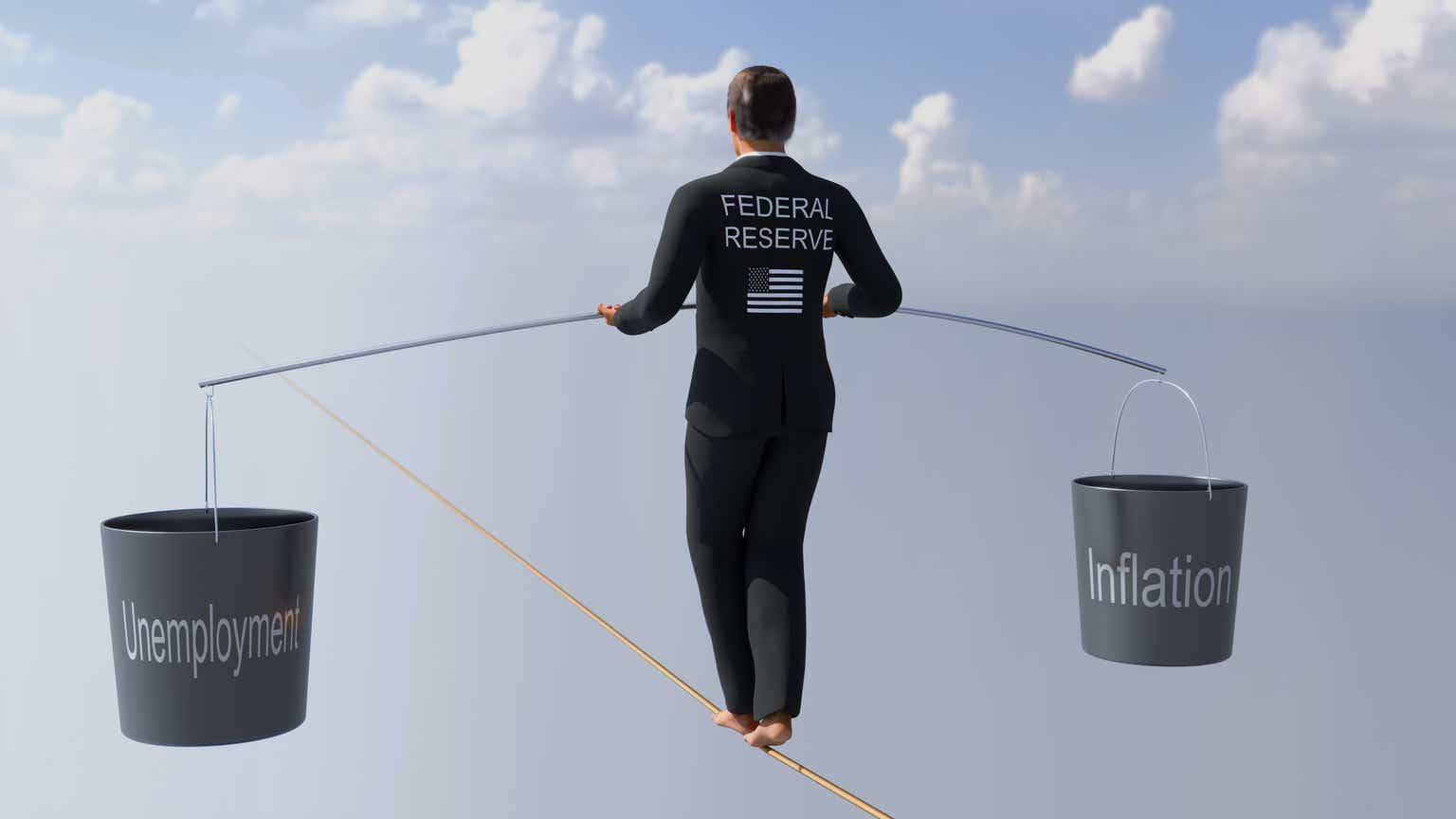
They’re walking a tight rope here.
RS: It seems for an economist especially that a lot of ivory tower academic theoretical thinking has now come into play, and there’s a lot of real world application.
What would you do if you were in charge for, let’s say, even just the next year? How would you address monetary policy and inflation?
DDB: I think that the Fed should continue to use to the extent it can, to use time as a tool.
The longer you draw this out, the less the risk of a massive shock to the savers of America.
If this happens very quickly, you could end up sparking a sell off in the stock market that began to feed off of itself as more and more retirees panicked and tried to monetize their stock holdings in order to shore up their retiree fixed incomes.
And so the Fed has to be very careful moving forward that there aren’t any sudden moves. And, that sounds great, and I can say it all I want from my position and speaking in hypotheticals.
But if as chair Powell warned, there is a sharp rise in the unemployment rate, and it’s extremely feasible that that’s going to be the case.
Right now, we’ve got major home builders in layoff mode. We’ve got a nonresidential construction on its knees. If it’s not a data center, or a hospital or something to do with health care. It’s really not being constructed.
So my good friend, Anna Wong, who’s over at Bloomberg, she heads Bloomberg Economics. She’s of the opinion and I’m right there with her that we’re gonna see construction payrolls finally turn into 2025.
So you could end up seeing that unemployment rate shock if this last standing strength, this last standing pillar in the job market was to start to weaken appreciably, and then the Fed would no longer have time on its side.
And all bets are off at that point.
RS: Well, that’s a perfect segue because the last two things I wanted to ask you about was housing and the US dollar. What your thoughts are there?
DDB: Well, you know, it’s interesting. With housing, you get the sense there’s already been 25 basis points, a quarter of a percentage point rate cut priced into mortgages. That happened very quickly, when that payroll revision was was released on August 1.
And we’re not seeing that much of a reaction in housing, and that tells you that we’ve really shifted after it being, for years and years and years, it’s been a seller’s market in the United States.
We’re seeing that flip, and it’s very much a buyer’s market. We’re seeing FHA delinquencies rise. We’re seeing foreclosures rise. Distress is going to rise again.
You cannot have the housing discussion without also talking about many of the individuals who are now repaying student loans or not repaying student loans, even though they’re obligated to do so by the law and having that affect their credit.
These are all interrelated factors, meaning that housing might not be as responsive to falling mortgage rates as the Fed would anticipate and hope to be the case.
We will have to see as banks continue to realize more distress, higher charge offs, their willingness to make mortgages is going to be replenished and kind of in a repeat of what we saw in 2007.
We have seen a rise in applications to purchase homes, but we’re now seeing evidence when you look at how few home sales are coming out of the pipeline as a result that these are actually multiple applications being submitted by the same potential home buyer because they’re being rejected.
RS: And the dollar?
DDB: The dollar (DXY), I think, is an interesting question here. Obviously, it’s getting completely shellacked today as the dollar prices in.
Again, not just a one off price cut rate cut in September, but indeed an entire easing cycle. But what happens in the United States does not occur on an island.
And we know that there is, there are similar levels of distress. Overnight, Germany fell back into recession and to a deeper extent than what was appreciated. World trade is in complete contraction.
So we had a long period of the dollar weakening when the Federal Reserve’s policy stance was relatively tighter than that of other global central bank peers, you could easily play out a contrarian scenario.
And I tend to think in a contrarian way that because this short the dollar trade is so crowded that once the dust settles and people realize, okay, this is how much the Fed is gonna be lowering rates by, and this is why, and we get another payable report out of the new Bureau of Labor Statistics.
What’s that effect gonna be on the rest of the global economy? How much are they going to have to continue lowering their interest rates? How detrimental will the United States slowdown be for other places in the country such that you could wake up and say, oh my gosh. Wait.
On a relative value basis, despite the Fed lowering interest rates, we have people crowding back into the dollar. So that’s kind of my counter trend contrarian way of thinking right now about the dollar and what I’m telling my clients.
RS: Well, I appreciate that, and I very much appreciate this conversation, Danielle. It’s a big day in the markets, and I appreciate you taking the time.
What would you say as we end the conversation is maybe the most important thing for investors to keep in mind and also would love it if you shared with our audience how to find out more about your work, get in touch with you?
DDB: Thank you very much, and it’s been great talking to you as well. Investors should be attuned with their risk appetite. And so if you’re young and you can ride anything out, so be it.
Sit back, relax. You know that there’s gonna be enough time in the future of your career. But, again, be in touch with your risk appetite. Be in touch with your risk horizon.
And when you feel that you might need to have those assets be liquid and to the extent that you feel is appropriate, be hedged and or at least be in assets that pay you a cash flow, whether it be a very secure dividend paying stock or a high quality corporate bond.
But this is the time to look deep and say, am I going to panic, or am I going to plan?
And when markets are all time highs, the natural impulse is to say, I’m just gonna ride this baby out. But that all should depend on how old you are, really, and when you plan on retiring and when you need those assets that you’ve been saving, those savings that you’ve been putting away all these years, when you need those to be liquid.
So look inward. And, if you’d like, at QI Research, we publish every trading day of the week, The Daily Feather. Love to have you join that community.
Dimartinobooth.substack.com. And then we have a wide institutional following as well for our QI pro. So come over to QI Research, do a little bit of reconnaissance there. And if you feel you’re a good institutional candidate, I give you my word that the research that we crank out is like nothing else on the street.
So love to have you come. And if you don’t already follow me on Twitter, I’ll always call it Twitter. Please do at dimartinobooth.
Credit: Source link