James Gritz/DigitalVision via Getty Images
Introduction
Pitney Bowes Inc. (NYSE:PBI) is a shipping and mailing company that provides technology, logistics, and financial services (via Pitney Bowes Bank). Historically, PBI operates three segments – Global Ecommerce (GEC), Presort Services, and Sending Technology Solutions.
On August 8th, of this year; however, PBI announced it would be completing a “Value-Maximizing Exit” from GEC by early 2025 at a maximum cost of $150M. More on this later.
I’ve discussed, in detail, the benefits of exiting Global Ecommerce; the segment lost $136M for the year ended December 31, 2023, and has never made money. The segment also required tens of millions of dollars in CapEx annually, which prevented the company from being able to deleverage, increase the dividend, or repurchase shares.
It has become clear that the market doesn’t really understand the remaining businesses: Presort and SendTech. Many people think that Pitney Bowes is a “mail” company in terminal decline that will die as mail continues to decline in volume. A deeper dive into these segments will reveal how flawed this conclusion is.
As is always the case – the greater the confusion or the more difficult it is to understand a business – the smaller the premium that investors are willing pay to own the shares. Therefore, I will attempt to explain the remaining segments in greater detail as well as dispel what, I believe, are several myths and falsehoods that surround the company.
Shape-Shifting Pitney Bowes
Before I do a deep dive on the Presort and SendTech segments, it’s important to discuss everything that has happened since Kurt Wolf finally achieved a majority on the Board in May of 2024. While it took years for “the wolf” to be able to cull all of the bad sheep from the Board of Directors, his success has led to immediate improvements for shareholders. His success, despite short-term pain for some, will also ensure that all stakeholders, including employees, will be part of a company that can profitably grow for decades to come.
On May 22nd, just weeks after Kurt Wolf gained control, the company announced that Lance Rosenzweig would become the interim CEO and that Jason Dies would step down. A series of initiatives aimed at significantly increasing shareholder value were also announced:
1) Identification of $60M to $100M in cost cuts that were completely unrelated to the GEC segment.
2) A promise to quickly finish the GEC review.
3) Reducing cash needs and freeing up ~$200M in cash.
4) Deleveraging the balance sheet by prioritizing the paydown of high-cost debt.
The company then held a surprise Investor Conference call, a week later, to introduce Lance Rosenzweig to shareholders and to explain the initiatives in more detail.
Then, one month later, on July 1st, Pitney Bowes announced that Lance Rosenzweig, in just one month, had already implemented $70M in cost reductions and that the target had now been increased from $60M to $100M to $120M to $160M in possible cost cuts that were completely unrelated to GEC.
On August 8th, just one more month later, Pitney Bowes announced in conjunction with earnings the conclusion to the GEC review as well as news that they had already freed up $140M in cash from overseas and Pitney Bowes Bank, and are now targeting to free up $240M in cash instead of the previously announced $200M.
The company’s adjusted EPS of $0.03 was also significantly higher than market expectations, which were for a loss of -$0.07. The company also guided to $340M to $355M in full-year EBIT. Based on the above fact pattern, I am convinced that it is highly likely that guidance will be increased again before the end of the year as Mr. Wolf continues his work.
It’s amazing what happens when a company is led by a board with significant ownership in the shares of the company.
Culling Global Ecommerce
The decision to cull GEC was clearly correct. Recent changes announced in June by the USPS, targeting the exact types of packages that the GEC segment handled, made the segment essentially worthless. However, it was clear that the plan Mr. Wolf delivered to the market was years in the making. If not for his prowess, shareholders would have been in dire straits.
Specifically, the Board approved the decision to sell a majority interest in GEC to Hilco Global and to proceed into Chapter 11 for the GEC entities. Hilco Global is a well-respected and reputable company that has helped many companies wind-down operations in an efficient, responsible manner, while maximizing the value of their assets. Pitney Bowes highlighted that this action would completely eliminate GEC’s annual losses ($136M in the most recent full fiscal year of 2023) at a cost not to exceed $150M. Included in the 150M was approximately $45M in debtor-in-possession (DIP) financing that Pitney Bowes provided to the entity.
After speaking to several experts, I believe this is how shareholders should think through this event.
The $150M cost represents money that will need to be spent at the corporate/parent level, the DIP loan of $45M from the parent company to the entities undergoing Chapter 11, and liabilities that corporate/parent signed onto in conjunction with the GEC entities.
The key points for shareholders to consider is how this amount may end up being less than $150M. Here are some things to consider.
People were fired. The parent company would have to pay unemployment insurance; however, as employees find new jobs, this cost would go away. The more employees that quickly find new jobs, the greater the reduction will be from the $150M estimate. Given the current job environment, it is likely that this cost will decline from original projections based on payouts throughout the entire time period allowed.
There will be some leases at the subsidiary level and some leases that the parent company probably signed onto. As Hilco is able to sublease these leases, the costs built into the $150M estimate will decline.
My understanding is that the DIP loan is being used to keep the subsidiary operating (i.e. paying GEC employees, lawyers, etc.) until the wind-down process is completely finished. By providing this financing, the company moves to the top of the creditor hierarchy after the employees and lawyers. Therefore, any leases that reside solely at the subsidiary level would be completely wiped out and would be of no concern.
If Hilco is able to quickly finish the process of selling the GEC assets (i.e. trucks, Returns segment, etc.) it’s possible that a portion or all of the DIP loan could be returned to the parent company since it is near the very top of the creditor hierarchy.
Therefore, given this management team’s three-month history – I would strongly suspect that the actual cost of exiting GEC will exceed $100M, but be materially lower than the guidance of $150M.
Last, I believe that Pitney Bowes exit from GEC is likely to greatly improve their relationship with the USPS. As I’ll note in the upcoming segments, the USPS views the delivery of packages (vs. just mail) as key to increasing their future profitability. If Pitney Bowes had retained GEC, they would have been directly competing with the USPS, potentially straining the relationship.
Presort Deep Dive
The Presort segment is really easy to understand at a high level. A Presort company simply groups mail by zip code and delivers it to the post office to help business save on postage costs. Pitney Bowes is the largest workshare partner of the USPS and in 2023 processed over 15 billion pieces of mail including First-Class Mail, Marketing Mail and Market Mail Flats, and Bound Printed Matter.
Some market participants believe that the USPS and Postmaster General DeJoy are eliminating Presort discounts, which will destroy Pitney’s Presort business segment.
On June 14th, 2024 the APWU (Post Workers Union) posted an article that specifically mentioned Pitney Bowes and the workshare discounts that the company receives from the USPS. In this article, they mention that Postmaster DeJoy has “changed course” on providing Presort discounts and is “in the early stages of eliminating the deepest of several discounts where package consolidators sort to the Destination Delivery Units (DDUs) and five-digit presort.” This led to a multitude of posts on social media that it would be the death knell for Pitney’s Presort business.
This belief is unfounded, as the USPS change only impacts packages, not mail or bound printed matter. As mentioned earlier, Pitney Bowes presorts mail and bound printed matter (i.e. books, catalogs, etc.). They do not presort any meaningful volume of packages.
Some market participants may argue that although the changes to Presort discounts only applies to packages – what if the Postmaster comes after mail next?
This argument may make a lot of sense on the face of it. It’s very easy to believe that this may be a risk that investors in Pitney Bowes have to fear.
But, is it true? Not according to my research.
The Postmaster cannot modify the Presort workshare discounts that it pays to Pitney Bowes and other Presort companies, because the product categories that Pitney Bowes services are Market Dominant products for the Post Office.
It should come as no surprise that the Union representing the Post Office employees would put a private company that can do the job more efficiently and cost effectively in its crosshairs. Fortunately, while the APWU article was strongly worded, in my opinion, it lacked any real credibility for the following reason: In 2006, Congress passed the Postal Accountability and Enhancement Act (PAEA). This act divided postal products into “market-dominant” and “competitive” categories, and ties rate increases to the market-dominant products. The USPS has market competitive products and market dominant products that you can visualize here.
This finally gets us into the weeds about how Pitney Bowes actually makes money on Presort. The Presort discounts that the USPS provides are available to anyone that Presorts mail for the USPS. For example, JPMorgan could decide to have their own Presort operations in-house, and they would then get 100% of the savings. However, as noted by Bluegrass, there are a lot of cons to having in-house presort operations as there are a lot of costs involved.
Enter Pitney Bowes.
Pitney Bowes doesn’t receive a larger discount from the USPS than any other company; however, what sets Pitney Bowes apart is scale. Unlike the Global Ecommerce segment where Pitney Bowes lacked scale, PBI is the largest Presort operation in the world. Pitney Bowes also has a lot of technological innovation and automation that allows them to presort at significantly lower costs than their competition, as well as any large corporation looking to perform the service in-house.
This is precisely why management highlighted the potential for Presort acquisitions on the last earnings call. As the lowest cost provider, Pitney Bowes can scoop up large competitors (and win over corporate in-house operations) and provide the same service more profitably.
Ironically, while some market participants viewed the Postmaster’s actions as negative for Pitney Bowes, they were actually the opposite. Since the Postmaster is attempting to make the Post Office profitable, he is continually going to the Postal Board that regulates the Post Office and asking for postage increases. Postage increases used to be infrequent, but are now occurring every 6 months. How does the Postmaster convince the Postal Board to allow him to increase postage? He inflates costs. What happens when costs increase? The discount that is paid out to Presort mail increases because the USPS must discount at least 85% of the avoided costs for entities performing presort work. Presort rates are public, and just a small increase adds up big time when you Presort over 15 billion pieces of mail annually!
In short – Pitney Bowes Presort segment is set for tremendous growth in both revenue and profitability over the next several years. As seen below, the segment EBIT is already up over 40% (>$20 million) YOY through the first half of 2024 and that was before the workshare discounts were increased in July:
Presort EBIT (Pitney Bowes Q2 10-Q)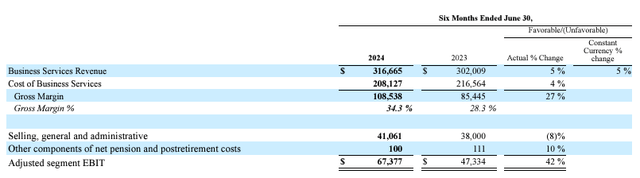
2024’s 40%+ growth is on top of last year’s 35% annual growth in EBIT from $82.5M in 2022 to $110.9M in 2023. Yes, in the first half of 2024, Presort EBIT is currently >80% of the segment’s 2022 EBIT for the entire year.
Does this look like a segment in terminal decline?
This brings us to our final Presort misconception: Many market participants believe that since mail is in secular decline, that Pitney Bowes’ Presort segment must also be (or is soon to be) in significant decline.
This is stated on social media over and over again. At a high level – there’s no question – it’s true that mail is in decline. According to Statistica:
After reaching a peak of around 213 billion units in 2006, the U.S. Postal Services has experienced a year-on-year decline in mail volume every year since. In 2023, the volume of mail delivered by the USPS dropped to just 116.15 billion units.
However, the reality is that although mail as a whole is declining, investors should actually expect Pitney Bowes Presort volume (as well as revenue and EBIT) to increase over the next decade for a variety of factors.
Last year, Pitney Bowes presented at Barclay’s High Yield Bond and Syndicated Loan Conference and provided the following graphic detailing that from 2008 through 2022 Presort volume grew by 19% while USPS total mail volumes declined 39% (a -3.5% CAGR):
PBI Presort Volume (Barclays High Yield Bond And Syndicated Loan Conference May 24, 2023)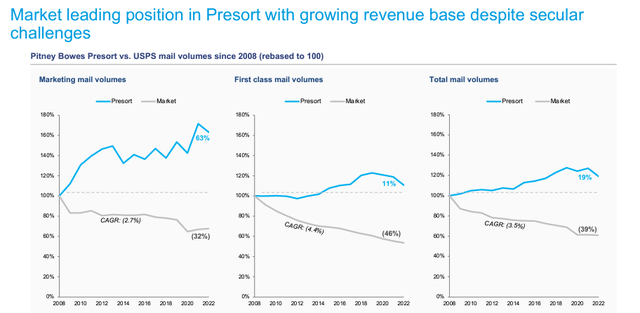
As total mail volume has declined, smaller competitors have been unable to maintain the scale and profit that they were accustomed to. This has allowed PBI to continuously tuck-in competitors, in a trend that is likely to continue. The bottom-line is that it is unlikely that anybody can make more money presorting mail than Pitney Bowes. Additionally, it’s becoming less and less lucrative for large corporations to presort mail in-house. Therefore, large corporations are more likely to be looking to outsource Presort operations, because even though they may receive less of a discount from Pitney Bowes than the USPS – the Pitney Bowes discount saves them significantly more money once they consider the cost associated with having their own in-house, less-efficient, presorting operation. The recent spike in labor costs has only reinforced Pitney’s leadership due to significant investments in automation.
The other thing to think about is… what type of mail is declining vs what type of mail is increasing? The days of sending letters to friends or family are essentially over. We now text or email. However, this type of mail was never presorted to begin with. On the other hand, we now have “explanation of benefits” from healthcare providers and a huge increase in credit cards and other types of corporate mail that are ideal for presorting.
Most of the shrink from what used to be presorted mail has already shrunk, and what’s left can’t shrink much more, while other types of mail that are perfect for Presort are growing annually.
I believe that Presort profitability and growth will continue to surprise to the upside and erode the credibility of this flawed bearish thesis.
SendTech Deep Dive
SendTech is short for Sending Technology Solutions and provides clients with physical and digital mailing and shipping technology solutions and other applications to help simplify and save on the sending, tracking and receiving of letters, parcels and flats.
As part of this segment, Pitney also offers financing alternatives that enable clients to finance equipment and product purchases through its wholly owned subsidiary, The Pitney Bowes Bank. The bank offers clients located in the United States a revolving credit solution for the purchase of postage, services and supplies and an interest-bearing deposit solution to clients who prepay postage.
There’s no denying it. This segment of Pitney Bowes is all about postage, whether that is postage printed from a postage meter or digitally from a computer.
I believe that the market hates Pitney Bowes, because they think postage meters are for mail, and this segment makes up the majority of Pitney’s EBIT.
This is a myth! Postage is not only for mail; it is also for packages. This is a very important distinction from Presort. In the greatest twist of irony, the very article that was supposed to be the doom and gloom of Pitney Bowes’ Presort segment may actually provide some benefit to the SendTech segment!
As this article from January highlights, the Postmaster is actively targeting growth in its packaging business:
The Postal Service says its competitive package business is growing, following its busy year-end holiday season.
USPS says it delivered 130 million more packages in the “peak” first quarter of fiscal 2024, a nearly 7% increase, compared to the same period last year.
USPS delivered more than 1.9 billion packages in the first quarter of fiscal 2023, which covers October through the end of December.
Postmaster General Louis DeJoy, in a video message to employees, said growing the package business is the key to turning around the Postal Service’s long-term financial problems.
In January, the Postmaster highlights how the package business is key to turning around the Postal Service’s long-term financial problems, and then in June, he announced a huge reduction in packaging Presort discounts. There’s no question that these actions significantly eroded the value of Global Ecommerce and impaired Pitney Bowes ability to sell the segment. However, the actions also mean that the USPS is going to start taking major chunks of business from FedEx (NYSE: FDX), UPS (NYSE: UPS), and DHL (OTCPK:DHLGY).
Why can the Post Office go after these major shippers as well as Presort discounts on packages but not Presort mail companies like Pitney Bowes? Because the package business is a “Market Competitive” service for the Post Office, while mail is a “Market Dominant” service.
How does the Post Office shipping more packages benefit Pitney Bowes?
Postal Meters vs Digital Postage
A postal meter is a physical device that allows for the printing of postage that is typically exclusive to the Post Office (some meters do have multi-carrier capability for packages). The device interacts with the Post Office and generates postage that the Post Office will recognize as real and not counterfeit. It will also check the shipper’s account to make sure they have the appropriate funds in their account to pay for the postage, and then pulls the money from their account as the postage is printed.
Why do shippers use postal meters? Because it’s a really smart way to do shipping. High-quality postage meters are great investments that save businesses a ton of time and money, as well as simplify their mail process and improve accuracy. Businesses can save up to 47% on Priority Mail shipments and 5% on every letter. They save time by not having to go to the post office, and they have built-in scales to ensure the mail is accurately weighed. They can also collect data to help make business decisions.
Digital postage, on the other-hand, is handled without a physical device and is typically used for much more complicated shipping. With shipping label software, a shipper can enter the size and weight of their package as well as the shipping route (i.e. Milwaukee, WI to Stamford, CT) and then the software will give the user a variety of options for overnight, 2-day, 3-day, etc. service. The software may say to use DHL for 2-day, UPS for 3-day, and FedEx for overnight service.
Remember the Thomas Bravo acquisition of Stamps.com in 2021 for $6.6 billion in cash? Stamps.com was leaps and bounds ahead of Pitney Bowes in the area of Digital postage. Stamps.com’s success was due to their ability to win huge amounts of business from Ecommerce companies shipping… packages – not mail.
The Pitney Bowes Advantage
The revenue and profitability of the largest shippers, as well as Stamps.com is going to erode as more and more packages flow through the USPS. I believe this is going to eventually lead to revenue growth (instead of just EBIT growth) in SendTech for Pitney Bowes as postage for growing package volume replaces shrinking mail volume.
Pitney Bowes has already been successful going after Stamps.com and growing digital revenue, as John Witek recently highlighted on the Q2 earnings call that digital “drove most of the 33% year-over-year improvement in this quarter’s business services revenue” for SendTech. Shipping related revenues (non-mail) already make-up 16% of SendTech revenues and is growing. The point; however, is that if the USPS begins winning package volume from FedEx, UPS, and DHL, then that may benefit Pitney Bowes if more clients use the postal meters not only to ship mail but to also ship packages via the USPS.
Pitney Bowes’ digital offering also has a distinct advantage over the competition. Unlike Stamps.com, Pitney Bowes shipping label software is much more customizable. Therefore, it is very popular at the office and enterprise level; whereas, Stamps.com is more dominant with Ecommerce shippers.
For example, it may not be well known that McKesson and EPIC Systems, leaders in comprehensive medical records, have fully integrated Pitney Bowes shipping label software into their own software:
Nearly every carrier, such as FedEx or UPS, has an online tool to help healthcare staff manage the inflow and outflow of materials. But when you engage multiple carriers — and multiple systems — it can create software overload on already burned-out staff.
“You don’t want to go in and train people on four to five different systems,” he said. “The goal is to make these workflows as streamlined as possible. With multicarrier software, you can simplify all shipping and receiving activities into one screen.”
EHR integrations, such as those that Pitney Bowes has with Epic and McKesson, can enhance that simplified experience. For example, such integrations could auto populate the patient’s name and address for labels, or track packages directly from the record, Laurenzi added.
Any hospital that utilizes EPIC Systems or McKesson has the ability to turn-on the shipping functionality. For example, let’s say the pharmacy doesn’t have something in-stock, the hospital can have the medicine shipped directly to the patient’s home straight from EPIC/McKesson. The customizability of Pitney Bowes’ software is a huge competitive advantage and one of the main reasons why Pitney Bowes’ digital shipping offering revenues are growing over 30% YOY.
Voila. A business in “terminal decline” is suddenly set for years of growth.
Valuation
Pitney Bowes released full-year 2024 EBIT guidance of $340 to $355 million. This guidance takes into account $30M in cost-saving realization in the back half of 2024 as well as a slight slowdown in SendTech due to less equipment sales. Equipment sales result in instant recognition of revenue and profit; however, the margin is significantly lower (~ 50% less) than lease renewals. Lease renewals are amortized over the life of the renewal (usually 5 years). Therefore, this will be a short-term hit to SendTech revenue/profit in the back half of 2024, but will actually lead to greater profitability in future years.
As noted earlier, I fully expect Pitney Bowes to exceed the 2024 guidance they provided, as I expect additional cost cuts to be implemented and a jump in Presort EBIT due to the July USPS changes.
As part of Pitney Bowes Q2 earnings announcement, the company also released an “illustration” to show the potential EBIT the company could achieve in 2025 and beyond without GEC and with cost savings of $140M (mid-point of the goal):
Illustrative Potential PBI Adjusted EBIT Post-Strategic Initiatives (Pitney Bowes Q2, 2024 Earnings Presentation)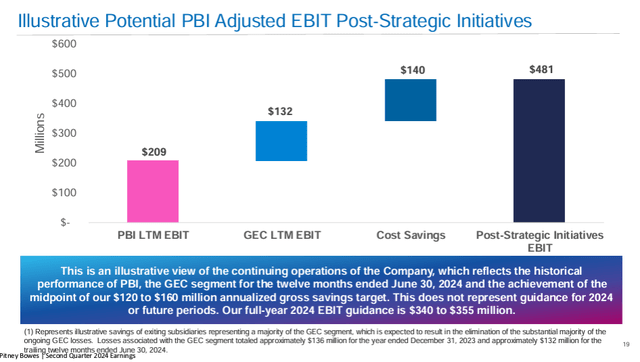
I intend to do a much deeper dive on the financials once Pitney Bowes releases November earnings, but here’s an extremely conservative Bear Case model.
Pitney Bowes Bear Case Model (DOMO Capital Management)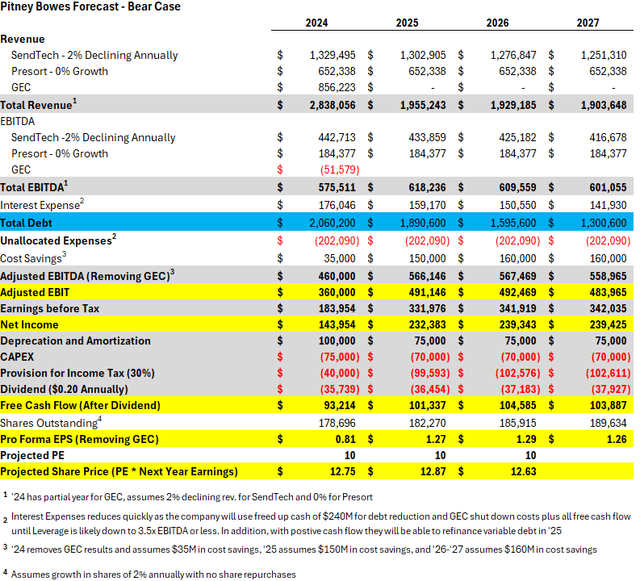
I assume no reduction in interest expense in 2024 even though every one point cut in interest rates by the Fed decreases Pitney’s interest expense by about $10M annually and increases EPS by $0.06 annually.
I assume SendTech EBIT falls in the 2nd half of the year due to less equipment sales (which is a short-term drag since lease extensions, which are amortized over time, are more profitable), but that Presort EBIT grows considerably due to the recent USPS changes in July.
I assume the full $150M GEC cost with no improvement from guidance.
I assume no refinancing of any debt through 2027, and I assume that the debt reduction occurs evenly across all unsecured debt (Term Loan A and B as well as the Notes due in March of 2027 and 2028). which has a current blended rate of 8.62%.
I make unrealistically low projections for SendTech and Presort future growth rates in 2025 and beyond.
I assume cost savings of only $35M in the back half of 2024, $150M for full year 2025, and then $160M for 2026 and beyond.
I assume an increase in shares outstanding through 2027 even though the Board of Directors, in my opinion, is likely to announce a share repurchase plan within the next 12 months, if not before year-end of 2024.
I assume a tax rate of 30% despite the likelihood of significant cash tax savings from GEC exit. For 2024 I used actual taxes of ~$0 for the first half and then assumed a 30% tax rate on income in the back half of the year.
I do not assume any tax savings from the $200M tax loss the company will realize from the GEC exit.
I assume a forward P/E ratio of just 10 times earnings, which is significantly below the note that Sidoti just released using a P/E of 13 based on Pitney’s peer group average. Pitney’s historical P/E ratio over the last 10 years has averaged 12. Sidoti has a price target of $13 despite estimating 2024 EPS at $0.35 and 2025 EPS at $0.98.
These figures are extremely conservative, but it helps to show just how undervalued Pitney Bowes shares still are.
I’ll write future articles that include base and bull cases once we get through another earnings report or two.
Risks
The risks facing Pitney Bowes are what the market has already priced in:
The risk that SendTech and Presort face terminal decline and that revenue and profit will start to rapidly erode as mail volume declines.
The risk of regulatory action by the Post Office – specifically Congressional changes to law that would result in significant changes to Presort workshare discounts on Market Dominant USPS services (i.e. mail).
The risk that the Pitney Bowes management team and Board of Directors grossly miscalculated GEC exit costs and that actual costs are materially above $150M.
In my opinion, these risks have a very low probability.
Opportunities
There are a lot of opportunities that I haven’t built into the model.
While the model I provided shows an aggressive reduction in debt and interest expense – it doesn’t take into account any reduction in actual interest rates that is very likely to occur. About half of Pitney Bowes’ debt is currently variable rate; therefore, every point reduction by the Federal Reserve reduces interest by about $10M annually.
However, with the news of Pitney Bowes exiting GEC, Pitney’s credit rating is likely to jump, which will allow them to refinance current debt at much lower rates. I have not adjusted for this. Note that this is also the only company-announced initiative (deleveraging the balance sheet) for which we have not yet received any update. Therefore, it’s likely we will receive further news on this item as the year progresses.
In-fact, just as I finished writing this article, Moody’s came out and revised upward Pitney Bowes’ outlook to stable from negative. I believe a ratings upgrade is now possible before year-end after Pitney Bowes reports Q3 earnings in November.
The Board of Directors may also choose to begin a share repurchase program to reduce shares outstanding well before 2027. In-fact, I think the Board should consider announcing a share repurchase plan before the end of 2024.
There are a multitude of opportunities to grow Presort. I wouldn’t be surprised to see a few acquisitions over time that results in meaningful growth to Presort revenue and profitability beyond just organic growth. Along those lines, the 0% organic growth rate I modeled for Presort is, to be frank, absurd.
Conclusion
After years of poor leadership at the CEO and Board level, we finally have a smart and effective team of decision makers that are eager to grow shareholder value. This will position Pitney Bowes to be an industry leader for decades to come.
In my opinion, Pitney Bowes shares, today, should already be conservatively valued over $12 per share. In-fact, the only reason I didn’t include other scenarios at this time is, because the future year price targets on even just a base case scenario would look fantastical ($20+).
As Pitney Bowes concludes the 2024 fiscal year, I believe that updated guidance and new shareholder accretive announcements will lead to greater market acceptance of more factual scenarios and price targets that would seem just too hard to believe at this point in time.
Once the Pitney Bowes future becomes clearer, less confusing, and as the company begins to materially deleverage, the shares will likely be rewarded with a P/E multiple materially higher than the 10x multiple that I modeled.
Credit: Source link