





























Physical Intelligence announced the Pi API beta on October 13, 2026, making its latest robotic foundation models available to outside developers for hosted fine-tuning and inference. Access to the beta runs through a waitlist, with applicants asked to describe what they want to build.
Under the workflow laid out in the announcement, a developer uploads robot data, launches fine-tuning on compute and infrastructure that Physical Intelligence manages, and accesses the fine-tuned model through a hosted gateway to run inference on their robot. Evaluation data then guides the next iteration. The company said the latest model available through the API already delivers more data-efficient fine-tuning and improved capability for its partners, and that because it can update the models underpinning the API rapidly, it plans to continue enabling access to its latest and most capable models. Physical Intelligence described the launch as its first step toward providing a physical intelligence foundation the community can build upon and enabling end-to-end autonomy.
The Models Behind the API
The announcement frames general-purpose robotic foundation models such as π0 and π0.5 as a promising way to tackle the challenge of deploying robots: beyond identifying the right use case and building the right hardware, developers need models intelligent enough to perform the task at hand. These models provide a strong foundation of physical knowledge and capabilities that substantially reduces the data and effort needed to adapt to new tasks, environments, or robots, the company said, but adapting them still requires ML infrastructure, compute, and complex data pipelines.
Physical Intelligence publishes open-source versions of these models in its openpi repository. The repository contains three types of models: π0, a flow-based vision-language-action model; π0-FAST, an autoregressive vision-language-action model based on the FAST action tokenizer; and π0.5, an upgraded version of π0 with better open-world generalization, trained with a method the company calls knowledge insulation. Base checkpoints for all three are pre-trained on more than 10,000 hours of robot data, and the repository is released under an Apache-2.0 license. Physical Intelligence released π0.5 and PyTorch support for the repository in September 2025, after adding instructions for training vision-language-action models on the full DROID dataset in June 2025.
Running the open models locally requires an NVIDIA GPU with more than 8 GB of memory for inference, with the RTX 4090 given as the example, and more than 70 GB of memory on hardware such as the A100 or H100 for full fine-tuning. The repository has been tested on Ubuntu 22.04 and does not currently support other operating systems. It also supports remote inference, in which a model runs on a separate server and streams actions to the robot over a websocket connection. The repository notes that π0 was developed for the company’s own robots, which differ from widely used platforms such as ALOHA and DROID, and that the team does not expect every adaptation attempt to succeed. The API takes that pipeline over as a hosted service: users supply the data, and Physical Intelligence manages the training compute and serves the finished model through its gateway.
Partner Deployments Across Industries
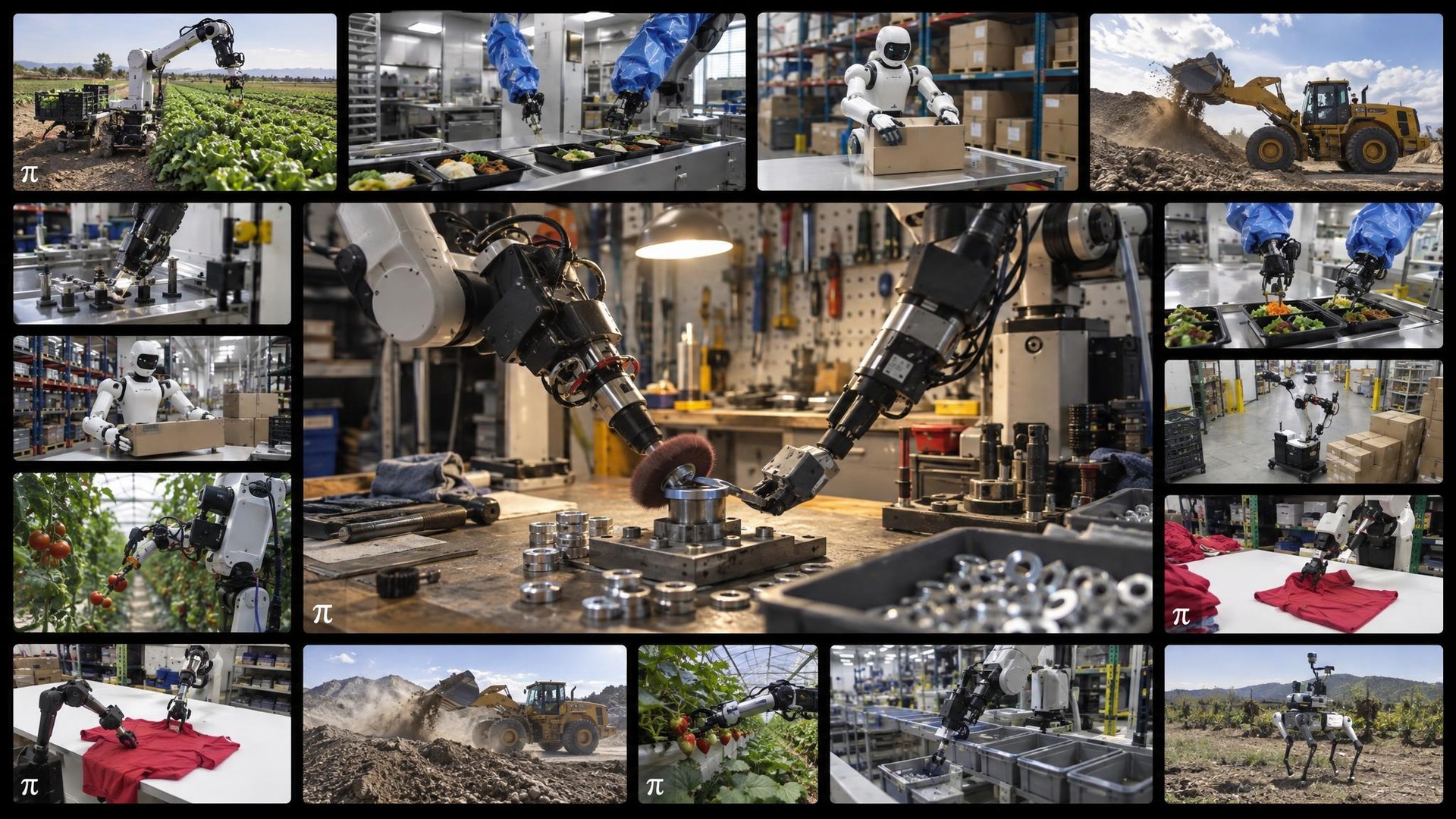
Physical Intelligence said it sought to answer two questions with the API: whether its models support a broad range of applications and robotic hardware in diverse industries, and how easily the API enables developers to iterate toward useful, practical autonomy. To test breadth, the company works closely with companies deploying robots, using these collaborations to validate how well its models perform across different tasks, hardware, and operating environments.
The announcement features Actor, a company located in Utah that deploys autonomous heavy machinery. In footage the company described as a real commercial deployment, Actor’s autonomous wheel loader scoops material and loads it into a dump truck without any operator inside the machine. Other collaborations named in the announcement include AgRobotics, CloudChef, a dairy partner, Ultra, and Weave.
Across these initial collaborations, the company said, a common pattern emerged. The challenges differed from task to task, from an inside-out garment to an ingredient that would not stay in a scoop to a manufacturing part that landed in the wrong position, but the improvement process was much the same: collect demonstrations, train a model, test it on the robot, and use the failures to decide what data to collect next. Physical Intelligence said it built the API to let developers run this iteration loop themselves, using its latest models.
Early-Access Results and Next Steps
To test independent iteration, Physical Intelligence gave a small number of companies early access to the API and said it was impressed by how quickly they got started and began making progress. The announcement highlights Almond, based in San Francisco, California, which builds Axol, a dual-arm robot for physical AI builders whose stated goal is for Axol to build itself. According to the company, Axol deburred spacers used in its own assembly while running a model the team obtained after iterating with the Pi API for four days.
Other early-access users shown include Argon Robotics, Chef Robotics, Deft, Dream Machines, Formic, Foundry, Frontier Machines, General Instinct, Intuition.dev, Omakase, robot.com, Ultra, and Yondu, alongside a hackathon project. Most of the applications shown ran with cloud-hosted inference through the API, spanning deployments from Japan to Switzerland to sites across the United States. The company said these early deployments covered a range of environments and tasks and highlighted areas for improvement, including network connectivity challenges for some.
Physical Intelligence said the examples show the models it develops can be used for real, useful applications and that its partners are able to use the API to independently iterate on policies and improve autonomy on their tasks, while characterizing the effort as still early, with feedback from developers set to help shape future releases. The company said it is hiring across research, infrastructure, hardware, people, and operations.
Credit: Source link