

Marat Musabirov
The PIMCO Corporate & Income Strategy Fund (NYSE:PCN) is a closed-end fund, or CEF, that income-focused investors can employ in pursuance of their objectives. As is the case with most PIMCO closed-end funds, this one appears to be very good at the provision of income for its investors, at least at first glance.
As of the time of writing, the fund boasts a 9.88% distribution yield, which compares pretty well to many of the other fixed-income funds that are currently trading in the market. Morningstar classifies the PIMCO Corporate & Income Strategy Fund as a “Fixed Income-Taxable-Investment Grade” fund, so here is how its yield compares to that of similar funds with this classification:
|
Fund |
Current Yield |
|
PIMCO Corporate & Income Strategy Fund |
9.88% |
|
BlackRock Core Bond Trust (BHK) |
8.39% |
|
John Hancock Investors Trust (JHI) |
6.15% |
|
Nuveen Multi-Market Income Fund (JMM) |
5.47% |
|
Western Asset Premier Bond Fund (WEA) |
7.90% |
As we can clearly see, the yield of the PIMCO Corporate & Income Strategy Fund compares pretty well to that of its peers. This is not exactly surprising, considering that the iShares iBoxx $ Investment Grade Corporate Bond ETF (LQD) only has a 30-day SEC yield of 5.29% right now. It is therefore rather difficult to achieve a yield close to 10% without the application of a copious amount of leverage or excessive trading. The PIMCO Corporate & Income Strategy Fund does neither, however.
As regular readers can likely remember, we previously discussed the PIMCO Corporate & Income Strategy Fund back in the middle of September of 2023. It was a very different market at that time, as September of 2023 was a period in which bond prices were dropping fairly quickly as the market was becoming used to the fact that interest rates would likely remain at very low levels for an extended period of time. This attitude reversed during the final two months of the year, causing bond prices to soar and yields to drop. In fact, the market environment got so euphoric that parts of December had the financial conditions index showing that monetary conditions were looser than they were before the Federal Reserve even started its rate hike campaign.
Year-to-date, however, bonds have generally been delivering a disappointing performance due to investors beginning to realize that the central bank is not likely to reduce interest rates to anywhere close to the expectations that the market had back in December. As a result, we might expect the PIMCO Corporate & Income Strategy Fund to have delivered a mixed performance since the time of our previous discussion. There is a certain truth to this, but in fact, the fund did much worse than would probably be expected. As we can see here, the shares of the fund have declined by 0.58% since the date that my previous article was published:
Seeking Alpha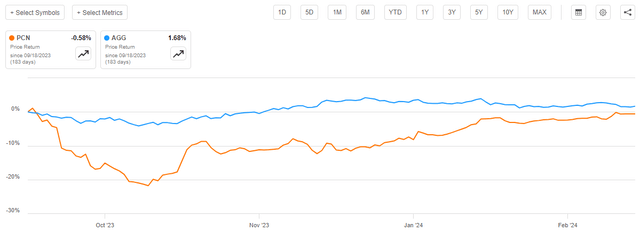
As the chart shows, the PIMCO Corporate & Income Strategy Fund in fact did much worse than the iShares Core U.S. Aggregate Bond ETF (AGG) over the period. This is somewhat surprising, as the trend that we have seen in the closed-end bond fund sector of the market is for these funds to outperform the index in terms of price over much of the past half-year. PIMCO funds in particular have a tendency to perform fairly well relative to the index, so this is doubly surprising.
However, as I have pointed out in various previous articles, the share price performance of a closed-end fund does not tell the whole story. That is because these funds typically pay out most or all of their investment profits to their shareholders in the form of distributions. The basic objective is to keep the fund’s asset base at right around the same level over time while paying out all of the profits to the investors. This is the reason why these funds tend to have higher yields than just about anything else in the market. It also means that investors will almost certainly do much better than the share price performance suggests because they receive the distributions that provide a real return. As such, it is critical that we include the fund’s distributions in any analysis of its performance. When we do that, we see that investors in the PIMCO Corporate & Income Strategy Fund have experienced a 4.89% over the period:
Seeking Alpha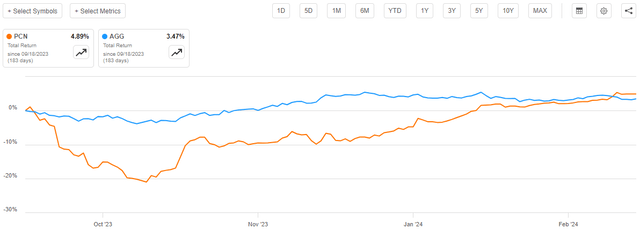
Perhaps surprisingly, this is actually somewhat better than the investors in the Bloomberg U.S. Aggregate Bond Index received over the same period, albeit not by very much. The reason for this is fairly obvious, as the PIMCO fund’s higher yield was sufficient to close the performance gap. Over extended periods of time, the PIMCO Corporate & Income Strategy Fund should outperform the bond index for this very reason. We certainly see this if we look back over the past five years:
Seeking Alpha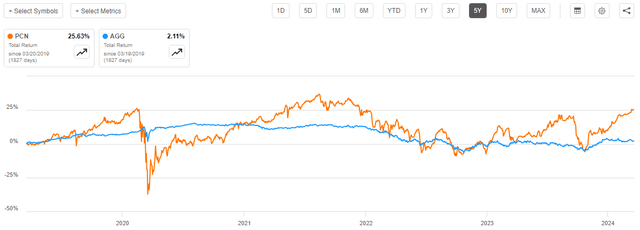
Naturally, though, this fund is beaten handily by anything that invests primarily in leveraged loans and most junk bond funds simply because of the fact that yields on investment-grade corporates are still incredibly low. As the Federal Reserve is probably not going to raise interest rates further (even though it arguably should), that will probably continue to be the case going forward.
As such, investors who are comfortable with a higher level of risk may want to stick with a good junk bond fund such as the Allspring Income Opportunities Fund (EAD) or a good mixed fund like the Ares Dynamic Credit Allocation Fund, Inc. (ARDC), which have both outperformed this one substantially over the past half-decade. However, the PIMCO Corporate & Income Strategy Fund does do pretty well when compared to other investment-grade bond funds so investors who are uncomfortable with risk could still find a lot to like here.
About The Fund
According to the fund’s website, the PIMCO Corporate & Income Strategy Fund has the primary objective of providing its investors with a high level of current income. This makes a lot of sense for a bond fund as bonds are by their very nature income vehicles. As I explained in a recent article:
As a rule, bonds provide all of their investment return in the form of direct payments to their investors. A bond investor purchases a newly issued bond at face value, collects a regular coupon payment from the issuer that corresponds to interest on the loan, and then receives the face value back when the bond matures. There are no net capital gains over the life of the bond because bonds have no inherent link to the growth and prosperity of the issuing company. Thus, the bond’s yield is the only source of net investment returns.
As the coupon is the only source of net investment return over the lifetime of the bond, it makes a lot of sense for any fund that invests in these securities to have the provision of income as its primary objective. After all, coupon payments are essentially a source of income.
With that said, it is possible for bond closed-end funds to earn some capital gains profits by trading bonds prior to maturity. This comes from the fact that bond prices move inversely to interest rates, such that bond prices go down when interest rates rise and vice versa. This is the biggest reason why both the Bloomberg U.S. Aggregate Bond Index and the PIMCO Corporate & Income Strategy Fund are down over the past three years:
Seeking Alpha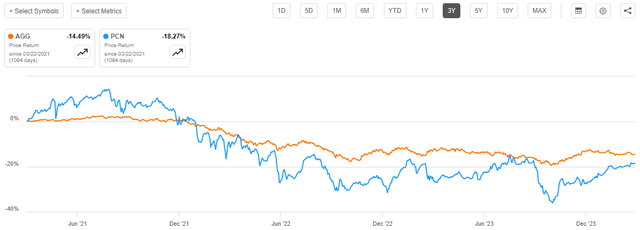
As everyone reading this is likely well aware, the Federal Reserve was aggressively raising interest rates over the Spring 2022 to Summer 2023 period in order to combat the high levels of inflation that were plaguing the economy. This pushed down the price of bonds over the period. However, there were still some periods of time, such as the final two months of 2023, in which long-term interest rates (which are not set by Federal Reserve policy) were declining. This caused bond prices to rise and could have provided some opportunities for the PIMCO Corporate & Income Strategy Fund to earn some profits by trading bonds. We can see those periods shown above, as the index fluctuated overall. However, the fund only had a 29.00% annual turnover in its most recent full-year period, so it does not seem to be engaging in a great deal of trading activity to earn profits.
This might explain why the fund’s net asset value exhibits a great deal of correlation to the Bloomberg U.S. Aggregate Bond Index. This chart shows both the fund’s net asset value and the index over the past three years:
Barchart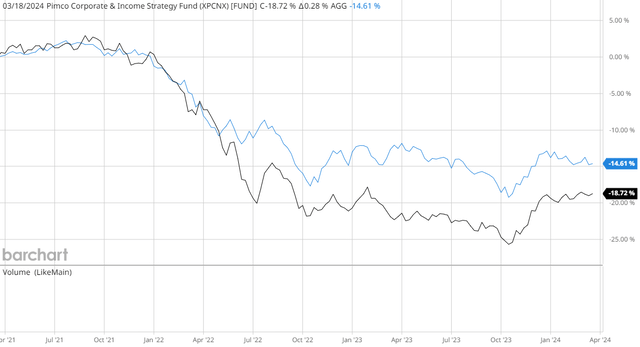
The net asset value of the PIMCO Corporate & Income Strategy Fund is represented by the black line in the chart. The blue line represents the Bloomberg U.S. Aggregate Bond Index. As we can clearly see, the upward and downward movements of both assets are nearly identical, although the fund’s assets declined a bit more in 2022. This could be partly due to the fund’s leverage, as it actually did have sufficient net investment income and net realized gains to cover its distributions during the three-year period that ended on June 30, 2023:
|
TTM Ending June 30, 2023 |
August 1, 2021, to June 30, 2022 |
TTM Ending July 31, 2021 |
|
|
Net Investment Income |
$55,626 |
$47,576 |
$50,459 |
|
Net Realized Gains |
$17,516 |
$55,173 |
($25,010) |
|
Net Unrealized Gains |
($31,090) |
($183,070) |
$95,304 |
|
Net Increase in Assets from Operations |
$42,052 |
($80,321) |
$120,753 |
|
Distributions |
($69,905) |
($52,821) |
($54,756) |
(All figures in thousands of U.S. dollars.)
Generally speaking, if a fund is able to earn sufficient net investment income and net realized gains to cover its distributions then it is not overdistributing. However, it is still possible that the fund’s distributions were at least partially responsible for its large decline relative to the index during 2022 as the index does not pay out realized capital gains to anywhere near the extent that this fund does. For the most part, though, I suspect that it is the leverage employed by the PIMCO Corporate & Income Strategy Fund that is responsible for the net asset value declining more rapidly than the index over the past three years.
As noted in the introduction, Morningstar classifies the PIMCO Corporate & Income Strategy Fund as an investment-grade bond fund. However, a look at the fund’s assets seems to dispute that classification. As we can see here, the fund’s website states that 33.09% of the fund’s assets are currently invested in high-yield credit (junk bonds):
PIMCO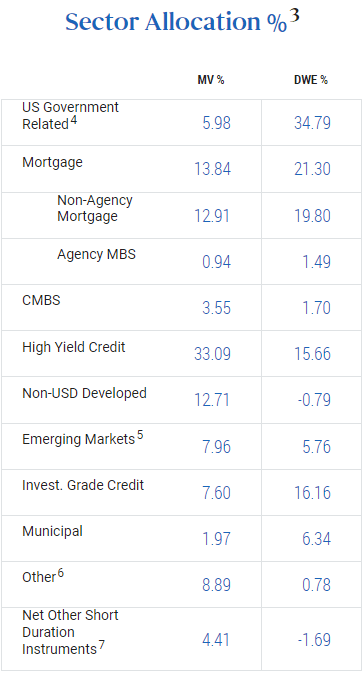
We also see a 7.96% weighting to emerging markets, many of which would also be considered speculative-grade assets. Unfortunately, PIMCO does not provide a breakdown of the credit quality of the assets held by its funds, unlike most other fund houses. As such, we do not know for sure what the actual credit ratings assigned to anything in this fund are.
It seems certain that 33.09% of its assets are invested in junk bonds but the actual percentage could be considerably higher than that depending on what ratings the other things in the fund carry. This makes it difficult to analyze the default risk carried by the fund, but its 447 current holdings should minimize the risk of losing much money due to defaults. After all, that many holdings should result in any individual issuer only accounting for a very small percentage of the fund’s total assets. As such, the amount of money that is lost when any given issuer defaults should be quickly offset by the coupon payments made by the other assets in the fund.
Overall, we probably do not have to worry about default risk despite this fund not providing its investors with a credit quality breakdown. It is still disappointing that PIMCO is not providing this information, however.
Although the presence of speculative-grade assets such as high-yield bonds and emerging market securities does not fit well with Morningstar’s classification of the PIMCO Corporate & Income Strategy Fund as an investment-grade bond fund, it does work pretty well with the fund’s own description of its strategy as provided on the website. Here is how the fund describes its strategy:
Using a dynamic asset allocation strategy that focuses on duration management, credit quality analysis, risk management techniques, and broad diversification among issuers, industries and sectors, the multi-sector fund seeks high current income, with a secondary objective of capital preservation and appreciation.
Under normal market conditions, the Fund seeks to achieve its investment objective by investing at least 80% of its net assets plus borrowings for investment purposes in a combination of corporate debt obligations of varying maturities, other corporate income-producing securities, and income-producing securities of non-corporate issuers, such as U.S. Government securities, municipal securities and mortgage-backed and other asset-backed securities issued on a public or private basis.
The Fund may invest a maximum of 25% of its total assets in non-U.S.-dollar-denominated securities. The Fund will normally maintain an average portfolio duration of between zero and eight years.
The portfolio manager attempts to identify investments that provide high current income through fundamental research, driven by independent credit analysis and proprietary analytical tools and also uses a variety of techniques designed to manage risk and minimize exposure to issues that are more likely to default or otherwise depreciate in value over time.
This description is very much like that of a multi-sector bond fund, such as the PIMCO Income Strategy Fund (PFL) rather than an investment-grade bond fund. The funds’ performance in terms of total return has also been pretty similar:
Seeking Alpha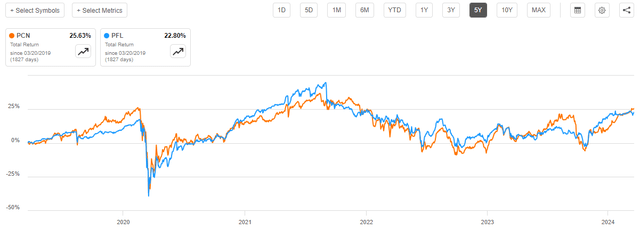
However, the PIMCO Corporate & Income Strategy Fund has delivered a much better price performance over time, which is probably due to the fact that these two funds still have some portfolio differences. In particular, the PIMCO Income Strategy Fund has a higher yield and much more exposure to foreign markets, foreign currencies, and emerging markets than the PIMCO Corporate & Income Strategy Fund.
As such, the PIMCO Corporate & Income Strategy Fund is a bit safer than some of PIMCO’s other offerings, but it is not a pure investment-grade bond fund.
Leverage
As is the case with most closed-end funds, the PIMCO Corporate & Income Strategy Fund employs leverage as a means of boosting the effective returns that are generated by its portfolio. I explained how this works in my previous article on this fund:
In short, the fund borrows money and uses that borrowed money to purchase bonds and similar securities. As long as the purchased assets have a higher yield than the interest rate that the fund has to pay on the borrowed money, the strategy works pretty well to boost the effective yield of the portfolio. As this fund is capable of borrowing money at institutional rates, which are considerably lower than retail rates, this will usually be the case. It is important to note though that this strategy is not nearly as effective today with rates at 6% as it was three years ago when rates were at 0%.
The use of debt in this fashion is a double-edged sword because leverage boosts both gains and losses. Thus, we want to ensure that the fund is not employing too much leverage as that would expose us to too much risk. I generally do not like to see a fund’s leverage exceed a third as a percentage of its assets for this reason.
As of the time of writing, the PIMCO Corporate & Income Strategy Fund has leveraged assets comprising 17.56% of its portfolio. This represents a substantial improvement over the 18.79% leverage that the fund had at the time of our previous discussion, which actually makes a great deal of sense. The fund’s net asset value has increased by 5.75% since that date:
Barchart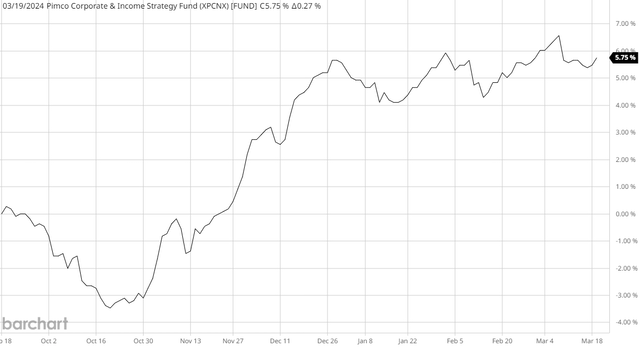
Thus, if the fund’s leverage remained static, it would now represent a smaller percentage of a larger portfolio. This is something that more risk-averse investors might appreciate considering that a higher level of leverage results in a greater amount of volatility overall, as well as the fund taking greater losses than it otherwise would during any market decline. However, the PIMCO Corporate & Income Strategy Fund has never been highly leveraged relative to its peers and for the most part, the balance between the risk and the reward is very reasonable here.
Distribution Analysis
As mentioned earlier in this article, the primary objective of the PIMCO Corporate & Income Strategy Fund is to provide its investors with a very high level of current income. In order to accomplish this objective, the fund invests its assets in a portfolio that consists of bonds and other debt securities all across the credit spectrum. As we have already discussed, bonds in general deliver the majority of their total return via direct payments to their owners. In fact, bonds have no net capital gains over their lifetimes, although it can be possible to achieve capital gains from these securities by selling them prior to their maturity date as they do tend to fluctuate in price along with interest rate movements. The PIMCO Corporate & Income Strategy Fund collects all of the payments that it receives from the bonds that it holds in its portfolio and combines them with any capital gains that it manages to achieve via the exploitation of pricing changes. The fund even goes so far as to borrow money in order to allow it to collect coupon payments from more bonds than it could otherwise achieve through the use of its own equity capital. Finally, the fund pays all of this money out to its investors, net of its expenses. When we consider that interest rates, and by extension bond coupon yields, are at close to the highest levels that we have seen in the past twenty years, we might assume that this business model will result in the fund’s shares having a very high yield.
This is indeed the case, as the PIMCO Corporate & Income Strategy Fund pays a monthly distribution of $0.1125 per share ($1.35 per share annually), which gives it a 9.88% yield at the current price. As we saw in the introduction, this yield is quite competitive with similar funds, and it is easily one of the highest yields that is currently available in the market regardless of the asset class in question. The fund has also been remarkably consistent with respect to its distribution over the years as we can see here:
CEF Connect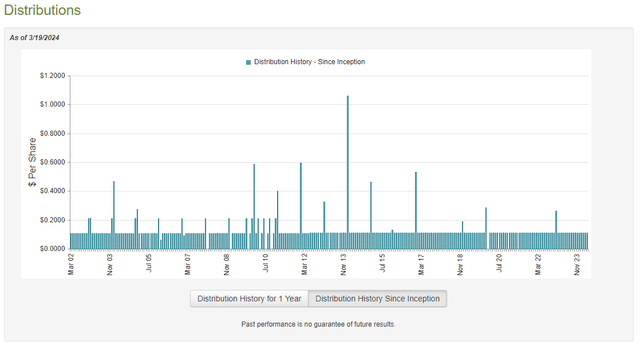
As is immediately apparent, the PIMCO Corporate & Income Strategy Fund has been able to keep its distribution stable since 2012, and even before that it had a very stable track record. This makes this fund one of the only bond funds to achieve such a performance, especially considering that interest rates have not been stable over that period. Indeed, the United States has even experienced two widespread economic and financial disruptions over the period shown above that forced the Federal Reserve to make rapid policy changes. As such, we will want to have a closer look at this fund’s finances, as it is difficult to believe that it was able to deliver a stable investment performance over the more than twenty-year period when most other bond funds could not. The last thing that we want to experience here is a situation where the fund is destroying its net asset value by distributing more than it is able to earn from its investment portfolio. That is not a sustainable scenario over any sort of extended period.
Fortunately, we have a very recent document that we can consult for the purposes of our analysis. As of the time of writing, the most recent financial report for the PIMCO Corporate & Income Strategy Fund corresponds to the six-month period that ended on December 31, 2023. This is a much newer report than the one that we had available to us the last time that we discussed this fund, which is quite nice to see. This is because this report will give us a good idea of how well the fund performed during the second half of 2023, which was a rather volatile period for the bond market in general.
As mentioned earlier in this article, the summer of 2023 was characterized by rising long-term interest rates and falling bond prices as investors began to become accustomed to the very real possibility that there would be no Federal Reserve pivot in 2023 and that interest rates would remain at high levels for an extended period of time. This could have caused the fund to take some losses as the assets in its portfolio declined in price. The reverse was, of course, true during the final two months of the year, as market participants aggressively bid up bond prices in expectation that interest rates would rapidly decrease over the course of 2024. That could have given the fund the potential to earn some capital gains.
This report should give us a good idea of how well the fund managed to navigate both market conditions, which we obviously did not have when the most recent report only extended through June of 2023.
During the six-month period, the PIMCO Corporate & Income Strategy Fund received $32.036 million in interest along with $651,000 in interest from the investments in its portfolio. When we combine this with a small amount of income from other sources, we see that the fund had a total investment income of $32.789 million for the six-month period. It paid its expenses out of this amount, which left it with $26.192 million available to shareholders.
That was, unfortunately, nowhere near enough to cover the distributions that the fund paid out over the same period. The PIMCO Corporate & Income Strategy Fund paid a total of $34.212 million to its investors over the course of six months. At first glance, this could be concerning as we would ordinarily prefer a fixed-income fund to fully cover its distributions out of net investment income. This one obviously failed to accomplish that task.
However, there are other methods available through which the fund can obtain the money that it requires in order to maintain the distribution. For example, it might be able to exploit the changes in bond prices that accompany interest rate movements and sentiment in order to earn some capital gains. Realized capital gains are not considered to be investment income for tax or accounting purposes, but they do represent money coming into the fund that can be distributed to shareholders.
Unfortunately, this fund had mixed results earning money via these alternative methods. For the six-month period, the PIMCO Corporate & Income Strategy Fund reported net realized losses of $32.932 million but this was more than offset by $59.643 million in net unrealized gains. Overall, the fund’s net assets increased by $58.789 million after accounting for all inflows and outflows during the period.
This sounds good on the surface. However, there are two things to consider here. The first is that PIMCO closed-end funds in general tend to issue new shares on a regular basis. These sales bring in outside money and make the fund’s net assets go up during a given period by an amount that is much greater than the fund’s portfolio performance actually produced. That was the case here, as this fund brought in $40.134 million of new money during the period. However, even if we exclude this new money coming in, the fund’s net assets would have increased by $18.655 million. Thus, technically the investment portfolio in isolation did earn sufficient total returns to fully cover the distribution that was paid out.
However, the fund only managed to cover its distribution due to its net unrealized gains during the period. The net investment income and the net realized gains were not enough to cover the amount of money that the fund paid out. As we are all very well aware, unrealized gains can easily be erased in any market correction. Thus, it is uncertain how solid the fund’s distribution coverage really is. We should keep an eye on the fund’s net asset value going forward, especially if the current prediction of 75 basis points of cuts to the federal funds rate proves to be overly optimistic and causes another mass sell-off of bonds when it fails to materialize.
Valuation
As of March 19, 2024 (the most recent date for which data is currently available), the PIMCO Corporate & Income Strategy Fund has a net asset value of $11.59 per share but the shares currently trade for $13.69 each. That gives the fund’s shares a massive 18.12% premium on net asset value at the current price. This is far above the 15.96% premium that the shares have averaged over the past month and honestly, it is an incredibly high price to pay for the shares of any closed-end fund.
The fact that this fund’s shares trade at such a high premium to net asset value is probably the biggest problem with this fund right now. While it is a good fund, it is hard to justify paying $118.12 for every $100 of assets in the fund’s portfolio.
Conclusion
In conclusion, the PIMCO Corporate & Income Strategy Fund does appear to be a pretty good fund at what it does. It, unfortunately, has not been as good at price performance as some of its peers and it has very much underperformed leverage loan and junk bond funds over the past half-decade, but so have investment-grade corporate bonds in general. This fund usually outperforms the Bloomberg U.S. Aggregate Bond Index in terms of total return, but its price performance cannot always match up.
This could prove to be a problem later this year if economic data continues to remain too strong to justify the three interest rate cuts that the Federal Reserve is currently predicting. That is a very real possibility, especially if the Federal government continues to run fiscally stimulative policies (this is quite possible in an election year). If history is any guideline, a failure of the Federal Reserve to cut interest rates by September could cause this fund’s share price to decline much more than the index and hand losses to any investors who purchase today.
The real problem with PIMCO Corporate & Income Strategy Fund that I can see is its huge premium to net asset value. The fund’s managers have usually been able to perform reasonably well in any interest rate environment, but any weakness in bonds could result in the premium shrinking. When we combine this with the real possibility that bonds themselves will exhibit some weakness going forward, we can see that the fund’s share price may not perform all that well. As such, a “hold” rating seems appropriate for now.
Editor’s Note: This article covers one or more microcap stocks. Please be aware of the risks associated with these stocks.
Credit: Source link