
Yuji Sakai
The High Income Securities Fund (NYSE:PCF) is a closed-end fund that many income-focused investors employ as a method of achieving their goals of receiving a significant amount of current income from their assets. On the surface, the fund certainly appears to do very well here, as its 11.64% current yield is one of the highest yields available in the market today. The fund’s yield compares quite well to that of its peers:
|
Fund Name |
Morningstar Classification |
Current Yield |
|
High Income Securities Fund |
Fixed Income-Taxable-Convertibles |
11.64% |
|
Advent Convertible & Income Fund (AVK) |
Fixed Income-Taxable-Convertibles |
11.78% |
|
Calamos Convertible & High Income Fund (CHY) |
Fixed Income-Taxable-Convertibles |
10.73% |
|
Ellsworth Growth and Income Fund (ECF) |
Fixed Income-Taxable-Convertibles |
6.65% |
|
Virtus Convertible & Income Fund (NCV) |
Fixed Income-Taxable-Convertibles |
12.63% |
I will admit that I am not certain that calling the High Income Securities Fund a convertible securities fund is appropriate. As we will see in this article, this fund invests in a variety of different high-yielding securities that are not convertible bonds or convertible preferreds. However, the same can probably be said about a few of the other funds on this list and I have always used Morningstar’s classification system for conducting peer comparisons of closed-end funds, so there is no reason to stop that now. As we can see, the High Income Securities Fund currently has a yield that is comparable to that of its peers, but it is certainly not the highest-yielding fund here. Of course, the Virtus Convertible & Income Fund, which is the only one that beats the High Income Securities Fund by a significant margin, has a number of problems and has generally disappointed most of its investors over the past few years. As such, risk-averse investors and retirees might favor the High Income Securities Fund despite its lower yield.
As regular readers can likely remember, we previously discussed the High Income Securities Fund in the middle of December. The market since that time has generally been weak for most bond funds, but common equities have held up reasonably okay, as have most closed-end funds. For its part, the High Income Securities Fund has been completely flat since the date that the prior article was published:
Seeking Alpha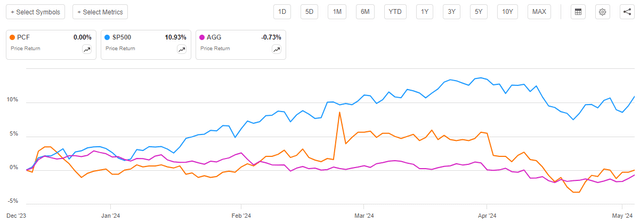
Admittedly, the share price has bounced around a bit since that date, but it has not been nearly as volatile as the S&P 500 Index (SP500). It did, however, substantially underperform the index when looking at share price alone. This is not really surprising though, since income securities in general will usually underperform common stocks in a bull market. The fund did manage to outperform investment-grade bonds, though, which is certainly nice to see.
However, as I pointed out in a previous article:
A simple look at a closed-end fund’s price performance does not necessarily provide an accurate picture of how investors in the fund did during a given period. This is because these funds tend to pay out all of their net investment profits to the shareholders, rather than relying on the capital appreciation of their share price to provide a return. This is the reason why the yields of these funds tend to be much higher than the yield of index funds or most other market assets.
We saw the high yield of this fund reflected in the first paragraph of this article. The High Income Securities Fund’s 11.64% current yield is substantially higher than the 1.31% trailing twelve-month yield of the S&P 500 Index (SPY). The fund’s distribution is even higher than the 6.59% trailing yield of the domestic junk bond index (JNK). Thus, we can expect that it will boost the investment return that investors receive by quite a bit. Indeed, when we include the effects of the fund’s distributions in the above chart, we get this one:
Seeking Alpha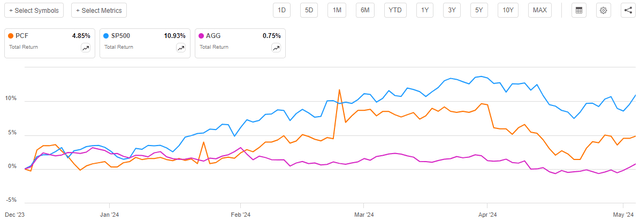
As we can clearly see, investors in the High Income Securities Fund realized a 4.85% total return since the date that my previous article on this fund was published. This is, undoubtedly, still worse than the total return that could have been realized by purchasing an S&P 500 Index fund on the same date, but it is far better than investment-grade bonds delivered. The fund even managed to beat investment-grade bonds when we included the impact of the coupon payments made by these bonds over the same period. Thus, the fund is probably a better choice for investors than a safe bond fund, but the truth is that investment-grade bonds have been pretty poor investments for quite some time, as we can see by looking at the total return of all three of these investments over the past ten years:
Seeking Alpha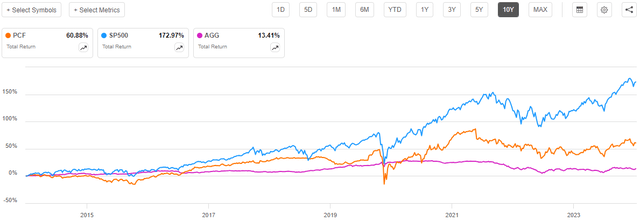
As expected, common stocks substantially beat the High Income Securities Fund over the past decade, even when we include the distributions that were paid out by this fund. However, it once again proves that it is far better than investment-grade bonds, which have historically been one of the most popular investments for conservative investors.
About The Fund
As I pointed out in my previous article, the fund’s webpage is extremely spartan. From the previous article:
The website for the High Income Securities Fund can be found here, but it includes very limited information about the fund. In fact, this is probably the only fund that does not publish a fact sheet on the website, nor does it include any information about the fund’s performance. It does still have the fund’s financial statements and quarterly holdings reports that are required by Securities and Exchange Commission regulations. We will therefore be forced to rely on those documents as well as outside sources for our analysis.
At the time that the previous article was published, the most recent financial report that was available was the fund’s annual report for the full-year period that ended on August 31, 2023. The fund has since released a more recent document, which corresponds to the six-month period that ended on February 29, 2024. Obviously, the closing date on the financial statements and holdings information that can be found here are only two months old, so it should be able to provide us with a very good update on what this fund is doing with the money that its investors have entrusted to it.
The fund’s semi-annual report describes its strategy thusly:
Generally, the fund invests in securities of discounted shares of income-oriented closed-end investment companies, business development companies and Special Purpose Acquisition Vehicles.
The stated strategy of investing in other closed-end funds at a discount is similar to the strategy used by some of the popular Saba Capital funds like the Saba Capital Income & Opportunities Fund (BRW). For the most part, it is a strategy that income-oriented investors can appreciate. After all, as I pointed out in the introduction to this article, many closed-end funds tend to have far higher yields than anything else in the market. These high yields provide this fund with a substantial level of income that can then be paid out to its own shareholders. In addition, by purchasing the fund at a discount, the High Income Securities Fund might be able to realize some capital gains simply through the closing of the discount. The Saba Closed-End Funds ETF (CEFS) explains on its website how this might work:
CEFS seeks to outperform index-based closed-end fund products by actively trading the portfolio to capture the widening and narrowing of discounts to net asset value.
As we have seen in a number of previous articles, closed-end funds typically trade at a market price that is lower than the value of the assets contained in the underlying portfolio. The difference between the market price and the underlying portfolio value frequently changes. For example, there have been several income-focused funds that have delivered a share price performance that has far exceeded the performance of the actual portfolio over the past six months. I have pointed this out in a few articles on funds in which this has occurred. The High Income Securities Fund is presumably attempting to take advantage of this scenario, which allows it to earn some capital gains in addition to the performance of the underlying portfolio of the respective closed-end funds in which it invests. After all, the High Income Securities Fund is an actively managed fund, so this is a logical strategy for it to employ.
Here is how the fund’s asset allocation looked on February 29, 2024:
Fund Semi-Annual Report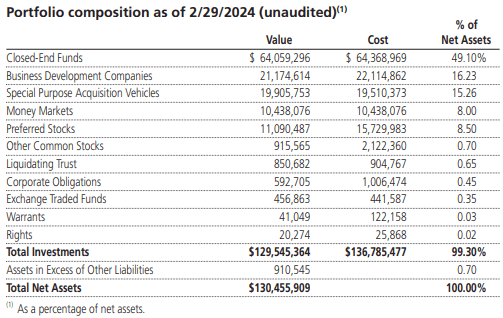
We can see that other closed-end funds accounted for the largest single weighting in the portfolio of the High Income Securities Fund. However, other closed-end funds are still a minority holding in the fund, as there is no single position here that accounts for more than 50% of the fund’s holdings. The fund has significantly increased its weighting to closed-end funds compared to the last time that we discussed it, though. Here is how the fund’s asset allocation today compares to how it looked back in August:
|
Asset Type |
February 29, 2024 |
August 31, 2023 |
|
Closed-End Funds |
49.10% |
44.88% |
|
Business Development Companies |
16.23% |
18.50% |
|
Special Purpose Acquisition Vehicles |
15.26% |
13.08% |
|
Money Markets |
8.00% |
12.21% |
|
Preferred Stocks |
8.50% |
9.55% |
|
Other Common Stocks |
0.70% |
1.03% |
|
Liquidating Trust |
0.65% |
0.23% |
|
Corporate Obligations |
0.45% |
0.45% |
|
Exchange-Traded Funds |
0.35% |
N/A |
|
Warrants |
0.03% |
0.07% |
|
Rights |
0.02% |
0.01% |
The biggest changes that we see here are that the fund substantially reduced its money market assets and increased its weighting to closed-end funds. This is not surprising at all. A money market fund yields 5.20% or so at best, and there are plenty of closed-end funds with substantially higher yields. As such, it makes very little sense to be holding cash in a money market as opposed to closed-end funds except in the case of a widespread bear market (in which the money market holdings are simply an attempt to reduce losses). At the end of August, the price of most things in the capital market was declining while yields were rising. A significant allocation to cash might have made sense in such an environment, as it was better than trying to catch a falling knife. However, since that time the market has generally improved and while yields have been rising year-to-date, we have not seen a widespread sell-off like we did during the summer of 2023. In fact, the only thing that is really down year-to-date is investment-grade bonds:
Seeking Alpha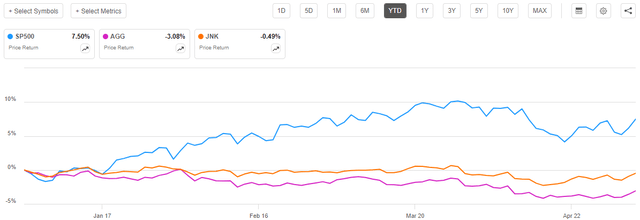
Thus, it makes much less sense to favor cash over a higher-yielding closed-end fund today than it did back in August.
The other significant change that we see in the fund’s portfolio over the August to February period is that the fund decreased its position in business development companies in order to increase its weighting to special purpose acquisition vehicles. I have much less confidence in this change than I did in the previous one.
The reduction in business development company holdings might make sense given the perception of Federal Reserve policy that existed during the period in which the change occurred. Many business development companies make loans to their client companies on a floating-rate basis that is usually based on some spread above short-term U.S. Treasury securities. As such, a reduction in the federal funds rate will often reduce the income of business development companies and even reduce the distributions that they are able to pay out. The Federal Reserve has been telegraphing that interest rate reductions will be coming for a while now, despite the inflation data suggesting that interest rate cuts would be a very bad idea. The market has reacted to the Federal Reserve’s statements though and loosened financial conditions significantly over the period:
Federal Reserve Bank of St. Louis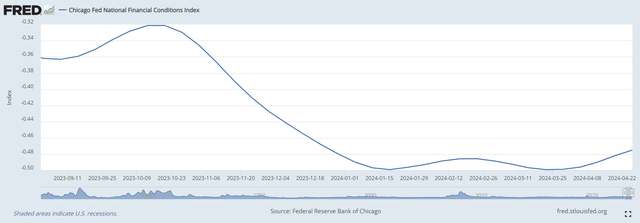
This would suggest that a fixed-income closed-end fund might have been able to outperform a business development company over the period. However, that idea does not appear to have necessarily played out the way that the fund’s management hoped.
For example, let us take a look at the total returns (including dividends and distributions) produced by two of the most popular business development companies, Ares Capital (ARCC) and PennantPark Investment Corporation (PNNT) over the period:
Seeking Alpha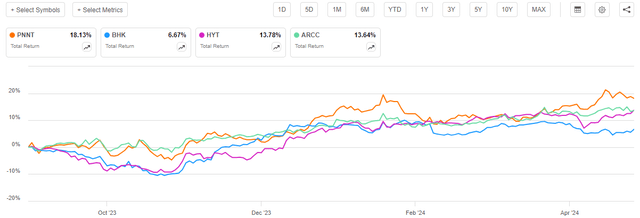
The chart above compares each of these business development companies to the BlackRock Core Bond Trust (BHK) and the BlackRock Corporate High Yield Fund (HYT), which should give a good idea of how the business development corporations compared to investment-grade and junk bond closed-end funds. We can see clearly that the investment-grade bond fund substantially underperformed, but the junk bond fund and Ares Capital were pretty close in terms of total return. PennantPark Investment Corporation, which almost entirely provides floating-rate financing, outperformed all of the other assets by quite a lot.
Thus, it appears that the High Income Securities Fund’s divestment of business development companies in the hopes of getting better returns elsewhere may not have played out as well as management hoped when they made that trade.
With that said, the actual performance provided by various business development companies varied a lot over the period. The business development companies held by the fund also delivered vastly different performances. The two largest business development company positions in the fund’s portfolio on February 29, 2024, were FS KKR Capital (FSK) and CION Investment (CION). Here is how these two companies performed over the period:
Seeking Alpha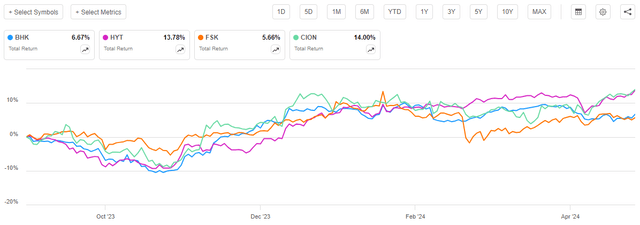
CION Investment certainly did alright, as it roughly matched the performance of the junk bond closed-end fund. However, FS KKR Capital was not a good holding for the fund. It underperformed even an investment-grade closed-end bond fund, let alone substantially underperforming CION Investment and PennantPark (which was not in the fund’s portfolio on February 29, 2024).
Thus, the fund might have benefited from getting rid of some of the business development companies that it might have had in its portfolio at some point over the period. After all, some of them underperformed income-producing closed-end funds. In truth, this appears to cast a shadow over the fund management’s ability to pick business development companies. The idea of switching away certain business development companies may have made sense if the Federal Reserve had actually cut interest rates as rapidly as the market anticipated back in December, but that was always a pipe dream as the data never supported the idea of rapid rate cuts.
Distribution Analysis
The primary reason for anyone to purchase shares of the High Income Securities Fund is because of the high yield that the fund pays out. As of the time of writing, the fund pays a monthly distribution of $0.0622 per share ($0.7464 per share annually), which gives it an 11.64% yield at the current price. The fund’s distribution historically has been all over the place, though, as it has both raised and lowered it numerous times over its history:
CEF Connect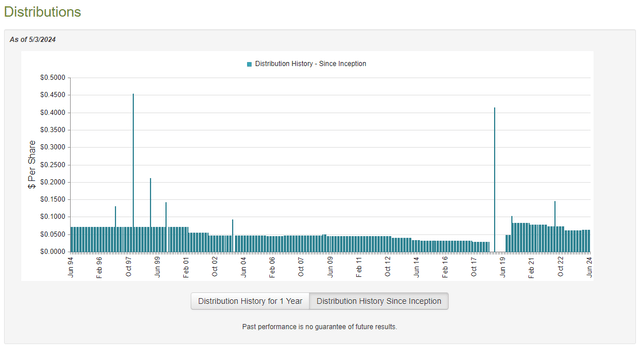
The fund’s semi-annual report includes a statement explaining the rationale for this:
The Fund currently pays monthly distributions at an annualized rate of at least 10% (or 0.8333% per month) of its share net asset value as of the last business day of the previous calendar year. Each of the first two monthly distributions in calendar year 2024 have been $0.0622 per share. Please note that in some calendar years, adhering to the Fund’s managed distribution policy may require some capital to be returned to shareholders. The Fund will not know what percentage, if any, of its distributions will be characterized as a return of capital until after the end of the calendar year in which they are made.
Basically, the distributions are going to heavily depend on the total return of the assets that the fund holds. As many of this fund’s assets provide a substantial percentage of their total return in the form of dividends and distributions, there could be an indirect link between interest rates and the fund’s distributions. After all, the fund will include closed-end funds that invest in floating-rate securities as well as business development companies that typically pay out larger distributions when short-term interest rates are high. That would naturally have a positive impact on the income of the High Income Securities Fund, which raises its net asset value as cash comes in. However, fixed-rate bond funds usually shoot up in price when interest rates decline, which would also have a positive impact on the fund’s net asset value to the degree to which the fund is holding such assets.
Let us have a look at the fund’s semi-annual report for the period that ended on February 29, 2024, in an attempt to determine how well it is covering its distribution that was just raised in January.
For the six-month period ending February 29, 2024, the High Income Securities Fund received $4,268,692 in dividends and $860,009 in interest from the securities in its portfolio. This gives the fund a total investment income of $5,128,701 for the six-month period. The fund paid its distributions out of this amount, which left it with $4,495,841 for the shareholders. That was, unfortunately, not sufficient to cover the $6,416,150 that the fund paid out in distributions. I will admit though that this fund did manage to get closer than I expected to achieve full distribution coverage solely with net investment income.
The fund did manage to make up the difference through capital gains. For the six-month period, the High Income Securities Fund reported net realized gains of $727,924 and net unrealized gains of $1,339,539. The fund’s net assets increased by $147,154 after accounting for all inflows and outflows in the period.
Thus, this fund did manage to fully cover the distributions that it paid out during the period and had money left over. This certainly explains why the fund raised its distribution in January. However, the fund did need to rely on unrealized capital gains to cover its distributions, so there is no guarantee that a market correction will not render it unable to cover its payouts. Of course, that is a problem with a managed distribution policy in general.
Over the past ten years, the fund has failed to fully cover the distributions in aggregate:
Barchart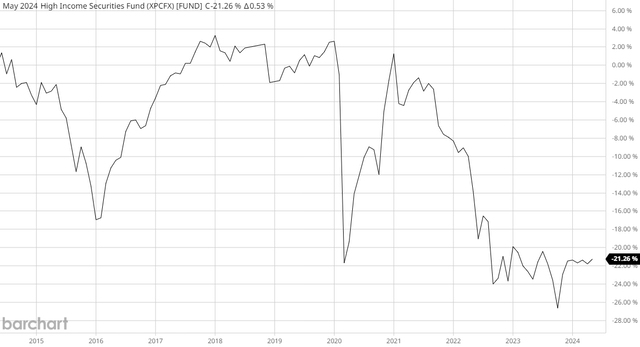
That chart shows the net asset value of the High Income Securities Fund over the past ten years. As we can see, it has declined by 21.26% over the period. This tells us that the fund failed to cover all of the distributions that it paid out. However, nearly all of its problems came from a failure to fully cover payouts in 2021 and 2022. While the fund did encounter some problems in 2015, it managed to correct them over the next few years. Overall, though, the long-term history of the fund suggests that investors who are seeking a safe and consistent income to use to pay their bills may be better off looking elsewhere.
Valuation
As of the time of writing, the High Income Securities Fund trades at a 13.73% discount to net asset value. This is a much more attractive price than the 9.37% average discount that the shares have had over the past month. As such, the current price looks like a pretty good entry point.
Conclusion
In conclusion, the High Income Securities Fund is a rather interesting fund that seeks to provide a very high yield at all times. The fund seeks to achieve this goal by investing in other closed-end funds and business development companies, both of which usually have pretty high yields themselves. Unfortunately, the fund has generally failed to cover its distributions over the long term and as a result, its portfolio has lost a lot of money. The fund did manage to cover its distribution during the most recent six-month period, however.
Overall, the fund is probably worth holding on to if you already own it. The most recent report shows that the fund has improved a lot since our prior discussion, especially when it comes to increasing the yield of its assets. The fact that it managed to cover its distribution during the most recent period is helpful too, even if the long-term trend is negative.
Credit: Source link