• bitcoinBitcoin(BTC)$80,543.005.56%
  • ethereumEthereum(ETH)$2,425.358.09%
  • tetherTether(USDT)$1.000.04%
  • binancecoinBNB(BNB)$715.234.56%
  • rippleXRP(XRP)$1.314.18%
  • usd-coinUSDC(USDC)$1.000.02%
  • solanaSolana(SOL)$96.536.40%
  • tronTRON(TRX)$0.319270-0.62%
  • Figure HelocFigure Heloc(FIGR_HELOC)$1.051.54%
  • zcashZcash(ZEC)$1,314.6511.51%
  • HyperliquidHyperliquid(HYPE)$83.731.56%
  • dogecoinDogecoin(DOGE)$0.0771045.42%
  • moneroMonero(XMR)$636.631.71%
  • USDSUSDS(USDS)$1.000.02%
  • whitebitWhiteBIT Coin(WBT)$77.966.34%
  • chainlinkChainlink(LINK)$11.577.80%
  • leo-tokenLEO Token(LEO)$9.350.55%
  • cardanoCardano(ADA)$0.1986847.40%
  • stellarStellar(XLM)$0.1683726.20%
  • bitcoin-cashBitcoin Cash(BCH)$282.225.11%
  • nearNEAR Protocol(NEAR)$4.048.36%
  • uniswapUniswap(UNI)$7.739.37%
  • daiDai(DAI)$1.00-0.01%
  • Ethena USDeEthena USDe(USDE)$1.000.05%
  • litecoinLitecoin(LTC)$56.236.50%
  • RainRain(RAIN)$0.005969-6.66%
  • CantonCanton(CC)$0.1023087.12%
  • avalanche-2Avalanche(AVAX)$8.795.09%
  • suiSui(SUI)$0.937.17%
  • USD1USD1(USD1)$1.000.06%
  • tether-goldTether Gold(XAUT)$4,110.734.58%
  • the-open-networkGram (prev. Toncoin)(GRAM)$1.161.30%
  • hedera-hashgraphHedera(HBAR)$0.0732267.37%
  • quant-networkQuant(QNT)$207.9210.34%
  • Global DollarGlobal Dollar(USDG)$1.000.02%
  • shiba-inuShiba Inu(SHIB)$0.0000054.91%
  • BittensorBittensor(TAO)$236.727.50%
  • paypal-usdPayPal USD(PYUSD)$1.000.02%
  • crypto-com-chainCronos(CRO)$0.0524986.18%
  • Ripple USDRipple USD(RLUSD)$1.000.03%
  • EthenaEthena(ENA)$0.1823358.13%
  • Ondo US Dollar YieldOndo US Dollar Yield(USDY)$1.15-0.08%
  • okbOKB(OKB)$112.185.56%
  • Circle USYCCircle USYC(USYC)$1.140.01%
  • pepePepe(PEPE)$0.0000054.53%
  • aaveAave(AAVE)$132.556.20%
  • OndoOndo(ONDO)$0.4126548.56%
  • Pump.funPump.fun(PUMP)$0.0043225.26%
  • MemeCoreMemeCore(M)$0.841.30%
  • BlackRock USD Institutional Digital Liquidity FundBlackRock USD Institutional Digital Liquidity Fund(BUIDL)$1.000.00%
TradePoint.io
  • Main
  • AI & Technology
  • Stock Charts
  • Market & News
  • Business
  • Finance Tips
  • Trade Tube
  • Blog
  • Shop
No Result
View All Result
TradePoint.io
No Result
View All Result

Parrot: Optimizing End-to-End Performance in LLM Applications Through Semantic Variables

June 3, 2024
in AI & Technology
Reading Time: 5 mins read
A A
Parrot: Optimizing End-to-End Performance in LLM Applications Through Semantic Variables
ShareShareShareShareShare

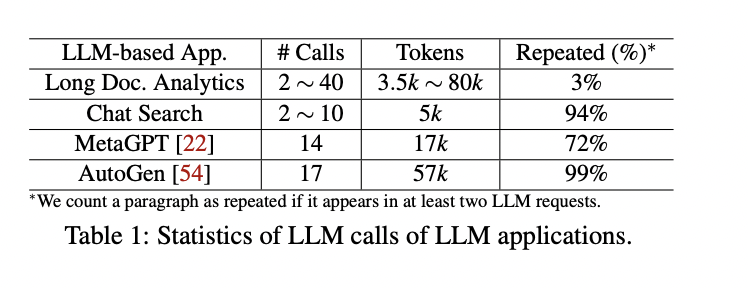
Large language models (LLMs) possess advanced language understanding, enabling a shift in application development where AI agents communicate with LLMs via natural language prompts to complete tasks collaboratively. Applications like Microsoft Teams and Google Meet use LLMs to summarize meetings, while search engines like Google and Bing enhance their capabilities with chat features. These LLM-based applications often require multiple API calls, creating complex workflows. Current API designs for LLM services are request-centric and lack application-level information, which results in sub-optimal performance.

The field of model serving has seen significant advancements with systems like Clipper, TensorFlow Serving, and AlpaServe addressing deep learning deployment challenges. These systems focus on batching, caching, and scheduling but often overlook the unique needs of LLMs. Orca and vLLM improve batching and memory utilization for LLM requests. Parrot enhances LLM serving by analyzing application-level data flow, and optimizing end-to-end performance. LLM orchestrator frameworks like LangChain and Semantic Kernel simplify LLM application management. Parrot integrates with these frameworks, utilizing Semantic Variables for optimization. Parrot also uses DAG information to optimize LLM applications, emphasizing prompt structure and request dependencies.

Researchers from Shanghai Jiao Tong University and Microsoft Research proposed Parrot, an LLM service system designed to treat LLM applications as first-class citizens, retaining application-level information through the use of Semantic Variables. A Semantic Variable is a text region in a prompt with a specific semantic purpose, such as task instructions or inputs, and it connects multiple LLM requests. By exposing prompt structures and request correlations, Parrot enables data flow analysis, optimizing end-to-end performance. Parrot’s unified abstraction facilitates joint optimizations, improving scheduling, latency hiding, and de-duplication.
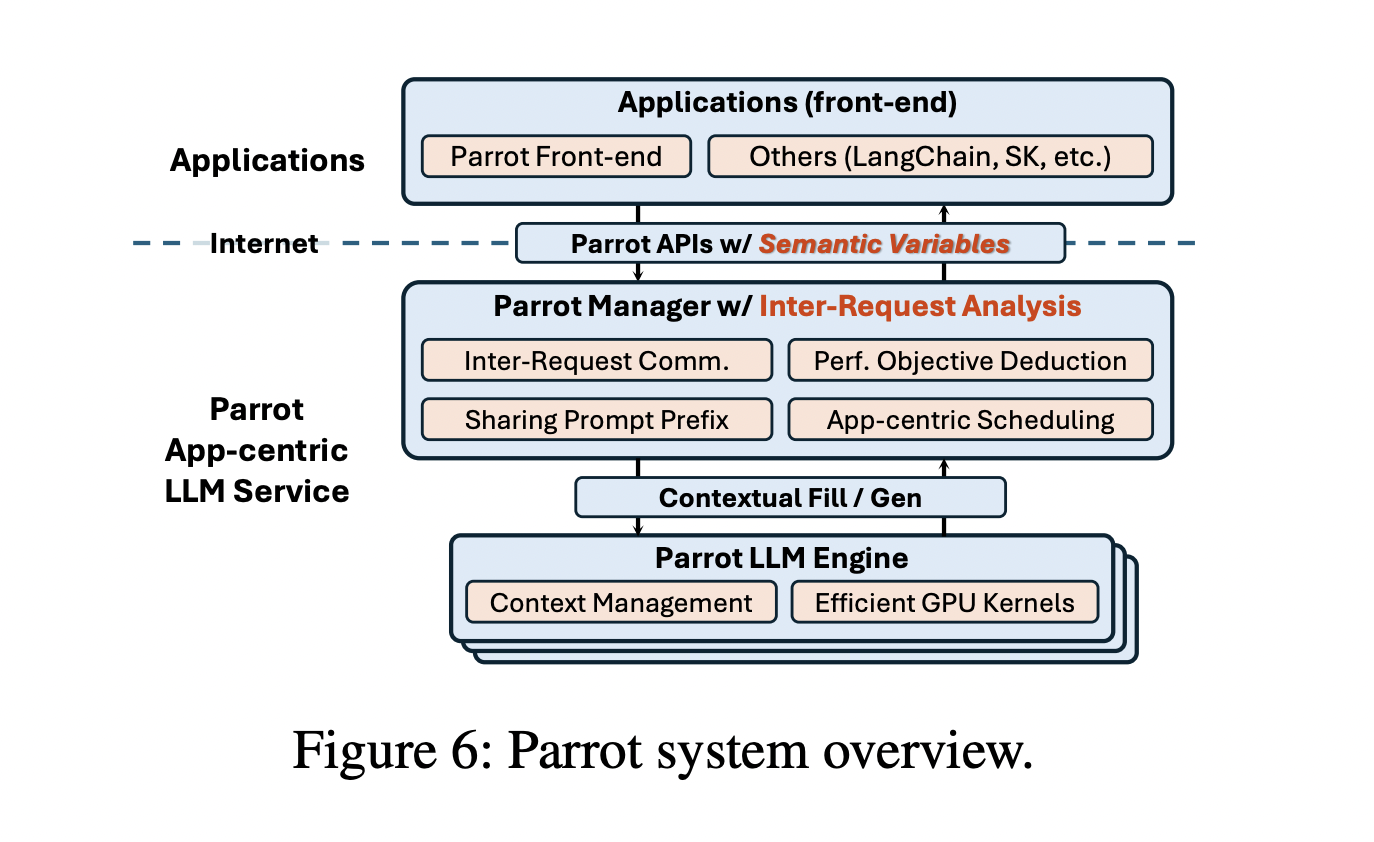
Parrot treats LLM requests as semantic functions implemented in natural language, executed by LLMs. Semantic Variables, defined as input or output placeholders in prompts, maintain the prompt structure for inter-request analysis. In multi-agent applications, such as MetaGPT, semantic functions like WritePythonCode and WriteTestCode use Semantic Variables to connect and sequence tasks. Parrot’s asynchronous design allows submitting and fetching requests separately, facilitating just-in-time relationship analysis. Performance criteria can be annotated for each variable, optimizing and scheduling based on end-to-end requirements like latency or throughput. 

Evaluating Parrot on both production and open-source LLM-based applications reveals significant improvements, achieving up to 11.7× speedup and 12× higher throughput compared to state-of-the-art solutions. These applications require numerous LLM calls, leading to high user-perceived latency. Treating requests individually can double end-to-end latency, but Parrot’s batching approach eliminates this overhead. By scheduling consecutive requests together, Parrot directly feeds outputs from one step to the next, bypassing network and queuing delays.
This study introduces Parrot, which optimizes the end-to-end performance of LLM applications by treating them as first-class citizens rather than focusing solely on individual requests. It introduces Semantic Variable, an abstraction that reveals dependencies and commonalities among LLM requests, creating new optimization opportunities. The evaluation demonstrates Parrot can enhance LLM-based applications by up to 11.7×. This approach opens new research directions for improving scheduling features, such as ensuring the fairness of end-to-end performance in LLM applications.


Check out the Paper. All credit for this research goes to the researchers of this project. Also, don’t forget to follow us on Twitter. Join our Telegram Channel, Discord Channel, and LinkedIn Group.

If you like our work, you will love our newsletter..

Don’t Forget to join our 43k+ ML SubReddit | Also, check out our AI Events Platform


YOU MAY ALSO LIKE

Cat Wu to Lead Product Management for OpenAI’s Core Products – Unite.AI

Snap Has More Than 30 Million Paid Subscribers Across Snapchat+ And Other Plans

Asjad is an intern consultant at Marktechpost. He is persuing B.Tech in mechanical engineering at the Indian Institute of Technology, Kharagpur. Asjad is a Machine learning and deep learning enthusiast who is always researching the applications of machine learning in healthcare.


🐝 Join the Fastest Growing AI Research Newsletter Read by Researchers from Google + NVIDIA + Meta + Stanford + MIT + Microsoft and many others…


Credit: Source link

ShareTweetSendSharePin

Related Posts

Cat Wu to Lead Product Management for OpenAI’s Core Products – Unite.AI
AI & Technology

Cat Wu to Lead Product Management for OpenAI’s Core Products – Unite.AI

November 5, 2026
Snap Has More Than 30 Million Paid Subscribers Across Snapchat+ And Other Plans
AI & Technology

Snap Has More Than 30 Million Paid Subscribers Across Snapchat+ And Other Plans

November 4, 2026
Atmospheric AI Secures M Seed for Procurement Modeling Push – Unite.AI
AI & Technology

Atmospheric AI Secures $10M Seed for Procurement Modeling Push – Unite.AI

November 4, 2026
Perplexity Adds Live Web Grounding to Its Decisions API – Unite.AI
AI & Technology

Perplexity Adds Live Web Grounding to Its Decisions API – Unite.AI

November 4, 2026
Next Post
Sacramento mom recalls last conversation with son shot by other 10-year-old

Sacramento mom recalls last conversation with son shot by other 10-year-old

Leave a Reply Cancel reply

Your email address will not be published. Required fields are marked *

Search

No Result
View All Result
Binance Attackers Used Fake Job Interviews To Pull Off .3 Billion Crypto Heist

Binance Attackers Used Fake Job Interviews To Pull Off $6.3 Billion Crypto Heist

November 4, 2026
AI victim video leads to manslaughter sentence reversal

AI victim video leads to manslaughter sentence reversal

October 30, 2026
Physicians Preferred AI Discharge Summaries in 95% of Cases in Stony Brook Study – Unite.AI

Physicians Preferred AI Discharge Summaries in 95% of Cases in Stony Brook Study – Unite.AI

November 2, 2026

About

Learn more

Our Services

Legal

Privacy Policy

Terms of Use

Bloggers

Learn more

Article Links

Contact

Advertise

Ask us anything

©2020- TradePoint.io - All rights reserved!

Tradepoint.io, being just a publishing and technology platform, is not a registered broker-dealer or investment adviser. So we do not provide investment advice. Rather, brokerage services are provided to clients of Tradepoint.io by independent SEC-registered broker-dealers and members of FINRA/SIPC. Every form of investing carries some risk and past performance is not a guarantee of future results. “Tradepoint.io“, “Instant Investing” and “My Trading Tools” are registered trademarks of Apperbuild, LLC.

This website is operated by Apperbuild, LLC. We have no link to any brokerage firm and we do not provide investment advice. Every information and resource we provide is solely for the education of our readers. © 2020 Apperbuild, LLC. All rights reserved.

No Result
View All Result
  • Main
  • AI & Technology
  • Stock Charts
  • Market & News
  • Business
  • Finance Tips
  • Trade Tube
  • Blog
  • Shop

© 2023 - TradePoint.io - All Rights Reserved!