












































Sundry Photography
Investment Thesis
CrowdStrike’s (CRWD) uneventful outage last week led to nightmarish digital lockdowns last week, which have distorted the constantly evolving, compelling outlook for the cybersecurity industry, where leading players such as Zscaler (ZS), Cloudflare (NET), and Palo Alto Networks (NASDAQ:PANW) operate at different intersections of the cybersecurity market.
Earlier this year, Palo Alto Networks advised investors that it would be anticipating a slowdown in its billings guidance amidst observed “spending fatigue,” only to be later refuted by CrowdStrike’s management in their earnings report.
The recent outage caused by CrowdStrike’s code deployment has again flipped the narrative for high-growth cybersecurity stocks, as seen in Exhibit A.
Exhibit A: Palo Alto Networks versus some of its peers in the cybersecurity industry (Seeking Alpha)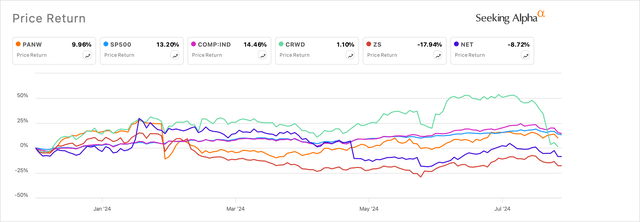
However, I believe investors need to look beyond the near-term to assess Palo Alto Network’s strengths, especially given the tailwinds it could benefit from CrowdStrike’s outage fiasco.
Piecing together Palo Alto Networks’ recent growth rates with their customer contracts duration cycles along with its TAM estimates points to a robust outlook for the company, which investors may be overlooking. I recommend a Buy on Palo Alto Networks.
Deferred Growth Concerns Are Short-sighted
With three-quarters of earnings already recorded in its books, Palo Alto Networks’ management is projecting full-year FY24 revenues to grow ~16% over the previous year to $8 billion in sales at the midpoint of its tightened guidance range. At the time of writing this research note, I see that markets agree with management’s sales projections, with consensus estimates matching the $8 billion midpoint sales target. That would imply an expected ~25% growth since 2016.
For a legacy cybersecurity company that has endured some successful business transitions through its lifetime, a 25% growth rate is highly impressive, given that many young cloud software companies still aspire for those growth rates. Let that sink in.
But the shine of that performance has recently paled given the market’s concerns about decelerating growth. While concerns are valid based on trend observations as illustrated in Exhibit B, I believe investors would be myopic in their assessment, discounting the outlook of the industry, Palo Alto Networks’ relative strength of its business, as well as the nature of Palo Alto Networks’ client contract tenures.
Exhibit B: Palo Alto Networks growth may be slowing but the acquisition of multi-tenured customer contracts in the past few years is telling. (Company filings)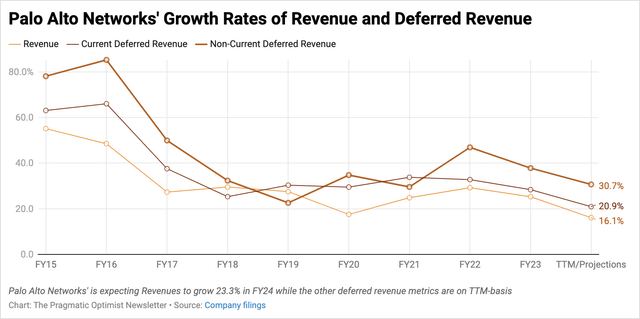
The Palo Alto-based cybersecurity leader is projected to close out its forthcoming FY24 with ~16% growth in sales to ~$8 billion, as I had estimated earlier. On a TTM basis, deferred revenues, or future sales that Palo Alto Networks has billed its customers for and already recorded in its bank accounts, also appear to be trending lower.
However, this is occurring after the company has consistently reported a robust set of annual sales growth in the years after the pandemic, growing in strong double digits. Simultaneously, the company has been consistently winning larger deals and tying down customers for longer contract durations, as seen in the +30% increase in non-current deferred revenue or future sales that it expects to recognize as revenue after the next twelve months.
In a previous BofA conference, Palo Alto Networks’ CEO explained why the company’s focus has been on tying down customers for longer contract durations as a key metric, in addition to bookings:
Bookings is when I go sell amount of business to a customer and there’s a duration of that deal. If it’s one year, two year, three years, four or five years, customers like commit to paying you $10 million a year, in 5 years you get $50 million of bookings this shows up on the RPO. This business I have — services I have to deliver, they have made the commitment, it’s contractually agreed.
Per its FY23 10-K, Palo Alto Networks says that customer contract durations are “typically one to five years,” whereas on the Q3 FY24 earnings call, management reported that the average duration of new contracts “increased slightly year-over-year but remained at approximately three years.”
There is no doubt that the pace at which Palo Alto Networks’ sells its cybersecurity products and solutions is slowing. But as the company exits FY24, it would mark the second year of deceleration, mirroring revenue deceleration trends as seen in FY17-FY19. This puts a majority of customers up for contract renewal as the company cycles through the next two years, and I expect the company to benefit from successful contract re-negotiations.
I also expect operating margins to significantly expand over the next three years, similar to the margin expansion cycles seen during FY17-FY19, which additionally offsets any concerns about a revenue slowdown. My assumptions for expected operating margin expansion should help sustain the high valuation premium it currently commands.
Exhibit C: Palo Alto Networks’ investors should get ready for an upcoming cycle of margin expansion that mirrors the FY17-FY19 years. (YCharts)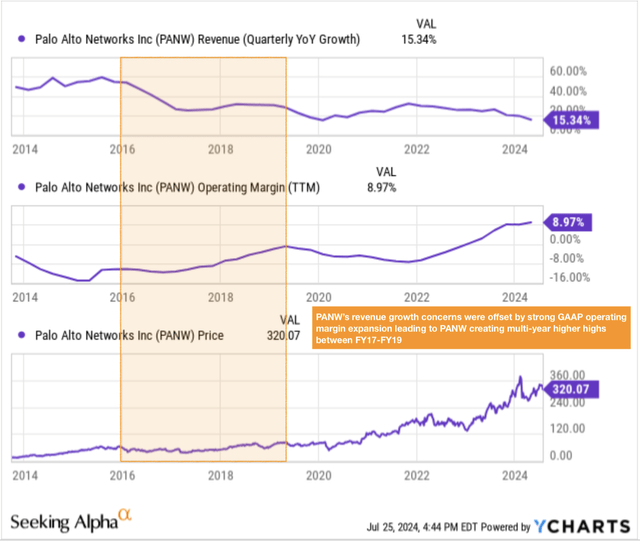
Palo Alto Networks Grows Faster Than Its Market
Research indicates the cybersecurity industry was valued at ~$191 billion last year and is expected to grow by ~9.4% CAGR through 2028, with Palo Alto Networks being the current industry leader. The cybersecurity TAM was also noted by Palo Alto Networks’ CEO at the C&T conference last year:
Honestly, like it’s a 200 — our addressable TAM is north of $200 billion, and we have nine or seven in a year. Like I don’t need the TAM to grow faster. I just need to take more of the TAM. And that’s why we think we have so many more swim lanes now that we play in. And it’s highly efficient from a sales go-to-market perspective.
The entire cybersecurity market has grown by a ~21% CAGR if I compare the current TAM of ~$190 billion to previous estimates of $50 billion in 2016. As I had noted in the previous section, Palo Alto Networks is projected to grow at a 25% CAGR, implying outpaced market growth and market penetration. Palo Alto Networks has attributed a majority of its growth to the success of its Prisma SASE product, giving the company a clear leadership position in the SASE space. In addition, the company’s Cortex XDR has been another recent success in this decade, with the company gaining significant share to rapidly contend for leadership in the XDR space with some strong incumbents.
Management is already expanding its AI-driven Cortex portfolio into emerging cybersecurity markets such as XSIAM (extended security intelligence and automation management). This also includes the recent acquisition of QRadar’s assets from IBM, which will be merged into its Cortex portfolio, estimated to increase its ARR by up to $100 million.
In addition, I anticipate that the recent outage by CrowdStrike will rebalance the scales in favor of Palo Alto Networks as the preferred XDR vendor.
Given the company’s slate of products lined up for distribution, I believe Palo Alto Networks can easily deliver 15-16% CAGR growth over the next three years, easily outpacing the ~9.4% expected industry growth.
Valuation for Palo Alto Networks Indicates Strong Double Digit Upside
As noted earlier, I expect Palo Alto Networks to grow in the mid-teens through FY27. With the company already reporting 9 months of data, I am forecasting growth past FY24 into next year through FY27.
I also expect adjusted operating income to grow ~21.3% through FY27. This is based on the flat margins management expects in FY25, followed by 1.5-2% of margin expansion throughout the year.
I am assuming a ~2.3% share dilution and a discount rate of 8.7%.
Exhibit D: Palo Alto Networks valuation model suggests strong double digit upside (Author)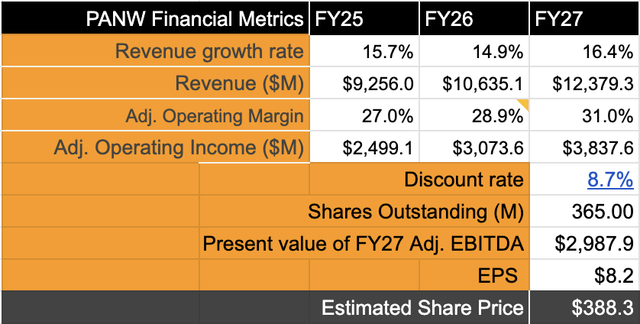
I believe a forward PE of 47-48x earnings is warranted if I compare the company’s 21% earnings growth rates to the long-term earnings growth rates of the S&P 500. This model implies >21% upside from current levels.
Risks & Other Factors to Consider
The “spending fatigue” or slowdown in platform/industry spending that customers were reportedly demonstrating, as first noted by Palo Alto Networks’ management in February, could continue for longer than expected, but I do not expect significant delays given the rapidly changing environment of the cybersecurity landscape.
Wiz, an emerging cybersecurity player, is expected to file papers to go public shortly, reneging its takeover deal with Alphabet (GOOG). When that happens, expect investors to reallocate capital away from existing listed cybersecurity players such as Palo Alto Networks in the interim period.
Finally, given the current souring market sentiment, I expect investors may balk at the company’s ~47x valuation premium that my valuation model suggests. The stock itself trades at 52x FY25 adjusted EPS. But I believe this volatility in PANW to be seasonal, creating buying opportunities in the stock.
Although management is still to confirm a date for its Q4 FY24 earnings report, the company is expected to report its FY24 earnings on 16th August, next month, per Seeking Alpha’s estimates.
Takeaways
Despite Palo Alto Networks experiencing a slowdown in its revenue spending, I believe these growth trends to be temporary and expect the company to benefit from upcoming customer contract renegotiation cycles. At the same time, the company’s impressive slate of cybersecurity products will aid the company’s strong double-digit growth rate, outpacing the expected industry growth rates.
I believe Palo Alto Networks does not warrant the skepticism it is currently receiving and rate the company as a Buy.
Credit: Source link









