
BING-JHEN HONG
My last article about NVIDIA Corporation (NASDAQ:NVDA) was published in mid-March 2024 following fourth quarter results. And while I covered NVIDIA before and was always cautious regarding the stock (which was clearly wrong in 2022 as I did not see what was coming), I always rated the stock as a “Hold”. But in my last article I rated NVIDIA as a “Sell” for the first time.
In my case a “Sell” rating is rather the exception. It is not that I am not bearish about companies or the stock market – I am actually really bearish for the entire stock market in the coming years. But I mostly try to cover high-quality businesses that can qualify as great long-term investments. And as I usually consider it dangerous to short these businesses only 3 articles (out of 700) have a “Strong Sell” rating and only about 30 have a “Sell” rating (see here).
But despite the “Sell” rating in my last article, the stock increased 24% in the meantime and clearly outperformed the S&P 500 which increased only 2% in the same timeframe. Let’s look at NVIDIA three months later and answer the question if I have been wrong and if we should change the rating.
Quarterly Results
On May 22, 2024, NVIDIA reported first quarter results and could beat analysts’ estimates for revenue as well as earnings per share once again. This is actually the sixth quarter in a row in which NVIDIA Corporation did beat earnings and revenue, but we can see that analysts are getting closer to actual reported earnings again (meaning the % surprise is getting lower again).
NVIDIA EPS Surprise Last Few Quarters (Seeking Alpha)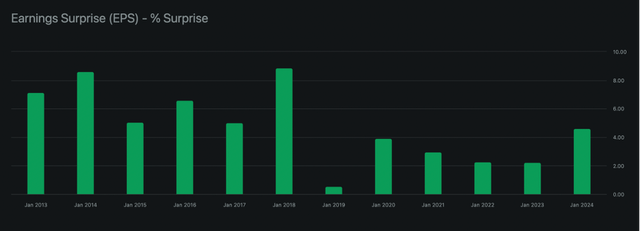
But overall, the analysts had to increase expectations constantly in the last few quarters and NVIDIA still did beat estimates again and again.
NVIDIA: Consensus EPS Revision Trend (Seeking Alpha)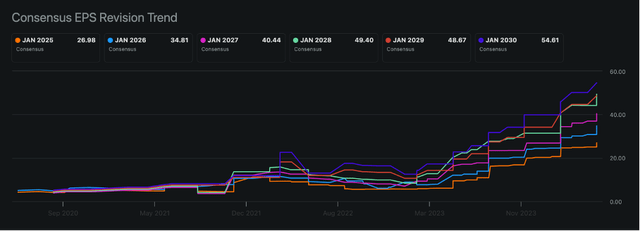
And NVIDIA reported great results once again. Revenue increased from $7,192 million in Q1/24 to $26,044 million in Q1/25 – resulting in 262% year-over-year growth. Operating income increased even more – 690% year-over-year growth from $2,140 million in the same quarter last year to $16,909 million this quarter. And diluted net income per share increased from $0.82 in Q1/24 to $5.98 in Q1/25 – resulting in 629% year-over-year growth.
NVIDIA Q1/25 Presentation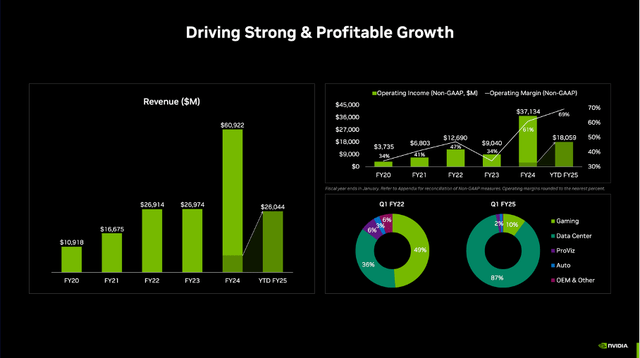
When looking at the different market platforms all five contributed to growth but it was especially “Data Center” being responsible for the overall top-line and bottom-line growth. Data Center revenue increased 427% year-over-year as well as 23% quarter-over-quarter. Data Center generated $22,563 million in revenue and is therefore responsible for 87% of total revenue. These increases are mostly due to higher shipments of the NVIDIA Hopper GPU computing platform with thousands of several different companies using these. During the last earnings call, management mentioned two different examples – Tesla as well as Meta Platforms. Tesla’s infrastructure was expanded by 35,000 H100 GPUs for their training AI clusters and Meta’s Llama 3 (the largest large language model the company has) was trained on a cluster of 24,000 H100 GPUs.
NVIDIA Q1/25 Presentation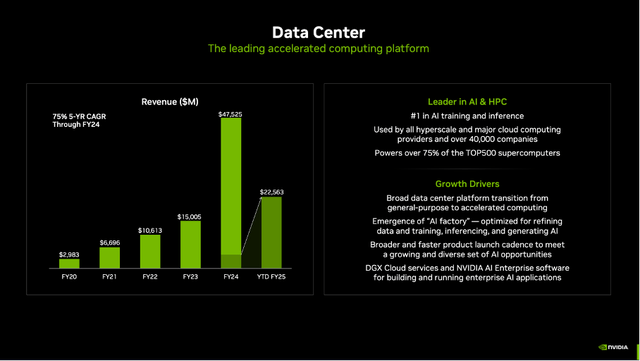
Data Center is now responsible for 87% of total revenue (at least in Q1/25) and this is also posing a huge risk. When one product (or product category) is suddenly responsible for growth and almost the entire revenue it poses a huge risk for the overall business as the company – in this case NVIDIA – is extremely dependent on this single business segment. And although we are talking about completely different industries, Novo Nordisk (NVO) is in a similar situation with GLP-1 and obesity drugs now being responsible for a huge part of overall revenue posing a huge risk if demand for these products should suddenly decline.
Growth Continuing
When listening to the earnings call, there only seems to one plausible conclusion for every investor: NVIDIA future is bright and high growth rates will continue and this is a great investment. During the last earnings call, CEO Jensen Huang stated:
The next industrial revolution has begun. Companies and countries are partnering with NVIDIA to shift the trillion-dollar installed base of traditional data centers to accelerated computing and build a new type of data center, AI factories, to produce a new commodity, artificial intelligence.
AI will bring significant productivity gains to nearly every industry and help companies be more cost and energy efficient while expanding revenue opportunities.
And I have no doubt that artificial intelligence is a game changer that will shift our world in several ways in the next 5, 10 or 20 years. The labor market will change as jobs will vanish, but new jobs will arise as well. Additionally, (most) companies must adopt to the new technology and those adopting well will certainly profit.
Despite most people (including myself) seem to have a clear opinion about AI being a revolution, the question if we are at the beginning of a technical revolution is still difficult to answer. But picking the right companies to invest in the early stage of such a technical revolution is even more difficult. Not only are many stocks severely overvalued (especially those stocks everybody believes to be the winners) but we also must pick the right companies. NVIDIA might continue to be one of the top companies – but we don’t know.
NVIDIA started shipping the H200, which nearly doubles the inference performance of its predecessor, the H100. The first H200 system was delivered to Sam Altman and the team of OpenAI and NVIDIA is on track with shipments for the second quarter. Right now, NVIDIA is the undisputable market leader for AI infrastructure, but that might change again and other competitors like Intel Corporation or AMD might catch up again and take market shares from NVIDIA. And it should be clear for everybody that the high growth rates of the last few quarters won’t persist. We are now comparing growth rates to much higher levels – making high double digit or triple digit growth rates much more difficult.
Sentiment Driving The Stock
When pointing out that competitors could take market shares from NVIDIA many might laugh about this statement and the pessimism of growth slowing down as in the current extremely bullish sentiment NVIDIA losing out to a competitor seems extremely unlikely.
And sentiment is always driving the stock market in the short term, but especially in times of huge depression or extreme bubbles this might be challenging for investors. In case of bubbles extreme sentiment is driving the stock (market) and in my opinion extreme sentiment is even more difficult to grasp. This is true for extreme optimism as well as extreme pessimism. When sentiment gets extreme, we often underestimate sentiment and rather expect a regression to the mean and investors getting more “reasonable” again. And this is often a huge misjudgment of sentiment, which is driving stock prices to extremes in both directions and the stock continuing to rise or decline at a point where many investors already see the stock price as extreme.
In my opinion, NVIDIA is also contributing to the bubble and the extreme bullish sentiment. During the last earnings call CEO Jensen Huang made several statements. And I certainly don’t oppose to this first statement:
As generative AI makes its way into more consumer Internet applications, we expect to see continued growth opportunities as inference scales both with model complexity as well as with the number of users and number of queries per user, driving much more demand for AI compute.
However, there are other more specific statements about investments paying off in a major way. And not only are these statements sounding extremely bullish, I would also question if these claims are reasonable:
Training and inferencing AI on NVIDIA CUDA is driving meaningful acceleration in cloud rental revenue growth, delivering an immediate and strong return on cloud provider’s investment. For every $1 spent on NVIDIA AI infrastructure, cloud providers have an opportunity to earn $5 in GPU instant hosting revenue over four years. NVIDIA’s rich software stack and ecosystem and tight integration with cloud providers makes it easy for end customers up and running on NVIDIA GPU instances in the public cloud.
Another similar claim made during the earnings call:
For example, using Llama 3 with 700 billion parameters, a single NVIDIA HGX H200 server can deliver 24,000 tokens per second, supporting more than 2,400 users at the same time. That means for every $1 spent on NVIDIA HGX H200 servers at current prices per token, an API provider serving Llama 3 tokens can generate $7 in revenue over four years.
And I am in no position to really evaluate if these statements are reasonable and what return on invested can actually be generated by using AI. However, these statements sound extremely bullish and a 400% to 600% return on investment is without any doubt an extremely bullish statement and I would argue that most companies won’t achieve this kind of RoI. It is also expectable for management being bullish about its own business and praising its own products. But such extremely bullish statements are contributing to already extremely bullish sentiment that drove the stock price 10x higher in about 1.5 years.
In the end, we are caught in a huge scale between “Unrealistic expectations and irrational exuberance” on the one side and “most people being unable to realize the revolution taking place and grasping its impact” Knowing beforehand where a technology revolution should be categorized on that broad range is extremely difficult and in most cases, we will be wrong. In most cases we will be either too pessimistic or too optimistic.
Stock Split
And one occasion where investors are often too optimistic (because there is no reason to be optimistic) is a stock split. Usually, following a stock split, the stock continues to gain in value and there are still investors not understanding that the fundamental value did not change and that a stock is not cheap now because one must pay only half, a third or a tenth of the original price.
NVIDIA also announced a 10:1 stock split, which makes sense as the stock is now trading for over $1,000 and these are rather untypical prices for listed equity. The nine additional shares every shareholder will receive for one share will be distributed after market close on Friday, June 7, 2024.
While there is no fundamental reason for the stock to rise due to a stock split, it is not unusual for stocks to continue rising after a stock split. A stock split is almost always occurring for stocks that were climbing in value with a high pace in the quarters leading up to the stock split. And in many cases these stocks are continuing to increase in value and are only continuing the predominant trend.
Dividend and Share Buybacks
And as long as we are talking about announcements, we can also mention the dividend. NVIDIA is actually paying a dividend for quite some time – since 2012. But the dividend never played an important role and is usually not worth mentioning.
Now NVIDIA increased the quarterly dividend by 150% and in most other cases this would have been major news. But NVIDIA increased the quarterly dividend from $0.04 per share to $0.10 per share resulting in $0.40 in annual dividends for a stock trading for about $1,100 at the time of writing. This is resulting in a dividend yield of 0.04%.
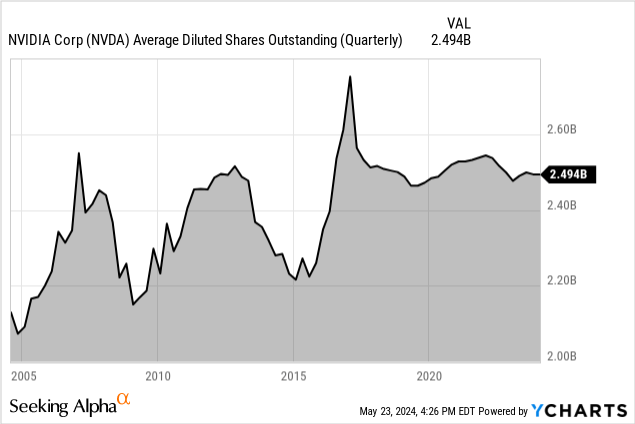
And while NVIDIA spent only $400 million on dividend payments in the last four quarters (will now be about $1,000 million), the company is spending higher amounts on share buybacks. In fiscal 2023, NVIDIA purchased shares worth $11,514 million and in fiscal 2024 the company purchased shares worth $12,316 million.
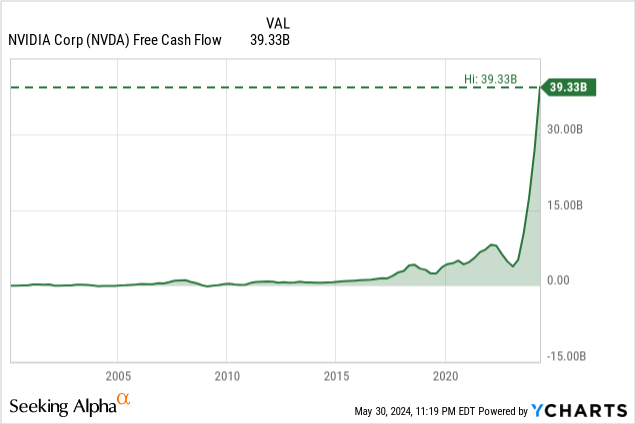
And considering about $40 billion in free cash flow NVIDIA generated in the last four quarters, it is spending only a fraction on dividends and share buybacks. And I personally don’t think the company should spend huge amounts on share buybacks as the stock is extremely overvalued.
Extremely Overvalued
I already wrote this in my past articles. In my opinion NVIDIA is extremely overvalued – despite the growth rates NVIDIA could report in the last few quarters. When looking at the P/E ratio as well as P/FCF ratio we see the ratios improving again over the quarters (and the stock growing into its valuation). Right now, NVIDIA is trading for a P/E ratio of 64 as well as a P/FCF ratio of 70.
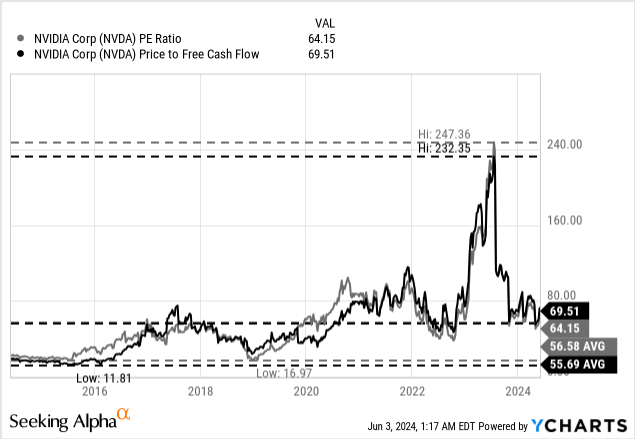
And although NVIDIA was certainly not a stock trading for low valuation multiples in the last few years, it is right now above the 10-year average P/E ratio (which was 56.58) and above the 10-year average P/FCF ratio (which was 55.69). When comparing NVIDIA’s P/E ratio to the P/E ratio of several peers from the semiconductor space, only AMD is trading for a much higher valuation multiples while most other companies are trading around a valuation multiple of 30.
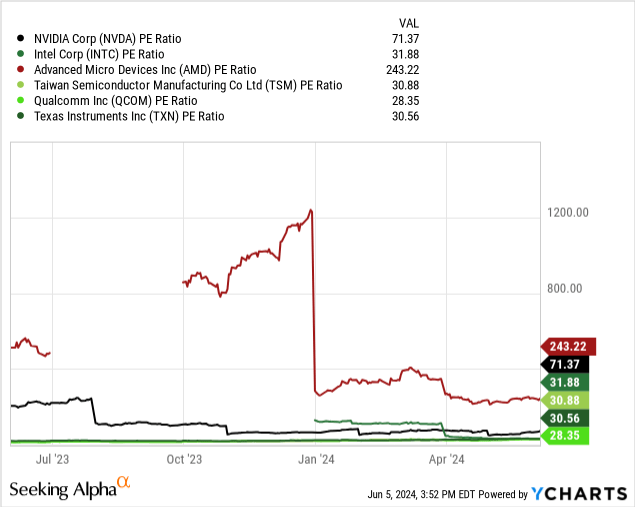
Cleary, when growing the bottom line 100% annually (or more), a valuation multiple of 70 might seem justified. But investing is always about looking ahead and we often make the mistake to perpetuate current growth rates far into the future.
In my last article I wrote that NVIDIA must grow 22% annually for the next ten years followed by 6% growth till perpetuity for the stock to be fairly valued. We can update this calculation, but the necessary growth rates are more or less the same. Free cash flow of the last four quarters, which I take as basis ($39.33 billion) is higher now than in my last calculation. But the stock price is also higher now and therefore we still need about 22-23% annual growth for the next ten years followed by 6% growth till perpetuity to be fairly valued. This assumes 10% discount rate and 2,489 million diluted outstanding shares.
And I don’t want to repeat all the arguments made in my last article, so I mention just a few catch phrases and buzz words: NVIDIA has an extremely high market share when talking about AI and the necessary infrastructure and a huge part of revenue is ending up as free cash flow. In both cases we should not bet on this scenario to continue forever.
Considering that competitors will most likely catch up in the coming quarters (or at least next few years) and take market shares from NVIDIA, a valuation multiple of 70 seems not justified. And increased competition will not only lead to lower top-line growth rates, but also lower margins for NVIDIA in the coming years. Additionally, the semiconductor industry was always cyclical and subject to spending cycles. And even if we are at the beginning of a long-lasting AI revolution, spending could still slow down in the next few years as the major tech companies already bought the necessary AI infrastructure for the next few years, which is another argument for a valuation multiple of 70 being too high.
And in theory, NVIDIA could be fairly valued – but for that scenario everything has to line up perfectly over the next decades and that is a level of perfection I don’t believe in. And when looking at cycles, theories about hype and are taking the historical perspective, it seems extremely unlikely that NVIDIA is not in a bubble.
Technical Picture
In case of NVIDIA, I already made the case in my last article that the stock might climb a little higher before a bigger correction might begin. In the article I wrote:
When using Fibonacci extension levels from the last bull run from 2018 to 2021, we got a potential target of around $863 (the 2.618 extension). However, Nvidia already exceeded this level (I started working on the article about two weeks ago). The next potential target would be the 3.618 Fibonacci extension around $1,180. At this level, we also have a white trendline which is combining the two highs of 2018 and 2021 and would generate a resistance level somewhere around $1,050 in the next few weeks/months for Nvidia.
And now it seems like NVIDIA reached that target. In the last few days, the stock marked an intraday trading high of $1,220 and hit my target. Of course, we should not forget that we are always dealing with probabilities and this is just one scenario that seems very likely in my opinion. The stock could end up performing very different in the next few months and quarters.
Risks
I also see two major risks to my bearish thesis (risk being defined here as the stock climbing and missing out on profit due to selling the stock as I am not short and won’t advise anyone to short the stock):
- NVIDIA might continue to climb higher as competitors like Intel Corporation (INTC) or Advanced Micro Devices, Inc. (AMD) continue to rather disappoint and underperform, and NVIDIA will be able to keep its extremely high market share.
- I might underestimate sentiment and the bullish sentiment gets even more extreme and is driving the stock price higher and higher (even if not justified by fundamentals). The recent roller-coaster ride of GameStop (GME) shares might be an example for unexpected extremes in sentiment.
Conclusion
In the end, I still see NVIDIA being one of the most overvalued stocks and the extremely bullish sentiment is driven by the hype surrounding AI in the last few quarters but also by extremely bullish statements from management. In the last few quarters, growth rates certainly supported the high valuation multiples NVIDIA is currently trading for, but it would not be the first company with growth rates suddenly falling off a cliff as companies suddenly head back on spending (for extremely due to a recession). And betting on perfect has always been dangerous.
Credit: Source link