













• bitcoinBitcoin(BTC)$81,230.003.84%
  • ethereumEthereum(ETH)$2,633.815.07%
  • tetherTether(USDT)$1.000.05%
  • binancecoinBNB(BNB)$769.172.29%
  • rippleXRP(XRP)$1.448.26%
  • usd-coinUSDC(USDC)$1.000.02%
  • solanaSolana(SOL)$111.525.10%
  • tronTRON(TRX)$0.337707-0.11%
  • zcashZcash(ZEC)$1,536.734.42%
  • Figure HelocFigure Heloc(FIGR_HELOC)$1.030.25%
  • HyperliquidHyperliquid(HYPE)$92.341.15%
  • dogecoinDogecoin(DOGE)$0.0889414.07%
  • moneroMonero(XMR)$578.748.84%
  • whitebitWhiteBIT Coin(WBT)$83.053.11%
  • RainRain(RAIN)$0.0139258.85%
  • USDSUSDS(USDS)$1.000.03%
  • chainlinkChainlink(LINK)$12.475.32%
  • cardanoCardano(ADA)$0.2274645.28%
  • leo-tokenLEO Token(LEO)$8.89-0.06%
  • stellarStellar(XLM)$0.2006947.16%
  • uniswapUniswap(UNI)$8.992.86%
  • bitcoin-cashBitcoin Cash(BCH)$251.981.00%
  • Ethena USDeEthena USDe(USDE)$1.000.03%
  • nearNEAR Protocol(NEAR)$3.58-3.91%
  • daiDai(DAI)$1.00-0.01%
  • litecoinLitecoin(LTC)$57.954.94%
  • CantonCanton(CC)$0.1115573.13%
  • USD1USD1(USD1)$1.000.05%
  • avalanche-2Avalanche(AVAX)$9.2615.03%
  • the-open-networkGram (prev. Toncoin)(GRAM)$1.391.87%
  • hedera-hashgraphHedera(HBAR)$0.0813355.21%
  • suiSui(SUI)$0.855.71%
  • Global DollarGlobal Dollar(USDG)$1.00-0.02%
  • shiba-inuShiba Inu(SHIB)$0.0000051.88%
  • BittensorBittensor(TAO)$265.226.77%
  • crypto-com-chainCronos(CRO)$0.0597930.85%
  • MemeCoreMemeCore(M)$1.290.03%
  • paypal-usdPayPal USD(PYUSD)$1.000.02%
  • tether-goldTether Gold(XAUT)$4,373.220.35%
  • okbOKB(OKB)$120.335.59%
  • Circle USYCCircle USYC(USYC)$1.140.00%
  • Ripple USDRipple USD(RLUSD)$1.000.00%
  • BlackRock USD Institutional Digital Liquidity FundBlackRock USD Institutional Digital Liquidity Fund(BUIDL)$1.000.00%
  • Ondo US Dollar YieldOndo US Dollar Yield(USDY)$1.14-0.16%
  • aaveAave(AAVE)$142.392.93%
  • mantleMantle(MNT)$0.636.25%
  • AsterAster(ASTER)$0.761.89%
  • OndoOndo(ONDO)$0.4240626.39%
  • EthenaEthena(ENA)$0.19817020.77%
  • Pump.funPump.fun(PUMP)$0.004141-2.15%
TradePoint.io
  • Main
  • AI & Technology
  • Stock Charts
  • Market & News
  • Business
  • Finance Tips
  • Trade Tube
  • Blog
  • Shop
No Result
View All Result
TradePoint.io
No Result
View All Result

NVIDIA AI Releases Universal Deep Research (UDR): A Prototype Framework for Scalable and Auditable Deep Research Agents

September 10, 2025
in AI & Technology
Reading Time: 10 mins read
A A
NVIDIA AI Releases Universal Deep Research (UDR): A Prototype Framework for Scalable and Auditable Deep Research Agents
ShareShareShareShareShare

Why do existing deep research tools fall short?

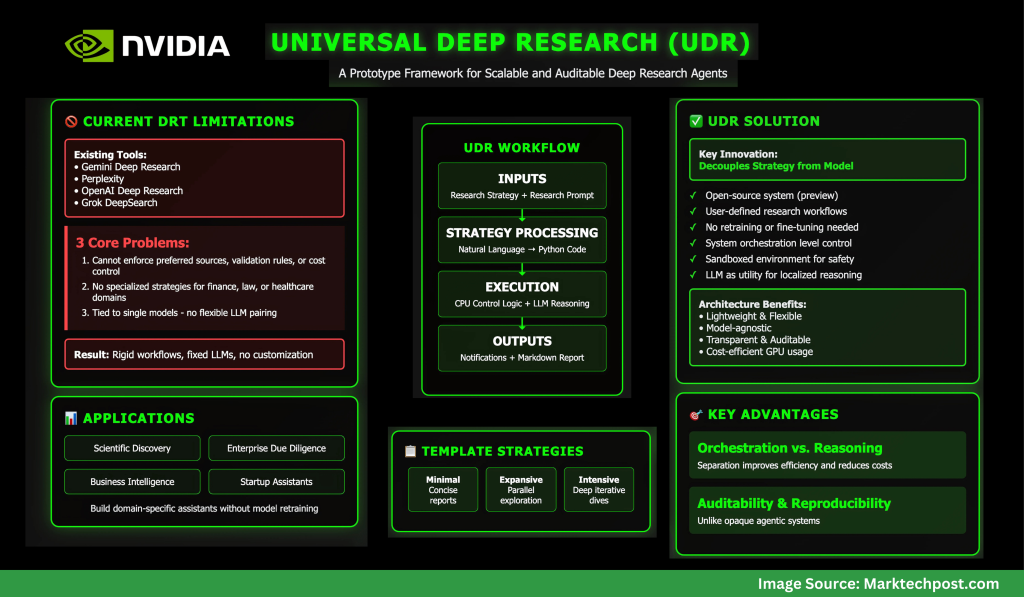
Deep Research Tools (DRTs) like Gemini Deep Research, Perplexity, OpenAI’s Deep Research, and Grok DeepSearch rely on rigid workflows bound to a fixed LLM. While effective, they impose strict limitations: users cannot define custom strategies, swap models, or enforce domain-specific protocols.

NVIDIA’s analysis identifies three core problems:

YOU MAY ALSO LIKE

Google Gemini Also Escaped Its Testing Environment And Hacked Three Companies

What Is AI Agent Memory? Short-Term, Long-Term, Episodic, and Semantic Memory Explained – Unite.AI

  • Users cannot enforce preferred sources, validation rules, or cost control.
  • Specialized research strategies for domains such as finance, law, or healthcare are unsupported.
  • DRTs are tied to single models, preventing flexible pairing of the best LLM with the best strategy.

These issues restrict adoption in high-value enterprise and scientific applications.
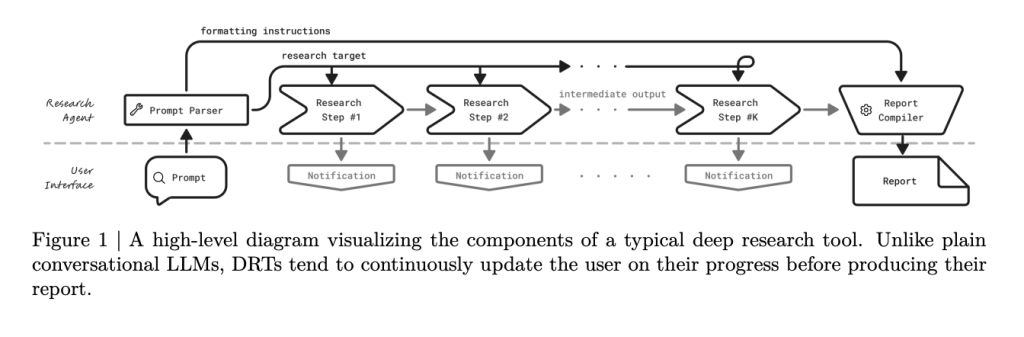
https://arxiv.org/pdf/2509.00244

What is Universal Deep Research (UDR)?

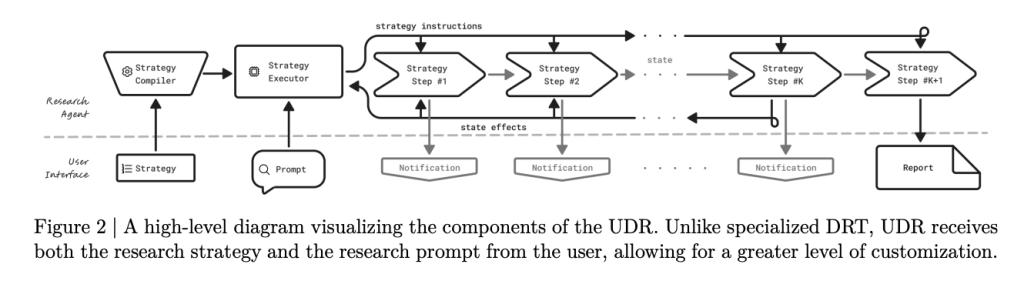
Universal Deep Research (UDR) is an open-source system (in preview) that decouples strategy from model. It allows users to design, edit, and run their own deep research workflows without retraining or fine-tuning any LLM.

Unlike existing tools, UDR works at the system orchestration level:

  • It converts user-defined research strategies into executable code.
  • It runs workflows in a sandboxed environment for safety.
  • It treats the LLM as a utility for localized reasoning (summarization, ranking, extraction) instead of giving it full control.

This architecture makes UDR lightweight, flexible, and model-agnostic.
https://arxiv.org/pdf/2509.00244

How does UDR process and execute research strategies?

UDR takes two inputs: the research strategy (step-by-step workflow) and the research prompt (topic and output requirements).

  1. Strategy Processing
    • Natural language strategies are compiled into Python code with enforced structure.
    • Variables store intermediate results, avoiding context-window overflow.
    • All functions are deterministic and transparent.
  2. Strategy Execution
    • Control logic runs on CPU; only reasoning tasks call the LLM.
    • Notifications are emitted via yield statements, keeping users updated in real time.
    • Reports are assembled from stored variable states, ensuring traceability.

This separation of orchestration vs. reasoning improves efficiency and reduces GPU cost.

What example strategies are available?

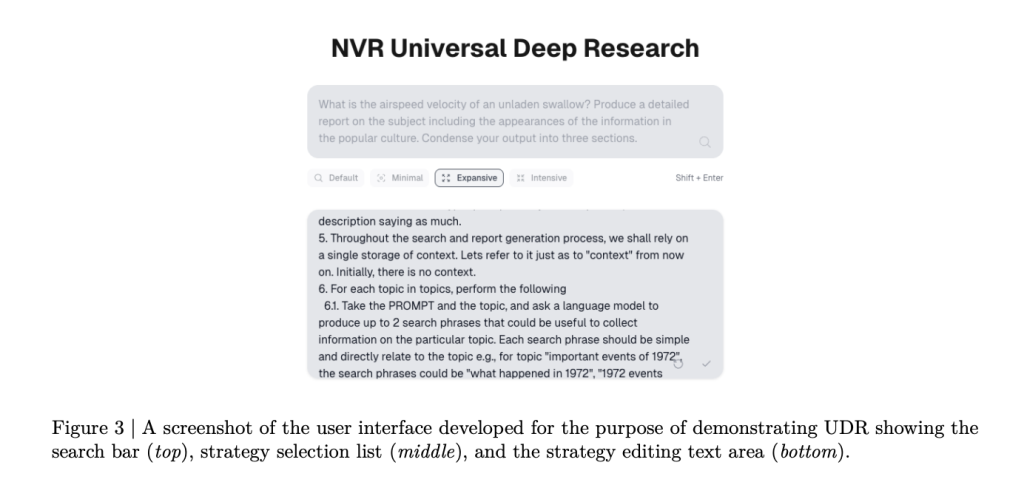
NVIDIA ships UDR with three template strategies:

  • Minimal – Generate a few search queries, gather results, and compile a concise report.
  • Expansive – Explore multiple topics in parallel for broader coverage.
  • Intensive – Iteratively refine queries using evolving subcontexts, ideal for deep dives.

These serve as starting points, but the framework allows users to encode entirely custom workflows.
https://arxiv.org/pdf/2509.00244

What outputs does UDR generate?

UDR produces two key outputs:

  • Structured Notifications – Progress updates (with type, timestamp, and description) for transparency.
  • Final Report – A Markdown-formatted research document, complete with sections, tables, and references.

This design gives users both auditability and reproducibility, unlike opaque agentic systems.

Where can UDR be applied?

UDR’s general-purpose design makes it adaptable across domains:

  • Scientific discovery: structured literature reviews.
  • Enterprise due diligence: validation against filings and datasets.
  • Business intelligence: market analysis pipelines.
  • Startups: custom assistants built without retraining LLMs.

By separating model choice from research logic, UDR supports innovation in both dimensions.

Summary

Universal Deep Research signals a shift from model-centric to system-centric AI agents. By giving users direct control over workflows, NVIDIA enables customizable, efficient, and auditable research systems.

For startups and enterprises, UDR provides a foundation for building domain-specific assistants without the cost of model retraining—opening new opportunities for innovation across industries.


Check out the PAPER, PROJECT and CODE. Feel free to check out our GitHub Page for Tutorials, Codes and Notebooks. Also, feel free to follow us on Twitter and don’t forget to join our 100k+ ML SubReddit and Subscribe to our Newsletter.


Asif Razzaq is the CEO of Marktechpost Media Inc.. As a visionary entrepreneur and engineer, Asif is committed to harnessing the potential of Artificial Intelligence for social good. His most recent endeavor is the launch of an Artificial Intelligence Media Platform, Marktechpost, which stands out for its in-depth coverage of machine learning and deep learning news that is both technically sound and easily understandable by a wide audience. The platform boasts of over 2 million monthly views, illustrating its popularity among audiences.

Credit: Source link

ShareTweetSendSharePin

Related Posts

Google Gemini Also Escaped Its Testing Environment And Hacked Three Companies
AI & Technology

Google Gemini Also Escaped Its Testing Environment And Hacked Three Companies

September 19, 2026
What Is AI Agent Memory? Short-Term, Long-Term, Episodic, and Semantic Memory Explained – Unite.AI
AI & Technology

What Is AI Agent Memory? Short-Term, Long-Term, Episodic, and Semantic Memory Explained – Unite.AI

September 19, 2026
Linkup Research Releases SPARSEUP: A 149M-Parameter Open-Source Sparse Embedding Model
AI & Technology

Linkup Research Releases SPARSEUP: A 149M-Parameter Open-Source Sparse Embedding Model

September 19, 2026
GGUF vs GPTQ vs AWQ vs EXL2: LLM Model Formats Explained (2026)
AI & Technology

GGUF vs GPTQ vs AWQ vs EXL2: LLM Model Formats Explained (2026)

September 19, 2026
Next Post
Apple is slowly morphing AirPods into an always-on wearable

Apple is slowly morphing AirPods into an always-on wearable

Leave a Reply Cancel reply

Your email address will not be published. Required fields are marked *

Search

No Result
View All Result
Mark Sanchez to plead guilty

Mark Sanchez to plead guilty

September 18, 2026
Iran says U.S. struck home where wedding was being held

Iran says U.S. struck home where wedding was being held

September 19, 2026
Trump agrees to new bipartisan ethics provision in massive crypto bill, GOP aide says – AP News

Trump agrees to new bipartisan ethics provision in massive crypto bill, GOP aide says – AP News

September 14, 2026

About

Learn more

Our Services

Legal

Privacy Policy

Terms of Use

Bloggers

Learn more

Article Links

Contact

Advertise

Ask us anything

©2020- TradePoint.io - All rights reserved!

Tradepoint.io, being just a publishing and technology platform, is not a registered broker-dealer or investment adviser. So we do not provide investment advice. Rather, brokerage services are provided to clients of Tradepoint.io by independent SEC-registered broker-dealers and members of FINRA/SIPC. Every form of investing carries some risk and past performance is not a guarantee of future results. “Tradepoint.io“, “Instant Investing” and “My Trading Tools” are registered trademarks of Apperbuild, LLC.

This website is operated by Apperbuild, LLC. We have no link to any brokerage firm and we do not provide investment advice. Every information and resource we provide is solely for the education of our readers. © 2020 Apperbuild, LLC. All rights reserved.

No Result
View All Result
  • Main
  • AI & Technology
  • Stock Charts
  • Market & News
  • Business
  • Finance Tips
  • Trade Tube
  • Blog
  • Shop

© 2023 - TradePoint.io - All Rights Reserved!