

Gary Yeowell
One week after the release of Q2 2024, Northrim BanCorp’s (NASDAQ:NRIM) price per share has plummeted 6.50% even though its results have been quite good. NIM continues to rise, the cost of deposits is surprisingly low, and shareholder remuneration remains one of the strengths. Probably, the motivation behind this negative performance stems not from the quarterly report itself, but from the uncertainty of where interest rates will be in the future. The Fed has decided to keep them high despite waning macroeconomic data, and this increases the chances of hard landing. Since NRIM is a bank, and therefore a cyclical business, it has suffered from a potential macroeconomic deterioration.
Loan portfolio and NPLs
Northrim BanCorp’s Q2 2024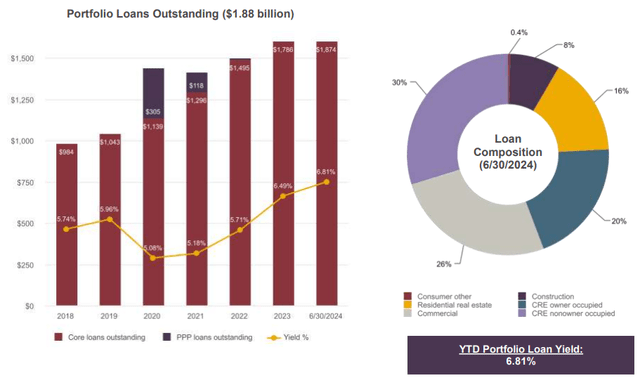
Compared to the end of 2023, the loan portfolio experienced 5% growth and reached $1.87 billion. Its YTD loan yield was 6.31%, so quite high but to be expected. CRE loans made up 50% of the portfolio, Construction Loans 8% and Commercial Loans 26%; Consumer and Residential Loans were only 24%. In other words, the composition of its portfolio remains rather unbalanced toward riskier loans mainly related to commercial/entrepreneurial activities.
In a way this is quite understandable given NRIM was created to do just that, finance local businesses and stimulate economic growth. For the uninitiated, this bank operates in Alaska, an extremely complex market limited by natural barriers. Just think that as many as 6 branches can be reached only by plane or boat.
There is not much competition in this area, and NRIM has the ability to choose carefully who it lends its money to.
Northrim BanCorp’s Q2 2024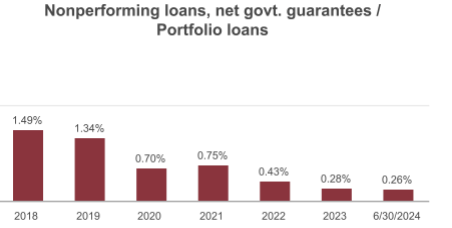
In fact, although the average portfolio yield is quite high, nonperforming loans are still quite low. By the way, they are getting better and better with each passing quarter, which is in contrast to what many regional banks are experiencing at the moment. High rates and labor market deterioration should cause NPLs to rise, but this is not seen in NRIM’s financial statements: this signals excellent credit risk management.
Northrim BanCorp’s Q2 2024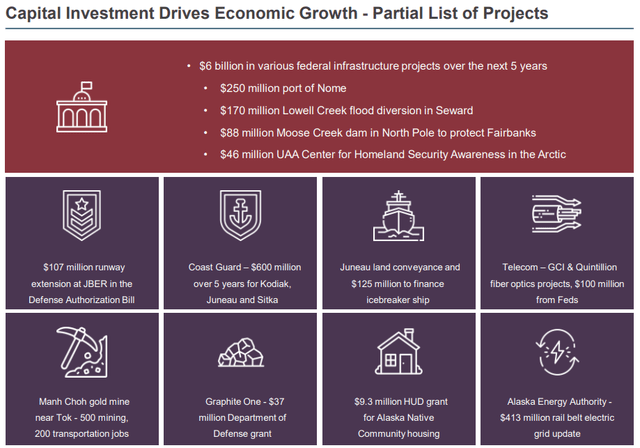
Finally, to fuel economic growth in this geographic area, there will be a series of government investments that could indirectly affect NRIM’s performance. Increased economic activity will likely lead to increased demand for credit, which will benefit NRIM’s coffers.
Deposits and NIM
Northrim BanCorp’s Q2 2024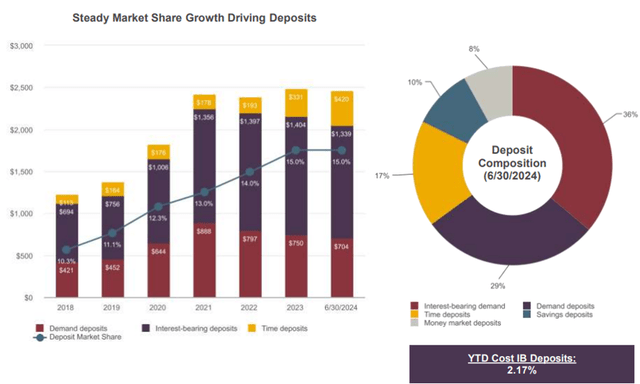
As mentioned, NRIM operates in a rather anomalous context, namely a geographic area where weather conditions have disincentivized competition to enter. Thus, since there is less competition, depositors have less bargaining power and settle for lower interest. Because of this, interest-bearing deposits have an average cost of only 2.17%: this is an outstanding achievement that only a few banks can accomplish. By the way, 29% of deposits are non-interest bearing, so the average cost of deposits is even lower than 2.17%.
In addition, from 2018 onward NRIM has managed to significantly increase its market share in the territory from 10.30% to 15%. In other words, it has done better than its few competitors.
Northrim BanCorp’s Q2 2024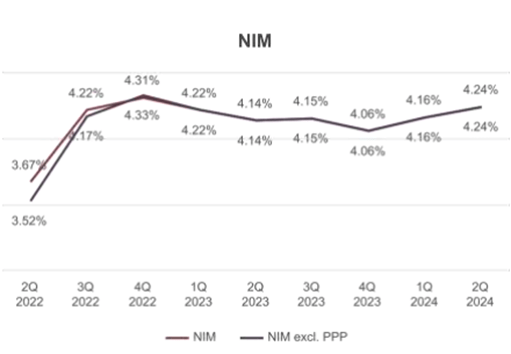
The overall result is an improving NIM for the second quarter in a row and that reached 4.24%. Overall, this is strong progress and by no means a foregone conclusion.
Northrim BanCorp’s Q2 2024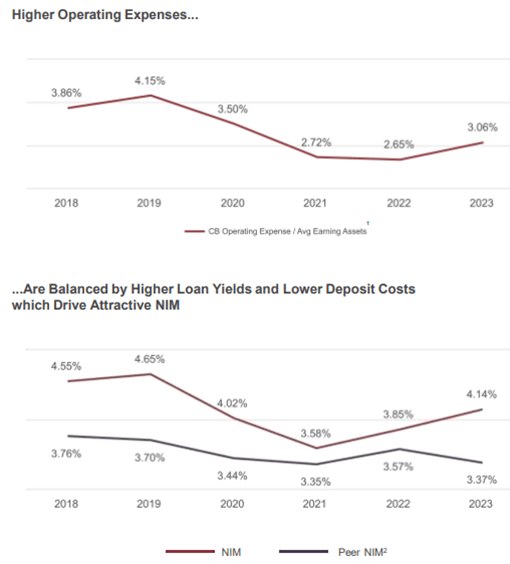
Adverse weather conditions consistently lead NRIM to have higher operating expenses, but its profitability is not lower than peers. On the contrary, the benefits of having a low cost of deposits more than offset the higher operating expenses, and the end result is a higher NIM than peers. Overall, this bank is very interesting mainly because of its unique characteristics.
Shareholders remuneration and valuation
An important aspect that management is focusing on is shareholder remuneration, either through dividends or buybacks.
Seeking Alpha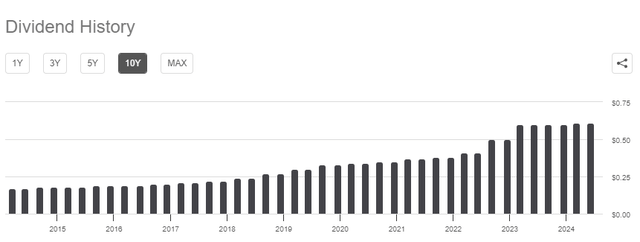
As for the former, NRIM has shown some continuity and has issued a growing dividend for 14 years in a row. In the past two years, growth has declined due to the adverse macroeconomic environment, but it remains significant compared to a few years ago. In fact, the 5-year dividend growth rate is 16.25%, much higher than the industry median of 6.03%. The payout ratio is only 41.94%, so at least in the short to medium term there should be no problem in terms of sustainability.
As for the buyback, about 20% of the outstanding shares have been bought back in the past 5 years, which is surprisingly large for a bank. After all, the buyback reduces equity and negatively affects the CET1 capital ratio, but NRIM is well capitalized nonetheless.
Northrim BanCorp’s Q2 2024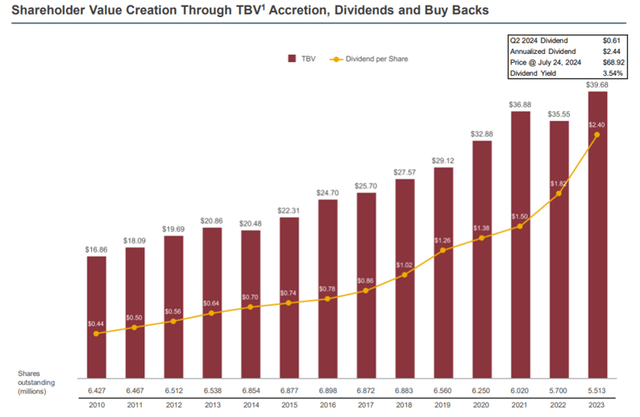
Overall, through this chart you can best appreciate shareholder compensation from 2010 to the present. The performance has been extraordinary, both in terms of growth in TBV per share (despite the buyback) and in terms of dividend per share.
TIKR 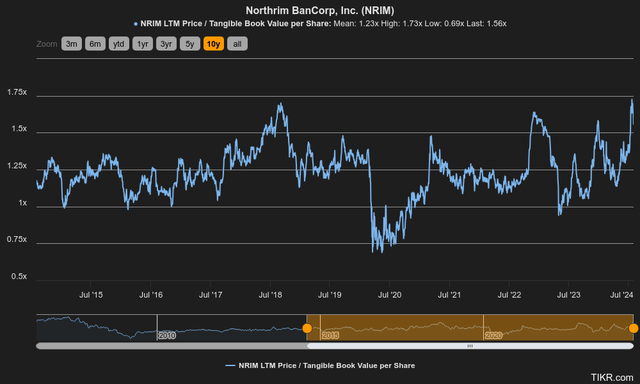
Finally, as far as valuation is concerned, I have a lot of confidence in NRIM’s long-term potential but at the moment I don’t think it is a buy. The Price/TBV per share is 1.56x, which is higher than the 10-year average of 1.23x. Ideally, I prefer to buy a bank when it is at a 10-15% discount to its 10-year average, but the conditions are not there now.
At the same time, given the quality of its business, I cannot consider it a sell: it could return to challenge new all-time highs in the coming weeks.
Conclusion
NRIM is a very interesting bank in my opinion because it has some peculiar characteristics that are uncommon. Its depositors accept a far lower yield than the money market, and this implies a certain competitive advantage. Moreover, from 2018 onward its market share is gradually increasing.
Alaska is not the first place we think of investing our money, but government subsidies to foster its growth are an important driver to fuel economic activity: NRIM could benefit implicitly. By the end of the year, the loan portfolio may reach double-digit growth, all with NPLs continuing to decline.
The only flaw concerns the valuation, still too high to consider it a buy. The Price/TBV per share is above the historical average, which is why my rating remains unchanged from my previous article.
Credit: Source link