jetcityimage
Introduction
Norfolk Southern (NYSE:NSC) just reported earnings and given the many concerns hovering right now over this Class 1 railroad due to the east Ohio derailment and the related charges (so far over $1.1 billion), I want to go over the release and see if the company still deserves its buy rating.
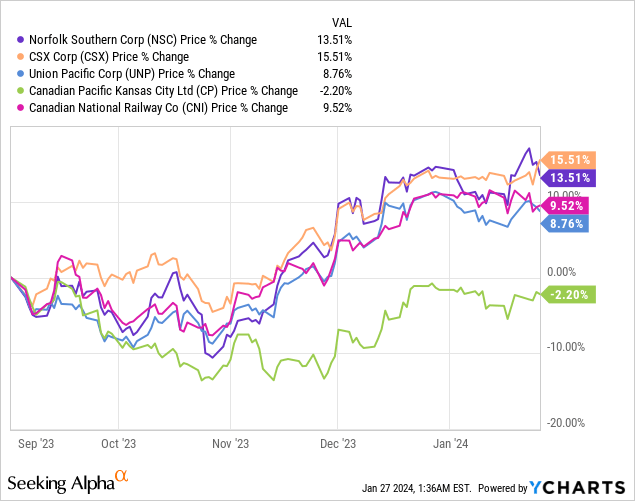
At the end of last summer, it was becoming pretty clear that railroads had been punished enough by investors and that rail traffic data was improving once again, thus creating the right environment to bet heavily on the industry as a whole. Moreover, it seemed as if the two Eastern railroads – CSX and Norfolk Southern – were the ones that would offer the best recovery, given the low multiples they were trading at. However, since I believe CSX has a weaker balance sheet, I upgraded my rating from hold to buy only for Norfolk Southern.
Summary of previous coverage
The way I try to look at railroads is grounded in what I have understood by studying and reviewing Warren Buffett’s investment in BNSF back in 2009 to assess the total returns Berkshire (BRK.A, BRK.B) has had so far from this acquisition. In case you have not read these foundational articles, I suggest clicking on the two links right above and taking a look to understand what way I am going. In short, I look at railroads through what I call “Buffett metrics”: earning power (pre-tax earnings/interest expense), operating ratio, fuel efficiency, ROIC, and shareholder distributions.
Last year, I shared some detailed research on each one of the five North American Class 1 railroads to show their operating history in the past decade and assess how they managed their balance sheets and their cash flows. Regarding Norfolk Southern, we came across a double-sided picture. The company – just like its main peer CSX – is exposed to a growing intermodal business, followed by chemicals. However, its exposure to coal was rather important and it has been declining since 2012, even though with the war in Ukraine, demand for coal saw an uptick. All in all, Norfolk’s top line has not grown much since 2012 staying in the $11-$12 billion range. At the same time, the company has been able to grow its cash from operations, and, due to decreasing capex, it boosted its free cash flow. At what expense? The East Ohio incident warns every railroader that inadequate investments in infrastructure maintenance and enhancement can lead to big disasters.
However, Norfolk has been able to reward its shareholders through big distributions that surpassed its yearly FCF. And yet, even though the company has taken LT debt to fund share repurchases, its total debt/net income ratio has slowly decreased from 5.11 to 4.6, meaning the company has been able to deleverage its balance sheet a bit.
Although the company has shown some issues with how its operations and its financials were managed, last year the stock traded below $200, which brought the stock into value territory and left investors with a rather big margin of safety. Sentiment was also particularly down both because of the east Ohio incident and slowing rail traffic. As a result, it was clear that Norfolk was becoming a good pick among railroads. Therefore, I upgraded it to a buy. Since then, the stock is up 20% while SPY is up a bit less than 10%.
Q4 and FY23 Earnings
Norfolk reported earnings and investors were unimpressed, with the stock trading down a couple of percentage points.
Let’s look at the main financial metrics the company reported to see why that was.
- Railway operating revenues of $3.1 billion, down $164 million,(-5% YoY)
- Income from railway operations was $808 million. The Eastern Ohio incident had an impact of $150 million. Overall this is a 32% decline YoY. Without the incident, we would have still been before a -19%.
- EPS was $2.32, a decline of 32% YoY. If we adjust them for the incident, EPS would have been $2.83, down 17% YoY.
We can also look at the other main metrics and we see a deteriorated operating ratio which went up to 68.8% when adjusted. This is way too high, considering railroads want to target a ratio below 60%.
NSC Q4 Earnings Presentation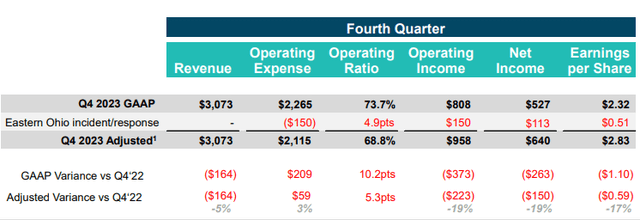
For those who have followed Norfolk quarter after quarter, it will be rather easy to know that, if Q4 was poor, then the whole fiscal year won’t be any better given the past earnings.
In fact, the 2023 summary reports a 5% decline in revenues to $12.2 billion. Railway opex increased 17% YoY to $9.3 billion, including a $1.1 billion charge for the Ohio incident. Net income came in at $2.9 billion, down 41% YoY and down 18% if adjusted. Diluted earnings per share were $8.02 inclusive of the $1.1 billion charge associated with the Eastern Ohio Incident, down 42% compared with 2022. Adjusting for the Eastern Ohio Incident, diluted earnings per share were $11.74, down 15%.
In particular, revenue headwinds persisted mainly due to intermodal being down 13% YoY during the quarter despite volume growth of 5%. On the other hand, merchandise seems to be holding up well.
NSC Q4 Earnings Presentation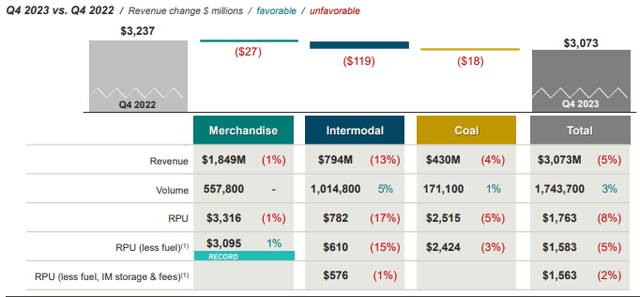
In particular, while volumes increased by 3%, what matters most is that at the end of this fiscal year, the revenue per unit (RPU) declined by 3% YoY to $1,802. If we subtract fuel, the RPU was $1,621 a decline of 1% YoY. This means revenue from fuel surcharge was lower compared to 2022.
As a result of these headwinds all summed up together, not only the quarter but the full-year operating ratio went up 510 bps from an already poor 62.3% to 67.4%. Surely, investors expect more than this.
NSC Q4 Earnings Presentation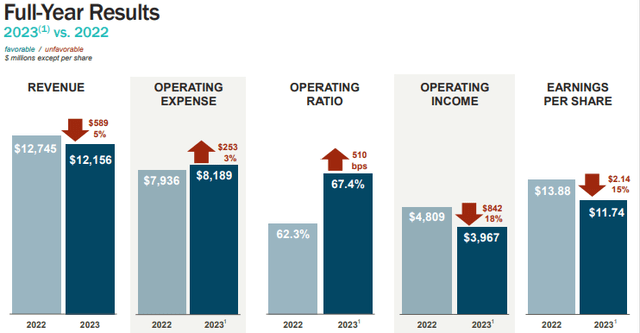
Given declining results from the company’s operations, free cash flow was impacted too and declined by $1.44 billion to $830 million. Shareholders didn’t see their dividends cut, but the boost to the stock provided by the several billion Norfolk annually spent to buyback shares came almost to an end as share repurchases decreased from $3.1 billion in 2022 to only $622 million in 2023.
NSC Q4 Earnings Presentation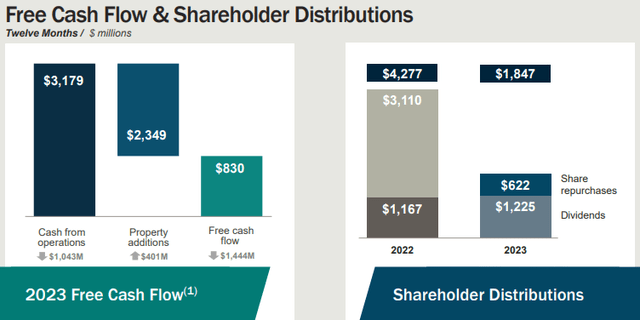
The company’s management could not hide and had to face the harsh reality during the earnings call, admitting the company underdelivered compared to its guidance:
We started the year planning for modest top-line growth that would afford a level of expense growth to help drive our strategic track toward resiliency. The disruptive events of the year and an adverse macro environment upended this. Revenue declined 5%, which was meaningfully affected by about 6 points of pressure from lower fuel surcharge revenue and a sharp year-over-year decline in storage fees. At the same time, OpEx rose 5%, fueled by inflation and investments in our business. As a result, operating income fell 18%, with the operating ratio rising to 67.4%. Favorable below-the-line items and benefits from share repurchases held the EPS decline to 15%.
As analysts asked several questions regarding this underperformance, Norfolk’s management finally had to give in and state that
This entire team recognizes that a margin gap exists today between where we are and where we should be, and we’re focused intently on closing and narrowing that gap before we get to an area of talking about why any remaining gap exists. There’s a lot of runway still for us organically and self-help.
So, the takeaway from this report is that Norfolk needs to work hard to offset the impact of the Ohio incident while closing the margin and operating ratio gap that separates it from its peers. It won’t be an easy task, nor a quick one. As some analysts pointed out, the “close-the-gap mantra” dates back to 2015.
Now, going to our Buffett metrics, let’s see if the overall picture changes a bit.
Norfolk’s earning power has plundered and it now is only 3.2, the worst I have ever seen since I researched railroads. Pre-tax earnings went down from $4.1 billion at the end of 2022 to $2.3 billion at the end of 2023. In the meantime, interest expense increased from $692 million to $722 million. As a result, we have a very low ratio, which I am uncomfortable with. This doesn’t mean Norfolk won’t be able to meet its obligations and its interest expense, but that its earning power is low and thus its pre-tax earnings will be significantly reduced by interest expense.
We have already seen the deterioration of the operating ratio. We can thus look at another proxy for operating efficiency: fuel consumption. Fuel efficiency was flat YoY to 1.12 gallons per kGTM.
If we calculate the company’s ROIC for the year, it is no wonder – given what we have seen – that the result is rather disappointing: 7.67%. To have a return such as this means the company is actually close to not creating any value, considering the current cost of capital. I want to see a ROIC at least above 13%.
Shareholders should also not expect the company to resume its share repurchase program soon. I am sure the company will pay and increase its dividend, but its balance sheet right now doesn’t have the room to take on more debt and fund share repurchases. Therefore, the stock will move only based on real earnings, with no support from a reduction of the share count.
In the discounted cash flow model I shared in my previous articles, I came to a fair price for the stock of $250. Norfolk did trade up almost to that price before earnings, to then pull back a bit to $234. Overall, this last report has not given me any reason to upgrade my expectations or expand the multiple I value the company with. A 19.6 as a fwd PE and a fwd EV/EBITDA of 12.2, combined with a fwd P/FCF of 13 are correct multiples for a company whose assets are incredibly valuable, but whose operations fail to deliver accordingly. Moreover, there is uncertainty about the ability of the company to actually deliver strong revenue growth in 2024 even though it should meet easy comparables. Therefore, I downgrade Norfolk from a buy to a hold, considering the stock reasonably valued without an obvious margin of safety at the current price.
Credit: Source link