
Sign up for CNN’s Wonder Theory science newsletter. Explore the universe with news on fascinating discoveries, scientific advancements and more.
CNN
—
A revolutionary new satellite that will provide an unprecedented look at Earth’s microscopic marine life and tiny atmospheric particles has launched.
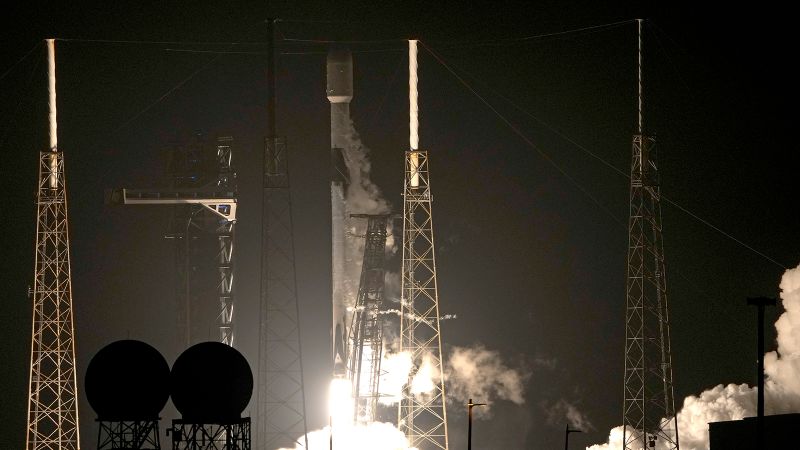
The NASA PACE, or Plankton, Aerosol, Cloud, and ocean Ecosystem, mission lifted off at 1:33 a.m. ET Thursday aboard a SpaceX Falcon 9 rocket from Cape Canaveral Space Force Station in Florida. The rocket’s booster successfully landed back on Earth about 10 minutes after launch. Just over half an hour after liftoff, the team confirmed that the spacecraft’s solar arrays deployed and it was receiving power.
The launch, initially set for Tuesday morning, was delayed twice due to high winds and cumulus clouds. But the weather conditions were more than 95% favorable for launch Thursday morning.
Scientists began envisioning a way to better understand how oceanic and atmospheric processes shape the planet about 20 years ago, said Jeremy Werdell, PACE project scientist.
John Raoux/AP
A SpaceX Falcon 9 rocket carrying NASA’s PACE mission lifted off from Space Launch Complex 40 at the Cape Canaveral Air Force Station on Thursday.
The mission will shed light on how aerosols and clouds as well as phytoplankton in the ocean serve as indicators for ocean health and global warming. The three instruments aboard PACE, including two polarimeters and one camera, will capture a rainbow of data across different wavelengths of light that “allows us to see things we’ve never been able to see before,” said Karen St. Germain, director of NASA’s Earth Science Division.
“What we’re doing here with PACE is really the search for the microscopic, mostly invisible universe in the sea and the sky, and in some degrees, on land, too,” Werdell said.
Although designed as a three-year mission, PACE has enough fuel to continue orbiting and studying Earth for up to 10 years. The spacecraft will join a fleet of more than two dozen NASA Earth science missions circling our planet that gather data on oceans, land, ice and the atmosphere to provide more insights into how Earth’s climate is changing.
Together, missions like PACE and the international Surface Water and Ocean Topography mission, known as SWOT, that launched in 2022 could also change the way researchers understand Earth’s oceans.
“We are undeniably in the midst of a climate crisis,” said NASA Deputy Administrator Pam Melroy. “Our planet is undergoing transformative changes from the surge in extreme weather events and devastating wildfires to the rising sea levels. NASA is not just a space and aeronautics agency. We are a climate agency. We leverage the unique vantage point of space to study our home as a holistic planet, collecting vital earth science data. This information is then available to people worldwide, empowering them to make informed decisions on how to safeguard our planet and its inhabitants for generations to come.”
In January, NASA and other agencies announced that 2023 was the hottest year on record, part of an overall trend in which global temperatures have warmed over the past decade, said Kate Calvin, chief scientist and senior climate advisor at NASA.
The warming is largely driven by greenhouse gases like carbon dioxide. After being released, carbon dioxide is absorbed by land and the oceans, but some of it remains in the atmosphere and traps greenhouse gases that warm up the planet.
“One of the great things about a mission like PACE is it’s going to give us a better understanding of the exchange of carbon between the ocean and the atmosphere,” Calvin said.
But other factors contribute to warming, including aerosol particles in the atmosphere that are collectively made of pollutants, dust, smoke and sea salt. Aerosols can reflect or absorb sunlight and affect cloud formation, Calvin said.
Aerosols play a tremendous role in Earth’s weather, air quality and climate, St. Germain said.
“They come from sources like dust blowing off the Sahara wildfires and even human activities,” St. Germain said. “They seed clouds that can grow into hurricanes coming across the Atlantic, but they also reflect a lot of the sun’s energy. So, they to play an important role in the long-term stability of Earth’s climate.”
Aerosols can contribute to bad air quality that drives chronic conditions like asthma, and understanding the composition of aerosols and their location in the atmosphere can help determine hotspots for polluted air and provide better warnings, said Andy Sayer, PACE atmospheric scientist.
The two polarimeter instruments on PACE will help scientists study the particle size, composition and amount of aerosols in Earth’s atmosphere across an array of wavelengths to provide a detailed portrait of the most problematic areas.
About 70% of Earth’s surface is covered by oceans, and these massive bodies of water typically present more questions than answers — but scientists hope PACE can help change that.
“In many ways, we know more about the surface of the moon than we do about our own oceans,” St. Germain said. “PACE will be the most advanced mission we’ve ever launched to study ocean biology. It’s going to teach us about the oceans in the same way that Webb is teaching us about the cosmos.”
From orbit, PACE will search for the light reflected from tiny organisms called phytoplankton to see where they thrive floating on the surface of Earth’s oceans. The mission carries the Ocean Color Instrument. It will use more than 100 different wavelengths of light to study phytoplankton on a global scale and identify different species, including some that pose a threat to other life-forms, from space for the first time.
Norman Kuring/NASA’s Ocean Color Web/Landsat data from the US Geological Survey
The waters off of the Alaskan coast usually come alive each year with striking blooms of phytoplankton that cause blue and green seawater patterns, such as those observed by the Landsat 8 satellite in June 2018.
Phytoplankton exist at the base of the marine food web. Without the tiny organisms, that web would collapse, and a lack of global fisheries could be devastating for humans, according to NASA.
These microalgae use photosynthesis to absorb carbon dioxide and sunlight, generating oxygen and carbohydrates that nourish all types of marine life. Phytoplankton began photosynthesizing more than 3 billion years ago, long before trees and plants did, and have contributed about 50% of all the oxygen ever produced on Earth, according to NASA.
While phytoplankton play a major role in drawing carbon dioxide from Earth’s atmosphere, some species can be harmful, too. Algal blooms can be critical to marine food webs like those in polar regions, but some blooms produce dangerous toxins that can spoil drinking water and disrupt entire ecosystems. The observations from PACE can help scientists understand which species cause the toxic blooms, track and monitor them over time, and determine how to prevent them going forward.
“I like to say that PACE is a mission that will use that unique vantage point of space to study the smallest things that have the biggest impact in the oceans,” St. Germain said.
Credit: Source link