
mesh cube
Investment thesis
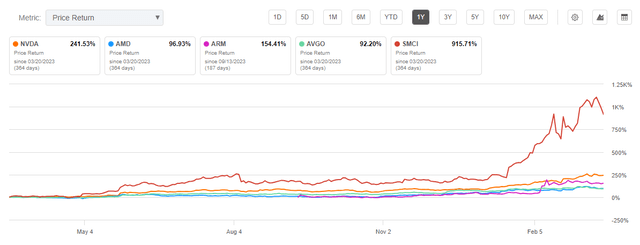
About a year ago, NVIDIA’s (NVDA) CEO, Jensen Huang called the emergence of ChatGPT “the iPhone moment” for the whole AI industry. If we look at NVIDIA’s and other major semiconductor players’ share price dynamic over the last twelve months, it is apparent that Mr. Huang was 100% right.
Seeking Alpha
While I am still bullish on most of these semiconductor names, many other investors are very cautious about investing in stocks which grew multiple fold within just one year. Moreover, semiconductor stocks are highly cyclical, which adds more negatives to investing in them at these levels. Therefore, today I want to focus on the best AI picks outside of the semiconductor industry.
AI industry overview
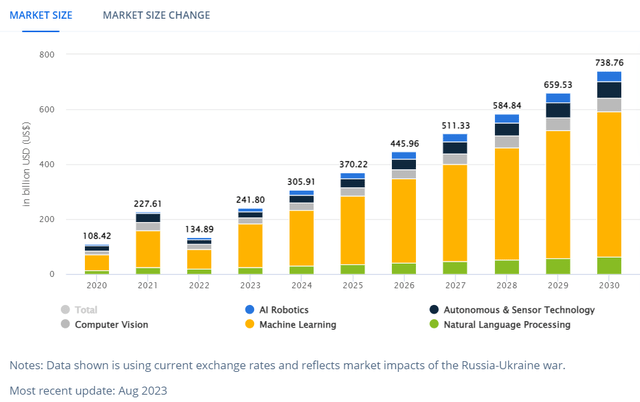
I have recently found an interesting page on the web, where Statista shares numerous compelling projections related to the AI industry. As an investor, the most I am interested in is the potential for the market to grow and the projected long-term CAGR. In August 2023 Statista valued the total global artificial intelligence market size at around $241 billion in 2023 with the expectation to reach $739 billion by 2030. This indicates around 16% CAGR.
Statista
Someone might say that August 2023 projections might be outdated considering the pace of the AI revolution, but what is important in the above chart is that it also discloses the composition of the AI industry, where machine learning [ML] is by far the largest segment. Moreover, Statista expects ML to outpace the broader AI industry, with a projected 17% CAGR.
The strength of ML looks sound given the extensive practical application of it. Generative AI, which is the brightest representative of the ML domain, can potentially add trillions to the global economy, according to McKinsey. What is also important is that generative AI is likely to have impact across all industries, which highly likely means that this industry will be resilient to macroeconomic cycles.
My criteria for selecting top-5 AI Stocks
Considering the above AI industry breakdown and projected growth, I want to narrow down my thesis today to the most promising machine learning and generative AI players. Today I am focusing on large players worth trillions or hundreds of billions in market cap because the major portion of investors are either risk averse or risk neutral. And the smaller the company, the greater the uncertainty and higher risks for investors.
I am also targeting companies that are already leaders with extensive ecosystems, since I believe that it is one of the major factors that ensure a wide moat for companies. Finally, I target companies with extensive profitability and clean balance sheets. To strengthen their strategic positions as generative AI/ML leaders, these companies should continue to invest substantial amounts in innovation. Strong cash flows together with a fortress-like financial position, are the golden bullets in the unfolding AI battle.
Seeking Alpha
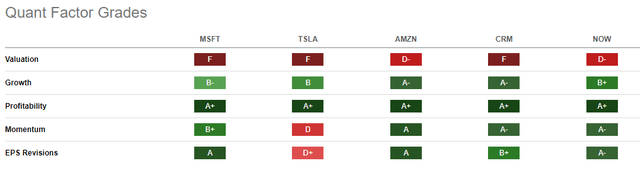
In the above screenshot you can see that the top-5 selected by me all have the highest possible Profitability grade from Seeking Alpha Quant, meaning that margins generated by these businesses are unmatched by rivals. Below I will describe each of the stocks in more detail to provide readers with all strengths these companies are demonstrating.
All stocks are generously valued from the valuation ratios perspective, which we can see above from the low “D-” or even “F” factor grades from Seeking Alpha’s Quant. However, in my analysis I will demonstrate that from the discounted cash flow [DCF] perspective all these stocks are currently reasonably valued.
Stock #1: Microsoft (MSFT)
My by far number one selection in my top-5 AI stocks is Microsoft. The company is at the forefront of the AI revolution thanks to its visionary leadership which recognized massive ML potential five years ago when the company invested $1 billion in OpenAI.
MSFT’s positioning in AI
The strategic partnership with ChatGPT’s owner unlocks vast technological advantages for MSFT. For example, the company introduced massive improvements to its Bing search engine, which is now powered by key learnings and advancements from ChatGPT. About a year passed since the new Bing was introduced and some say that it managed to gain only a tiny portion of the search market share over the year, but I think that achieving an additional 1.5% market share at the expense of a monopolist like Google is a big step to disrupting the entire industry. For example, the process when smartphones “killed” Nokia’s dominance in the mobile handsets industry also was not overnight and Nokia was dethroned only in 2012, which is relatively far from the iPhone or Samsung Galaxy first releases.
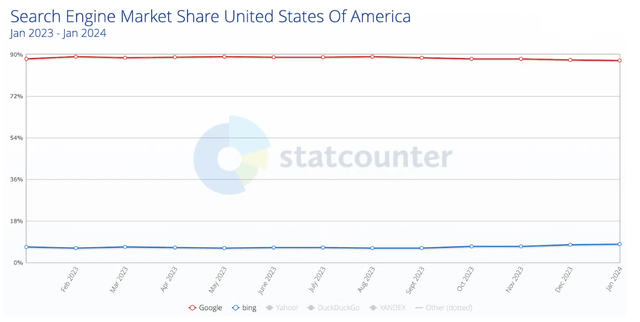
searchengineland.com
Moreover, last year Microsoft said that the company adds $2 billion in revenue for every one percentage point of search engine market share added. Therefore, I believe that Bing has the potential to disrupt the search engine industry over the next 4-5 years, which will likely change the whole landscape of the $300 billion search advertising industry.
Microsoft’s potential to monetize its strategic partnership with Bing is just the tip of the iceberg. With Microsoft 365’s 45% market share of the office productivity software market, the company has a massive customer base to “land-and-expand” with its AI-powered capabilities. In my life, I have seen many back offices across the world, and it appears to me that tools such as Microsoft Excel or Word are the golden standard for back offices. According to IBM’s CEO, lots of back-office jobs can already be replaced by generative AI and I expect this trend to accelerate as AI capabilities are evolving. In the future, some advanced version of the Microsoft Excel Copilot which might cost $1,000 per month might replace a financial analyst and the $5,000 monthly salary. Therefore, I see massive potential for Microsoft’s AI capabilities in office productivity as well.
I think that Microsoft’s wide moat is also fortified by Azure’s strong position in the cloud industry, with a staggering 24% market share. Having such a massive market share means Microsoft operates vast amounts of data, which can be used to “feed” its ML algorithms which is also crucial to ensure technological advantage of MSFT’s generative AI capabilities.
MSFT Stock Valuation
I simulated the DCF model for MSFT relatively recently, on February 27. I will not repeat the same analysis here because I do not see any changes to my assumptions, and the detailed DCF simulation can be found here.
Today I just want to reiterate my fair value estimate for the business at $3.7 trillion, which indicates around 20% upside potential from current levels.
Stock #2: Tesla (TSLA)
I give the second spot in my top-5 AI picks list to Tesla, even though some people will say that it is not a software company. Indeed, Tesla is a car manufacturer, but modern cars look more like computers with wheels nowadays rather than motorized carriages.
TSLA’s positioning in AI
Tesla bet big on artificial intelligence as its full self-driving [FSD] capability is not far from achieving a cumulative billion miles driven.
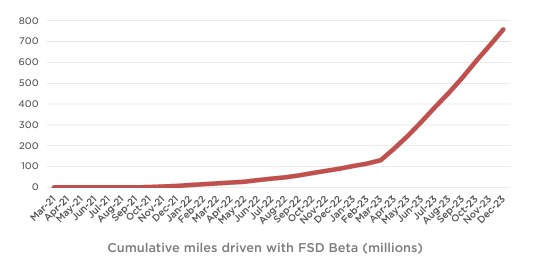
Tesla’s latest earnings presentation
This year Tesla released its 12th version of FSD Beta, which means that quite a lot of iterations and improvements were already made to the technology. I have seen multiple videos on social media where people share their experience with FSD V12 and capabilities of FSD are indeed impressive. I see several ways that Tesla might aggressively monetize its AI capabilities.
The most apparent is selling the technology directly to the Tesla customers, who are buying the company’s vehicles. There are two options already offered to customers, the $12,000 FSD and a lighter $6,000 “Autopilot” version. Since Tesla is already close to selling two million vehicles per year, even if FSD is acquired only by 20% of new buyers and assuming a median $9,000 price between two options, it gives the company an additional $3.6 billion in revenue per year. Given that the major portion of the costs to train the FSD is already recorded, it is highly likely that this additional revenue will contribute to the bottom line almost in full. It is also crucial that this software cannot only be sold to new Tesla buyers but is available to all Tesla cars sold in recent years, which means that in reality the potential customer base for FSD is much larger.

Tesla’s official website
Since I do not see any rivals who are even close to FSD, I think that over time, Tesla might license its FSD technology to other EV makers. Just like almost all automotive companies gave up last year and adopted Tesla’s supercharger standard, it might be the same case for FSD over the long-run. It took years and billions of dollars invested in FSD for Tesla, and I do not think that any other automotive player will be able and willing to embark on the same journey to replicate FSD. That said, there is a big potential opportunity to license its FSD technology to other automotive makers.
TSLA Stock Valuation
Once again, as with Microsoft, I have covered Tesla’s valuation relatively recently, in early February 2024. Not to repeat the same information here I will provide a link to my latest in-depth TSLA analysis and reiterate my fair base-case scenario target price of $224. This represents around 30% upside potential.
Stock #3: Amazon (AMZN)
The third spot goes to the undisputed global cloud infrastructure leader, Amazon. Cloud computing is a cornerstone for the AI revolution and the company invests heavily in fortifying its leadership in cloud.
AMZN’s positioning in AI
Amazon dominates the cloud infrastructure business capturing almost one-third of the global market. As I mentioned in the Microsoft analysis above, cloud leaders possess vast amounts of data which provides wider opportunities to train their ML models.
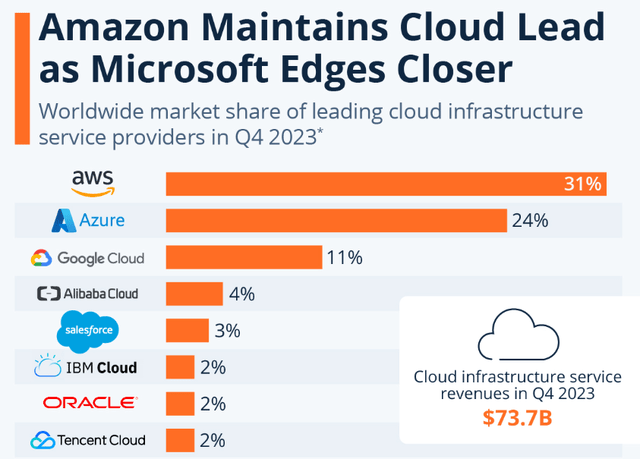
Statista
Apart from its unmatched position in the cloud, let us also not forget that Amazon is by far the world’s largest e-commerce retailer [excluding China], which also contributes to the company’s vast amount of data. Amazon possesses large masses of data related to consumers’ spending patterns, changing preferences, behavioral models across different geographies, genders, ages, etc. This will highly likely help the company to fortify its position as the largest e-commerce retailer and will also help monetize its ML algorithms via digital advertising. Cutting edge e-commerce AI tools also might be monetized from the merchants’ side by charging extra fees for advanced AI tools.
The company also joined the AI chatbots race last year after investing $4 billion in Anthropic. I think that the strategic partnership between Amazon and Anthropic looks promising given potential synergies from Amazon’s massive scale and Anthropic’s laser-focus on developing AI chatbots. A couple of weeks ago the Claude 3 chatbot was introduced by Anthropic, and according to the company the new chatbot is slightly stronger than GPT-4 across several metrics.
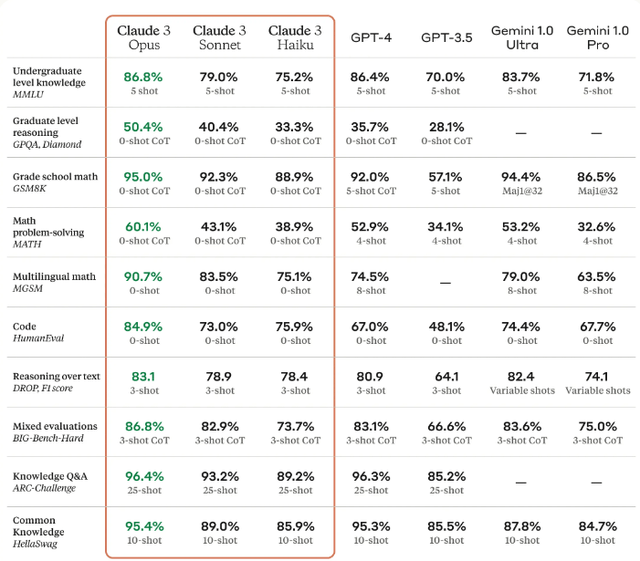
anthropic.com
Based on the number of users, Anthropic’s chatbot is far less widespread than ChatGPT, but the fact that it demonstrates strength from the technological perspective makes its wider adoption just a matter of time, in my opinion.
AMZN Stock Valuation
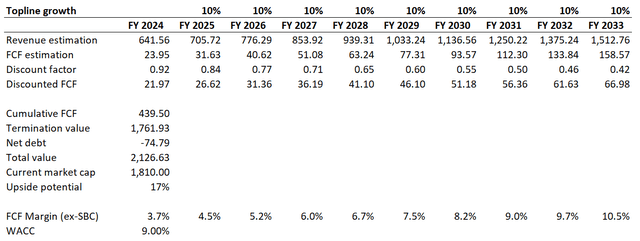
I haven’t covered AMZN in deep details yet this year, so I want to refresh my AMZN DCF model here. I am using the same 9% WACC since my late December thesis already incorporated projected three rate cuts by the Fed in 2024. I am using a $641 billion revenue estimate for the base years, which is a suggestion from Wall Street consensus. I reiterate a 10% long-term revenue CAGR, which is a conservative estimate and aligns with consensus projections. I use a TTM 3.7% FCF ex-SBC margin for my base year and expect a 75 basis points yearly expansion as the topline grows. I also subtract almost $75 billion net debt position from my fair capitalization calculation.
Author’s calculations
My DCF simulation suggests that the business’s fair value is around $2.1 trillion. This represents a 17% upside potential which looks like a very generous discount for the largest e-commerce and cloud players with robust exposure to the AI revolution.
Stock #4: Salesforce (CRM)
Any business in the world aims to drive sales growth since, in a sound business model enabling operating leverage, revenue growth usually means improving profitability. CRM is an undisputed leader in software solutions to manage key revenue sources, specifically customer relationships.
CRM’s positioning in AI
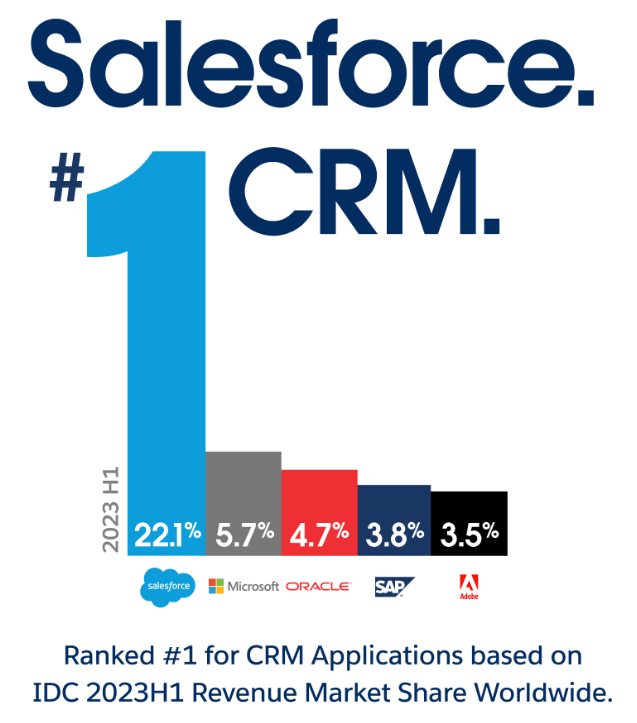
Salesforce is by far leading in its industry of customer relationship management software, leaving the second-placed giant like Microsoft miles behind in terms of the market share.
IDC
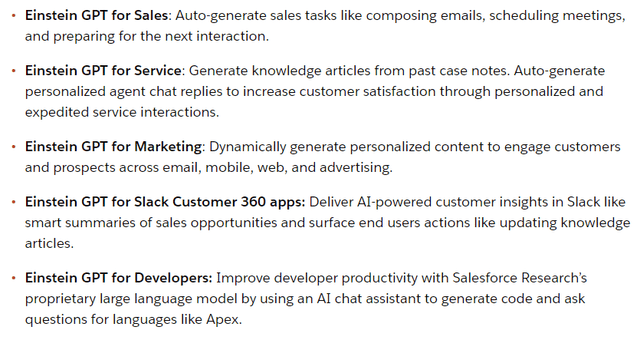
Managing customer relationships in the most efficient and proactive manner is a cornerstone to fuel revenue growth for any business. Therefore, I expect businesses to invest heavily in tools which will help them to improve their sales metrics. And Salesforce is a likely beneficiary of this trend. The company invests heavily in R&D and the management’s visionary talent impresses me. CRM introduced its AI-powered tool Salesforce Einstein more than seven years ago, in September 2016. The current version is called Einstein GPT, which integrates with OpenAI meaning that it is highly likely the most sophisticated solution in its niche. The functionality of Einstein GPT is impressive, and it looks like numerous marketing jobs will likely be disrupted by the AI as well.
Salesforce.com
Given its status as the most technologically advanced provider of customer relationship management solutions, I am highly confident that Salesforce will surpass the growth rate of the overall industry, which is projected to compound at a massive 12.5% CAGR by 2030.
CRM Stock Valuation
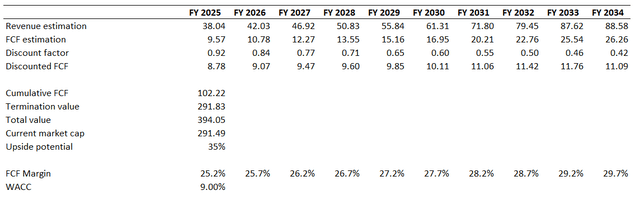
It has been a long time since I covered CRM with the last time being almost a year ago. Therefore, I have to simulate a fresh DCF model today. I am using a 9% WACC which aligns with the range recommended by valueinvesting.io. Consensus revenue estimates for FY 2025-2034 project a 10% CAGR, which looks conservative enough to use considering the growth rate projected for the whole industry [please see previous paragraph]. For the base year I use a TTM 25.2% FCF ex-SBC margin and expect a 50 basis points yearly expansion. I ignore the net cash position for CRM since it is insignificant compared to the company’s scale.
Author’s calculations
According to my DCF template, the business’s fair value is slightly below $400 billion, which means there is a massive 35% upside potential. Such a big discount for the undisputed leader in a thriving industry looks like a gift to me.
Stock #5: ServiceNow (NOW)
While my previous stock pick is represented by the company that leads an AI revolution for services which enable businesses to generate more revenue, ServiceNow is a company that helps boosting efficiency in internal processes of modern businesses. According to Gartner, NOW is a number one provider in the IT service and operations management.
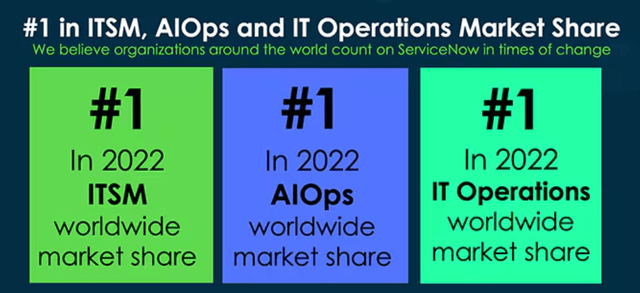
servicenow.com
NOW’s positioning in AI
ServiceNow started as an automated workflow provider for IT companies, but has expanded into risk, HR, asset, and strategic portfolio management in recent years. What is the most important for us as investors seeking exposure to ML is that NOW’s platform leverages advanced AI capabilities.
The company has an ambitious mission “to be the defining enterprise software company of the 21st century” and on the company’s official website there is a presentation where NOW’s path in AI is neatly outlined, meaning that management has clear vision of how to navigate in the AI revolution. As I mentioned before, management’s visionary talent is crucial for technology disruptors. The fact that NOW established an AI innovation hub in Canada and acquired one of the most promising AI startups of that time, Element, far before the ChatGPT mania, in 2020, is a significant indicator of visionary strength.
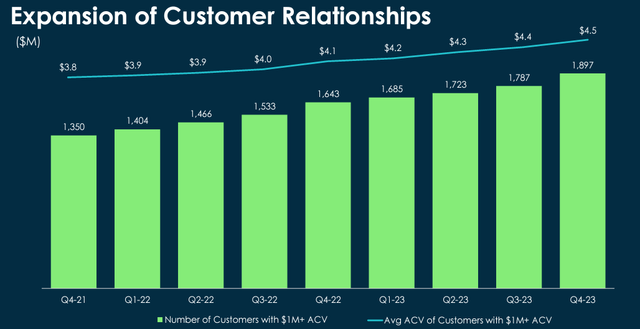
NOW’s latest earnings presentation
I like SaaS companies which have vast potential to upsell and cross-sell, and NOW is apparently one of those companies. With its workflow offerings expanded across multiple business functions, NOW has massive potential to bring down customer acquisition costs and drive profitability expansion. In the above chart we can see how the value per customer has been consistently expanding over multiple quarters, which means that NOW exercised massive cross selling potential.
NOW’s valuation
Last time I covered NOW’s valuation was October 2023, so I have to update my DCF today. By the way, my October 2023 valuation analysis for NOW was even cited by Forbes, which I am very proud of. Given the company’s current $154 billion market cap, I believe that my previous NOW valuation analysis aged well.
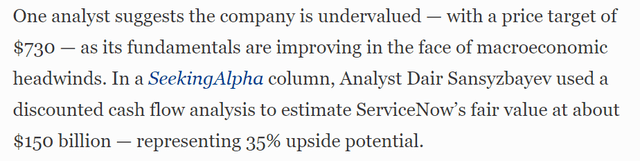
Forbes
I am using the 9.25% WACC for my updated valuation, given the announced three rate cuts by the Fed in 2024. Consensus revenue estimates project a 17% revenue CAGR for NOW, which does not look too optimistic given the company’s ability to drive revenue growth both by increasing the customer base and exercising the cross-selling potential. Therefore, I am using revenue consensus estimates for my DCF simulation. For my base year I use a TTM 18% FCF ex-SBC margin and expect a 125 basis points yearly expansion with the metric peaking at slightly below 30% in FY 2033. I also adjust my fair value calculation by the notable $5.8 billion net cash position on the face of the company’s balance sheet as of the latest reporting date.
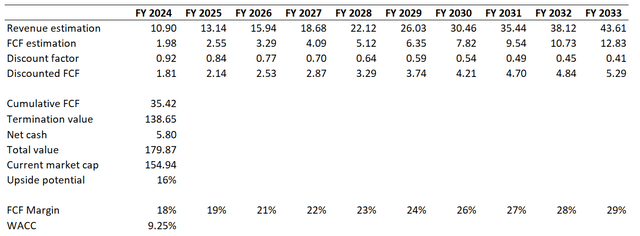
Author’s calculations
As shown above, the business’s fair value under new assumptions increases to almost $180 billion. This means that the stock is currently around 16% undervalued, which looks like a compelling investment opportunity.
Are AI stocks in a bubble?
Investing in stocks is inherently risky and in this article I am not describing each company’s specific risks because every author here on Seeking Alpha details company-specific for each ticker in their articles. What I want to focus on is the overarching general risks/issues for all the aforementioned companies: whether we are currently in an AI bubble or not?
Indeed, when stocks like NVDA grow by 3.3 times in terms of share price within just 12 months, it looks like a bubble mostly driven by FOMO investors. However, the fact that NVDA’s free cash flow increased by more than three times between FY 2022 and FY 2024 is a clear indication that the lion’s portion of the big rally was driven by fundamental reasons.
Seeking Alpha
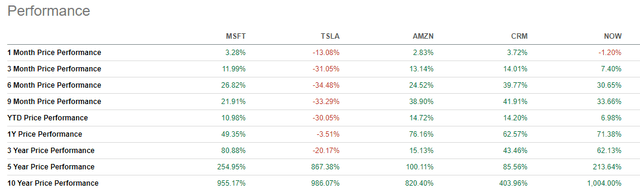
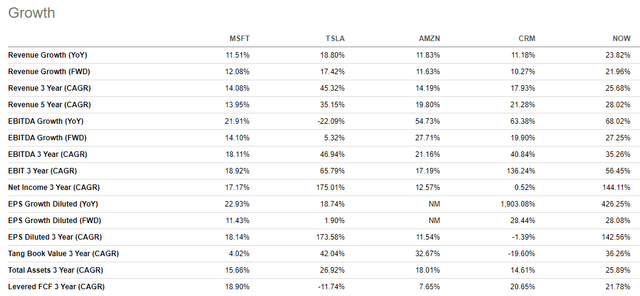
My top-five AI picks also rallied by an impressive margin over the last twelve months, as can be seen above. I am leaving Tesla outside of brackets here since it has suffered from overall weak sentiment around the EV industry due to cyclical reasons, which I describe in more detail in my in-depth TSLA analysis as of February 2024. But rallies of the remaining four names aligns with the YoY and forward EBITDA expansion record, meaning that the growth in their market cap was fueled by fundamental reasons.
Seeking Alpha
I agree that numerous smaller names might be substantially overvalued due to the AI-driven rally of 2023, but it is the largest players that set the tone in the stock market. Since it looks like valuations of the largest players are moving in line with their financial performance and growth estimates, the current situation does not look like a bubble to me.
On the other hand, growth is never linear on longer timeframes. While I do not expect a dot-com bubble burst style carnage in the stock market in 2024, it does not mean that companies will never miss on quarterly earnings estimates or adjust their guidance to a softer stance. The macro environment is ever evolving and some of the swings might pose short-term challenges even to the most successful and profitable companies. Therefore, to mitigate risks of short-term volatility, I recommend potential investors to diversify between all the five names and dollar cost average on a regular basis.
Bottom line: My Top-5 AI Stocks to Buy Now
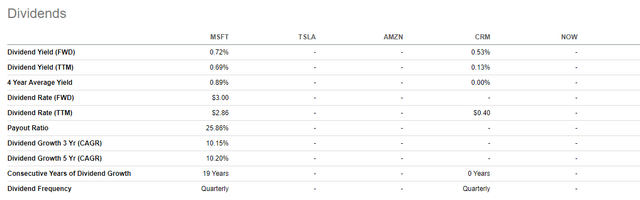
Investing in top semiconductor names after stock prices increased by multiple factors over just several months is risky and the risk of correction increases with every new historical high achieved by NVDA or other prominent semiconductor stocks. On the contrary, the valuation of my top five stocks located at the forefront of ML and generative AI look very attractive. All these stocks generate unmatched profitability and possess ample financial resources to continue investing heavily in fortifying their technological advantages. Moreover, two of them, MSFT and CRM, are AI stocks with dividends. The yields are low at the moment, but Microsoft has a 10% dividend CAGR over the last five years and CRM’s stellar profitability also positions Salesforce well to become a good dividend growth opportunity for investors.
Seeking Alpha
Credit: Source link