
ginton
Overview
Morgan Stanley (NYSE:MS) delivers a diverse range of financial products and services across the Americas, Europe, the Middle East, Africa, and Asia. The company operates through three segments: Institutional Securities, Wealth Management, and Investment Management.
The Institutional Securities segment specializes in capital raising and financial advisory services, encompassing underwriting of debt, equity, and other securities. The Wealth Management segment is dedicated to financial advisor-led brokerage, custody, administrative, and investment advisory services. The Investment Management segment delivers equity, fixed income, alternatives and solutions, liquidity, and overlay services to a diverse clientele.
I really value the dividend income that my investments provide me and MS has a great track record with providing a growing stream of income. While I do not have an active position in MS, I would like to start one in the future if the price comes back down a bit. In terms of valuation, I think the stock sits a bit expensive with the recent run-up throughout November and December. So let’s dig in and see whether or not MS deserves a spot in your portfolio.
Recent Earnings
In their recently reported Q3 earnings, Morgan Stanley faced challenges as its net interest income fell short of Wall Street expectations, and the provision for credit losses exceeded forecasts. The Institutional Securities business experienced a decline in revenue compared to the previous year due to subdued M&A activity and less favorable conditions in fixed income markets.
Despite these challenges, the company reported an earnings per share (‘EPS’) of $1.38, surpassing the estimate of $1.31. The EPS showed an improvement from $1.24 in the second quarter but declined from $1.47 in Q3 of the previous year. Morgan Stanley’s net revenue for the quarter reached $13.3 billion, slightly exceeding estimates of $13.2 billion. This marked an increase from $13.0 billion in the prior quarter and the same period of the previous year.
Morgan Stanley Q3 Presentation
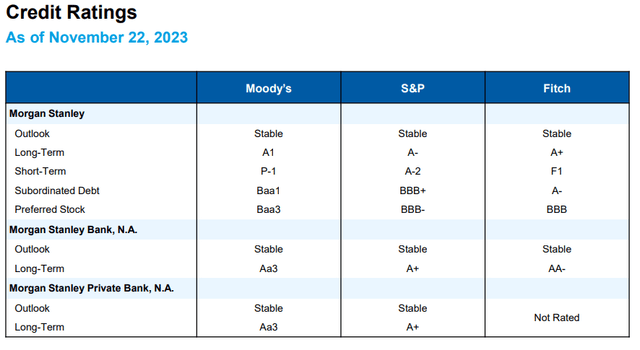
When referencing their credit ratings, the outlook is stable, reflecting confidence in its financial stability. In the long-term, Morgan Stanley’s credit ratings are A1, A-, and A+ from Moody’s, S&P, and Fitch, respectively. Good credit ratings are crucial for Morgan Stanley. It helps ensure lower borrowing costs, signaling financial stability, access to capital and regulatory compliance, and enhancing competitiveness in the market. These ratings reinforces confidence among stakeholders and positively influences operational efficiency.
Breaking down revenue by segment, Institutional Securities reported $5.67 billion, remaining flat quarter-over-quarter and decreasing by 3% year-over-year. Investment banking revenue experienced a significant 27% year-over-year drop, while equity net revenue rose by 2%, and fixed income net revenue dropped by 11%. Wealth Management recorded $6.40 billion in revenue, reflecting a 4% decrease quarter-over-quarter but a 5% increase year-over-year. Investment Management reported $1.34 billion in revenue, showing a 4% increase quarter-over-quarter and a substantial 14% increase year-over-year.
Dividend Growth & Valuation
As of the latest declared quarterly dividend of $0.85/share, the current dividend yield sits at 3.65%. MS is one of those dividend growth companies that don’t get enough recognition, unfortunately. I think the growth story here has been stellar! For example, the 5-year dividend CAGR sits slightly above 24%! MS has managed to increase their dividend for ten consecutive years and with a healthy payout ratio of only 55%, I anticipate more raises in the future. Through a five-year time frame, the dividend has grown a total of 183%.
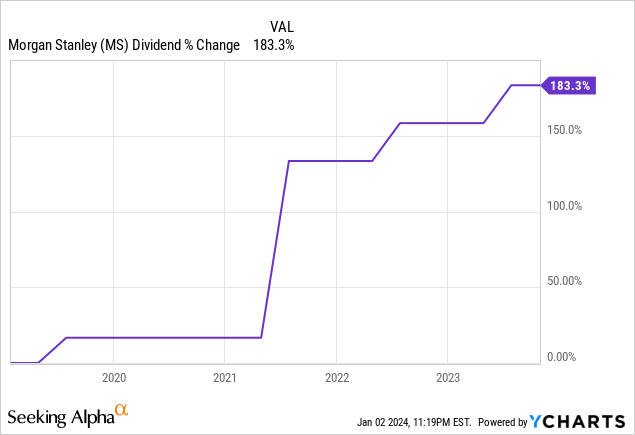
This is further reinforced when you compare the dividend growth performance metrics against the sector median. For instance, the previously mentioned five year dividend CAGR is at 24% compared to the sector median of 6.7%. On an even longer time horizon of ten years, the dividend CAGR is a whopping 32% compared to the sector median of 7.8% over the same time horizon. The dividend growth has been so strong that when only looking back over a five-year period, your YOC (yield on cost) would now be over 8% in comparison to the sector median five year YOC of 3.9%.
In terms of valuation, MS does admittedly look like it’s trading at a premium. For example, the P/E sits at 16.6x in comparison to the sector median of 10.91x and MS’s five-year average P/E of 11.48x. Also, the current price already trades slightly above the average Wall St. price target of $92.20/share. However, the price target has a wider range with a high of $116/share and a low of $80/share. We will run a quick DCF (discounted cash flow) calculation to get another idea on where MS stands in terms of valuation.
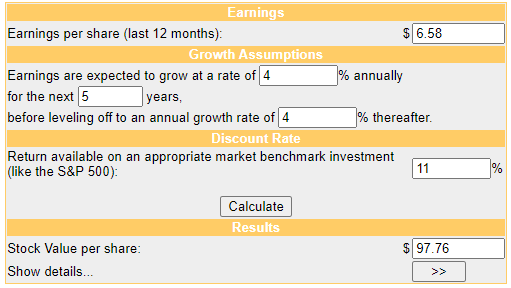
The projected EPS for FY2024 is 6.58x. In addition, the 3 – 5 year EPS growth average is 4%. Using these metrics as inputs for our calculations, we can determine a rough fair value estimate of $97.76/share. This would represent a modest upside potential of about 4%. Combine this potential upside with the current 3.6% dividend yield and you’re looking at a pretty average total return.
Money Chimp
Risk
A potential risk lies in the introduction of new management, as it may bring about changes in the strategic direction of the firm. In the case of Morgan Stanley, the focus is on incoming CEO Ted Pick. The decision to appoint an insider like Ted Pick suggests a prioritization of stability and security, signaling that the board anticipates a known trajectory under his leadership.
A new CEO can be a risk for a company due to several factors. Changes in leadership often bring about shifts in corporate culture, and employees may need time to adapt to a different management approach. Additionally, investors and stakeholders may react dramatically to the unknowns associated with a change in leadership, potentially affecting the company’s stock price and overall market perception whenever earnings are reported in the future. I think it may take a few quarters of improved performance until the new CEO is embraced.
Takeaway
Morgan Stanley stands as a global financial powerhouse, delivering a diverse range of financial services across continents. Despite recent challenges in net interest income and provisions for credit losses, the company exhibited resilience in its Q3 earnings, surpassing EPS estimates and slightly exceeding revenue expectations.
The company’s dividend growth story, often underrated, shines with a stellar 24% 5-year CAGR, surpassing sector medians. Valuation metrics indicate a premium, yet a DCF calculation suggests a modest upside potential. However, the recent run-up in stock price prompts caution. Looking ahead, a potential risk arises from the introduction of new CEO Ted Pick, bringing uncertainties about strategic shifts. While his appointment signals a focus on stability, embracing the new leadership may take time, and investor reactions to future earnings reports remain a factor to watch.
Credit: Source link