












• bitcoinBitcoin(BTC)$77,249.00-0.68%
  • ethereumEthereum(ETH)$2,525.62-1.93%
  • tetherTether(USDT)$1.000.00%
  • binancecoinBNB(BNB)$731.020.17%
  • rippleXRP(XRP)$1.37-0.48%
  • usd-coinUSDC(USDC)$1.000.00%
  • solanaSolana(SOL)$101.96-0.34%
  • tronTRON(TRX)$0.3399141.07%
  • Figure HelocFigure Heloc(FIGR_HELOC)$1.01-2.27%
  • zcashZcash(ZEC)$1,139.41-3.39%
  • HyperliquidHyperliquid(HYPE)$80.49-1.79%
  • dogecoinDogecoin(DOGE)$0.084842-0.72%
  • RainRain(RAIN)$0.015133-4.34%
  • moneroMonero(XMR)$527.762.87%
  • USDSUSDS(USDS)$1.000.00%
  • whitebitWhiteBIT Coin(WBT)$80.26-0.96%
  • chainlinkChainlink(LINK)$11.50-2.23%
  • leo-tokenLEO Token(LEO)$9.11-0.43%
  • cardanoCardano(ADA)$0.207457-0.54%
  • stellarStellar(XLM)$0.1813340.05%
  • Ethena USDeEthena USDe(USDE)$1.000.00%
  • bitcoin-cashBitcoin Cash(BCH)$228.26-1.84%
  • daiDai(DAI)$1.000.00%
  • USD1USD1(USD1)$1.000.00%
  • litecoinLitecoin(LTC)$53.87-0.18%
  • uniswapUniswap(UNI)$6.323.17%
  • CantonCanton(CC)$0.097606-0.41%
  • the-open-networkGram (prev. Toncoin)(GRAM)$1.381.19%
  • Global DollarGlobal Dollar(USDG)$1.000.00%
  • avalanche-2Avalanche(AVAX)$7.40-2.28%
  • hedera-hashgraphHedera(HBAR)$0.074663-0.64%
  • nearNEAR Protocol(NEAR)$2.39-8.53%
  • shiba-inuShiba Inu(SHIB)$0.0000050.53%
  • suiSui(SUI)$0.72-1.75%
  • crypto-com-chainCronos(CRO)$0.0586772.63%
  • paypal-usdPayPal USD(PYUSD)$1.00-0.02%
  • BlackRock USD Institutional Digital Liquidity FundBlackRock USD Institutional Digital Liquidity Fund(BUIDL)$1.000.00%
  • MemeCoreMemeCore(M)$1.18-0.26%
  • tether-goldTether Gold(XAUT)$4,349.84-0.41%
  • Circle USYCCircle USYC(USYC)$1.140.00%
  • Ripple USDRipple USD(RLUSD)$1.00-0.01%
  • okbOKB(OKB)$113.36-0.67%
  • BittensorBittensor(TAO)$234.10-1.87%
  • Ondo US Dollar YieldOndo US Dollar Yield(USDY)$1.14-0.17%
  • aaveAave(AAVE)$125.83-0.11%
  • mantleMantle(MNT)$0.57-4.66%
  • pax-goldPAX Gold(PAXG)$4,355.08-0.39%
  • AsterAster(ASTER)$0.69-0.68%
  • World Liberty FinancialWorld Liberty Financial(WLFI)$0.0580509.15%
  • polkadotPolkadot(DOT)$1.04-2.46%
TradePoint.io
  • Main
  • AI & Technology
  • Stock Charts
  • Market & News
  • Business
  • Finance Tips
  • Trade Tube
  • Blog
  • Shop
No Result
View All Result
TradePoint.io
No Result
View All Result

MIT and Google Researchers Propose Health-LLM: A Groundbreaking Artificial Intelligence Framework Designed to Adapt LLMs for Health Prediction Tasks Using Data from Wearable Sensor

January 24, 2024
in AI & Technology
Reading Time: 4 mins read
A A
MIT and Google Researchers Propose Health-LLM: A Groundbreaking Artificial Intelligence Framework Designed to Adapt LLMs for Health Prediction Tasks Using Data from Wearable Sensor
ShareShareShareShareShare

The realm of healthcare has been revolutionized by the advent of wearable sensor technology, which continuously monitors vital physiological data such as heart rate variability, sleep patterns, and physical activity. This advancement has paved the way for a novel intersection with large language models (LLMs), traditionally known for their linguistic prowess. The challenge, however, lies in effectively harnessing this non-linguistic, multi-modal time-series data for health predictions, requiring a nuanced approach beyond the conventional capabilities of LLMs.

This research pivots around adapting LLMs to interpret and utilize wearable sensor data for health predictions. The complexity of this data, characterized by its high dimensionality and continuous nature, demands an LLM’s ability to understand individual data points and their dynamic relationships over time. Traditional health prediction methods, predominantly involving models like Support Vector Machines or Random Forests, have been effective to a certain extent. However, the recent emergence of advanced LLMs, such as GPT-3.5 and GPT-4, has shifted the focus towards exploring their potential in this domain.

MIT and Google researchers introduced Health-LLM, a groundbreaking framework designed to adapt LLMs for health prediction tasks using data from wearable sensors. This study comprehensively evaluates eight state-of-the-art LLMs, including notable models like GPT-3.5 and GPT-4. The researchers meticulously selected thirteen health prediction tasks across five domains: mental health, activity tracking, metabolism, sleep, and cardiology. These tasks were chosen to cover a broad spectrum of health-related challenges and to test the models’ capabilities in diverse scenarios.

The methodology employed in this research is both rigorous and innovative. The study involved four distinct steps: zero-shot prompting, few-shot prompting augmented with chain-of-thought and self-consistency techniques, instructional fine-tuning, and an ablation study focusing on context enhancement in a zero-shot setting. Zero-shot prompting tested the models’ inherent capabilities without task-specific training, while few-shot prompting utilized limited examples to facilitate in-context learning. Chain-of-thought and self-consistency techniques were integrated to enhance the models’ understanding and coherence. Instructional fine-tuning further tailored the models to the specific nuances of health prediction tasks.

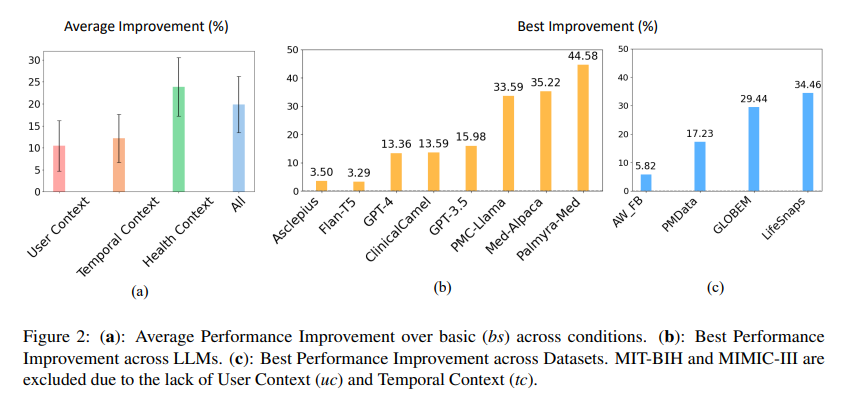
The Health-Alpaca model, a fine-tuned version of the Alpaca model, emerged as a standout performer, achieving the best results in five out of thirteen tasks. This achievement is particularly noteworthy considering Health-Alpaca’s substantially smaller size than larger models like GPT-3.5 and GPT-4. The study’s ablation component revealed that including context enhancements – comprising user profile, health knowledge, and temporal context – could yield up to a 23.8% improvement in performance. This finding highlights the significant role of contextual information in optimizing LLMs for health predictions.
In summary, this research marks a significant stride in integrating LLMs with wearable sensor data for health predictions. The study demonstrates the feasibility of this approach and underscores the importance of context in enhancing model performance. The success of the Health-Alpaca model, in particular, suggests that smaller, more efficient models can be equally, if not more, effective in health prediction tasks. This opens up new possibilities for applying advanced healthcare analytics in a more accessible and scalable manner, thereby contributing to the broader goal of personalized healthcare.


Check out the Paper. All credit for this research goes to the researchers of this project. Also, don’t forget to follow us on Twitter. Join our 36k+ ML SubReddit, 41k+ Facebook Community, Discord Channel, and LinkedIn Group.

If you like our work, you will love our newsletter..

Don’t Forget to join our Telegram Channel


YOU MAY ALSO LIKE

Altman Says OpenAI Will Match Anthropic’s Embedded Evaluator Pledge – Unite.AI

Anthropic’s CEO Proposes A Three-Step Plan To Curb AI Development

Sana Hassan, a consulting intern at Marktechpost and dual-degree student at IIT Madras, is passionate about applying technology and AI to address real-world challenges. With a keen interest in solving practical problems, he brings a fresh perspective to the intersection of AI and real-life solutions.


Credit: Source link

ShareTweetSendSharePin

Related Posts

Altman Says OpenAI Will Match Anthropic’s Embedded Evaluator Pledge – Unite.AI
AI & Technology

Altman Says OpenAI Will Match Anthropic’s Embedded Evaluator Pledge – Unite.AI

September 12, 2026
Anthropic’s CEO Proposes A Three-Step Plan To Curb AI Development
AI & Technology

Anthropic’s CEO Proposes A Three-Step Plan To Curb AI Development

September 12, 2026
Amodei Calls for Slowing the Pace of AI Capability Improvement – Unite.AI
AI & Technology

Amodei Calls for Slowing the Pace of AI Capability Improvement – Unite.AI

September 12, 2026
Are You Using The Right Ethernet Port On Your Router? Here’s How To Know
AI & Technology

Are You Using The Right Ethernet Port On Your Router? Here’s How To Know

September 12, 2026
Next Post
#netflix goes all in on #sports with #wwe deal #shorts

#netflix goes all in on #sports with #wwe deal #shorts

Leave a Reply Cancel reply

Your email address will not be published. Required fields are marked *

Search

No Result
View All Result
Google and NASA JPL Unveil AI Model Mapping Global Methane Plumes – Unite.AI

Google and NASA JPL Unveil AI Model Mapping Global Methane Plumes – Unite.AI

September 9, 2026
Smithsonian chief to retire as Trump fights to reshape the institution – The Washington Post

Smithsonian chief to retire as Trump fights to reshape the institution – The Washington Post

September 8, 2026
Unpacking the rivalry between Apple and OpenAI

Unpacking the rivalry between Apple and OpenAI

September 5, 2026

About

Learn more

Our Services

Legal

Privacy Policy

Terms of Use

Bloggers

Learn more

Article Links

Contact

Advertise

Ask us anything

©2020- TradePoint.io - All rights reserved!

Tradepoint.io, being just a publishing and technology platform, is not a registered broker-dealer or investment adviser. So we do not provide investment advice. Rather, brokerage services are provided to clients of Tradepoint.io by independent SEC-registered broker-dealers and members of FINRA/SIPC. Every form of investing carries some risk and past performance is not a guarantee of future results. “Tradepoint.io“, “Instant Investing” and “My Trading Tools” are registered trademarks of Apperbuild, LLC.

This website is operated by Apperbuild, LLC. We have no link to any brokerage firm and we do not provide investment advice. Every information and resource we provide is solely for the education of our readers. © 2020 Apperbuild, LLC. All rights reserved.

No Result
View All Result
  • Main
  • AI & Technology
  • Stock Charts
  • Market & News
  • Business
  • Finance Tips
  • Trade Tube
  • Blog
  • Shop

© 2023 - TradePoint.io - All Rights Reserved!