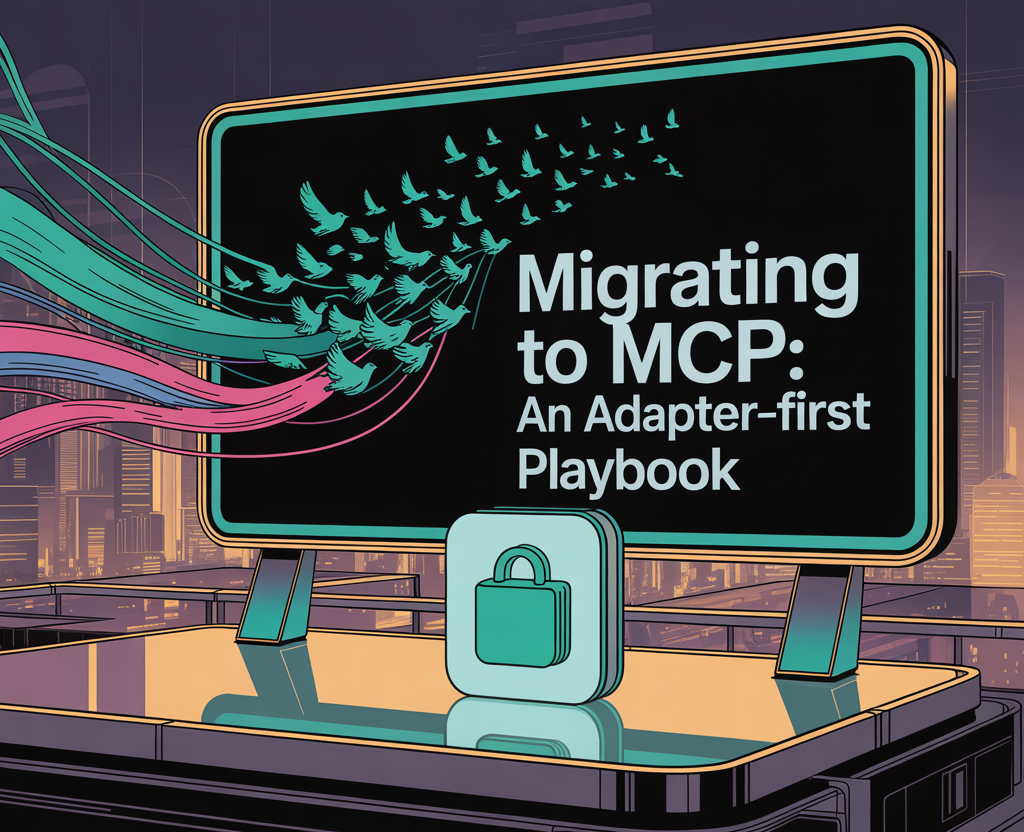

Model Context Protocol (MCP) has rapidly emerged as a universal standard for connecting AI models to diverse applications, systems, and tools—imagine “USB-C for AI integrations,” as commonly described in the industry. For organizations accustomed to custom integrations, the migration to MCP can be transformative, simultaneously reducing technical debt and unlocking new interoperability benefits. This playbook provides a structured, repeatable approach to migrating to MCP with an emphasis on adapters—the lightweight servers that bridge your existing software stack to the protocol’s standardized interface.
Why Migrate to MCP?
- Scalability & Flexibility: MCP’s modular, adapter-based architecture allows seamless integration with new tools and systems, avoiding the bottlenecks and rewrites common with custom integrations.
- Reduced Technical Debt: By standardizing the interface between AI models and applications, MCP minimizes the need for bespoke, brittle code. Integration bugs and maintenance effort drop sharply as teams consolidate on a single protocol.
- Interoperability: MCP is designed as a universal adapter, enabling AI models to interact with virtually any application or data source that has an MCP server (adapter), from cloud databases to design tools.
- Structured Context Exchange: MCP ensures that context (data, commands, responses) is exchanged in a schema-enforced, structured format. This eliminates the uncertainty and brittleness of string-matching or ad-hoc message passing between AI agents and tools.
Understanding MCP Architecture
MCP is built as a client-server protocol:
- MCP Client: Embedded in AI platforms (e.g., Claude Desktop, Cursor IDE), it initiates requests to MCP servers.
- MCP Server (Adapter): A lightweight process that exposes an application’s functionality (via REST, SDK, plugin, or even stdin/stdout) as a set of standardized MCP commands. The server translates natural-language requests into precise application actions and formats responses for the AI model.
- MCP Protocol: The language and rules for exchanging messages. It is transport-agnostic (works over HTTP, WebSockets, stdio, etc.) and typically uses JSON Schema for message definition.
- Tool Discovery: MCP servers advertise their available commands, enabling AI models to dynamically discover and use new capabilities—no manual configuration required for each new integration.
Architects and developers sometimes use the term adapter-first to emphasize the critical role of MCP adapters in making migration feasible and maintainable.
Step-by-Step Migration Playbook
1. Assessment and Inventory
- Audit Existing Integrations: Catalog all interfaces between your AI models and external tools, APIs, or databases.
- Identify High-Value Candidates: Prioritize migrating integrations that are brittle, expensive to maintain, or frequently updated.
- Document Architectural Dependencies: Note where custom code, glue logic, or fragile string parsing exists.
2. Prototype and Proof of Concept
- Select a Non-Critical Integration: Choose a manageable, low-risk candidate for your first MCP adapter.
- Scaffold an MCP Server: Use an MCP SDK (Python, TypeScript, Java, etc.) to create a server that maps your application’s functionality to MCP commands.
- Test with an AI Client: Validate that your MCP adapter works as expected with an MCP-compatible AI platform (e.g., Claude Desktop, Cursor).
- Measure Impact: Benchmark integration reliability, latency, and developer experience versus the previous custom solution.
3. Development and Integration
- Build and Deploy Adapters: For each integration point, develop an MCP server that wraps the application’s API or control surface (REST, SDK, scripting, etc.).
- Adopt Incrementally: Roll out MCP adapters in phases, starting with the lowest-risk, highest-reward integrations.
- Implement Parallel Running: During migration, run both custom and MCP integrations side-by-side to ensure no loss of functionality.
- Establish Rollback Mechanisms: Prepare to revert quickly if any MCP adapter introduces instability.
4. Training and Documentation
- Train Teams: Upskill developers, data scientists, and operations staff on MCP concepts, SDK usage, and adapter development.
- Update Documentation: Maintain clear, searchable records of all MCP adapters, their capabilities, and integration patterns.
- Cultivate a Community: Encourage internal sharing of adapter templates, best practices, and troubleshooting tips.
5. Monitoring and Optimization
- Instrument Monitoring: Track adapter health, latency, error rates, and usage patterns.
- Iterate and Improve: Refine adapter implementations based on real-world usage and feedback from AI model operators.
- Expand Coverage: Gradually migrate remaining custom integrations to MCP as the ecosystem matures.
Best Practices for Adapter-First Migration
- Incremental Adoption: Avoid big-bang migrations. Build confidence with small, controlled phases.
- Compatibility Layers: For legacy systems, consider building compatibility shims that expose legacy interfaces via MCP adapters.
- Security by Design: Limit network exposure of MCP adapters. Use authentication, encryption, and access controls as appropriate for your environment.
- Tool Discovery and Documentation: Ensure adapters properly advertise their capabilities through MCP’s tool discovery mechanism, making it easy for AI models to use them dynamically.
- Testing Rigor: Subject each adapter to robust integration and regression testing, including edge cases and failure modes.
Tools and Ecosystem
- MCP SDKs: Anthropic and the community provide SDKs in Python, TypeScript, Java, and more for rapid adapter development.
- Reference Servers: Leverage open-source MCP servers for common tools (e.g., GitHub, Figma, databases) to accelerate your migration.
- AI Platforms with Native MCP Support: Cursor, Claude Desktop, and others natively integrate MCP clients, enabling seamless interaction with your adapters.
Common Challenges and Risk Mitigation
- Legacy System Compatibility: Some older systems may require significant refactoring to expose a clean API for MCP adapters. Consider compatibility layers or light wrappers.
- Skill Gaps: Teams may need time to learn MCP concepts and SDKs. Invest in training and pair programming.
- Initial Overhead: The first few adapters may take longer to build as teams climb the learning curve, but subsequent integrations become dramatically faster.
- Performance Monitoring: MCP adds a layer of abstraction; monitor for any latency or throughput impact, especially in high-frequency integration scenarios.
In Summary:
Migrating to MCP is not just a technical upgrade—it’s a strategic shift toward interoperability, scalability, and reduced technical debt. By following an adapter-first playbook, you can methodically replace custom integrations with standardized, maintainable MCP servers, unlocking the full potential of AI-to-application communication across your stack.
Michal Sutter is a data science professional with a Master of Science in Data Science from the University of Padova. With a solid foundation in statistical analysis, machine learning, and data engineering, Michal excels at transforming complex datasets into actionable insights.
Credit: Source link