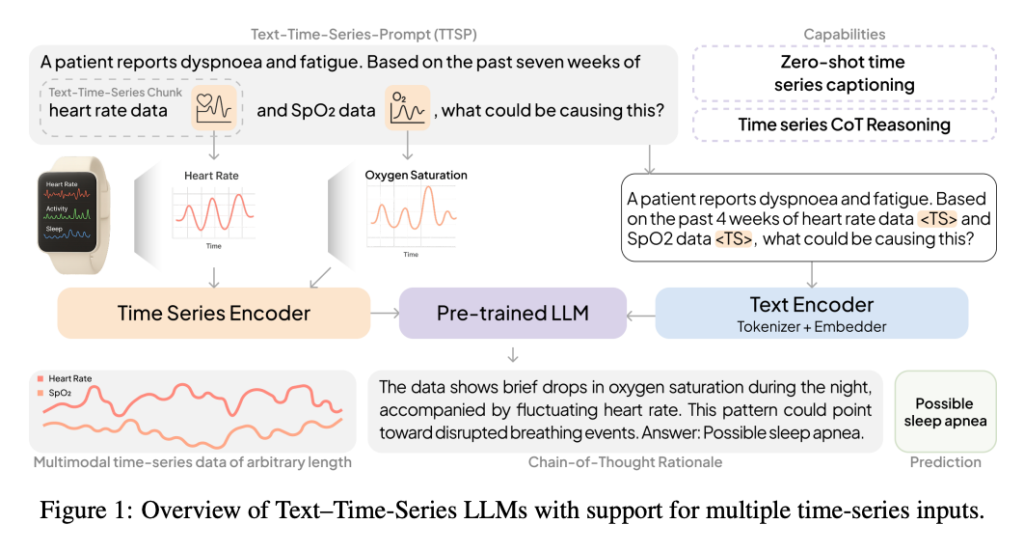

A significant development is set to transform AI in healthcare. Researchers at Stanford University, in collaboration with ETH Zurich and tech leaders including Google Research and Amazon, have introduced OpenTSLM, a novel family of Time-Series Language Models (TSLMs).
This breakthrough addresses a critical limitation in current LLMs by enabling them to interpret and reason over complex, continuous medical time-series data, such as ECGs, EEGs, and wearable sensor streams, a feat where even frontier models like GPT-4o have struggled.
The Critical Blind Spot: LLM Limitations in Time-Series Analysis
Medicine is fundamentally temporal. Accurate diagnosis relies heavily on tracking how vital signs, biomarkers, and complex signals evolve. Despite the proliferation of digital health technology, today’s most advanced AI models have struggled to process this raw, continuous data.
The core challenge lies in the “modality gap”, the difference between continuous signals (like a heartbeat) and the discrete text tokens that LLMs understand. Previous attempts to bridge this gap by converting signals into text have proven inefficient and difficult to scale.
Why Vision-Language Models (VLMs) Fail at Time-Series Data
A common workaround has been to convert time-series data into static images (line plots) and input them into advanced Vision-Language Models (VLMs). However, the OpenTSLM research demonstrates this approach is surprisingly ineffective for precise medical data analysis.
VLMs are primarily trained on natural photographs; they recognize objects and scenes, not the dense, sequential dynamics of data visualizations. When high-frequency signals like an ECG are rendered into pixels, crucial fine-grained information is lost. Subtle temporal dependencies and high-frequency changes, vital for identifying heart arrhythmias or specific sleep stages, become obscured.
The study confirms that VLMs struggle significantly when analyzing these plots, highlighting that time series must be treated as a distinct data modality, not merely a picture.
Introducing OpenTSLM: A Native Modality Approach
OpenTSLM integrates time series as a native modality directly into pretrained LLMs (such as Llama and Gemma), enabling natural language querying and reasoning over complex health data.
The research team explored two distinct architectures:
Architecture Deep Dive: SoftPrompt vs. Flamingo
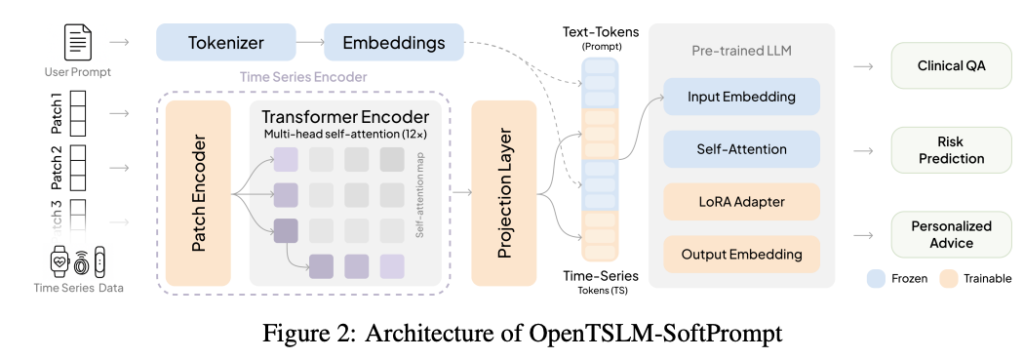
1. OpenTSLM-SoftPrompt (Implicit Modeling)
This approach encodes time-series data into learnable tokens, which are then combined with text tokens (soft prompting). While efficient for short data bursts, this method scales poorly. Longer sequences require exponentially more memory, making it impractical for comprehensive analysis.
2. OpenTSLM-Flamingo (Explicit Modeling)
Inspired by the Flamingo architecture, this is the breakthrough solution for scalability. It explicitly models time series as a separate modality. It uses a specialized encoder and a Perceiver Resampler to create a fixed-size representation of the data, regardless of its length, and fuses it with text using gated cross-attention.
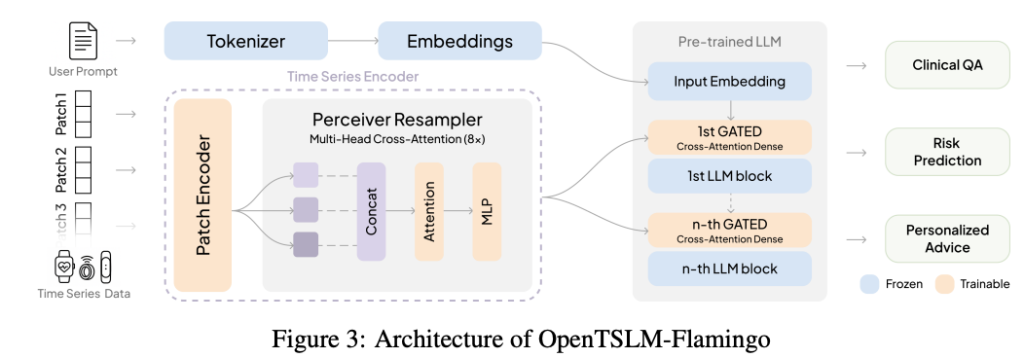
OpenTSLM-Flamingo maintains stable memory requirements even with extensive data streams. For instance, during training on complex ECG data analysis, the Flamingo variant required only 40 GB of VRAM, compared to 110 GB for the SoftPrompt variant using the same LLM backbone.
Performance Breakthroughs: Outperforming GPT-4o
The results demonstrate the clear superiority of the specialized TSLM approach. To benchmark performance, the team created three new Chain-of-Thought (CoT) datasets focused on medical reasoning: HAR-CoT (activity recognition), Sleep-CoT (EEG sleep staging), and ECG-QA-CoT (ECG question answering).
- Sleep Staging: OpenTSLM achieved a 69.9% F1 score, vastly outperforming the best fine-tuned text-only baseline (9.05%).
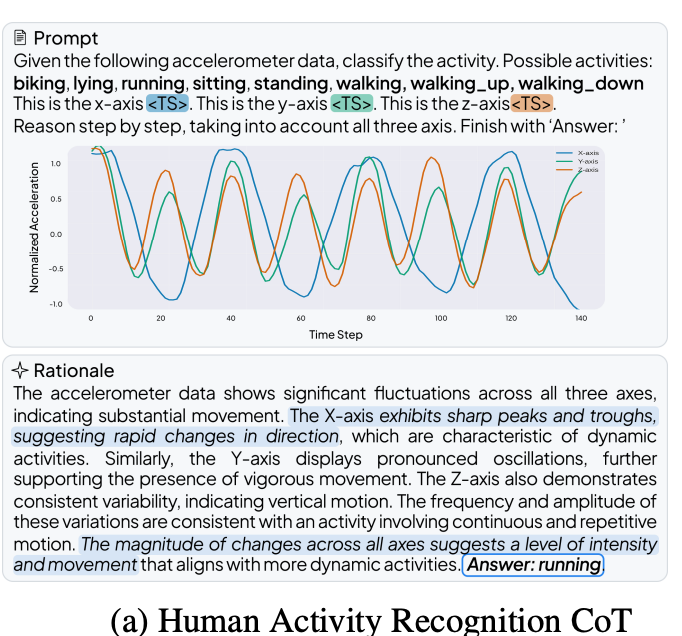
- Activity Recognition: OpenTSLM reached a 65.4% F1 score
Here is an example of human activity recognition COT.
Here is an example of Sleep activity detection:
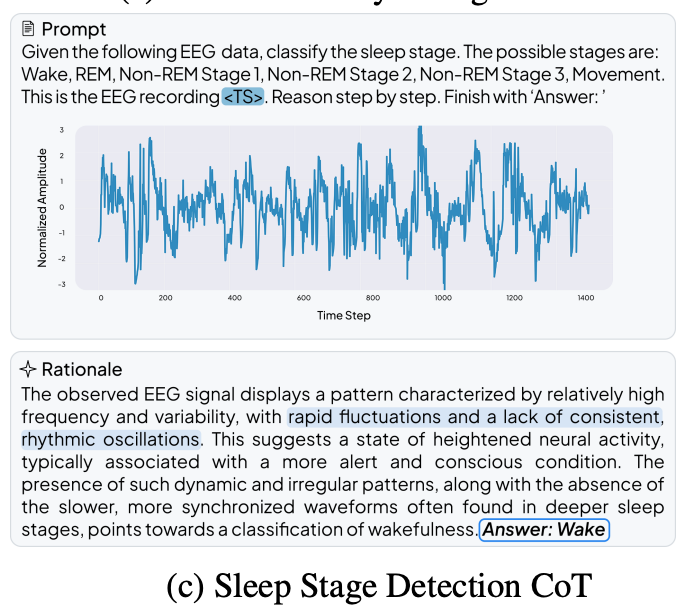
Remarkably, even small-scale OpenTSLM models (1 billion parameters) significantly surpassed GPT-4o. Whether processing the data as text tokens (where GPT-4o scored only 15.47% on Sleep-CoT) or as images, the frontier model failed to match the specialized TSLMs.
This finding underscores that specialized, domain-adapted AI architectures can achieve superior results without massive scale, paving the way for efficient, on-device medical AI deployment.
Clinical Validation at Stanford Hospital: Ensuring Trust and Transparency
A crucial element of Medical AI is trust. Unlike traditional models that output a single classification, OpenTSLM generates human-readable rationales (Chain-of-Thought), explaining its predictions. This AI transparency is vital for clinical settings.
To validate the quality of this reasoning, an expert review was conducted with five cardiologists from Stanford Hospital. They assessed the rationales generated by the OpenTSLM-Flamingo model for ECG interpretation.
The evaluation found that the model provided a correct or partially correct ECG interpretation in an impressive 92.9% of cases. The model showed exceptional strength in integrating clinical context (85.1% positive assessments), demonstrating sophisticated reasoning capabilities over raw sensor data.
The Future of Multimodal Machine Learning
The introduction of OpenTSLM marks a significant advancement in multimodal machine learning. By effectively bridging the gap between LLMs and time-series data, this research lays the foundation for general-purpose TSLMs capable of handling diverse longitudinal data, not just in healthcare, but also in finance, industrial monitoring, and beyond.
To accelerate innovation in the field, the Stanford and ETH Zurich teams have open-sourced all code, datasets, and trained model weights.
Check out the Paper here. Feel free to check out our GitHub Page for Tutorials, Codes and Notebooks. Also, feel free to follow us on Twitter and don’t forget to join our 100k+ ML SubReddit and Subscribe to our Newsletter. Wait! are you on telegram? now you can join us on telegram as well.
The post Meet OpenTSLM: A Family of Time-Series Language Models (TSLMs) Revolutionizing Medical Time-Series Analysis appeared first on MarkTechPost.
Credit: Source link