












• bitcoinBitcoin(BTC)$76,848.00-1.56%
  • ethereumEthereum(ETH)$2,276.16-2.99%
  • tetherTether(USDT)$1.00-0.03%
  • rippleXRP(XRP)$1.39-2.89%
  • binancecoinBNB(BNB)$621.30-1.75%
  • usd-coinUSDC(USDC)$1.00-0.02%
  • solanaSolana(SOL)$84.06-2.86%
  • tronTRON(TRX)$0.3248720.38%
  • Figure HelocFigure Heloc(FIGR_HELOC)$1.020.00%
  • dogecoinDogecoin(DOGE)$0.097184-1.84%
  • whitebitWhiteBIT Coin(WBT)$54.33-1.76%
  • USDSUSDS(USDS)$1.00-0.02%
  • HyperliquidHyperliquid(HYPE)$41.750.96%
  • leo-tokenLEO Token(LEO)$10.370.94%
  • cardanoCardano(ADA)$0.244564-3.14%
  • bitcoin-cashBitcoin Cash(BCH)$450.77-0.32%
  • moneroMonero(XMR)$380.12-4.15%
  • chainlinkChainlink(LINK)$9.19-3.09%
  • zcashZcash(ZEC)$351.94-0.73%
  • CantonCanton(CC)$0.148397-1.23%
  • stellarStellar(XLM)$0.165227-3.41%
  • MemeCoreMemeCore(M)$3.94-9.92%
  • daiDai(DAI)$1.00-0.02%
  • USD1USD1(USD1)$1.00-0.03%
  • litecoinLitecoin(LTC)$55.13-1.56%
  • avalanche-2Avalanche(AVAX)$9.14-3.45%
  • hedera-hashgraphHedera(HBAR)$0.089149-3.87%
  • Ethena USDeEthena USDe(USDE)$1.00-0.03%
  • suiSui(SUI)$0.92-2.65%
  • shiba-inuShiba Inu(SHIB)$0.000006-2.02%
  • RainRain(RAIN)$0.007351-1.14%
  • paypal-usdPayPal USD(PYUSD)$1.00-0.03%
  • the-open-networkToncoin(TON)$1.30-0.92%
  • crypto-com-chainCronos(CRO)$0.069268-1.68%
  • Circle USYCCircle USYC(USYC)$1.120.00%
  • tether-goldTether Gold(XAUT)$4,664.43-0.77%
  • Global DollarGlobal Dollar(USDG)$1.00-0.02%
  • BittensorBittensor(TAO)$245.84-1.18%
  • World Liberty FinancialWorld Liberty Financial(WLFI)$0.072393-3.62%
  • BlackRock USD Institutional Digital Liquidity FundBlackRock USD Institutional Digital Liquidity Fund(BUIDL)$1.000.00%
  • pax-goldPAX Gold(PAXG)$4,667.54-0.74%
  • mantleMantle(MNT)$0.63-3.50%
  • polkadotPolkadot(DOT)$1.22-3.73%
  • uniswapUniswap(UNI)$3.19-2.41%
  • SkySky(SKY)$0.086329-2.54%
  • Pi NetworkPi Network(PI)$0.180972-0.73%
  • Falcon USDFalcon USD(USDF)$1.000.01%
  • nearNEAR Protocol(NEAR)$1.35-2.80%
  • okbOKB(OKB)$83.21-1.59%
  • HTX DAOHTX DAO(HTX)$0.0000020.29%
TradePoint.io
  • Main
  • AI & Technology
  • Stock Charts
  • Market & News
  • Business
  • Finance Tips
  • Trade Tube
  • Blog
  • Shop
No Result
View All Result
TradePoint.io
No Result
View All Result

Meet OAT: The New Action Tokenizer Bringing LLM-Style Scaling and Flexible, Anytime Inference to the Robotics World

February 9, 2026
in AI & Technology
Reading Time: 7 mins read
A A
Meet OAT: The New Action Tokenizer Bringing LLM-Style Scaling and Flexible, Anytime Inference to the Robotics World
ShareShareShareShareShare

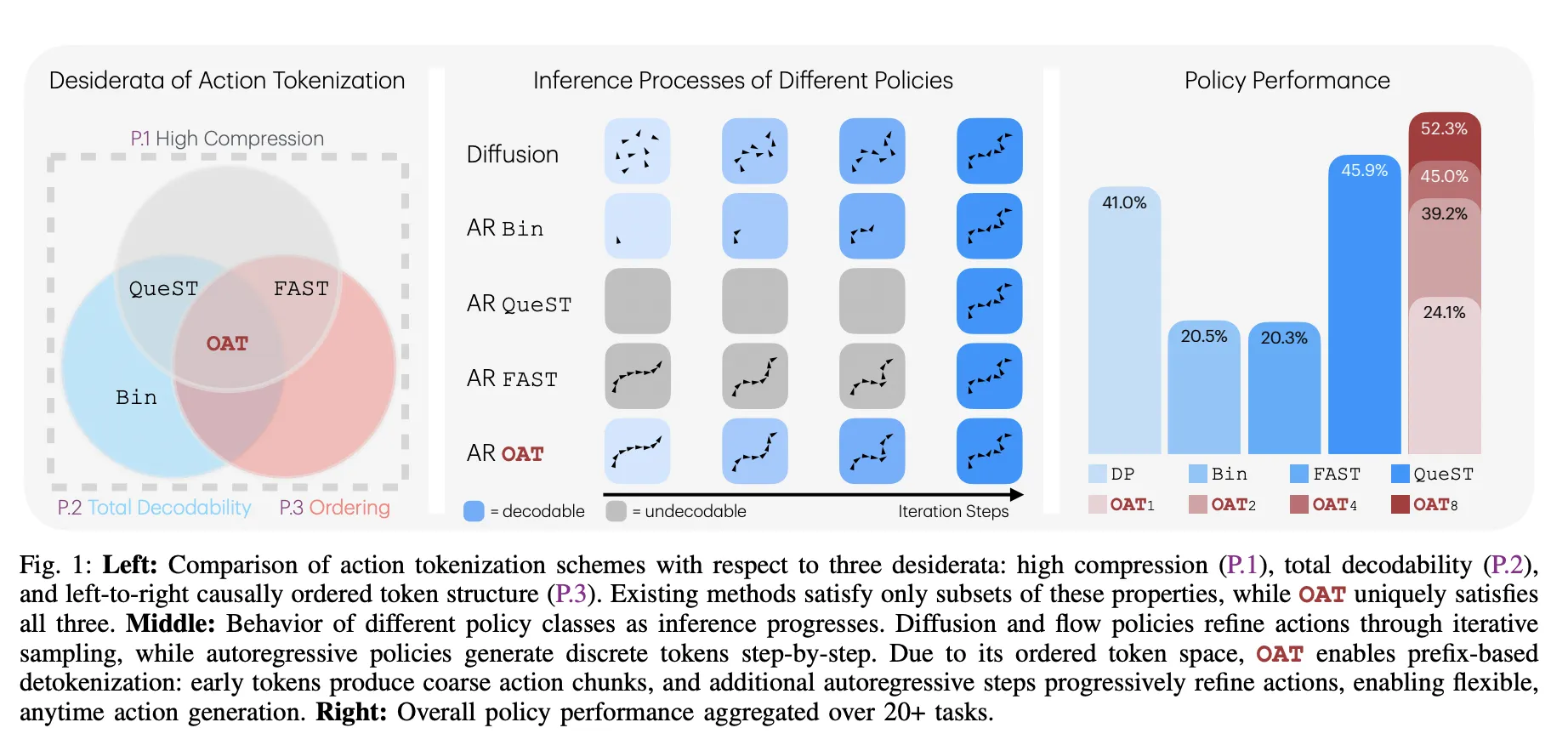
Robots are entering their GPT-3 era. For years, researchers have tried to train robots using the same autoregressive (AR) models that power large language models (LLMs). If a model can predict the next word in a sentence, it should be able to predict the next move for a robotic arm. However, a technical wall has blocked this progress: continuous robot movements are difficult to turn into discrete tokens.

A team of researchers from Harvard University and Stanford University have released a new framework called Ordered Action Tokenization (OAT) to bridge this gap.

YOU MAY ALSO LIKE

RAG precision tuning can quietly cut retrieval accuracy by 40%, putting agentic pipelines at risk

Ford’s Mustang Cobra Jet sets a new EV quarter mile record at 6.87 seconds

https://arxiv.org/pdf/2602.04215

The Messy Reality of Robot Actions

Tokenization turns complex data into a sequence of discrete numbers (tokens). For robots, these actions are continuous signals like joint angles. Previous strategies had fatal flaws:

  • Binning: Turns every action dimension into a ‘bin.’ While simple, it creates massive sequences that make training and inference slow.
  • FAST (Frequency-space Action Sequence Tokenization): Uses math to compress movements into frequency coefficients. It is fast but often produces ‘undecodable’ sequences where small errors cause the robot to halt or move unpredictably.
  • Learned Latent Tokenizers: These use a learned ‘dictionary’ of movements. They are safe but lack a specific order, meaning the model treats early and late tokens as equally important.
https://arxiv.org/pdf/2602.04215

The Three Golden Rules of OAT

The research team identified 3 essential properties—desiderata—for a functional robot tokenizer:

  1. High Compression (P.1): Token sequences must be short to keep models efficient.
  2. Total Decodability (P.2): The decoder must be a total function, ensuring every possible token sequence maps to a valid movement.
  3. Causal Ordering (P.3): Tokens must have a left-to-right structure where early tokens capture global motion and later tokens refine details.

The Secret Sauce: Nested Dropout and Registers

OAT uses a transformer encoder with register tokens to summarize action chunks. To force the model to learn ‘important’ things first, the research team used a innovative approach called Nested Dropout.

https://arxiv.org/pdf/2602.04215

Breaking the Benchmarks

The research team tested OAT across 20+ tasks in 4 major simulation benchmarks. OAT consistently outperformed the industry-standard Diffusion Policy (DP) and previous tokenizers.

Performance Results

Benchmark OAT Success Rate DP Success Rate Bin Token Count OAT Token Count
LIBERO 56.3% 36.6% 224 8
RoboMimic 73.1% 67.1% 224 8
MetaWorld 24.4% 19.3% 128 8
RoboCasa 54.6% 54.0% 384 8

‘Anytime’ Inference: Speed vs. Precision

The most practical benefit of OAT is prefix-based detokenization. Since the tokens are ordered by importance, you can stop the model early.

  • Coarse Actions: Decoding just 1 or 2 tokens gives the robot a general direction quickly, which is useful for low-latency tasks.
  • Fine Actions: Generating all 8 tokens provides the high-precision details needed for complex insertions.

This allows for a smooth trade-off between computation cost and action fidelity that previous fixed-length tokenizers could not offer.

Key Takeaways

  • Solving the Tokenization Gap: OAT addresses a fundamental limitation in applying autoregressive models to robotics by introducing a learned tokenizer that simultaneously achieves high compression, total decodability, and causal ordering.
  • Ordered Representation via Nested Dropout: By utilizing nested dropout during training, OAT forces the model to prioritize global, coarse motion patterns in early tokens while reserving later tokens for fine-grained refinements.
  • Total Decodability and Reliability: Unlike prior frequency-domain methods like FAST, OAT ensures the detokenizer is a total function, meaning every possible token sequence generates a valid action chunk, preventing runtime execution failures.
  • Flexible ‘Anytime’ Inference: The ordered structure enables prefix-based decoding, allowing robots to execute coarse actions from just one or two tokens to save computation or full eight-token sequences for high-precision tasks.
  • Superior Performance Across Benchmarks: Autoregressive policies equipped with OAT consistently outperform diffusion-based baselines and other tokenization schemes, achieving a 52.3% aggregate success rate and superior results in real-world ‘Pick & Place’ and ‘Stack Cups’ tasks.

Check out the Paper, Repo and Project Page. Also, feel free to follow us on Twitter and don’t forget to join our 100k+ ML SubReddit and Subscribe to our Newsletter. Wait! are you on telegram? now you can join us on telegram as well.

The post Meet OAT: The New Action Tokenizer Bringing LLM-Style Scaling and Flexible, Anytime Inference to the Robotics World appeared first on MarkTechPost.

Credit: Source link

ShareTweetSendSharePin

Related Posts

RAG precision tuning can quietly cut retrieval accuracy by 40%, putting agentic pipelines at risk
AI & Technology

RAG precision tuning can quietly cut retrieval accuracy by 40%, putting agentic pipelines at risk

April 27, 2026
Ford’s Mustang Cobra Jet sets a new EV quarter mile record at 6.87 seconds
AI & Technology

Ford’s Mustang Cobra Jet sets a new EV quarter mile record at 6.87 seconds

April 27, 2026
Meta AI Releases Sapiens2: A High-Resolution Human-Centric Vision Model for Pose, Segmentation, Normals, Pointmap, and Albedo
AI & Technology

Meta AI Releases Sapiens2: A High-Resolution Human-Centric Vision Model for Pose, Segmentation, Normals, Pointmap, and Albedo

April 27, 2026
The LoRA Assumption That Breaks in Production 
AI & Technology

The LoRA Assumption That Breaks in Production 

April 27, 2026
Next Post
Dangerous winter storm slams South 

Dangerous winter storm slams South 

Leave a Reply Cancel reply

Your email address will not be published. Required fields are marked *

Search

No Result
View All Result
1 dead after small plane crashes into Florida yard

1 dead after small plane crashes into Florida yard

April 21, 2026
Man charged in attack on Sam Altman’s home

Man charged in attack on Sam Altman’s home

April 25, 2026
Obama and Mamdani meet preschoolers in the Bronx

Obama and Mamdani meet preschoolers in the Bronx

April 22, 2026

About

Learn more

Our Services

Legal

Privacy Policy

Terms of Use

Bloggers

Learn more

Article Links

Contact

Advertise

Ask us anything

©2020- TradePoint.io - All rights reserved!

Tradepoint.io, being just a publishing and technology platform, is not a registered broker-dealer or investment adviser. So we do not provide investment advice. Rather, brokerage services are provided to clients of Tradepoint.io by independent SEC-registered broker-dealers and members of FINRA/SIPC. Every form of investing carries some risk and past performance is not a guarantee of future results. “Tradepoint.io“, “Instant Investing” and “My Trading Tools” are registered trademarks of Apperbuild, LLC.

This website is operated by Apperbuild, LLC. We have no link to any brokerage firm and we do not provide investment advice. Every information and resource we provide is solely for the education of our readers. © 2020 Apperbuild, LLC. All rights reserved.

No Result
View All Result
  • Main
  • AI & Technology
  • Stock Charts
  • Market & News
  • Business
  • Finance Tips
  • Trade Tube
  • Blog
  • Shop

© 2023 - TradePoint.io - All Rights Reserved!