

twohumans
Credit risk and bond durations are serious topics of conversation these days, as a volatile economic environment has introduced a lot of uncertainty. We are proponents of onboarding credit risk for now; however, we recognize that some investors are on the lookout for credit exposure. As such, we dialed in on an asset that we think introduces safe credit exposure.
I hereby introduce the focal point of today’s discussion, the iShares iBoxx $ Investment Grade Corporate Bond ETF (NYSEARCA:LQD). LQD ETF tracks the Markit iBoxx USD Liquid Investment Grade Index with subtle freedom for active risk management. Despite its sluggish five-year performance, we think LQD ETF is primed for peak performance going into the latter stages of 2024 and beyond.
LQD ETF 5-Y Return (Seeking Alpha)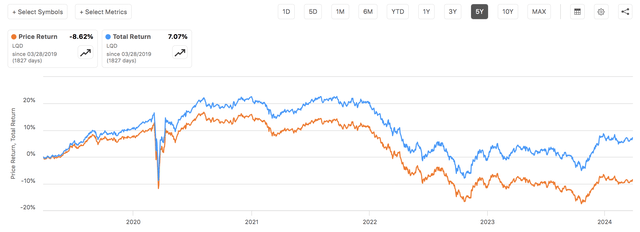
Without further ado, herewith are some of our latest findings on the iShares iBoxx $ Investment Grade Corporate Bond ETF.
LQD ETF Overview
As previously mentioned, the LQD ETF tracks the Markit iBoxx USD Liquid Investment Grade Index. The index rebalances monthly to achieve exposure to Moody’s, Fitch, and S&P investment-grade-rated bonds with exposures longer than three years. Moreover, the index caps its issuer exposure to 3%, ensuring low idiosyncratic concentration risk.
Below is a decomposition of the ETF’s credit exposure; sectoral and issuer exposure will be covered later in the text.
Markit iBoxx USD Liquid Investment Grade Index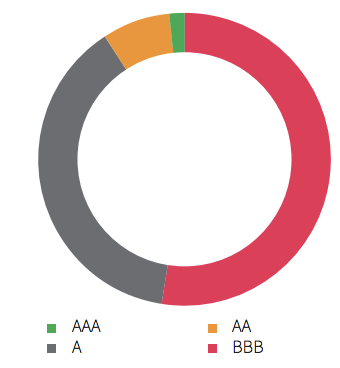
The ETF’s credit and duration exposure introduces a few implications. Firstly, investment-grade bonds are highly sensitive to credit migration and interest rates, but credit spreads can play a role in some instances. Additionally, LQD ETF’s mandate dictates term premium and illiquidity exposure, which essentially means investors typically demand higher returns (versus shorter-term bonds) because longer-term bonds have higher interest rate and liquidity risk.
A final mention for this section is LQD ETF’s dividend. The following diagram and the realized monetary environment show a strong correlation between LQD ETF’s dividend yield and interest rates. Remember that the contra price-dividend effect would not play much of a role if you’re holding the ETF until its targeted maturity (around 9 to 9.5 years at current exposure). However, price risk will probably be a consideration if you’re looking to sell beforehand, while reinvestment risk will play a role if you hold for longer than 9.5 years.
Aside: I used the MacAuley Duration as maturity, which I computed as effective duration x (1 + weighted average yield to maturity) x (1 + YTM) = 8.39 x 1.0524 x 1.0524 = 9.3.
Seeking Alpha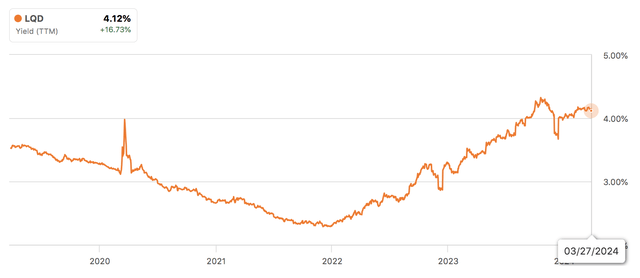
Credit Migration
I cannot emphasize what I’m about to say enough. Credit migration risk is pivotal to investment-grade bonds. In fact, it usually plays a larger role than credit spreads. But what’s the difference, you may ask? Credit ratings are based on a company’s internal robustness and how that may translate into its bond risk. On the other hand, credit spreads are market-based observations emphasizing bonds’ probability of default and potential loss severity (both drawn from market-based events and/or risk premiums).
Let’s assess LQD ETF’s credit migration risk. I collated its top holdings and attached the credit outlooks on their senior unsecured bonds. A discussion follows beneath.
Sources: Respective Company Websites (links embedded in the second column)
You’ll notice that I focused on Outlook instead of recent upgrades or downgrades. Although downgrades can be sequential, they have likely been priced, and the market is on the lookout for any change in Outlook. The data suggests that LQD ETF’s primary constituents are stable; therefore, additional research is required. Let’s look at sectoral risk.
iShares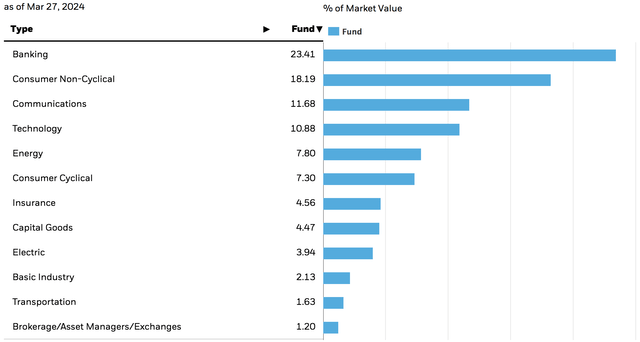
About 23.41% of LQD ETF’s portfolio consists of banking stocks, illustrating its industry concentration. To our knowledge, mass-scale external CET 1 ratios were last released in June last year, meaning its reference will be slightly misleading. Thus, I decided to eyeball it and provide an anecdotal opinion.
Banking stocks will likely suffer from higher credit risk in the coming months due to a slowing real economy (see the GDPNow below), disinflation, and a pending interest rate pivot, among other factors. However, large banks could provide resistance and phase out many risks due to their “through the economic cycle” status. Therefore, we/I am not too worried.
GDPNow GDP Forecast (Atlanta Fed)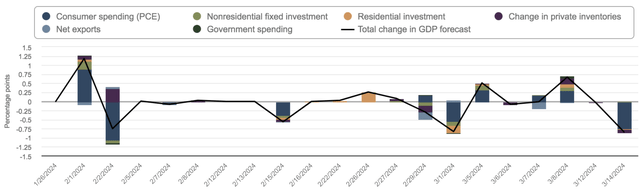
Furthermore, the LQD ETF has exposure to various non-cyclical or secular industries, such as consumer non-cyclical (18.19%), communications (11.685%), and technology (10.88%). Although interest coverage ratios declined toward the end of last year, we think the big players in the U.S. economy have the necessary characteristics to maintain robust balance sheets and phase out economic risk.
S&P Global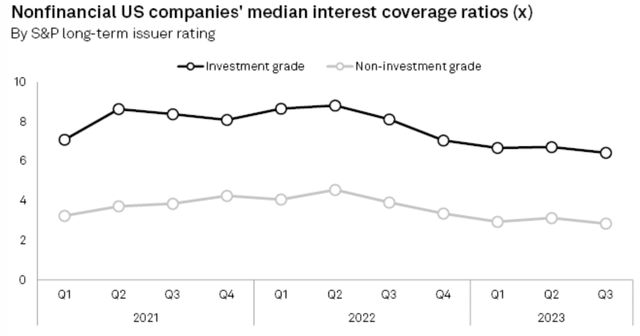
In essence, we see no reason to upgrade LQD ETF’s credit outlook, but we don’t think downgrades will occur either. Stable is the call.
Duration, Convexity, and Credit Spreads
The iShares iBoxx $ Investment Grade Corporate Bond ETF has an effective duration of 8.39. With all other factors kept constant, this means LQD ETF is likely to experience a return of 8.39% if the yield curve shifts down by 1% and vice versa. However, there are other contributing factors. For one, LQD ETF has a convexity of 1.22, meaning it is protected in a down market and experiences exponential returns in an up market.
Note: Click on this link to learn more about convexity.
iShares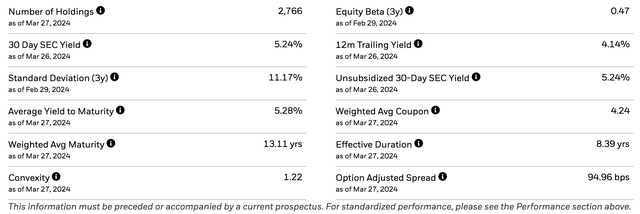
Okay, Pearl Gray, thanks for all that, but what’s your outlook?
In our view, the yield curve will continue to drop lower in the coming months, providing the LQD ETF with price support. Although we think lower yields will result in lower dividends, we believe the ETF’s elevated duration and convexity will save the day, allowing price gains to outpace dividend cuts.
Furthermore, a lower yield curve might slope the yield curve upward. All other factors held constant, we think a steeper slope would present price risk to an ETF such as this because of its lengthy maturity. However, the drop in the curve will likely lead to a bullish steepener, introducing a favorable pricing environment.
worldgovernmentbonds.com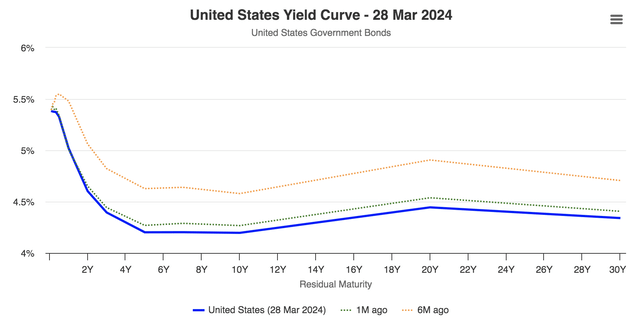
Now for credit spreads.
The LQD ETF’s option-adjusted spread of 94.96 basis points is infinitesimally higher than the ICE BofA US Corporate Index’s of 94. Therefore, little relative value exists on this basis alone. Moreover, as mentioned before, credit spreads usually play a smaller role than interest rates and credit migration when it comes to investment-grade bonds.
A decline in yields may introduce higher credit spreads, but we don’t think it will hurt this ETF.
US OAS (St. Louis Fed)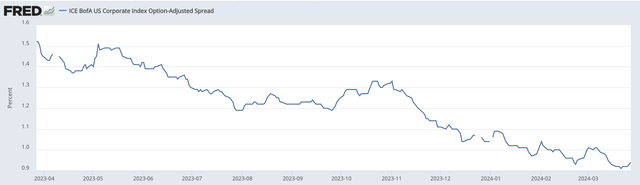
In essence, we see a positive price outlook for the LQD ETF. We anticipate a surge in its price to outpace a potential decrease in dividends.
Risks To Our Argument
The primary risk to our bullish argument is that the bond market isn’t easy to forecast. The yield curve can signal a million different things at once and leave us guessing. As such, it’s critical for readers to consider that our outlook is based on facts, but it’s not the only outlook that exists.
Furthermore, as mentioned earlier, the term premium could eventually affect LQD ETF’s market price. An increase in the term premium usually occurs due to inflation uncertainty, recession risk, and bond supply/demand, among other factors. And guess what? All of the aforementioned are in highly uncertain territory. Therefore, an increase in the term premium might occur and deplete the price of LQD ETF.
St. Louis Fed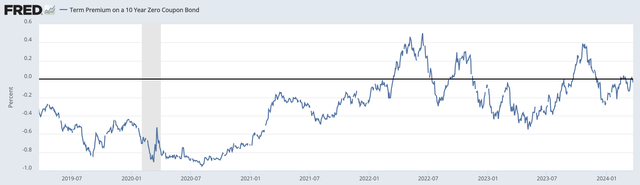
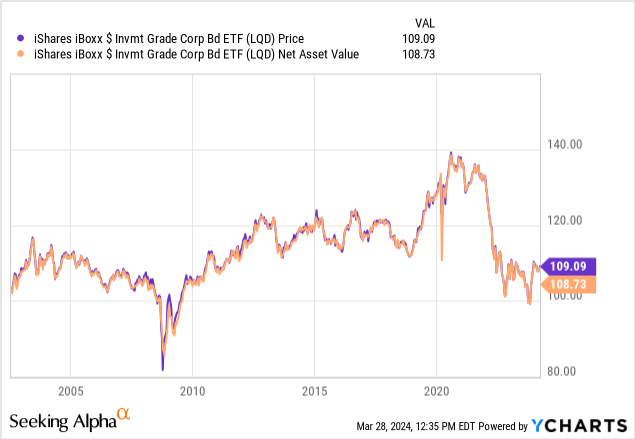
Lastly, LQD ETF is trading at a premium to its net asset value, which, in our view, shouldn’t be happening as the ETF’s constituents are highly liquid issuers (illiquidity can sometimes justify a premium-NAV).
Final Word
Our analysis shows that the iShares iBoxx $ Investment Grade Corporate Bond ETF likely provides investors with safe exposure to credit risk. Many investors might want to pivot out of cash when money market rates eventually do settle lower, and we think this ETF provides an excellent opportunity as critical risk premiums and issuer-based characteristics are aligned toward asymmetrical returns.
Credit: Source link