
Dilok Klaisataporn/iStock via Getty Images
Charlie Munger, Warren Buffett’s business partner, once said that “life will have terrible blows in it, horrible blows, unfair blows. It doesn’t matter. And some people recover, and others don’t.”
I can relate.
As many of you know, I was a successful real estate developer in my past life. The retail and industrial portfolio I built was worth around $100 million by the time I hit my late-30s.
I’m not saying I made that money by lounging on my couch, sipping high-end champagne and eating caviar. There was a lot of work involved.
At the same time, I was definitely enjoying that money made, flying on private jets, vacationing at luxurious destinations, and buying speculative real estate without blinking an eye.
That’s because financing was so very, very easy to come by, mostly in the form of debt. There was very little equity that went into our real estate deals, as lenders were very generous.
For instance, I was a partner in a private real estate investment trust (‘REIT’) that had obtained a multi-million dollar credit facility from Lehman Brothers.
Yes, that Lehman Brothers.
There were many things that led to my financial collapse. But I’m going to focus on just three lessons I learned in this article.
My goal, of course, is for you to become intelligent REIT investors from my mistakes.
As late motivational speaker Zig Ziglar said,
Sometimes adversity is what you need to face in order to become successful.
But hopefully not in your case.
Quality Properties
Sometimes, when I’m driving around my hometown, I get to see properties I used to own. And some of them, I have to admit, make me ask why I owned them in the first place.
Take the warehouse that I leased to Goodyear Tire (GT) back in the day. It’s now over 30 years old and has low ceiling heights – hardly an attractive feature and probably one that factored into Goodyear moving out years ago. I’m so glad I don’t own it anymore.
Instead, I’m now a stakeholder in a much more intelligently allocated local portfolio of just under 4 million square feet, thanks to STAG Industrial (STAG).
STAG website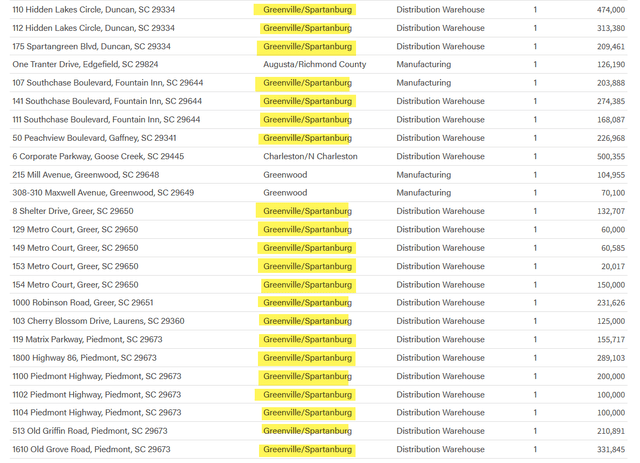
As shown above, STAG has a large portfolio of high-quality warehouses in my hometown. Unlike my old property, these ones are relatively new with – you guessed it – high ceilings.
About 31% of STAG’s portfolio handles e-commerce activity. And 55% of its portfolio here in the Carolinas is located within 30 miles of the projects on the map below:
STAG Investor Presentation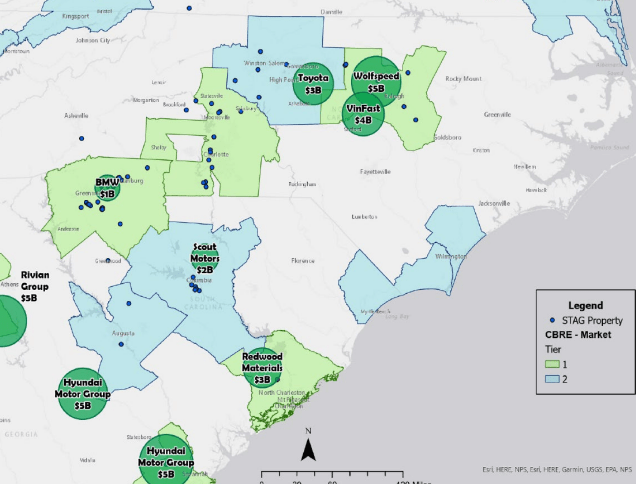
I think you’re getting my point, but let me share another one of my formerly held ugly ducklings anyway. This time, it’s a retail property in Gaffney, South Carolina.
It appears to be leased to Hibbett Sports (HIBB) and CitiTrends, two retailers that were part of my original development plan. So they were good picks.
However, there are also obvious vacancies that will be difficult to lease since Gaffney is a small town. Its population is only around 50,000.
I’m much happier being a stakeholder in this high-quality retail property:
Simon website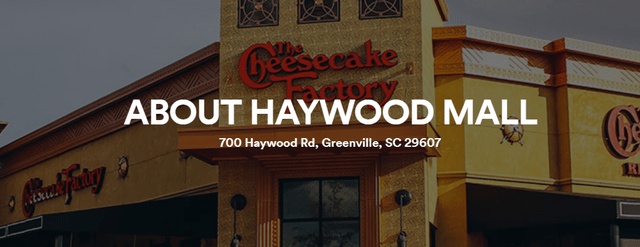
This time, my investment is in Simon Property Group (SPG) that happens to own the Haywood Mall in Greenville, South Carolina. It’s an A-quality retail center with more than 120 shops, including national brands like Belk, Dillard’s (DDS), Macy’s (M), JC Penney, Apple (AAPL), and The Cheesecake Factory (CAKE).
Another example is one of the single-family rentals I ran, located in downtown Spartanburg.
Being an apartment landlord is very involved. But being a shareholder of an apartment landlord like Mid-America Apartment Communities (MAA)? Not so much.
Here’s one of its South Carolina properties:
MAA website
All three of these REITs respect the concept of quality. Unlike how I operated back in the day, they don’t just want to own properties.
They want to own properties that continue to provide obvious, higher-end value year in and year out. And so they don’t settle for anything less. Not for themselves. Not for their tenants.
And not for their investors.
Shouldn’t you be demanding the same?
Quality Balance Sheets
Now, as I said, most of my development deals were highly leveraged. My partner’s and my capital stack was around 90% bank debt and 10% equity.
If that sounds appalling, it is. But it was also the norm back in the late ’90s and early 2000s. The banks were almost literally throwing money at us.
This means we were personally responsible for paying off most of the debt. So we were taking on outsized risks to generate mediocre returns.
In 2004, my business partner decided to go head over heels into a hotel project in downtown Spartanburg. Fortunately, I wasn’t a partner in that deal, however…
It became a big money suck for the partnership and eventually became the first domino to fall for my ultimate crash.
Marriott.com
The next domino was the Great Recession – the no-holds-barred reset button for me and thousands of other real estate developers across the country.
Just like that, the friendly bankers who were calling me every week wanting to go to lunch were ignoring me while getting nervous over their default lists.
I had little choice than to start over.
So in 2010, I showed up on Seeking Alpha.
I began to study REITs, almost becoming obsessed with their “forced” dividend attributes. I wasn’t used to that feature since my previous business partner had been hoarding dividends for his hotel project.
The one that ultimately went into foreclosure.
I studied CEOs like Tom Lewis, who was with Realty Income (O) at the time; Craig Macnab, formerly of NNN REIT (NNN) and now board member at VICI Properties (VICI) and David Simon over at Simon Property Group.
I became fixated on quality balance sheets, investment-grade ratings, and dividend payout ratios. I began reading books like The Intelligent Investor and Security Analysis.
I was completely transformed, with my mindset reshaped as I finally came to understand an enormously important two-pronged lesson: that monetary success involves playing:
- Good offense (i.e., earning money)
- Good defense (spending as little as possible).
Otherwise, you’re risking losing out on your true investment potential.
Quality Management
The last piece of the puzzle for me was people.
Although real estate is a property game, it takes people to generate the value. As legendary value investor Benjamin Graham wrote in the aforementioned Security Analysis:
It must never be forgotten that a stockholder is an owner of the business and an employer of its officers.
I was involved in dozens of partnerships before the Great Recession, which I thought I was handling well. But after I lost my first fortune, I began to train myself to think like an owner instead of as a shareholder.
Because the truth is that when I invest in a REIT – or any other company – I’m actually paying the executives’ salaries.
As an owner, I deserve to be treated with respect and consideration… something I guess I wasn’t used to in my previous life. This included meeting with management teams on a regular basis.
I’ve since interviewed well over 200 insiders, ranging from executives to analysts to even a few billionaires.
Having access to management teams has been better than obtaining an MBA at an Ivy League school – with all due respect to Cornell, Georgetown, and Wharton, where I guest lecture. I’m learning from some of the best risk managers in the world.
iREIT
And while I know that’s a privilege not every investor has at their disposal, I offer the next best thing to my readers…
My interactions and analysis of those interactions laid out in written and video (for members) form every week.
Speaking of which, I love that I now get to help investors build wealth by investing in stocks… while simultaneously teaching tens of thousands of people around the globe.
Sometimes, I even get to interact with you all in person, whether through conferences or the book signings I’ll begin doing for REITs for Dummies in just a few weeks.
The first one, incidentally, will be at a Barnes & Noble store I built back in the day – one of my better investments, even if I don’t own it anymore.
Barnes and Noble
I’m so excited about all the hard work I’ve put into my writing here at Seeking Alpha and my future prospects. I was once bitter about my financial troubles, but I decided long ago to learn from my mistakes…
And to help others avoid them altogether.
Ben Graham said it best when he said:
Adversity is bitter, but its uses may be sweet. Our loss was great, but in the end, we could count great compensations.
So thank you for being part of my trusted network! I hope that my writing encourages you to become an intelligent REIT investor and to avoid speculative opportunities.
Note: Brad Thomas is a Wall Street writer, which means he’s not always right with his predictions or recommendations. Since that also applies to his grammar, please excuse any typos you may find. Also, this article is free: Written and distributed only to assist in research while providing a forum for second-level thinking.
Credit: Source link