
georgeclerk
Author’s note: This article was released to CEF/ETF Income Laboratory members on June 11th.
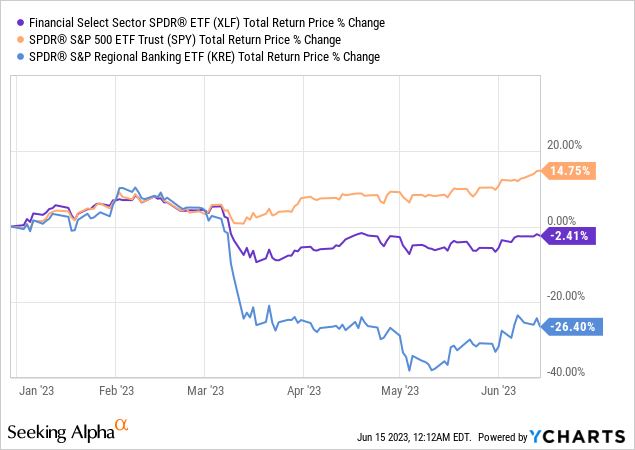
Banks have had a terrible year, with most seeing significant deposit outflows, lower share prices, and underperformance. Weakening bank balance sheets, caused by lower bond prices from higher interest rates, were the main culprit. Although all banks were impacted, regional banks saw much greater losses, with the SPDR® S&P Regional Banking ETF (NYSEARCA:KRE) down 26.4% YTD.
KRE saw much greater losses for several reasons, including the fact that some regional banks were massively overweight bonds, some had fickle customers, lax government regulation, and general bearish sentiment. These issues persist, and so regional banks remain risky investments, at least until interest rates normalize. As the Fed has stopped hiking, for now at least, this is a distinct possibility.
Why Are Banks Down?
Some context first.
The Federal Reserve has engaged in one of the most aggressive hiking regimes in recent history, hiking benchmark rates from around 0.0% in early 2022, to 5.00% – 5.25% as of mid-2023.
Data by YCharts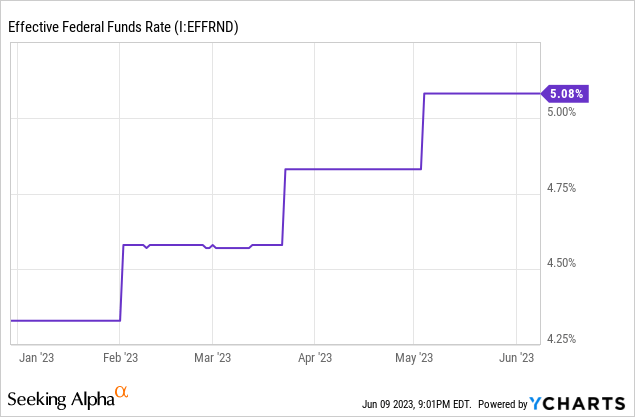
As the Fed hikes rates, the interest rate on newly-issued bonds increases, but most older bonds maintain their older, lower rates. As an example, 10Y treasuries issued in early 2022, before the Fed started to hike, yield 1.5% – 1.6%, while those issued today, after an aggressive set of hikes, yield around 3.7%. Higher Fed rates meant higher rates for newly-issued treasuries only.
Data by YCharts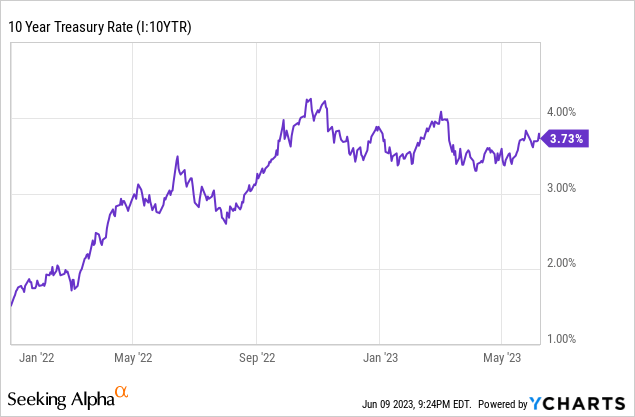
As rates rise, demand for older, lower-yielding bonds declines, leading to lower prices for the same. Demand for those older 10Y treasuries (US10Y) yielding 1.6% is quite low, as investors can receive more than double the yield investing in newer issues. The same is true for most other bond and fixed-income sub-asset classes, including investment-grade bonds, high-yield bonds, mortgages, and even simple commercial or personal loans.
Banks invest quite heavily in treasuries, mortgages, and other assorted fixed-income securities, and so have seen significant losses from higher interest rates. As an example, First Republic Bank (OTCPK:FRCB), which was an important regional bank, and the epicenter of the regional banking crisis, saw accounting losses of $426 million in 2022.
First Republic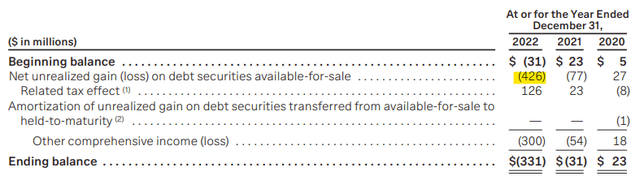
Importantly, due to accounting conventions, banks are not required to mark to market their held-to-maturity securities. Meaning, if a bank says they will hold a 10Y treasury until maturity, they can ignore any short-term price movements, and do not need to record these in their accounting statements. Banks generally hold a sizable percentage of their assets as held-to-maturity securities. First Republic’s investment portfolio was around 90% held-to-maturity, for instance.
First Republic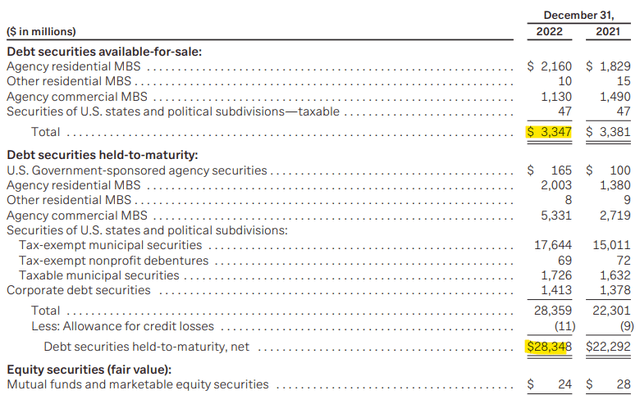
These saw $4.8 billion in unrealized losses in 2022. As these were held-to-maturity securities, these were not accounting losses, and were not registered in the company’s balance sheet or income statement.
First Republic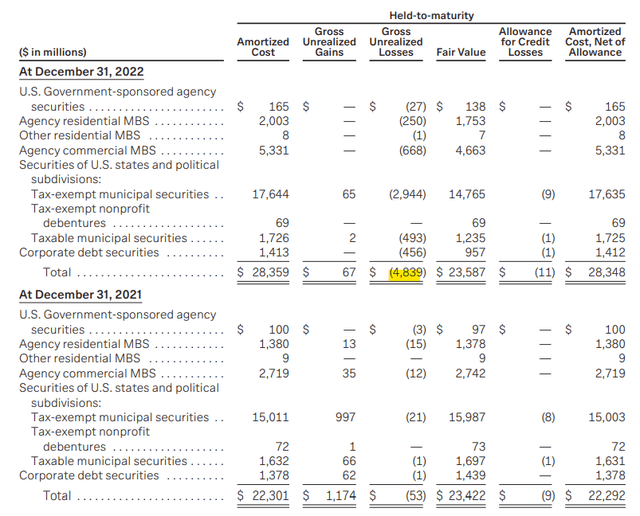
From the above, it seems that First Republic saw losses of $5.2B in 2022, all but wiping out the bank’s $5.6B in interest income (before expenses). For reference, First Republic was a $24B company before its collapse.
Data by YCharts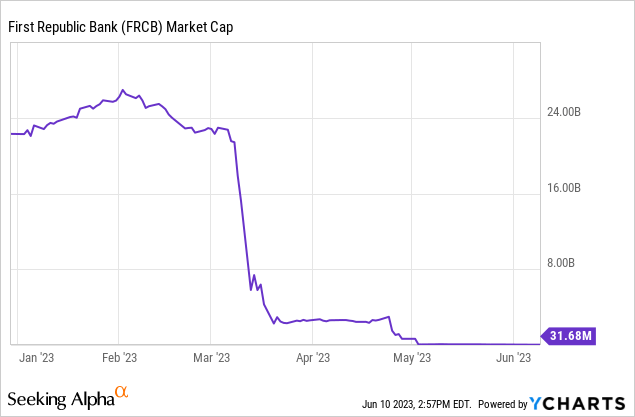
As per the FDIC, total industry unrealized losses amounted to $620B, as of late 2022. These losses were, well, staggering, and responsible for double-digit industry underperformance YTD. The graph is striking, with banks mirroring the S&P 500 until March 8th, when Silicon Valley Bank of SVB Financial Group (OTCPK:SIVBQ) announced a planned stock sale, investors got spooked, and the regional banking crisis started in earnest (in or around that date).
Data by YCharts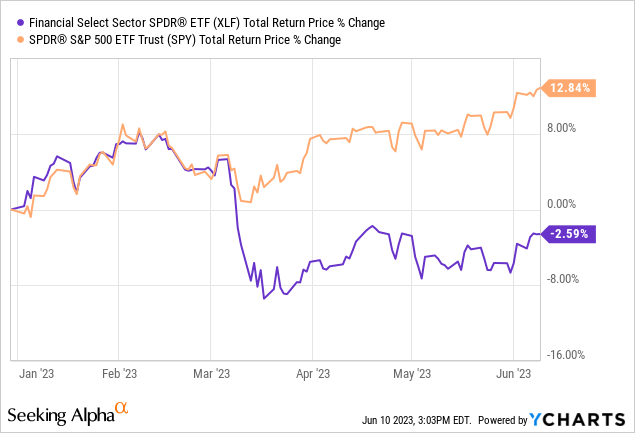
Although all banks were down, regional banks were down much, much more than average, with KRE seeing losses of 26.4% YTD.
Importantly, higher interest rates have more or less the same impact on banks of all sizes. JPMorgan Chase (JPM), for instance, saw $14.1B in accounting losses in 2022 due to higher rates, and unrealized losses of $36.6B for its held-to-maturity securities for the year.
JPMorgan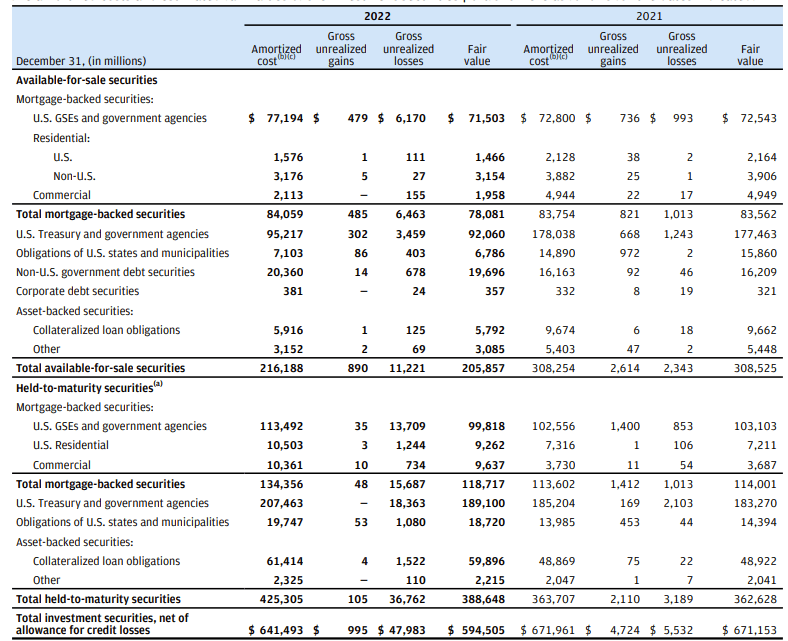
Both banks saw significant losses during the year, but only one, First Republic, collapsed. More broadly, regional banks have significantly underperformed mega-cap banks during the year, even though all have seen significant losses YTD. There are several reasons for this. Let’s have a look.
Why Are Regional Banks Down So Much?
Overweight Bonds
The larger U.S. banks, including JPMorgan and Citigroup (C), have incredibly well-diversified business and revenue streams – think mortgages, investment portfolios, corporate lending, and overseas operations. Their balance sheets and assets tend to be quite diversified as well, for the same reason.
Regional banks, however, are much smaller, and so are not necessarily as diversified. Some focus on a specific business or revenue stream, or hold a disproportionate amount of a specific type of asset. Some might focus on investment securities or bonds, for instance. Silicon Valley Bank, for instance, focused on, well, Silicon Valley VC and tech clients. On the asset side, SVB focused on investment securities, specifically bonds, as its client base had little appetite for mortgages, VCs can only own so many houses, and corporate lending, startups prefer equity.
Investment securities, mostly bonds, accounted for almost 60% of SVB’s balance sheet in 2022.
Silicon Valley Bank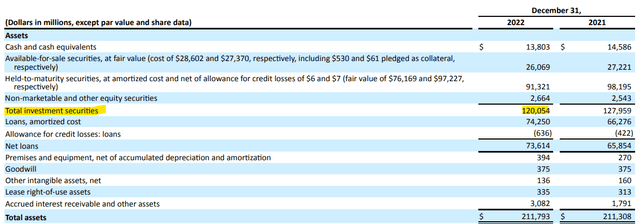
For JPMorgan, the figure was roughly 17%, much lower.
JPMorgan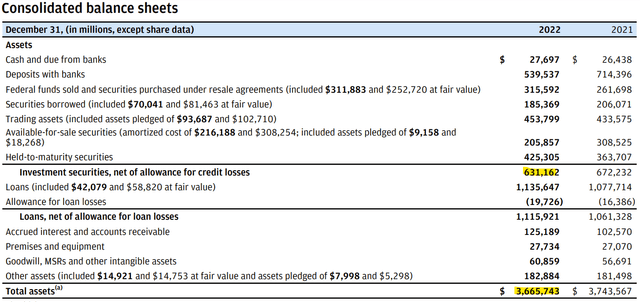
Higher interest rates led to lower bond prices, negatively impacting both SVB and JPMorgan. As SVB invested more heavily in bonds than JPMorgan, it suffered greater losses, with these ultimately leading the bank to collapse. Although not all regional banks focused on bonds, some did, which helps explain some regional banking underperformance YTD.
Fickle Customers
As the regional banking crisis unfolded, investors and consumers grew weary, and some decided to withdraw their deposits. As per the FDIC, U.S. banks saw a record $472B in deposit outflows in 1Q2023. In most cases, the larger banks saw below-average outflows, as consumers perceived these banks to be safer, and more resilient in the face of trouble. JPMorgan, for instance, saw its deposits decrease by 8% in 1Q2023.
JPMorgan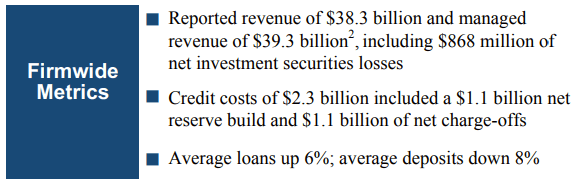
In most cases, regional banks saw above-average outflows, as consumers perceived these banks to be riskier. Some banks, including SVB, saw coordinated, large-scale outflows from its customers. Specifically, tech and VC group chats were abuzz with rumors and speculation about SVB days before its collapse. In a matter of days, these rumors turned into a bank run, with SVB’s customers withdrawing $42B in deposits in a single day. These amounted to around 25% of the bank’s total deposits. Customers wanted to withdraw another $100B the next day, for a combined 81% of the bank’s deposits, but the FDIC intervened.
For another, less dramatic, example, First Republic saw deposit outflows of 35.5% in 1Q2023, around twice those of JPMorgan.
First Republic Bank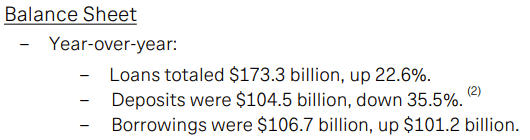
Regional bank customers have proven to be more fickle, quicker to withdraw their funds at the first sight of trouble. This has contributed to regional banking woes, and hence underperformance.
Lax Government Regulation
Or less strict, depending on your point of view.
In the U.S., larger banks must generally meet a stricter set of regulatory standards. Specifically, larger banks must generally hold a higher percentage of common equity tier 1 (CET1) capital than smaller banks. In most cases, around 2.0% – 4.0% more. As an example, JPMorgan had 13.2% in CET1 in 2022.
JPMorgan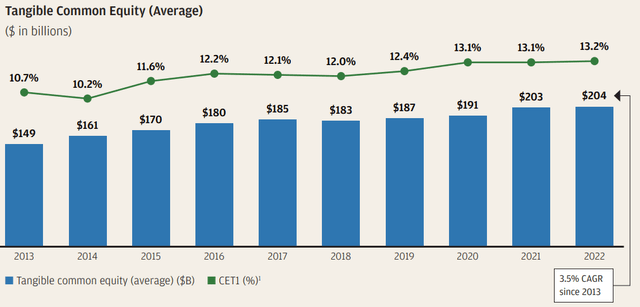
Versus 9.2% for First Republic.
First Republic
CET1 can be used to absorb losses, reducing the impact of these. First Republic would be insolvent with a 10% hit to its balance sheet, in life-threatening trouble at 5%. The same is true for most regional banks. JPMorgan would be insolvent at 15%, in serious trouble at 10%. The same is true for most of the larger U.S. banks.
As should be clear from the above, an equal amount of losses has a greater impact on the more leveraged, riskier regional banks, hence their underperformance YTD.
Larger banks must also meet a stricter set of liquidity and stress tests, which almost surely had a similar impact as their stricter set of capital requirements.
Bearish Sentiment
As a final point, it seems clear to me that bearish consumer and investor sentiment played a role in regional banking underperformance. Some of these banks, including First Republic, had reasonably well-diversified business streams, adequate balance sheets, and did not suffer outsized losses from higher interest rates. The bank did suffer losses, and it made some amount of sense for customers to withdraw their deposits and for investors to drive down its stock price, but I do think the bank could have survived with a more bullish, friendly customer and market outlook. Remember, JPMorgan ended up buying First Republic and assuming all of its deposits, so customers gained nothing from withdrawing their deposits. With better sentiment, First Republic might have retained its depositors, and weathered the storm.
Conclusion
Banks have significantly underperformed YTD, as higher interest rates have led to lower bond prices, weakening bank balance sheets. Regional banks / KRE have seen above-average losses, as some regional banks were massively overweight bonds, some had fickle customers, lax government regulation, and bearish sentiment.
Credit: Source link