
• bitcoinBitcoin(BTC)$80,664.003.49%
  • ethereumEthereum(ETH)$2,429.395.78%
  • tetherTether(USDT)$1.000.06%
  • binancecoinBNB(BNB)$714.362.08%
  • rippleXRP(XRP)$1.313.06%
  • usd-coinUSDC(USDC)$1.000.04%
  • solanaSolana(SOL)$96.233.63%
  • tronTRON(TRX)$0.318713-0.93%
  • Figure HelocFigure Heloc(FIGR_HELOC)$1.051.53%
  • zcashZcash(ZEC)$1,321.833.79%
  • HyperliquidHyperliquid(HYPE)$83.43-1.60%
  • dogecoinDogecoin(DOGE)$0.0765372.55%
  • moneroMonero(XMR)$635.23-0.55%
  • USDSUSDS(USDS)$1.000.04%
  • whitebitWhiteBIT Coin(WBT)$78.064.20%
  • chainlinkChainlink(LINK)$11.544.51%
  • leo-tokenLEO Token(LEO)$9.360.57%
  • cardanoCardano(ADA)$0.1978554.01%
  • stellarStellar(XLM)$0.1679623.43%
  • bitcoin-cashBitcoin Cash(BCH)$284.463.47%
  • nearNEAR Protocol(NEAR)$4.031.85%
  • uniswapUniswap(UNI)$7.653.90%
  • daiDai(DAI)$1.000.04%
  • Ethena USDeEthena USDe(USDE)$1.000.06%
  • litecoinLitecoin(LTC)$55.922.92%
  • RainRain(RAIN)$0.005827-7.39%
  • CantonCanton(CC)$0.1027924.12%
  • avalanche-2Avalanche(AVAX)$8.772.92%
  • suiSui(SUI)$0.933.42%
  • USD1USD1(USD1)$1.000.01%
  • the-open-networkGram (prev. Toncoin)(GRAM)$1.17-0.26%
  • tether-goldTether Gold(XAUT)$4,106.112.55%
  • hedera-hashgraphHedera(HBAR)$0.0727213.99%
  • quant-networkQuant(QNT)$208.066.95%
  • Global DollarGlobal Dollar(USDG)$1.000.03%
  • shiba-inuShiba Inu(SHIB)$0.0000051.66%
  • BittensorBittensor(TAO)$235.373.44%
  • paypal-usdPayPal USD(PYUSD)$1.000.03%
  • crypto-com-chainCronos(CRO)$0.0522063.23%
  • Ripple USDRipple USD(RLUSD)$1.000.04%
  • EthenaEthena(ENA)$0.180296-1.36%
  • Ondo US Dollar YieldOndo US Dollar Yield(USDY)$1.150.04%
  • okbOKB(OKB)$111.743.32%
  • Circle USYCCircle USYC(USYC)$1.140.01%
  • pepePepe(PEPE)$0.0000050.20%
  • aaveAave(AAVE)$132.652.18%
  • OndoOndo(ONDO)$0.4084042.24%
  • Pump.funPump.fun(PUMP)$0.004329-0.43%
  • MemeCoreMemeCore(M)$0.84-1.49%
  • BlackRock USD Institutional Digital Liquidity FundBlackRock USD Institutional Digital Liquidity Fund(BUIDL)$1.000.00%
TradePoint.io
  • Main
  • AI & Technology
  • Stock Charts
  • Market & News
  • Business
  • Finance Tips
  • Trade Tube
  • Blog
  • Shop
No Result
View All Result
TradePoint.io
No Result
View All Result

Key Factors That Drive Successful MCP Implementation and Adoption

July 27, 2025
in AI & Technology
Reading Time: 7 mins read
A A
Key Factors That Drive Successful MCP Implementation and Adoption
ShareShareShareShareShare


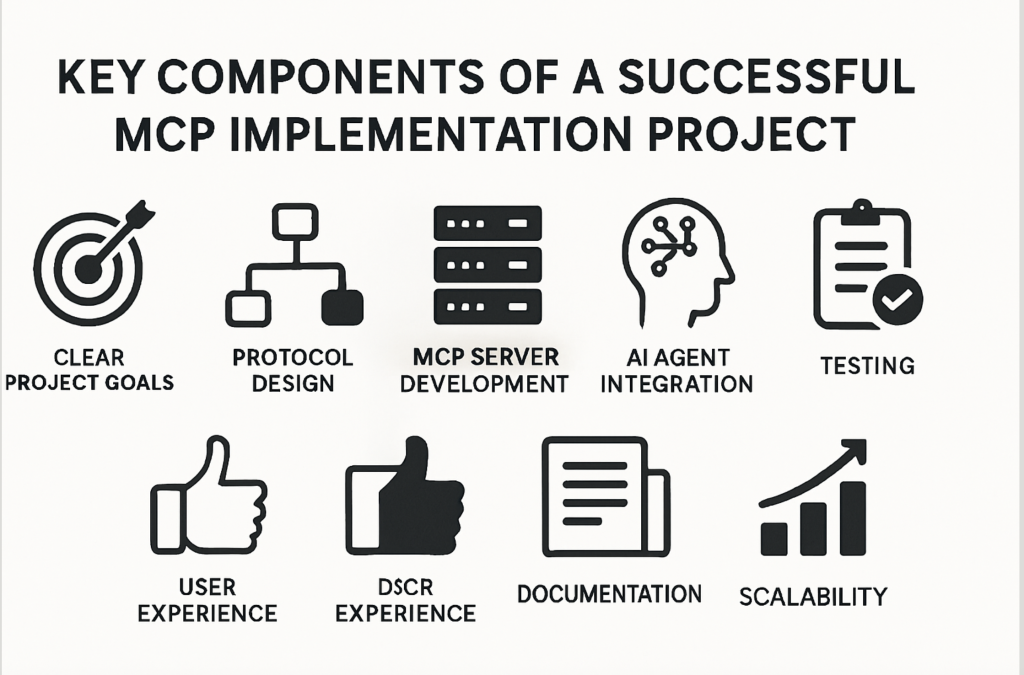
The Model Context Protocol (MCP) is changing how intelligent agents interact with backend services, applications, and data. A successful MCP implementation project hinges on much more than writing protocol-compliant code. Systematic adoption involves architecture, security, user experience, and operational rigor. Here’s a data-driven look at essential components that ensure MCP projects deliver value and resilience in production environments.
Source: Marktechpost.com

1. Clear Project Goals, Use Cases, and Stakeholder Buy-In

  • Define business and technical problems you’re solving with MCP: Example use cases include multi-app workflow automation, AI-powered content generation, or agent-based DevOps operations.
  • Engage users and IT early: Successful MCP teams conduct requirements workshops, interviews, and prioritize quick pilot wins.

2. Protocol, Integration, and Architecture Design

  • Mapping AI agent, MCP middleware, and target applications: The principle of loose coupling (stateless API endpoints) is key. Most advanced teams use HTTP/2 or websockets for real-time data push, avoiding heavy polling and reducing latency by up to 60% in agent workflows.
  • Contextual payloads: Embedding rich context (user, task, permissions) in protocol messages leads to higher agent accuracy and fewer ambiguous requests—critical for safety and compliance.

3. Robust Security & Permissions

Data Point: A 2024 GitLab DevSecOps survey found 44% of teams place security as the #1 blocker to AI workflow adoption.

YOU MAY ALSO LIKE

OpenAI’s Enterprise Sales Take Majority as Brockman Sees IPO Readiness – Unite.AI

Cat Wu to Lead Product Management for OpenAI’s Core Products – Unite.AI

  • Authentication: OAuth 2.0, JWT tokens, or mutual TLS remain best practices for MCP endpoints.
  • Granular permissions: Implement role-based access control (RBAC), with audit logging for every AI-triggered action.
  • User consent & transparency: End users should be able to view, approve, and revoke MCP access to data and controls.

4. MCP Server Development & Extensibility

  • Reusable, scalable, and stateless MCP servers: Architect servers that scale horizontally (containerized, cloud-native). Container orchestration (Kubernetes, Docker Swarm) is common for elastic scaling.
  • Open API definitions: Use OpenAPI/Swagger to document endpoints, enabling rapid onboarding of AI agents and developers.
  • Extensibility: Modular plugin or handler architecture supports future integrations without core refactoring—a trait in the most successful MCP deployments.

5. AI Agent Integration, Memory, and Reasoning

  • Contextual memory: Store recent actions (with expiry) or full session transcripts for auditability and continuity.
  • Failure handling: Implement structured error payloads and fallback logic—critical for scenarios where agent actions are irreversible or costly.

6. Comprehensive Testing and Validation

  • Automated test suites: Use mocks and stubs for MCP integration points. Cover input validation, error propagation, and edge cases.
  • User acceptance testing: Pilot workflows with real users, collect telemetry, and iterate quickly based on feedback.

7. User Experience and Feedback Mechanisms

  • Conversational UX: For agent-driven flows, natural language feedback and confirmations are critical. Well-designed systems show intent recognition rates >90% (Google Dialogflow research).
  • Continuous feedback loop: Integrate NPS surveys, bug reporting, and feature requests directly into the MCP-enabled tools.

8. Documentation and Training

  • Comprehensive, up-to-date documentation: Top-performing teams publish API docs, setup guides, and integration playbooks.
  • Hands-on training: Interactive demos, sample code, and “office hours” help drive adoption among developers and non-developers alike.

9. Monitoring, Logging, and Maintenance

  • Dashboards: Real-time monitoring of agent initiations, action completions, and API errors.
  • Automated alerting: Set up threshold-based alerts for critical paths (e.g., failed authentication spikes).
  • Maintenance routines: Schedule regular reviews of dependency versions, security policies, and context/permissions scope.

10. Scalability and Extensibility

  • Horizontal scaling: Use managed container services or function-as-a-service models for rapid scale-out and cost efficiency.
  • Consistent versioning: Adopt semantic versioning and maintain backward compatibility—enabling agents (and users) to operate during upgrades.
  • Plug-in architecture: Future-proofing your MCP implementation with plug-in compatible modules allows for the integration of new tools, agents, or services with minimal friction.

Conclusion

A successful MCP implementation is as much about robust architecture and security as it is about creating seamless, valuable user experiences. Teams that invest in clear vision, security, comprehensive testing, and continuous feedback are best positioned to harness MCP for transformative AI-powered workflows and applications. With the protocol ecosystem maturing rapidly and examples from industry adoption emerging each month, the playbook above helps ensure MCP projects deliver on their intelligent automation promise.


Michal Sutter is a data science professional with a Master of Science in Data Science from the University of Padova. With a solid foundation in statistical analysis, machine learning, and data engineering, Michal excels at transforming complex datasets into actionable insights.



Previous articleNVIDIA AI Dev Team Releases Llama Nemotron Super v1.5: Setting New Standards in Reasoning and Agentic AI


Credit: Source link

ShareTweetSendSharePin

Related Posts

OpenAI’s Enterprise Sales Take Majority as Brockman Sees IPO Readiness – Unite.AI
AI & Technology

OpenAI’s Enterprise Sales Take Majority as Brockman Sees IPO Readiness – Unite.AI

November 5, 2026
Cat Wu to Lead Product Management for OpenAI’s Core Products – Unite.AI
AI & Technology

Cat Wu to Lead Product Management for OpenAI’s Core Products – Unite.AI

November 5, 2026
Amodei Wins Dismissal of Direct Copyright Claim with Leave to Amend – Unite.AI
AI & Technology

Amodei Wins Dismissal of Direct Copyright Claim with Leave to Amend – Unite.AI

November 5, 2026
Snap Has More Than 30 Million Paid Subscribers Across Snapchat+ And Other Plans
AI & Technology

Snap Has More Than 30 Million Paid Subscribers Across Snapchat+ And Other Plans

November 4, 2026
Next Post
Stacey Abrams on her new book and the ethical questions of AI

Stacey Abrams on her new book and the ethical questions of AI

Leave a Reply Cancel reply

Your email address will not be published. Required fields are marked *

Search

No Result
View All Result
Two Measures Of Inflation: September 2026

Two Measures Of Inflation: September 2026

October 30, 2026
Anthropic IPO: How Investors in Asia Can Get In

Anthropic IPO: How Investors in Asia Can Get In

October 29, 2026
Former Army Secretary Dan Driscoll Joins OpenAI as Senior Counselor – Unite.AI

Former Army Secretary Dan Driscoll Joins OpenAI as Senior Counselor – Unite.AI

November 3, 2026

About

Learn more

Our Services

Legal

Privacy Policy

Terms of Use

Bloggers

Learn more

Article Links

Contact

Advertise

Ask us anything

©2020- TradePoint.io - All rights reserved!

Tradepoint.io, being just a publishing and technology platform, is not a registered broker-dealer or investment adviser. So we do not provide investment advice. Rather, brokerage services are provided to clients of Tradepoint.io by independent SEC-registered broker-dealers and members of FINRA/SIPC. Every form of investing carries some risk and past performance is not a guarantee of future results. “Tradepoint.io“, “Instant Investing” and “My Trading Tools” are registered trademarks of Apperbuild, LLC.

This website is operated by Apperbuild, LLC. We have no link to any brokerage firm and we do not provide investment advice. Every information and resource we provide is solely for the education of our readers. © 2020 Apperbuild, LLC. All rights reserved.

No Result
View All Result
  • Main
  • AI & Technology
  • Stock Charts
  • Market & News
  • Business
  • Finance Tips
  • Trade Tube
  • Blog
  • Shop

© 2023 - TradePoint.io - All Rights Reserved!