

Kimberly White
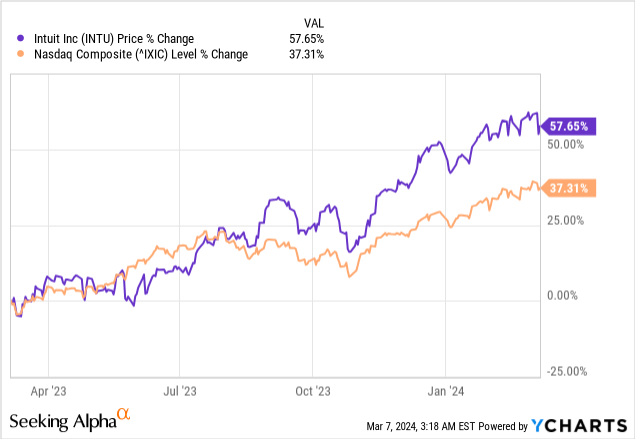
Intuit Inc.’s (NASDAQ:INTU) share price has been on a tear recently, appreciating by more than 57% over the 12-month period alone. At the same time, the Nasdaq Composite Index (COMP.IND) increased by only 37%, which is a record high but yet looks insignificant when compared to what INTU has achieved.
As a matter of fact, we have been here before – in 2021, when Intuit’s stock price skyrocketed and has nearly doubled over the course of just one year (see the graph below). At the time, I turned neutral on the stock as it was obviously in the epicenter of the unsustainable market melt-up.
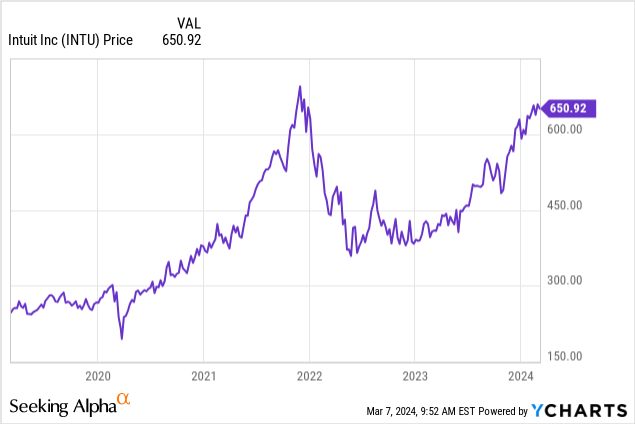
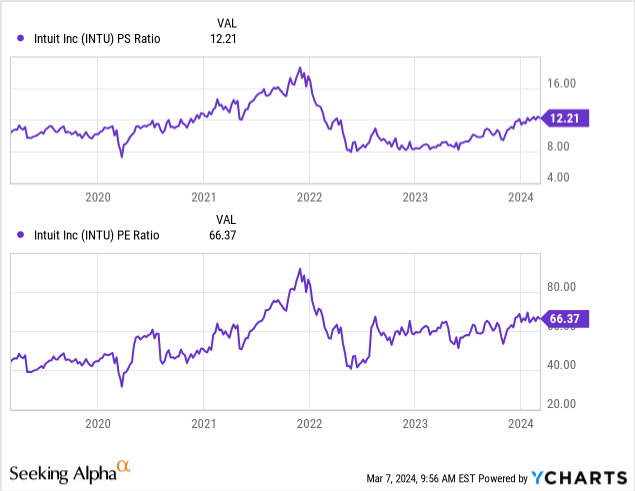
Although there are similarities between now and 2021, it will be foolish to simply draw the line and assume that the stock is headed for a similar drop as it did in 2022. The current multiples appear to be once again running ahead of fundamentals, but they are nowhere near to the levels we witnessed in 2021.
To shareholders’ disappointment, however, there are other moving parts within the business that no longer look as good as they used to just a few years ago, and this matters a great deal for expected returns over the long run.
Making Sense Of Intuit’s Premium Valuation
As we saw in the graph above, Intuit’s earnings and sales multiples are nowhere near the exuberant levels of late 2021, but they do appear elevated within the historical context. The same could be told when compared against the industry average, with Intuit trading at a significant premium against the sector median.
Seeking Alpha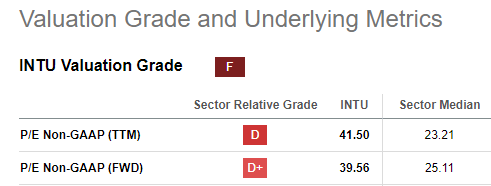
Even when we narrow down the company’s peer group to large cap software-as-a-service and cloud players, Intuit is still priced at a significant premium when considering the company’s current margins. On the graph below, we could see that Intuit’s Forward Price/Sales multiple of 11.3 is well-above the trendline, which suggests that either the multiple needs to compress or that the market is already pricing-in a notable expansion of the company’s net income margin.
prepared by the author, using data from Seeking Alpha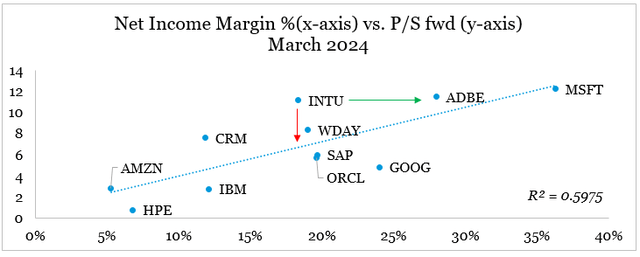
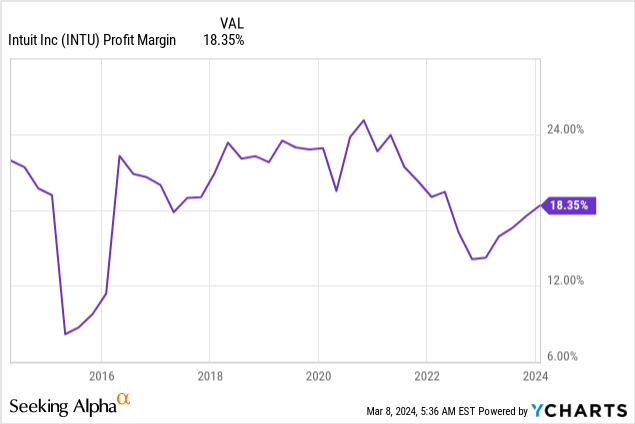
The first scenario would obviously be a disaster for Intuit’s shareholders, that’s why the company would have to achieve net income margins of more than 25%. This would be even higher than the record highs achieved in the 2020-2021 period.
One way to achieve that would be through economies of scale on fixed cost items, but since FY 2019 only selling and marketing expenses have noted a meaningful decline as a share of sales – from 28% in FY 2019 to 25% over the past 12-month period. In research & development and general & administrative expenses, Intuit has not managed to achieve any meaningful progress over the past couple of years.
prepared by the author, using data from SEC Filings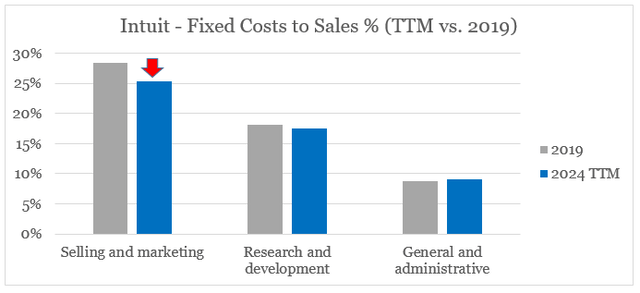
Another area of improvement would be gross margin, which unfortunately has fallen significantly in recent years as Intuit acquired two lower margin businesses – Credit Karma and Mailchimp.
prepared by the author, using data from SEC Filings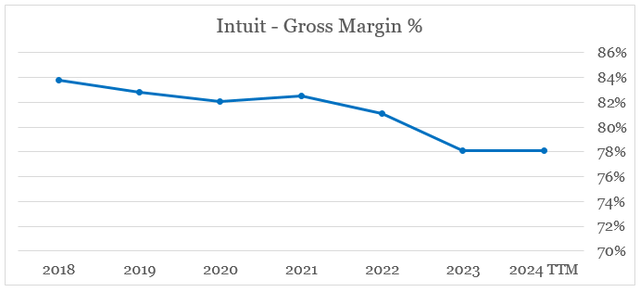
Ultimately, these two deals should increase the average revenue per user for Intuit and hopefully also allow the company to further increase pricing, thus improving gross margins. So far, however, this does not appear to be the case.
What About Growth?
Even if Intuit does not achieve the aforementioned net income margins, investors might not punish the stock as long as the exceptionally high top-line growth experienced in recent years is sustained.
At the moment, analysts expect a slight acceleration in the company forward revenue growth from the one realized over the past year (see below).
Seeking Alpha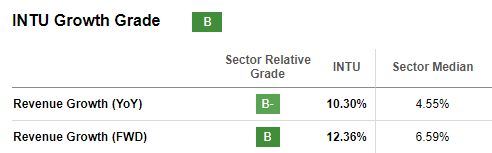
During the last conference call in February, Intuit’s management has also reaffirmed its guidance for a topline growth in the range of 11% to 12%.
We are reaffirming our fiscal 2024 guidance. This includes total company revenue growth of 11% to 12% and GAAP operating income growth of 15% to 18%; non-GAAP operating income growth of 12% to 14%. GAAP earnings per share growth of 11% to 15% and non-GAAP earnings per share growth of 12% to 14%.
Source: Intuit Q2 2024 Earnings Transcript (emphasis added).
It is essential that the company not only meets this target for FY 2024 but provides a similar or even better guidance for FY 2025, if a multiple contraction is to be avoided. The reason being that GAAP earnings per share are expected to grow at similar rates to the revenue in the current fiscal year which assumes flat net income margin.
A troublesome trend in recent years, however, has been the gradual decline in Intuit’s forward revenue growth rate from 23% in FY 2022 to 12% currently.
prepared by the author, using data from Seeking Alpha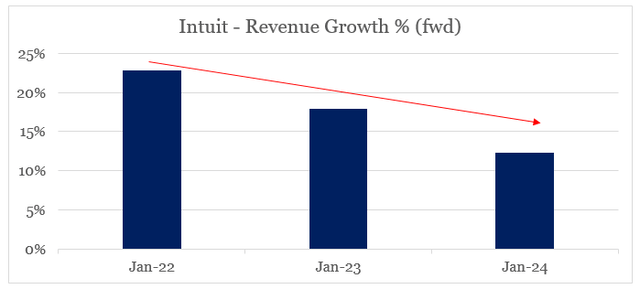
Although growth rates have been declining more broadly in the technology sector, Intuit is no longer growing at rate that is significantly higher to those in the expanded peer group. Companies, such as Microsoft (MSFT), Amazon (AMZN), Oracle (ORCL), Adobe (ADBE), Salesforce (CRM) and Alphabet (GOOG) are all currently expected to grow at very similar rates to that of Intuit.
prepared by the author, using data from Seeking Alpha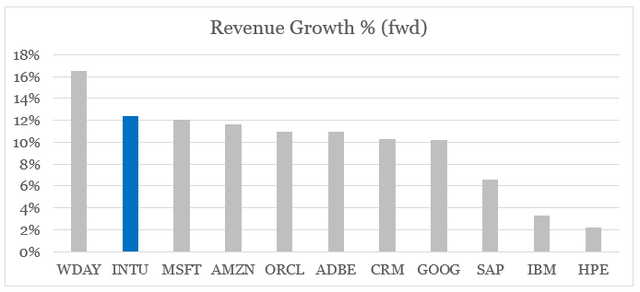
The big selling point of Intuit when it comes to either accelerating or at the very least sustaining its top-line growth is the creation of an ecosystem aimed at serving individuals and small businesses.
Intuit Investor Presentation
By combining its existing service offerings of TurboTax and QuickBooks with the recently acquired companies, the management is doubling down on cross-selling opportunities between the different platforms.
(…) small businesses can file their taxes with TurboTax and, if a small business is a QuickBooks Online customer, they can file their taxes with an expert.
(…) we’re more deeply integrating Credit Karma and TurboTax, making it even more seamless for Credit Karma members to file with TurboTax directly in the Credit Karma app, with exclusive offers for members
Source: Intuit Q2 2024 Earnings Transcript.
This is a similar strategy to the one adopted and successfully implemented by Salesforce with the aim to also increase average revenue per user and reduce attrition.
Salesforce Investor Presentation
The disadvantage that Intuit has, however, is that it serves individuals and smaller businesses as opposed to the focus on large corporate clients that CRM has. In the case of INTU, the company needs to rely more heavily on branding – an area where its legacy services are particularly good at, but the newly acquired businesses are not. The ongoing difficulties of Credit Karma, in spite of all the cross-selling opportunities, is a sign that Intuit’s strategy might not work as well as that of Salesforce did.
prepared by the author, using data from SEC Filings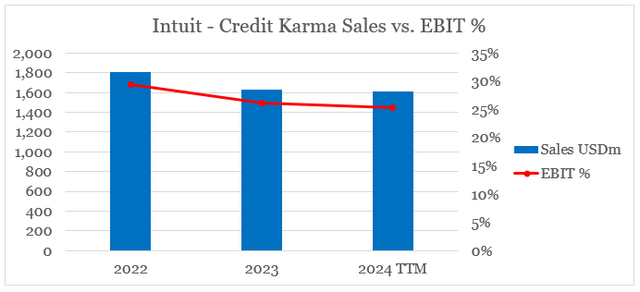
All this integration sounds very good on paper, but it is hard to convince individuals and small businesses to spend more on tax related and credit services. When compared to large corporate clients, smaller businesses are more price sensitive and switching costs are relatively low.
Another growth area of focus for Intuit is generative AI and the hope that such added features would allow for more price increases in the future. Although this could be the case when it comes to filing taxes, I am skeptical that AI-generated emails, email automations, analytics and reporting would be sufficient to differentiate a business like Mailchimp from its competitors in order to allow for sustained price increases.
Intuit Investor Presentation
Conclusion
After a stellar performance over the past year, Intuit Inc.’s share price is once again running well-ahead of business fundamentals. Although the gap between the two is not as high as it was back in 2021, there is significant downside risk at current levels. In order to sustain the valuation, Intuit’s management would need to significantly improve margins or prove to investors that it could at least sustain its high revenue growth in the meantime. Both of these scenarios appear highly unlikely based on the current strategy and the progress made in recent years. That is why, I change my rating on the stock from “Hold” to “Sell.”
Credit: Source link