
kynny
Investment Thesis
inTEST Corporation (NYSE:INTT) has plummeted around 50% since my first article and hit my price alert, therefore, I wanted to revisit the company to see if it would be a good time to start a position now or if there was a good reason the company fell so much since that article. The company progressed decently over the last 3 quarters, but since it was up over 200% back in June, any negative that came out after that, made some investors lock in those profits. The declines in backlog and slower revenue growth were the culprits in my opinion. However, given that I believe the worst is behind us, I am upgrading the company to a buy from a hold.
Briefly on the Company
INTT offers test solutions for many different markets, such as Automotive, defense/aerospace, primarily in the semiconductor sector. It offers induction heating products, that help with precise heating and cooling in the mentioned sectors, and manipulator and docking products that help with precision in moving delicate components found in the semiconductor sector.
Briefly on Financials
As of Q3 ’23, the company had around $46m in cash and equivalents, against around $9m in long-term debt. That is not a problem, and the company can easily manage it. They’ve been chipping away at it over time, so I would expect it to be gone very soon, which will free up more capital to further the growth of the company. Let’s see how INTT’s other financial metrics progressed over the last 3 quarters, which may give us an indication of why the company dropped so much so quickly.
Looking at the company’s margins, there have been improvements all across the board, although minuscule improvements, nonetheless. It is better to have consistent and stable margins than a deterioration, so I don’t see anything wrong here.
Margins (SA)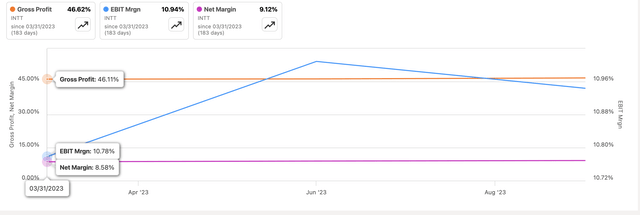
When we look at some efficiency and profitability metrics, we can see a different picture. ROA and ROE have been on a decline since the beginning of last year, which tells me that the management is not utilizing the company’s assets and shareholder capital as efficiently as before, that is not a good sign, but I wouldn’t worry about it too much right now because I would like to see how these develop over the next few quarters to conclude. Furthermore, the company has been losing its competitive edge, as ROTC has declined slightly too, but the same applies here, I need more data to conclude that it’s getting worse.
Efficiency and Profitability (SA)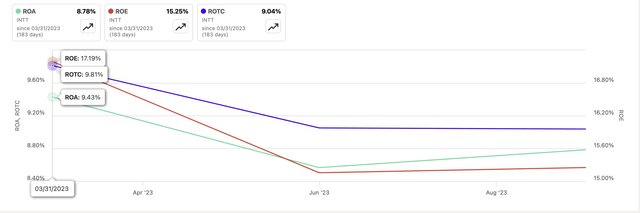
In terms of revenue, we can see a solid upward trajectory. However, the growth has slowed down somewhat, which could be just due to the softening of the macroenvironment and the semiconductor sector in general in 2023, in which case, this should be short-lived.
Revenue (SA)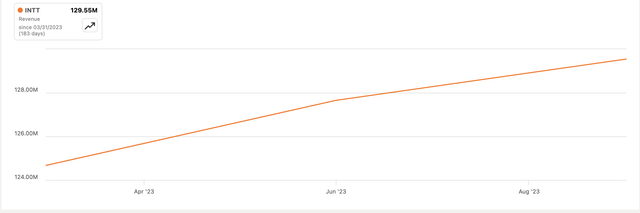
Overall, the company performed rather decently in my opinion. I did not see a lot of negative trends except in efficiency and profitability, however, as I mentioned earlier, I need more quarters to draw a certain conclusion. The company’s balance sheet remains solid with plenty of dry powder to fuel the company’s expansion going forward via organic and inorganic growth alike.
Comments on the Performance
So, why has the share price plummeted since my first article on the company, if it is still growing? I think it’s a mix of quite a few things. In my first article, I argued that the company’s meteoric rise of around 200% in one year was unsustainable and not a good time to start a position. 200% is quite a runup, so naturally people took profits. Couple that with the company’s not-as-impressive growth as once thought, and deteriorating backlog, the company’s performance was lacking overall, which made more people sell their positions and lock in some profits. The company’s 5-point strategy which aimed to grow at 30% CAGR through 2025 hit a bump in FY23 due to the negative sentiment of the industry macroeconomic environment overall, which is going to be hard to achieve going forward. Not impossible but it will be tough and will require quite a miracle if the company was to pull it off. The growth for FY23 slowed down to around 8% y/y, which is way below the expectations of the strategy.
The backlog has been on the decline for the last 2 quarters, which no doubt made a lot of investors pull out of their investments and look for other opportunities.
Q4 Expectations
Analysts estimate the company to make $0.11 a share and $0.14 a share, on GAAP and adjusted basis, respectively. The analysts are also expecting the company to make around $29.15m in revenues for the quarter, which is a 10% decrease sequentially and y/y. These are very similar to what the management is guiding for the quarter as well, which is not the best outlook in my opinion. The y/y decrease in revenues is not what anyone wanted to see, however, given the tough times in the industry it is not at all surprising, which according to the investor slides “worsening macroeconomic conditions drove a shift in demand as customers slowed project timing and decisions on future projects.” Semi and industrial markets were also the reason for such a slowdown in performance, which will be present in Q4 results.
Company’s Guidance (Investor Slides)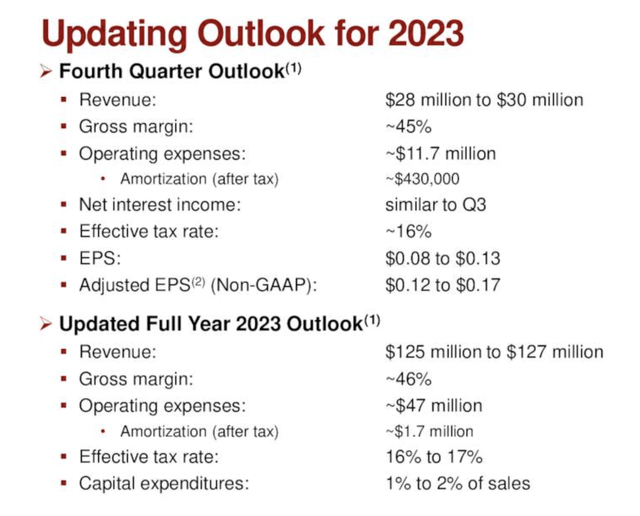
In the last 11 quarters, the company missed EPS and revenue numbers only once, which may indicate that the company should at least meet expectations for Q4.
Earnings Beats and Misses (SA)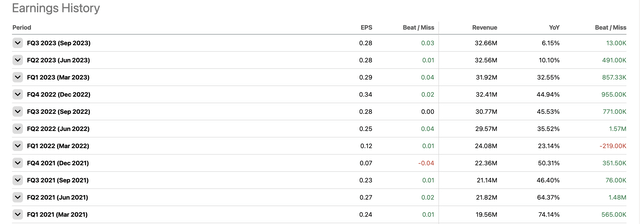
Comments on the Outlook
I would like to see the backlog getting stronger again. In Q4 I wouldn’t be surprised if the backlog softened, but what I would like to see is a rebound across the board in terms of revenues in different segments. Many analysts are expecting the semiconductor industry to rebound in 2024, which should help boost the company’s revenue considerably.
Furthermore, I would like to see how the defense and aerospace segment progresses. The last 9 months have seen a substantial revenue growth of around 109% y/y when comparing 9 months ended September 30th ’22 to ´23. If this segment continues to perform like this, it will become a major revenue catalyst for the company, and coupled with the improvements in the semiconductor industry, I expect the management to be upbeat about the next year, and if we get anything but that, I could see the share price plummet even more on the day. Guidance is what matters the most in this market.
I will listen to how the 5-point strategy is progressing how the company feels about its future, and whether the 30% CAGR is still on the books. I think it’s going to be tough but I’m hopeful.
Overall, I do believe that the worst is behind for the company, as the main sector is poised for a rebound, and because the shares are down 50% since my first article, I believe the entry point is much more enticing now than it was back in June of last year. So, let’s look at some updated valuation estimates.
Valuation
For revenue growth, I went with around 8% growth for FY23, and for the rest of the model, the CAGR will be at around 9% through FY32, which I think is on the more conservative end, and will act as sort of a margin of safety. To cover my bases, I am also modeling a more conservative scenario and a more optimistic one. Below are those estimates, with their respective CAGRs.
Revenue Assumptions (Author)
For margins and EPS, I decided to improve gross margins by around 200bps over the next decade, while keeping operating margins as they are, which will act as a further margin of safety. This way the EPS growth is around 12% per year, which for the size of the company isn’t particularly impressive. Below are those estimates.
Margins and EPS assumptions (Author)
For the DCF model, I went with the company’s elevated WACC of around 12.5%. I usually like to use around 10% as my discount for the DCF but I figured the more room for error the better. Furthermore, I went with a 2.5% terminal growth rate. And just to be completely protected from the downside, I decided to discount the intrinsic value by another 20%, just to be safe. With that said, INTT’s intrinsic value is around $12.30 a share, which means the company is trading slightly below its conservative fair value.
Intrinsic Value (Author)
Risks
The semiconductor industry and aerospace and defense sectors may turn negative even more in 2024, due to lingering inflation and high interest rates, which may push a lot of customers to delay their projects further. This will in turn continue to weigh on the company’s backlog negatively and we will see the share price continue to fall further, even after such a drop already.
The 5-point strategy is not successful, which will force the company to come up with a new plan to restore the company’s growth. I think that this will put more pressure on the downside as investors may lose confidence in the management and will start to flee in droves.
Since the company is very small, as of writing this article it is down to just a $137m market cap, with very little daily trading volume, I would expect a lot of volatility in share price. So, be ready to stomach further large fluctuations in share price, especially if someone decides to unload their shares on a bad report.
Closing Comments
Since the company did eventually come down to my PT that I set back in June, and with the tougher environment behind us, I believe that starting a position at this price is not a bad idea. The risk/reward is much more enticing now than it was just 8 months ago. There may be some further fluctuations in the share price, so it is up to you to do further research into the company and its prospects, and whether you would want to start a position before the earnings come out or not.
I am going to hold off until after the earnings just to flush out the built-up volatility and would want to hear the management’s guidance for 2024. Nevertheless, I am upgrading the company to a buy as I believe the downside risks are minimal.
Credit: Source link