Thai Noipho/iStock via Getty Images
Co-authored by Treading Softly.
When you hear the word catalyst, what comes to mind? For many, you may immediately think of your car and its catalytic converter.
Good thinking!
The catalytic converter contains a material to help finalize the conversion of emissions in your car’s exhaust system to less dangerous and less smelly gases.
A catalyst is something, a chemical, a material, or an energy source that helps kickstart a reaction and often remains unchanged by the reaction it starts.
When it comes to the market, interest rate changes are a catalyst for many investments. Rising rates add economic pressure to various realms of the economy and market. Fixed income usually suffers and falls in interim trading value. Falling rates can have an inverse effect, causing fixed-income trading prices to rise. We’re on the edge of rates getting cut, we just don’t know when. Like turning the key on a cold winter day and you hear the engine turning.
Whether it’s 3 months from now or next year, we want to be in a position to benefit from falling rates, all while collecting high levels of outstanding income from our portfolio.
Today, I want to touch on one investment that will benefit from falling rates but will continue to provide us with strong income while we wait.
Let’s dive in!
AGNC
AGNC Investment Corp. (NASDAQ:AGNC), yielding 15%, is an agency mortgage real estate investment trust, or mREIT. It follows a business model of investing in “agency MBS,” and using leverage to maximize returns. Agency MBS are mortgages that are guaranteed by the agencies – Fannie Mae and Freddie Mac. As a result, they have very low credit risk. You will frequently find agency MBS alongside U.S. Treasuries as low-risk, highly liquid investments for banks or insurance companies. They are also often used to support the yield of money markets. AGNC buys agency MBS on a leveraged basis and shorts US Treasuries as a hedge. So while there isn’t any credit risk, the value and cash flow from AGNC’s portfolio is very sensitive to interest rate movements, and in particular the relationship between agency MBS and US Treasuries. Over the past few years, AGNC has seen its book value decline as MBS and Treasuries have sold off due to higher interest rates. Spreads between MBS and Treasuries have increased.
Despite the headwinds, AGNC continues to comfortably cover its dividend. In Q4 2023, it reported a net spread and dollar roll income of $0.60/share, easily covering its $0.36 dividend for the quarter. It is worth noting that this number declined throughout 2023, and we expect that it will decline further as it is benefiting from below-market interest rate swaps that will expire over the next 6 months. We do expect that the dividend is set at a level that will be sustainable.
When asked about the dividend, CEO Federico emphasized that management and the Board looked at the dividend based on current economics, not on a current carry or accounting basis. He concluded that the dividend and economics were “still well aligned,” while alluding to the likely potential of some favorable changes saying:
“That number with spreads, call it just roundly in the 150 basis point range, I think you can conclude that mortgages are generating mid-teens ROEs, given the way we’re managing our portfolio, so I think the important takeaway is those two things still remain relatively well aligned. Again, as the environment unfolds, and we talk about some favorable drivers – decline in interest rate volatility is beneficial, there’s no doubt about that, and so we’ll have to make those determinations over time. But generally speaking, I think it’s fair to say that those two things are still well aligned.”
Ultimately, a mortgage REIT is passing along the results of their underlying trade, for better or worse. There are a lot of reasons to be quite optimistic about agency MBS considering that they were recently trading at multi-decade lows, and will generally benefit from stable to declining interest rates.
Breaking The Tie To Book Value?
We’ve held AGNC through what has proven to be one of the most difficult cycles in history for MBS. The reason we’ve held AGNC is because it has continued to provide significant dividends and we have confidence that it will continue to pay relatively high dividends while we wait for the next upswing. We have been content to hold, focused more on the income generated from the investment, and not particularly concerned about book value.
This is a position that has faced significant critique. There is a large segment of investors who strongly hold the belief that an agency mortgage REIT “should” only be bought at a discount to book value, and should be sold if it is ever at book value.
In all fairness, for the past decade, this strategy has been quite successful as AGNC has rarely traded at a premium to tangible book value:
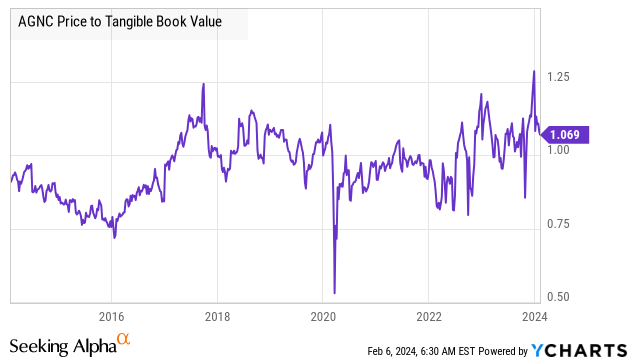
For the past decade, the pattern was following book value with a bias to the downside. But is this pattern inherent in the structure? No. From 2009 through 2012, AGNC traded at a 10-20% premium to tangible book value more often than not.
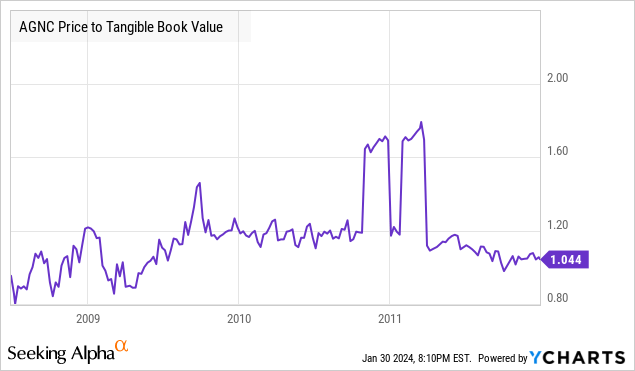
Investors who sold when AGNC first started trading at a 20% premium in January 2009 missed out on the greatest streak of outperformance in AGNC’s history. (And a boatload of dividends!)
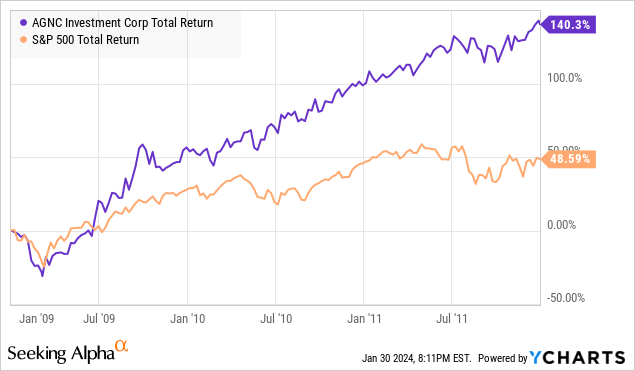
Agency MBS is an asset class that shines when interest rates are declining and when investors are worried about a recession. We just went through the opposite, years of rising interest rates, and most investors were more worried about inflation than a recession. As investors start to become more fearful that a recession will happen, it is very reasonable to expect that the pattern of trading at a premium to book value will return.
While two quarters do not establish a pattern, the past two quarters of AGNC’s price has shown the market is no longer as obsessed with book value as it once was.
AGNC reported an improvement in book value to $8.70, and in the earnings call management indicated that book value was up 1-2% year to date, so book value was recently at $8.78-$8.87. AGNC’s share price responded by declining to $9.50, which is a 7% premium to management’s high-end estimate.
The market seems much more willing to provide AGNC with a valuation at a premium to book value. It is possible that AGNC reverts to the tendency over the past decade and goes back to book value or below. Yet, it is also possible that the cycle has turned and that trading at a premium will become the new normal. Either way, as book value recovers and the price rebounds, we will sit here collecting our dividends.
Conclusion
Today, we’ve reviewed the past impacts of falling rates on MBS and how AGNC, as a leveraged play on MBS, can directly and heavily benefit from falling rates. As a professional income investor, my portfolio is designed to be heavily interest rate agnostic, meaning different holdings thrive from falling rates, while others are going to thrive from rising rates. AGNC plays a critical role in helping balance my income portfolio’s agnostic nature to interest rates.
When it comes to retirement, you want a steady stream of cash following into your portfolio. AGNC can help balance your exposure to business development companies (“BDCs”), for example, as AGNC’s dividends are set to rise with falling rates, while BDCs would see declines. This type of interest impact balancing can help you enjoy a stable and growing income stream in all economic environments. That type of income stream helps you develop financial security and independence – something we all could use more of!
That’s the beauty of my Income Method. That’s the beauty of income investing.
Credit: Source link