








































Thomas De Wever
Strategy
Launched and managed by BlackRock, Inc., and BlackRock Fund Advisors, the iShares Cohen & Steers REIT ETF (BATS:ICF) invests in stocks of companies operating across Mortgage Real Estate Investment Trusts (REITs) in the United States. The fund invests in growth and value stocks across diverse market capitalizations and aims to track the performance of the Cohen & Steers Realty Major Index using a representative sampling technique. Its portfolio holdings are selected based on several factors, including management, portfolio quality, capital structure, sector, and geographic diversity. The fund was launched on January 29, 2001, and has amassed an AUM of $2.24 billion.
Holding Analysis
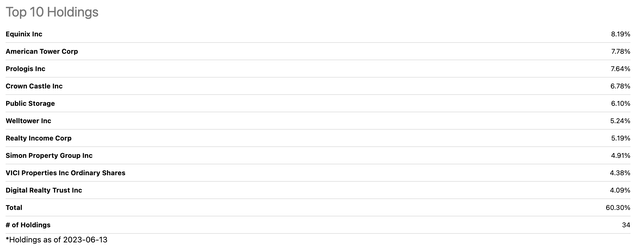
ICF primarily invests in relatively large and liquid mortgage REITs that are dominant in their respective property sectors. The fund only invests in a total of 34 holdings in a variety of sub-sectors, including Telecom Towers, Retail, Multi-Family Residential, Data Centers, and Industrials, to name a few. A comprehensive breakdown of the sectors can be seen in the chart below. Moreover, the top 10 holdings in its portfolio constitute over 60% of its entire portfolio, with a skew in weighting towards the top five holdings. The weights of the top 10 holdings range from 4% to 8%. With only 34 holdings, the fund is heavily dependent on the top few holdings in this portfolio.
iShares Seeking Alpha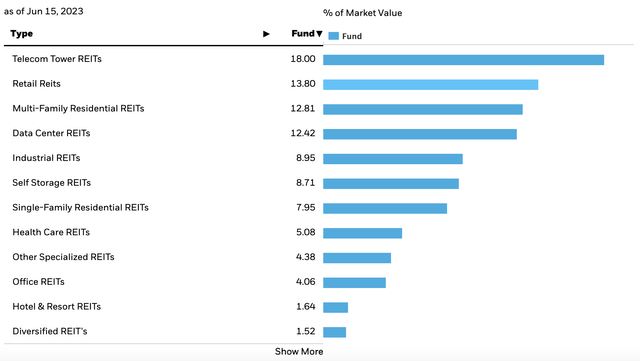
Steady and Consistent Dividends
One of ICF’s key strengths is its decently attractive and steady dividend yield. The fund currently has a dividend yield of 2.72%, which is slightly higher than the median for all ETFs. Although this number is not extraordinarily high, ICF makes up for it by having a high dividend growth rate (TTM) of over 25%, which has a 66% differential to the median of all ETFs. While ICF currently only has two consecutive years of dividend growth, the fund has been consistently paying out dividends since its inception, for 21 years. The median of all ETFs in this regard is only two years. Furthermore, the fund has also maintained an average yield of 2.37% over the past four years, which is only slightly lower than its current yield. This is another testament to the fund’s stability in dividends considering the market downturn in 2022 and into 2023.
ICF Performance Analysis
If we look at the returns of ICF and its closest peer competitors, it is evident that REITs performed terribly in 2022. After reaching a peak at the onset of 2022, their returns have been consistently falling until they somewhat leveled out in 2023. While these funds all perform very similarly to each other, ICF has experienced the lowest returns in the group, at a rate less than 12%. However, the fund is able to keep up with and closely mimic the performance of its peers.
Seeking Alpha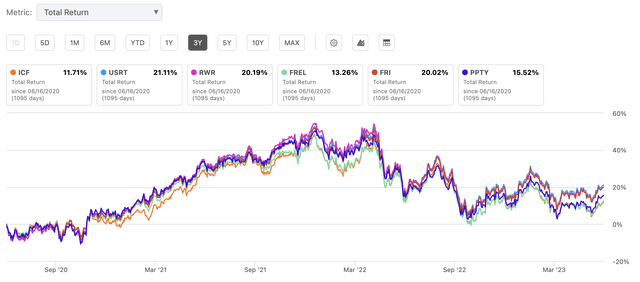
As noted above, ICF’s performance has not been especially stellar in the past year. If we compare ICF’s total return to that of the S&P 500, we can see that ICF was closely following the index up until November 2022, when a notable disparity occurred between the two. This disparity continued until February 2023, where the gap became increasingly larger. Currently, there is more than a 22% differential between ICF and the S&P 500.
Seeking Alpha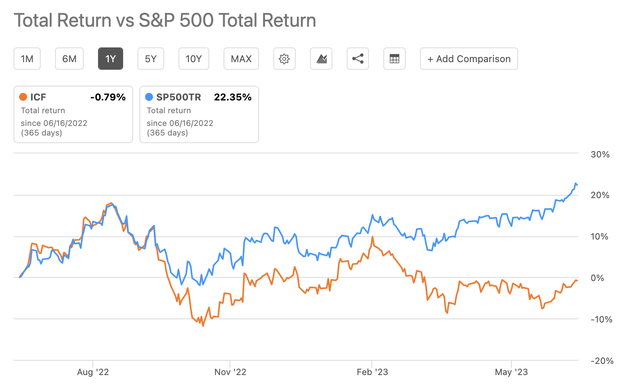
ICF’s price from a five-year outlook tells a similar story to the fund’s returns. The fund’s price reaches a peak at the onset of 2022 but has been consistently falling throughout 2022 and into 2023. While the fund is not currently decreasing at as high a rate as it did last year, it has still struggled to gain traction, despite a potential economic recovery on the rise. Several industries such as tech, healthcare, and automotive, to name a few, have seen a significant rebound in 2023, following a downturn they experienced in 2022. On the other hand, real estate has not followed this same trajectory.
Tower REITs on the Rise
Telecom tower ETFs represent a significant portion of ICF’s portfolio at 18%. Given this percentage, ICF’s performance can largely be influenced by the conditions and growth of the sector alone. Typically, tower REITs have relatively steady cash flows with long-term leases with tenants that can provide a consistent supply of income. This is because tower REITs operate in competitive markets with high barriers to entry, which also makes leasing more selective. Furthermore, the sector is positioned well to capitalize on the growth of several emerging trends. For example, the growth of 5G networks and the Internet of Things can significantly drive demand for wireless communication infrastructure, which can drive growth for tower REITs. The modern economy is increasingly being supported by wireless networks, and tower REITs are an important part of the growing digital economy.
Risks in Commercial Real Estate
Despite my optimism surrounding the telecom tower sector, I see many foreseeable threats to the commercial real estate sector. My biggest concerns for the sector include the increasing risks associated with rising interest rates and tightening monetary policies. Commercial real estate transaction volumes were down 65% year-over-year in the first quarter of 2023. Since March of 2022, the Federal Reserve has hiked interest rates at the fastest rate in four decades. This has ultimately led to higher borrowing costs, diminishing demand for real estate, and subsequently, causing real estate prices to fall in the past few months. Meanwhile, lenders also contend with challenging financing conditions as banks have grown more conservative in their lending practices following the collapse of Silicon Valley Bank and others in recent times. Simultaneously, the rise of remote work and e-commerce are reducing demand for office and retail spaces. This decline in commercial real estate also hurt banks, pension funds, and asset managers, as commercial mortgages account for nearly 40% of the median US bank’s loan holdings. Ultimately, market outlooks do not look favorable for the sector, and it will likely not contribute as much to the country’s economic growth at this moment.
Conclusion
Nonetheless, ICF is a significant player in the REIT market, with a focus on mortgage REITs in the United States. Despite a challenging market climate, ICF’s strengths lie in its ability to generate attractive income consistently. Although it may not have the highest dividend yield, the fund has been issuing dividends since its inception, with a relatively strong dividend growth rate. However, the fund has not seen the best performance this past year. As of the past few months, the fund has been significantly trailing the S&P 500. Moreover, ICF, along with many of its peers, has been unable to gain much traction in 2023. This is especially notable considering that many other industries have rebounded in 2023 following an economic downturn in 2022. Moreover, while I’m bullish on tower REITs moving forward, I am not as optimistic about commercial real estate. I ultimately rate ICF a Hold, at least until conditions look more favorable in the commercial real estate sector.
Credit: Source link








