• bitcoinBitcoin(BTC)$81,184.000.40%
  • ethereumEthereum(ETH)$2,626.220.69%
  • tetherTether(USDT)$1.00-0.01%
  • binancecoinBNB(BNB)$761.270.01%
  • rippleXRP(XRP)$1.410.70%
  • usd-coinUSDC(USDC)$1.00-0.01%
  • solanaSolana(SOL)$110.86-1.46%
  • tronTRON(TRX)$0.3397300.44%
  • zcashZcash(ZEC)$1,473.96-5.10%
  • Figure HelocFigure Heloc(FIGR_HELOC)$1.02-1.49%
  • HyperliquidHyperliquid(HYPE)$92.04-0.34%
  • dogecoinDogecoin(DOGE)$0.0875670.06%
  • moneroMonero(XMR)$545.10-3.79%
  • whitebitWhiteBIT Coin(WBT)$82.81-0.23%
  • RainRain(RAIN)$0.0137292.72%
  • USDSUSDS(USDS)$1.00-0.02%
  • chainlinkChainlink(LINK)$12.371.14%
  • cardanoCardano(ADA)$0.2275250.49%
  • leo-tokenLEO Token(LEO)$8.90-0.09%
  • stellarStellar(XLM)$0.1952781.05%
  • uniswapUniswap(UNI)$8.62-2.26%
  • bitcoin-cashBitcoin Cash(BCH)$253.98-0.52%
  • Ethena USDeEthena USDe(USDE)$1.00-0.02%
  • nearNEAR Protocol(NEAR)$3.60-3.54%
  • daiDai(DAI)$1.00-0.01%
  • avalanche-2Avalanche(AVAX)$10.1923.98%
  • litecoinLitecoin(LTC)$57.96-0.84%
  • USD1USD1(USD1)$1.00-0.02%
  • CantonCanton(CC)$0.109126-2.20%
  • the-open-networkGram (prev. Toncoin)(GRAM)$1.380.31%
  • hedera-hashgraphHedera(HBAR)$0.0812822.30%
  • suiSui(SUI)$0.864.88%
  • MemeCoreMemeCore(M)$1.5014.48%
  • Global DollarGlobal Dollar(USDG)$1.00-0.01%
  • shiba-inuShiba Inu(SHIB)$0.0000050.58%
  • BittensorBittensor(TAO)$263.204.71%
  • crypto-com-chainCronos(CRO)$0.059547-0.38%
  • paypal-usdPayPal USD(PYUSD)$1.00-0.02%
  • tether-goldTether Gold(XAUT)$4,374.30-0.03%
  • Circle USYCCircle USYC(USYC)$1.140.00%
  • okbOKB(OKB)$117.501.08%
  • Ripple USDRipple USD(RLUSD)$1.000.00%
  • BlackRock USD Institutional Digital Liquidity FundBlackRock USD Institutional Digital Liquidity Fund(BUIDL)$1.000.00%
  • Ondo US Dollar YieldOndo US Dollar Yield(USDY)$1.14-0.42%
  • aaveAave(AAVE)$140.590.59%
  • AsterAster(ASTER)$0.76-1.29%
  • EthenaEthena(ENA)$0.20307121.11%
  • mantleMantle(MNT)$0.62-0.50%
  • OndoOndo(ONDO)$0.4176254.67%
  • Pump.funPump.fun(PUMP)$0.0042370.61%
TradePoint.io
  • Main
  • AI & Technology
  • Stock Charts
  • Market & News
  • Business
  • Finance Tips
  • Trade Tube
  • Blog
  • Shop
No Result
View All Result
TradePoint.io
No Result
View All Result

IBM AI Team Releases an Open-Source Family of Granite Code Models for Making Coding Easier for Software Developers

May 10, 2024
in AI & Technology
Reading Time: 4 mins read
A A
IBM AI Team Releases an Open-Source Family of Granite Code Models for Making Coding Easier for Software Developers
ShareShareShareShareShare

IBM has made a great advancement in the field of software development by releasing a set of open-source Granite code models designed to make coding easier for people everywhere. This action stems from the realization that, although software plays a critical role in contemporary society, the process of coding is still difficult and time-consuming. Even seasoned engineers frequently struggle to keep learning new things, adjust to new languages, and solve challenging problems.

Large language models (LLMs) have grown in importance within development environments, contributing to increased efficiency and independence when managing complex programming jobs. The WatsonX Code Assistant (WCA) series, IBM’s most recent innovation, uses the astounding 20-billion parameter capabilities of the Granite large language code model. This technology’s usefulness in corporate environments has been demonstrated by its role in converting COBOL applications into contemporary services that are optimized for IBM Z. 

IBM has made four Granite code model versions, with parameter counts ranging from 3 to 34 billion, publicly available. These models are designed specifically for a variety of coding jobs, such as memory-constrained applications and application modernization. They have undergone a thorough evaluation process to guarantee that they satisfy the highest requirements of performance and adaptability in a variety of coding tasks, including generation, debugging, and explanation.

IBM’s dedication to democratizing access to great technology has been demonstrated by its choice to make these models available under an open-source license. It has publically released these models on sites such as Hugging Face, GitHub, and RHEL AI. Furthermore, these solutions are reliable and trustworthy enough for enterprise adoption, provided strict ethical norms are followed throughout data gathering and model training.

Through its open-sourcing project, IBM hopes to remove the obstacles that come with proprietary models’ high prices and unclear licensing rules and hasten the adoption of generative AI models in the business sector. Because of the Granite code models’ adaptability and corporate workflow optimization, developers have access to a powerful toolbox that can automate repetitive coding activities, improve code quality, and enable smooth integration between legacy and contemporary applications.

The deliberate release of models in different sizes enables developers to select, in accordance with their particular requirements, the ideal compromise between computational efficiency and performance. There are variations with 34 billion, 20 billion, 8 billion, and 3 billion parameters. These models, which are licensed under the Apache 2.0 license, were trained using depth upscaling on an extensive dataset of 4.5 trillion tokens. They include 116 programming languages, which is a broad range. 

The Stack, a comprehensive resource that performs both exact and fuzzy deduplication and filters out low-quality code, has been used in the training data for these models. To further improve the models’ capabilities, natural language data has been merged with the code. This methodology guarantees that the models are adequately prepared to manage a range of coding tasks with effectiveness and efficiency. 

In conclusion, IBM predicts that in the future, coding will be as natural as speaking with an AI assistant, freeing up engineers to concentrate more on creative work and less on repetitive duties. The Granite code models are only the start of IBM’s larger plan to enable developers to use AI technologies to reshape computing in the future.


Check out the Blog and Project. All credit for this research goes to the researchers of this project. Also, don’t forget to follow us on Twitter. Join our Telegram Channel, Discord Channel, and LinkedIn Group.

If you like our work, you will love our newsletter..

Don’t Forget to join our 41k+ ML SubReddit


YOU MAY ALSO LIKE

Trump Proposes Renaming Artificial Intelligence, Announces AI Force – Unite.AI

SpaceX Targets September 28 For Starship’s First Orbital Flight

Tanya Malhotra is a final year undergrad from the University of Petroleum & Energy Studies, Dehradun, pursuing BTech in Computer Science Engineering with a specialization in Artificial Intelligence and Machine Learning.
She is a Data Science enthusiast with good analytical and critical thinking, along with an ardent interest in acquiring new skills, leading groups, and managing work in an organized manner.


[Recommended Read] Rightsify’s GCX: Your Go-To Source for High-Quality, Ethically Sourced, Copyright-Cleared AI Music Training Datasets with Rich Metadata


Credit: Source link

ShareTweetSendSharePin

Related Posts

Trump Proposes Renaming Artificial Intelligence, Announces AI Force – Unite.AI
AI & Technology

Trump Proposes Renaming Artificial Intelligence, Announces AI Force – Unite.AI

September 19, 2026
SpaceX Targets September 28 For Starship’s First Orbital Flight
AI & Technology

SpaceX Targets September 28 For Starship’s First Orbital Flight

September 19, 2026
Now Trump Says He’s Creating An AI Force
AI & Technology

Now Trump Says He’s Creating An AI Force

September 19, 2026
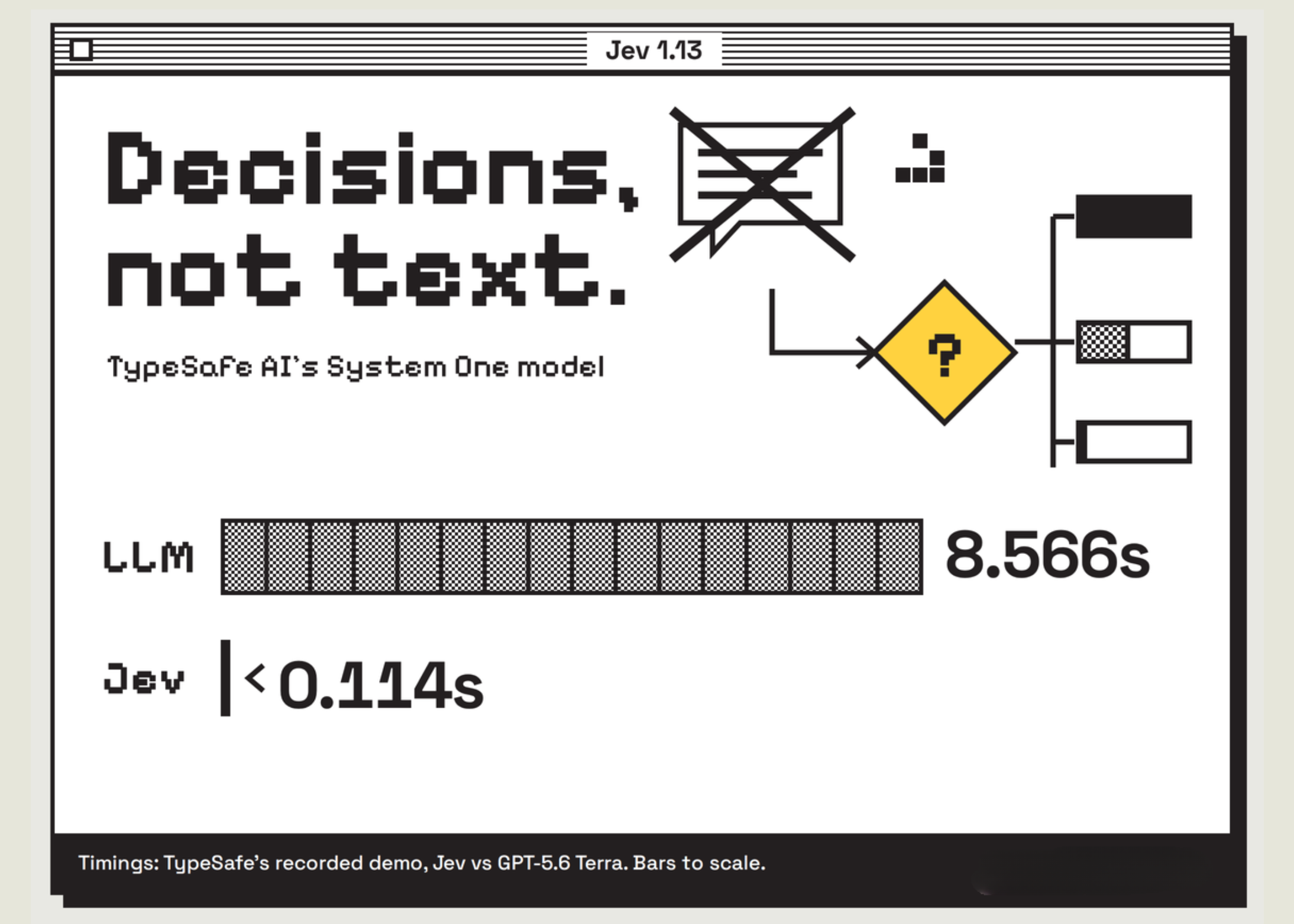
TypeSafe AI Releases Jev: A System One Model That Returns Typed, Calibrated Decisions Instead of Text
AI & Technology

TypeSafe AI Releases Jev: A System One Model That Returns Typed, Calibrated Decisions Instead of Text

September 19, 2026
Next Post
Rivian CEO Won’t Reveal Order Numbers for the R2

Rivian CEO Won't Reveal Order Numbers for the R2

Leave a Reply Cancel reply

Your email address will not be published. Required fields are marked *

Search

No Result
View All Result
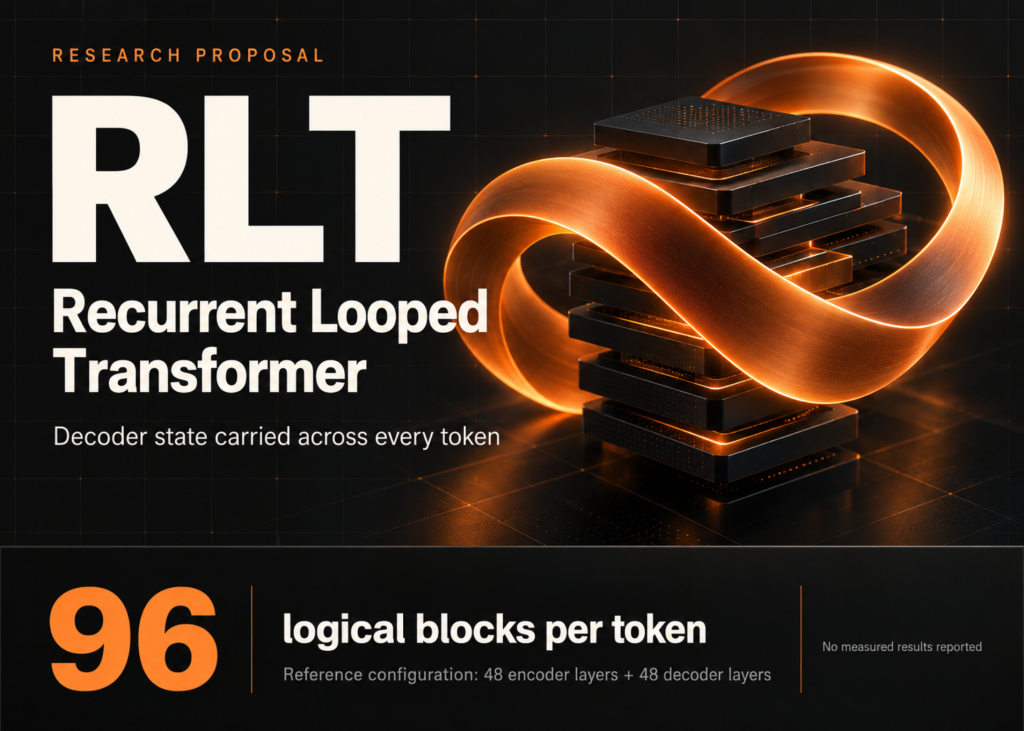
A Princeton Researcher Proposes Recurrent Looped Transformer (RLT) that Carries Decoder State across Every Token, Fixing 96 Blocks per Token with Unbounded Temporal Depth

A Princeton Researcher Proposes Recurrent Looped Transformer (RLT) that Carries Decoder State across Every Token, Fixing 96 Blocks per Token with Unbounded Temporal Depth

September 13, 2026
MIT is building space stations like you would build with magnatiles

MIT is building space stations like you would build with magnatiles

September 14, 2026
OpenAI Launches Misalignment Reporting Framework With Six Incident Reports – Unite.AI

OpenAI Launches Misalignment Reporting Framework With Six Incident Reports – Unite.AI

September 16, 2026

About

Learn more

Our Services

Legal

Privacy Policy

Terms of Use

Bloggers

Learn more

Article Links

Contact

Advertise

Ask us anything

©2020- TradePoint.io - All rights reserved!

Tradepoint.io, being just a publishing and technology platform, is not a registered broker-dealer or investment adviser. So we do not provide investment advice. Rather, brokerage services are provided to clients of Tradepoint.io by independent SEC-registered broker-dealers and members of FINRA/SIPC. Every form of investing carries some risk and past performance is not a guarantee of future results. “Tradepoint.io“, “Instant Investing” and “My Trading Tools” are registered trademarks of Apperbuild, LLC.

This website is operated by Apperbuild, LLC. We have no link to any brokerage firm and we do not provide investment advice. Every information and resource we provide is solely for the education of our readers. © 2020 Apperbuild, LLC. All rights reserved.

No Result
View All Result
  • Main
  • AI & Technology
  • Stock Charts
  • Market & News
  • Business
  • Finance Tips
  • Trade Tube
  • Blog
  • Shop

© 2023 - TradePoint.io - All Rights Reserved!