



• bitcoinBitcoin(BTC)$84,376.000.41%
  • ethereumEthereum(ETH)$2,694.070.01%
  • tetherTether(USDT)$1.00-0.01%
  • binancecoinBNB(BNB)$772.74-0.46%
  • rippleXRP(XRP)$1.52-3.57%
  • usd-coinUSDC(USDC)$1.00-0.01%
  • solanaSolana(SOL)$120.99-0.89%
  • tronTRON(TRX)$0.333416-1.24%
  • zcashZcash(ZEC)$1,644.476.37%
  • Figure HelocFigure Heloc(FIGR_HELOC)$1.063.41%
  • HyperliquidHyperliquid(HYPE)$92.910.72%
  • dogecoinDogecoin(DOGE)$0.096424-2.90%
  • chainlinkChainlink(LINK)$14.131.06%
  • moneroMonero(XMR)$556.06-0.48%
  • whitebitWhiteBIT Coin(WBT)$84.150.31%
  • USDSUSDS(USDS)$1.000.00%
  • cardanoCardano(ADA)$0.251691-3.44%
  • RainRain(RAIN)$0.01276217.12%
  • leo-tokenLEO Token(LEO)$8.980.99%
  • stellarStellar(XLM)$0.215155-2.72%
  • bitcoin-cashBitcoin Cash(BCH)$334.44-2.53%
  • nearNEAR Protocol(NEAR)$5.092.54%
  • uniswapUniswap(UNI)$9.842.57%
  • litecoinLitecoin(LTC)$72.27-0.69%
  • CantonCanton(CC)$0.1378412.75%
  • Ethena USDeEthena USDe(USDE)$1.00-0.02%
  • suiSui(SUI)$1.18-0.28%
  • avalanche-2Avalanche(AVAX)$10.77-1.09%
  • daiDai(DAI)$1.00-0.03%
  • the-open-networkGram (prev. Toncoin)(GRAM)$1.6010.70%
  • USD1USD1(USD1)$1.000.01%
  • hedera-hashgraphHedera(HBAR)$0.092930-2.15%
  • BittensorBittensor(TAO)$319.460.81%
  • shiba-inuShiba Inu(SHIB)$0.000006-1.84%
  • crypto-com-chainCronos(CRO)$0.0680012.64%
  • Global DollarGlobal Dollar(USDG)$1.00-0.01%
  • MemeCoreMemeCore(M)$1.242.67%
  • paypal-usdPayPal USD(PYUSD)$1.00-0.01%
  • BitwayBitway(BTW)$1.01-0.56%
  • EthenaEthena(ENA)$0.2691110.75%
  • tether-goldTether Gold(XAUT)$4,279.31-0.06%
  • OndoOndo(ONDO)$0.54-1.30%
  • quant-networkQuant(QNT)$176.6475.55%
  • okbOKB(OKB)$120.80-0.70%
  • Ripple USDRipple USD(RLUSD)$1.00-0.01%
  • Circle USYCCircle USYC(USYC)$1.140.00%
  • aaveAave(AAVE)$155.04-0.23%
  • BlackRock USD Institutional Digital Liquidity FundBlackRock USD Institutional Digital Liquidity Fund(BUIDL)$1.000.00%
  • Ondo US Dollar YieldOndo US Dollar Yield(USDY)$1.150.00%
  • mantleMantle(MNT)$0.691.58%
TradePoint.io
  • Main
  • AI & Technology
  • Stock Charts
  • Market & News
  • Business
  • Finance Tips
  • Trade Tube
  • Blog
  • Shop
No Result
View All Result
TradePoint.io
No Result
View All Result

How To Check Your PC’s Hard-Drive Health

September 6, 2026
in AI & Technology
Reading Time: 4 mins read
A A
How To Check Your PC’s Hard-Drive Health
ShareShareShareShareShare

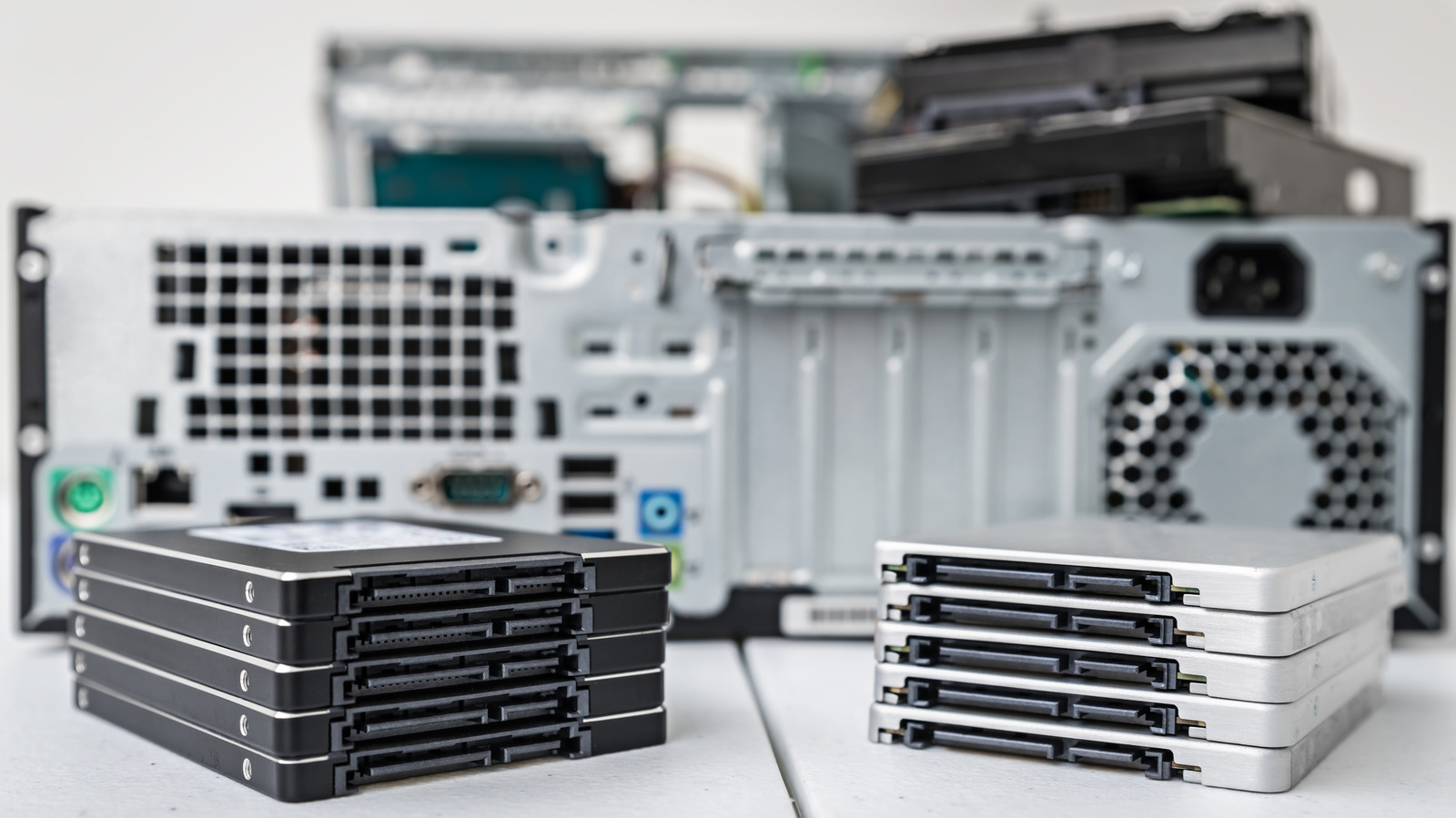
A few built-in checks can tell you whether your HDD or SSD is showing signs of trouble.


myphotobank.com.au/Shutterstock

Storage drives have a tendency to fail when you least expect it. A traditional hard drive may give you a warning with clicking or grinding sounds, but an SSD has no moving parts to make a fuss. Problems with either type can manifest as corrupted files, abnormally slow access, frequent read or write errors, crashes, or a drive that periodically disappears from Windows.

YOU MAY ALSO LIKE

Your Old GPU Could Be Worth More Than You Think

Sarvam AI Releases Saaras V4: A Speech-to-Text Model for All 22 Indian Languages and Global English

If any of that is already occurring, back up your important files before doing much else. Diagnostics are good, but it’s not as much fun to recover the only copy of something when a drive dies.

Windows has several built-in methods for checking the health of drives, but the information it can provide will vary based on the hardware in the computer. Free utilities can go further and read the drive’s Self-Monitoring, Analysis and Reporting Technology (SMART) data.

There is one limitation, though. A healthy status can be reassuring, but it’s certainly not a lifetime guarantee.

See what Windows knows about your drive
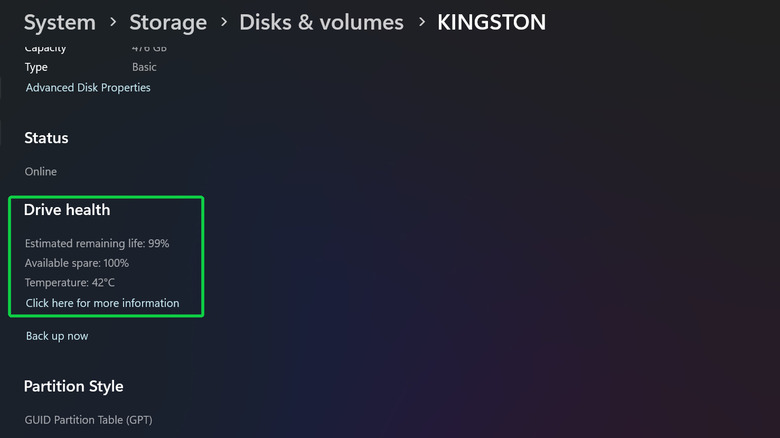

Windows 11 storage settings showing health information for an NVMe SSD.
Screenshot by Husain Parvez (Microsoft)

The simplest way to get started in Windows 11 doesn’t involve opening a terminal or feigning a love for command lines.

  1. Open Settings and choose System.
  2. Go to Storage > Advanced storage settings > Disks & volumes.
  3. Select your drive and choose Properties.

Windows can display estimated remaining life, available spare capacity and temperature for supported NVMe SSDs. It can also alert you if spare capacity is low, reliability has decreased or if the drive has gone into read-only mode.

There is one thing to look out for here. Microsoft says this health monitoring doesn’t cover SATA SSDs or traditional hard drives. If Windows provides little or no health information, don’t assume that it’s a clean bill of health.

Another quick check can be done via PowerShell. Open a PowerShell tab in Windows Terminal, type Get-PhysicalDisk and check the HealthStatus column. The status can be Healthy, Warning, Unhealthy or Unknown.

Older guides might instruct you to use wmic diskdrive get status instead, but that’s old advice. WMIC has been removed from currently supported versions of Windows 11, and Microsoft recommends supported alternatives like PowerShell.

How to act on Healthy, Warning or Bad results
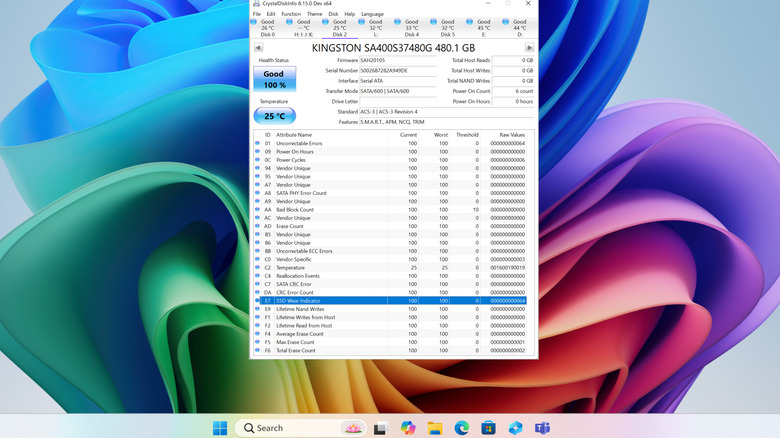

CrystalDiskInfo showing SMART health information for a storage drive.
Screenshot by Husain Parvez (CrystalDiskInfo)

If the result is Healthy and the PC is acting normally, that’s a good sign. Keep backing up your data, as drive-health systems can detect some potential issues, but not all failures.

For a second opinion, CrystalDiskInfo is a free tool that can read SMART data from many HDDs and SSDs, including NVMe drives. More importantly for those who don’t really want to spend an afternoon trying to understand what the raw storage counters mean, it gives the drive a health status of Good, Caution, Bad or Unknown.

If you get a Caution or Bad result, backing up becomes the priority. You can then verify the issue using the drive manufacturer’s own diagnostic software, like Seagate’s SeaTools or Samsung Magician (for supported Samsung SSDs). Persistent warnings, an Unhealthy result or obvious mechanical symptoms are all good reasons to stop trusting that drive with the only copy of important data and start considering a replacement.

CHKDSK is also helpful, but for a different task. It checks a volume’s file system and metadata for errors. The /f option fixes file-system errors, and the /r option locates bad sectors and attempts to recover readable data.

However, if a file-system problem is corrected with CHKDSK, the questionable hardware is not magically made healthy. For HDDs, CrystalDiskInfo can trigger a Caution status based on three SMART attributes: reallocated sectors, pending sectors and uncorrectable sectors.

Credit: Source link

ShareTweetSendSharePin

Related Posts

Your Old GPU Could Be Worth More Than You Think
AI & Technology

Your Old GPU Could Be Worth More Than You Think

September 26, 2026
Sarvam AI Releases Saaras V4: A Speech-to-Text Model for All 22 Indian Languages and Global English
AI & Technology

Sarvam AI Releases Saaras V4: A Speech-to-Text Model for All 22 Indian Languages and Global English

September 26, 2026
Supersonic Labs Releases Julia 1: A 144.3M-Parameter Open Decision Model That Runs on a CPU
AI & Technology

Supersonic Labs Releases Julia 1: A 144.3M-Parameter Open Decision Model That Runs on a CPU

September 26, 2026
This External GPU Uses Wi-Fi To Transform Any Device Into A Gaming Rig
AI & Technology

This External GPU Uses Wi-Fi To Transform Any Device Into A Gaming Rig

September 26, 2026
Next Post
Florida city issues warning to stay away from wild monkeys

Florida city issues warning to stay away from wild monkeys

Leave a Reply Cancel reply

Your email address will not be published. Required fields are marked *

Search

No Result
View All Result
How To Use Xbox Mode On Your Windows PC

How To Use Xbox Mode On Your Windows PC

September 20, 2026
Meta Put Muse In A Tamagotchi Like ‘Charm’ Device

Meta Put Muse In A Tamagotchi Like ‘Charm’ Device

September 24, 2026
Jury deliberates in Lindsay Clancy murder trial

Jury deliberates in Lindsay Clancy murder trial

September 22, 2026

About

Learn more

Our Services

Legal

Privacy Policy

Terms of Use

Bloggers

Learn more

Article Links

Contact

Advertise

Ask us anything

©2020- TradePoint.io - All rights reserved!

Tradepoint.io, being just a publishing and technology platform, is not a registered broker-dealer or investment adviser. So we do not provide investment advice. Rather, brokerage services are provided to clients of Tradepoint.io by independent SEC-registered broker-dealers and members of FINRA/SIPC. Every form of investing carries some risk and past performance is not a guarantee of future results. “Tradepoint.io“, “Instant Investing” and “My Trading Tools” are registered trademarks of Apperbuild, LLC.

This website is operated by Apperbuild, LLC. We have no link to any brokerage firm and we do not provide investment advice. Every information and resource we provide is solely for the education of our readers. © 2020 Apperbuild, LLC. All rights reserved.

No Result
View All Result
  • Main
  • AI & Technology
  • Stock Charts
  • Market & News
  • Business
  • Finance Tips
  • Trade Tube
  • Blog
  • Shop

© 2023 - TradePoint.io - All Rights Reserved!