


















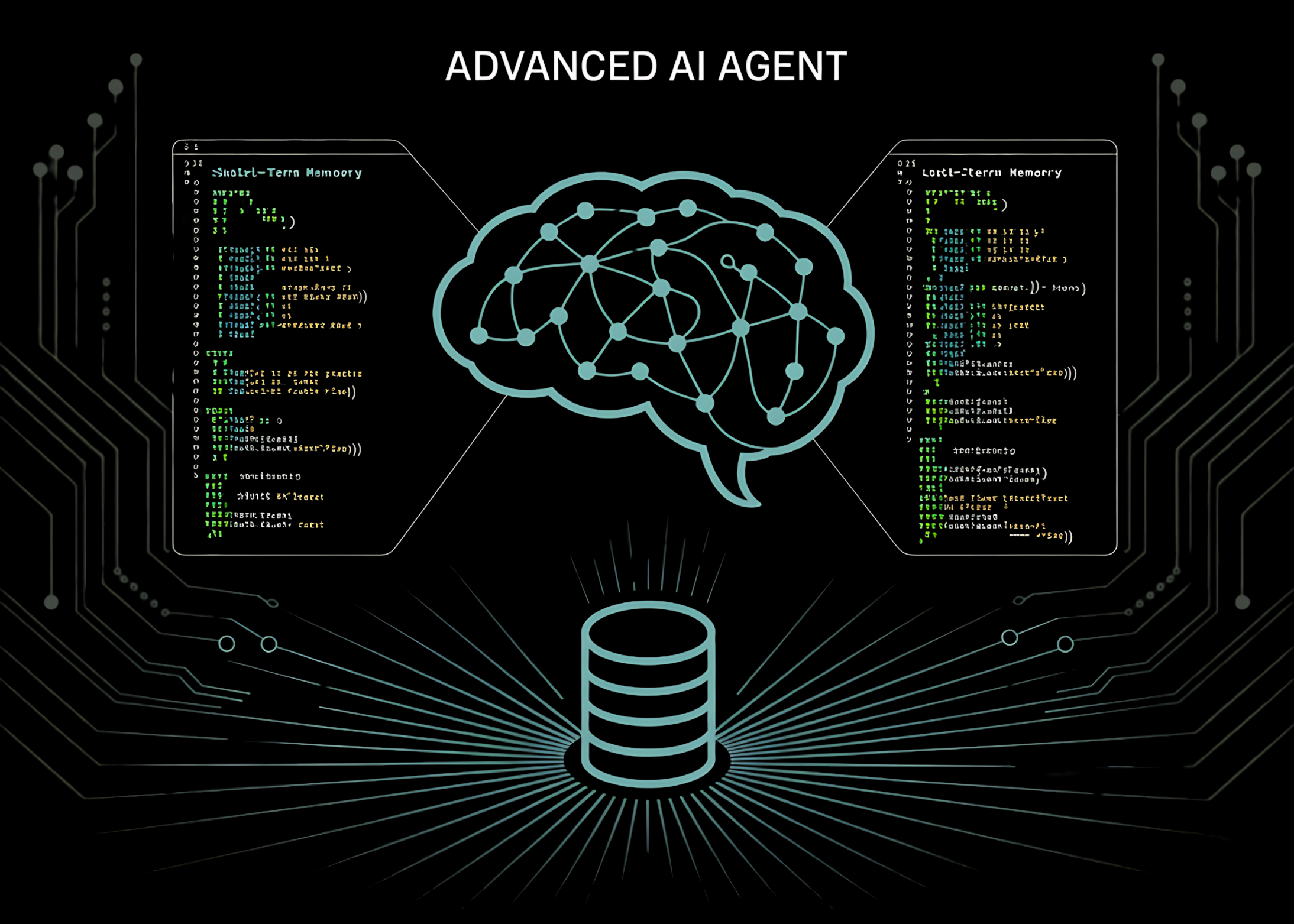

In this tutorial, we walk you through building an advanced AI Agent that not only chats but also remembers. We start from scratch and demonstrate how to combine a lightweight LLM, FAISS vector search, and a summarization mechanism to create both short-term and long-term memory. By working together with embeddings and auto-distilled facts, we can craft an agent that adapts to our instructions, recalls important details in future conversations, and intelligently compresses context, ensuring the interaction remains smooth and efficient. Check out the FULL CODES here.
!pip -q install transformers accelerate bitsandbytes sentence-transformers faiss-cpu


import os, json, time, uuid, math, re
from datetime import datetime
import torch, faiss
from transformers import AutoModelForCausalLM, AutoTokenizer, pipeline, BitsAndBytesConfig
from sentence_transformers import SentenceTransformer
DEVICE = "cuda" if torch.cuda.is_available() else "cpu"
We begin by installing the essential libraries and importing all the required modules for our agent. We set up the environment to determine whether we are using a GPU or a CPU, allowing us to run the model efficiently. Check out the FULL CODES here.
def load_llm(model_name="TinyLlama/TinyLlama-1.1B-Chat-v1.0"):
   try:
       if DEVICE=="cuda":
           bnb=BitsAndBytesConfig(load_in_4bit=True,bnb_4bit_compute_dtype=torch.bfloat16,bnb_4bit_quant_type="nf4")
           tok=AutoTokenizer.from_pretrained(model_name, use_fast=True)
           mdl=AutoModelForCausalLM.from_pretrained(model_name, quantization_config=bnb, device_map="auto")
       else:
           tok=AutoTokenizer.from_pretrained(model_name, use_fast=True)
           mdl=AutoModelForCausalLM.from_pretrained(model_name, torch_dtype=torch.float16 if torch.cuda.is_available() else torch.float32, low_cpu_mem_usage=True)
       return pipeline("text-generation", model=mdl, tokenizer=tok, device=0 if DEVICE=="cuda" else -1, do_sample=True)
   except Exception as e:
       raise RuntimeError(f"Failed to load LLM: {e}")
We define a function to load our language model. We set it up so that if a GPU is available, we use 4-bit quantization for efficiency; otherwise, we fall back to the CPU with optimized settings. This ensures we can generate text smoothly regardless of the hardware we are running on. Check out the FULL CODES here.
class VectorMemory:
   def __init__(self, path="/content/agent_memory.json", dim=384):
       self.path=path; self.dim=dim; self.items=[]
       self.embedder=SentenceTransformer("sentence-transformers/all-MiniLM-L6-v2", device=DEVICE)
       self.index=faiss.IndexFlatIP(dim)
       if os.path.exists(path):
           data=json.load(open(path))
           self.items=data.get("items",[])
           if self.items:
               X=torch.tensor([x["emb"] for x in self.items], dtype=torch.float32).numpy()
               self.index.add(X)
   def _emb(self, text):
       v=self.embedder.encode([text], normalize_embeddings=True)[0]
       return v.tolist()
   def add(self, text, meta=None):
       e=self._emb(text); self.index.add(torch.tensor([e]).numpy())
       rec={"id":str(uuid.uuid4()),"text":text,"meta":meta or {}, "emb":e}
       self.items.append(rec); self._save(); return rec["id"]
   def search(self, query, k=5, thresh=0.25):
       if len(self.items)==0: return []
       q=self.embedder.encode([query], normalize_embeddings=True)
       D,I=self.index.search(q, min(k, len(self.items)))
       out=[]
       for d,i in zip(D[0],I[0]):
           if i==-1: continue
           if d>=thresh: out.append((d,self.items[i]))
       return out
   def _save(self):
       slim=[{k:v for k,v in it.items()} for it in self.items]
       json.dump({"items":slim}, open(self.path,"w"), indent=2)
We create a VectorMemory class that gives our agent long-term memory. We store past interactions as embeddings using MiniLM and index them with FAISS, allowing us to search and recall relevant information later. Each memory is saved to disk, enabling the agent to retain its memory across sessions. Check out the FULL CODES here.
def now_iso(): return datetime.now().isoformat(timespec="seconds")
def clamp(txt, n=1600): return txt if len(txt)<=n else txt[:n]+" …"
def strip_json(s):
   m=re.search(r"\{.*\}", s, flags=re.S);
   return m.group(0) if m else None


SYS_GUIDE = (
"You are a helpful, concise assistant with memory. Use provided MEMORY when relevant. "
"Prefer facts from MEMORY over guesses. Answer directly; keep code blocks tight. If unsure, say so."
)


SUMMARIZE_PROMPT = lambda convo: f"Summarize the conversation below in 4-6 bullet points focusing on stable facts and tasks:\n\n{convo}\n\nSummary:"
DISTILL_PROMPT = lambda user: (
f"""Decide if the USER text contains durable info worth long-term memory (preferences, identity, projects, deadlines, facts).
Return compact JSON only: {{"save": true/false, "memory": "one-sentence memory"}}.
USER: {user}""")


class MemoryAgent:
   def __init__(self):
       self.llm=load_llm()
       self.mem=VectorMemory()
       self.turns=[]
       self.summary=""
       self.max_turns=10
   def _gen(self, prompt, max_new_tokens=256, temp=0.7):
       out=self.llm(prompt, max_new_tokens=max_new_tokens, temperature=temp, top_p=0.95, num_return_sequences=1, pad_token_id=self.llm.tokenizer.eos_token_id)[0]["generated_text"]
       return out[len(prompt):].strip() if out.startswith(prompt) else out.strip()
   def _chat_prompt(self, user, memory_context):
       convo="\n".join([f"{r.upper()}: {t}" for r,t in self.turns[-8:]])
       sys=f"System: {SYS_GUIDE}\nTime: {now_iso()}\n\n"
       mem = f"MEMORY (relevant excerpts):\n{memory_context}\n\n" if memory_context else ""
       summ=f"CONTEXT SUMMARY:\n{self.summary}\n\n" if self.summary else ""
       return sys+mem+summ+convo+f"\nUSER: {user}\nASSISTANT:"
   def _distill_and_store(self, user):
       try:
           raw=self._gen(DISTILL_PROMPT(user), max_new_tokens=120, temp=0.1)
           js=strip_json(raw)
           if js:
               obj=json.loads(js)
               if obj.get("save") and obj.get("memory"):
                   self.mem.add(obj["memory"], {"ts":now_iso(),"source":"distilled"})
                   return True, obj["memory"]
       except Exception: pass
       if re.search(r"\b(my name is|call me|I like|deadline|due|email|phone|working on|prefer|timezone|birthday|goal|exam)\b", user, flags=re.I):
           m=f"User said: {clamp(user,120)}"
           self.mem.add(m, {"ts":now_iso(),"source":"heuristic"})
           return True, m
       return False, ""
   def _maybe_summarize(self):
       if len(self.turns)>self.max_turns:
           convo="\n".join([f"{r}: {t}" for r,t in self.turns])
           s=self._gen(SUMMARIZE_PROMPT(clamp(convo, 3500)), max_new_tokens=180, temp=0.2)
           self.summary=s; self.turns=self.turns[-4:]
   def recall(self, query, k=5):
       hits=self.mem.search(query, k=k)
       return "\n".join([f"- ({d:.2f}) {h['text']} [meta={h['meta']}]" for d,h in hits])
   def ask(self, user):
       self.turns.append(("user", user))
       saved, memline = self._distill_and_store(user)
       mem_ctx=self.recall(user, k=6)
       prompt=self._chat_prompt(user, mem_ctx)
       reply=self._gen(prompt)
       self.turns.append(("assistant", reply))
       self._maybe_summarize()
       status=f"💾 memory_saved: {saved}; " + (f"note: {memline}" if saved else "note: -")
       print(f"\nUSER: {user}\nASSISTANT: {reply}\n{status}")
       return reply
We bring everything together into the MemoryAgent class. We design the agent to generate responses with context, distill important facts into long-term memory, and periodically summarize conversations to manage short-term context. With this setup, we create an assistant that remembers, recalls, and adapts to our interactions with it. Check out the FULL CODES here.
agent=MemoryAgent()


print("✅ Agent ready. Try these:\n")
agent.ask("Hi! My name is Nicolaus, I prefer being called Nik. I'm preparing for UPSC in 2027.")
agent.ask("Also, I work at  Visa in analytics and love concise answers.")
agent.ask("What's my exam year and how should you address me next time?")
agent.ask("Reminder: I like agentic RAG tutorials with single-file Colab code.")
agent.ask("Given my prefs, suggest a study focus for this week in one paragraph.")
We instantiate our MemoryAgent and immediately exercise it with a few messages to seed long-term memories and verify recall. We confirm it remembers our preferred name and exam year, adapts replies to our concise style, and uses past preferences (agentic RAG, single-file Colab) to tailor study guidance in the present.
In conclusion, we see how powerful it is when we give our AI Agent the ability to remember. We now have an agent that stores key details, recalls them when relevant, and summarizes conversations to stay efficient. This approach keeps our interactions contextual and evolving, making the agent feel more personal and intelligent with each exchange. With this foundation, we are ready to extend memory further, explore richer schemas, and experiment with more advanced memory-augmented agent designs.
Check out the FULL CODES here. Feel free to check out our GitHub Page for Tutorials, Codes and Notebooks. Also, feel free to follow us on Twitter and don’t forget to join our 100k+ ML SubReddit and Subscribe to our Newsletter.
Asif Razzaq is the CEO of Marktechpost Media Inc.. As a visionary entrepreneur and engineer, Asif is committed to harnessing the potential of Artificial Intelligence for social good. His most recent endeavor is the launch of an Artificial Intelligence Media Platform, Marktechpost, which stands out for its in-depth coverage of machine learning and deep learning news that is both technically sound and easily understandable by a wide audience. The platform boasts of over 2 million monthly views, illustrating its popularity among audiences.
Credit: Source link