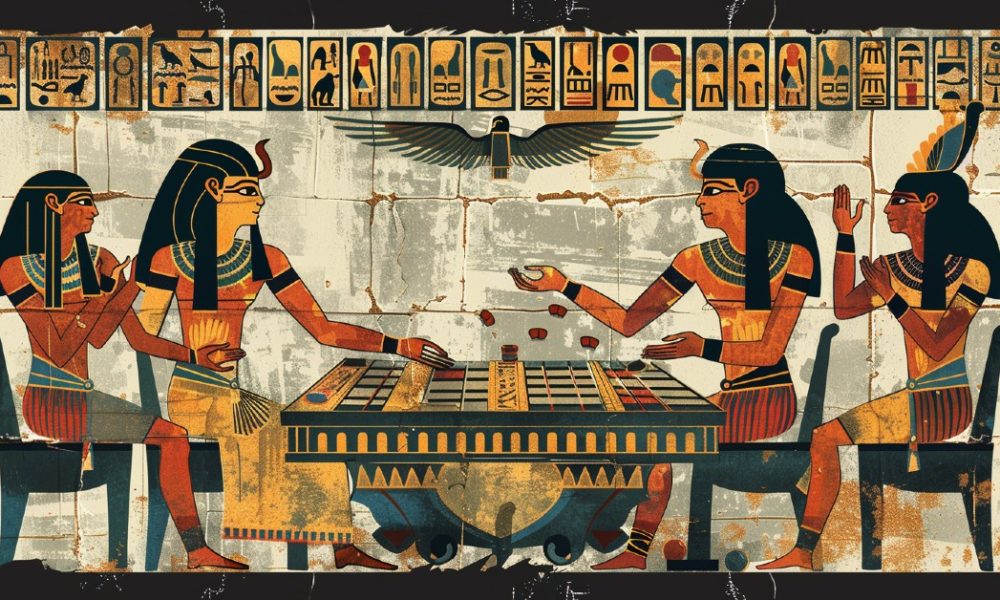

Imagine delving into the mysteries of ancient civilizations through their board games, such as Senet and Patolli. They offer a glimpse into the past, but their rules have been lost, leaving people wondering how they were played. Artificial intelligence shines in this scenario, and it’s the key to unlocking these ancient secrets.
AI revolutionizes how people understand these old games, using complex algorithms to hypothesize rules from fragments of historical texts and artifacts. This innovative approach allows researchers to step back in time and play these games, just as their ancestors might have centuries ago.
The Mystery of Ancient Board Games
Games have been a cornerstone of human social and cultural life for millennia. The oldest artifacts considered to be game boards date back 6,000 to 10,000 years. This suggests that long before written history, humans were already engaging in strategic gameplay.
These games were beyond pastimes but held significant cultural importance, often reflecting society’s beliefs, values and social hierarchies. As researchers explore these ancient relics, they tap into the collective memory of civilizations. Doing so helps them understand more about how people interact and entertain themselves.
However, uncovering how these games were played poses a unique challenge due to the scant information left behind. Historians stumbled upon ancient games without instructions or rules, their secrets lost to the ages.
This gap in knowledge invites researchers to imagine and reconstruct using fragmented pieces and partial game sets found in archaeological digs. The task is daunting, yet it’s also what makes the discovery process so intriguing and rewarding. As they piece together these ancient puzzles, they contribute to a deeper understanding of their ancestors’ lives and leisures.
AI and the Game of Reconstruction
AI — particularly machine learning — revolutionizes how researchers understand ancient games. It allows computers to learn from data, adapting and improving their knowledge over time without explicit programming.
One standout initiative in this field is the five-year Digital Ludeme Project — a groundbreaking computational study of the world’s traditional strategy games. This undertaking leverages AI to dissect and reconstruct the rule sets of these games, providing a digital window into the past.
Researchers train AI models to hypothesize game rules by analyzing available components and relevant historical texts. They use a technique known as reinforcement learning, where the AI learns through trial and error, playing countless game scenarios.
This method helps the program deduce which rules make sense and which do not based on outcomes that seem logical or align with historical accounts. As researchers explore this process, they’ll see software playing games and testing hypotheses build bridges across time.
The AI Model: How It Learns and Adapts
The technical process begins with inputting data. This information includes detailed images of ancient game boards, fragments of texts describing gameplay and related cultural artifacts. A model examines this data during training, making connections that might not be immediately obvious.
It then moves into error correction, where it adjusts incorrect assumptions based on feedback from trial game scenarios. This iterative process helps refine the hypotheses about how the games were possibly played.
AI uses sophisticated pattern recognition to propose rules that make logical sense and align with the artifacts’ physical layouts and historical descriptions. This method allows historians to glimpse how these games might have functioned, bridging the gap between past leisure and present curiosity.
Examples of AI at Work
Here are examples of how researchers use AI to resurrect the forgotten rules of ancient board games.
The Royal Game of Ur
Believed to be a precursor to modern backgammon, the Royal Game of Ur has intrigued scholars since its discovery. Played in Ancient Sumer around 4,000 years ago, this game caught the attention of AI researchers who aimed to decipher its rules. Using it, they formulated game rules by aligning with instructions on ancient cuneiform tablets.
This process involved training models to interpret these inscriptions and test various gameplay strategies, proposing rules that made sense and respected the game’s historical and cultural context. This innovative use of technology allows researchers to experience a game ancient civilizations once enjoyed.
Senet
AI has been instrumental in piecing together theories about Senet’s rules and end goals. By processing data from game boards found in tombs and ancient texts, AI generates simulations to test various game progressions.
This helps researchers understand how the game was set up and the strategic thinking it may have required. The insight offers a glimpse into the intellectual culture of ancient Egypt, revealing more about the game that once entertained pharaohs.
Patolli
Patolli — potentially originating from the South Asian game Pachisi — offers a fascinating case study in ancient strategy and risk. Historians can explore how players might have approached this game through AI simulations while it suggests possible gameplay strategies and betting methods.
The simulations analyze the layout and possible movement patterns, enabling researchers to consider various strategies that could have influenced the game’s outcomes. These scenarios also give them a deeper appreciation for the cleverness and complexity of ancient gameplay.
Collaboration Between AI Experts and Historians
Collaboration between AI experts, historians, archaeologists and anthropologists is essential to unraveling the mysteries of ancient board games. AI must work alongside professionals to ensure a holistic approach where technology meets traditional scholarship.
This interdisciplinary teamwork allows academics to integrate diverse insights from different fields. It also ensures the AI’s hypotheses about game rules are technically sound and culturally and historically informed.
The rich blend of perspectives significantly enhances their understanding of ancient games. It provides a more accurate and nuanced recreation of pastimes that shaped early human societies.
Ethical Considerations in AI Research
Using AI in cultural and historical research brings ethical concerns to attention. In particular, the authenticity and accuracy of AI-generated rules could potentially misrepresent ancient cultures. The type of data these systems are trained on can often carry biases and discrimination, which may lead to unfair or skewed interpretations of historical facts.
To mitigate these issues, researchers are increasingly vigilant about the sources they use for training. They strive to ensure their methods respect historical integrity and cultural significance. This approach helps safeguard against the perpetuation of biases and supports a more accurate and respectful representation of ancient histories in modern scholarship.
Implications and Future Prospects
Integrating AI technology in archaeological and historical research holds immense potential to revolutionize people’s understanding of the past. Facilitating the reconstruction of ancient board games and other cultural artifacts enables scholars to uncover nuances of historical life that might otherwise remain obscured.
Beyond board games, AI could also assist in decoding lost languages, reconstructing broken artifacts through pattern recognition and predicting the locations of yet-to-be-discovered archaeological sites. These applications deepen the understanding of historical contexts and help preserve cultural heritage. They offer a richer, more connected sense of human history.
Unveiling the Past Through AI and Cultural Insights
AI dramatically enhances people’s understanding of their heritage by breathing new life into ancient games, revealing how ancient civilizations once strategized and socialized. This fusion of technology and history enriches society’s knowledge of the past, ensuring future generations preserve and appreciate these invaluable cultural insights.

Credit: Source link