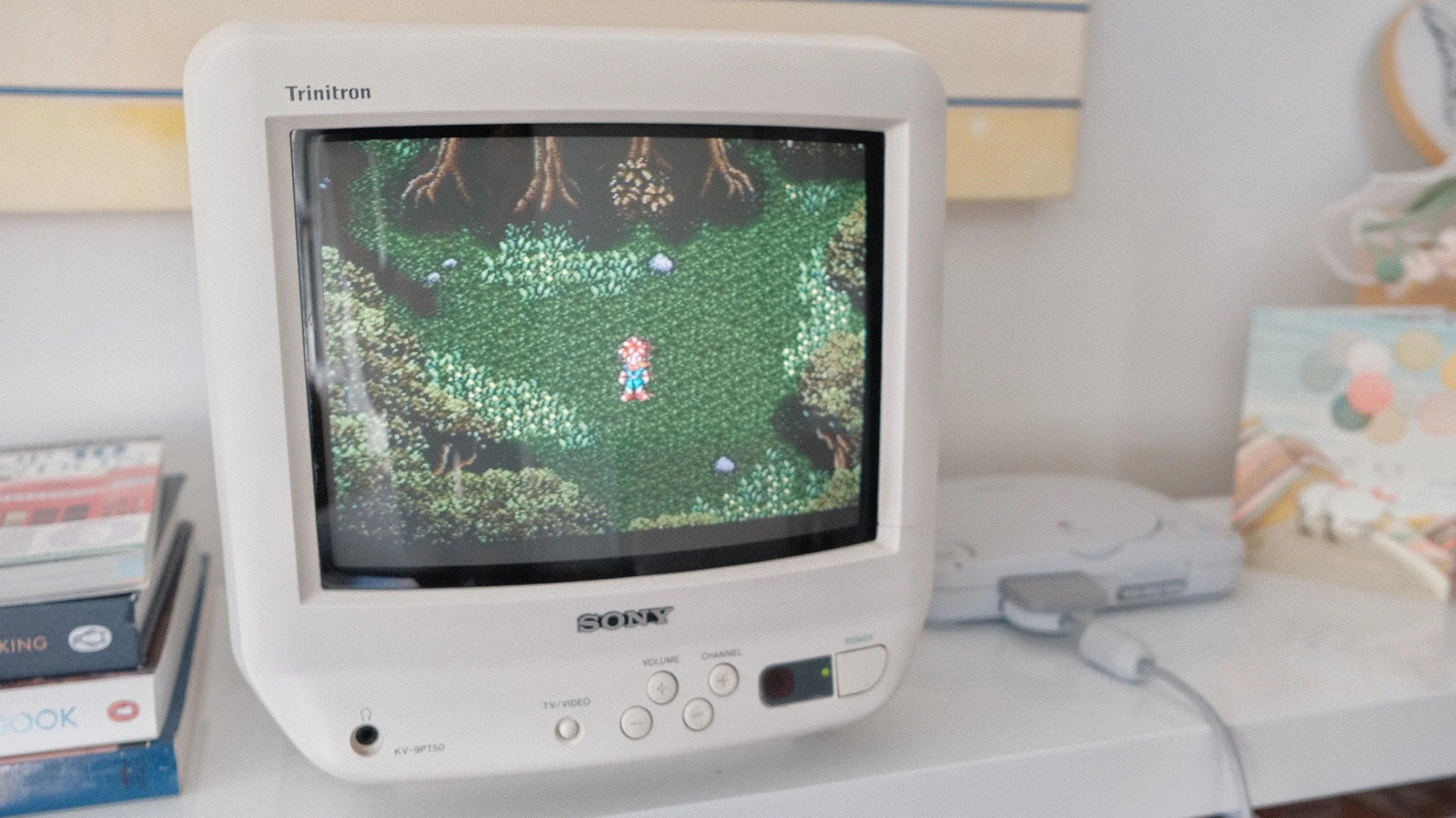

Now we have enough of a base to understand why retro games look the way they do on modern TVs. One major issue is that recent LCD and OLED TVs don’t offer great analog connections. If you’re lucky, your TV might have composite ports. But even if that’s the case, composite cables introduce a lot of noise to the signal from your console.
Chrono Trigger (1995, Squaresoft) – SNES
PC Emulator vs. SNES Composite via Sony KV-14M10
Recycling this comparison I did last year for Toriyama’s passing in celebration of Chrono Trigger’s anniversary!
— CRT Pixels (@crtpixels.bsky.social) 2025-03-11T16:33:26.109Z
Another roadblock is that modern screens aren’t designed to display interlaced content. They use software to convert 480i content to 480p. That process, known as “deinterlacing,” introduces input lag, which makes games feel less responsive. What’s more, many moderns TVs will detect 240p content as 480i, which they will then once again try to deinterlace. In that case, the process produces visual artifacts like motion blur. This all happens before your TV attempts to upscale a 480p image to 1080p or 4K. Unless you own a dedicated scaler like the RetroTink 4K, blowing a 240p image up to 4K will not look good.
Final Fantasy Tactics (1997, Squaresoft) – PS1
Sharp Pixels vs. PS1 Composite via Sony KV-27S43
FFT is actually THE game responsible for this blog. When I got an HDTV in 2012, I hooked up my PS2, but when I saw FFT’s dithering for the first time I thought my console was broken!
— CRT Pixels (@crtpixels.bsky.social) 2025-06-04T15:08:48.777Z
Then you have the fact that retro games’ art was designed for display on CRTs. Over decades, video game artists developed and perfected techniques to make pixel art (and later 2D textures) look more lifelike. Dithering was one of those techniques. This involved artists adding visual noise to sprites and textures, often in the form of a checkboard pattern, to create smooth color gradients. Dithering is transformative on CRTs due to how the technique interacts with a phosphorescent screen; on an LCD or OLED, it completely loses its effect. In fact, for the recent rerelease of Final Fantasy Tactics, Square Enix removed dithering from the game’s Classic presentation mode for that exact reason.
Separately, there are games like Silent Hill 2 and Doom 3 that look washed-out unless you play them on a CRT or OLED. Until the recent advent of local dimming, LCD panels could not produce deep blacks due to the tech’s reliance on backlighting. This limitation of LCDs changed the look of games for more than a decade.
Credit: Source link