
24K-Production
The current Bull Market
Markets have been on the rise since January. This has surprised a lot of people especially since we are in a rising interest rate environment. Bull and bear markets always gain traction from an underlying theme. However, this theme may not always be based on complete reality but something that people perceive to be reality. It will be a one-liner where people can convince themselves that whether they are buying or selling, it is a good thing to do and everybody else is in the same boat. In this case the bull theme has been, ‘AI will change the world forever”. However, everybody was a bit amazed by how far things went this time. Valuations of the “Magnificent 7” (M7) – Tesla (TSLA), NVIDIA (NVDA), Amazon (AMZN), Apple (AAPL), Alphabet (GOOG), Microsoft (MSFT), and Meta Platforms (META) – have been driven to insane levels. For example, the price to sales for Nvidia is now 42 compared to a NASDAQ average of 4.4. There seems to have been excessive levels of FOMO around. All this reminds me of what Isaac Newton said at the time of the South Sea bubble; “I can calculate the movements of the planets, but I can’t calculate the madness of humans”.
Stocks need to come down to earth. A lot. However, it can be dangerous to bet against a rising market just because you think it may be overvalued. There is the saying “Markets can stay irrational longer than you can stay solvent”. So, first, it is always best to wait until you find a reason to think that the markets have topped out.
Why should we think for that we have just seen the market top?
Put/call ratio
Put/Call Ratio (YCharts)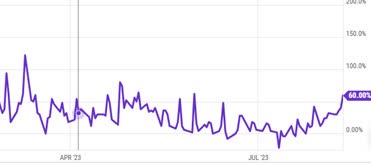
The Put/Call ratio can be a good leading indicator for turning points. It had been slowly declining from about May until the end of July when it suddenly started to revert to the upside. This means that the number of call options compared to puts were on the increase until late July when things suddenly reversed direction.
Hedge Fund/Institutional Action
It had been finally recognized that Apple was dangerously overpriced. Over a 5-day period in early August the stock lost 10% of its value causing it to burst through the lower Bollinger band. It just so happened that this also corresponded to the market peak and the markets started falling from here. This is when I started putting my put options on.
On August 17 a large put option was traded on Apple worth $37M.
Technical Indicators
On 8th August the S&P and NASDAQ indexes closed beneath the 50-day moving average. When this happens, it is commonly interpreted as a change to the downside.
Why should we think for that we are now in for a bear market?
Bitcoin
Bitcoin was down 7% on the 17th August, 16% from its July 13 zenith to below 26,000. Barron’s have indicated that Bitcoin’s Fall Is a Bad Sign and may point to more pain for the S&P 500 and Nasdaq as it has been a leading indicator of risk sentiment. While stocks have already fallen significantly in recent sessions, the most recent dip in the Bitcoin price-which is now below key technical levels and vulnerable to further declines-could spell that risk sentiment for stocks has not yet hit rock bottom.
Chinese Situation
The grossly overvalued Chinese property market has finally met its Nemesis and is bringing the economy down with it.
The share price of the country’s largest property developer, Country Garden, has collapsed with debt that it cannot pay back. Another embattled developer, Evergrande, has filed for US bankruptcy protection. Property accounts for 25% of the Chinese economy and the government has stopped publishing embarrassing economic statistics. These problems will not be resolved any time soon.
Since China is the world’s second-largest economy this will inevitably have a knock-on effect to the rest of the world. Indeed, this may already be happening, since Chinese exports are also collapsing this tells us that the rest of the world is also already in a downward economic spiral.
The AI situation
It has been said that, in short order, AI will completely change how the world is run but in reality, significant change may probably take years. We are perhaps seeing a similar bull market theme that we saw during the .com bubble that burst in 2000 and which stated that the internet itself will change things fast. Things did change but not that quickly.
Recession
In the past an inverted yield curve has always resulted in a recession soon after. But investors are saying “How can there be a recession coming when corporate profits are beating estimates 80% of the time”. Yes, companies have been beating expectations, but these are being continually reduced. Setting bar low. Corporate profits are down 5% Y/Y. Second quarter performance this year is the worst since 2020 and has now fallen for 3 quarters in a row.
The bulls highlight the strength of the US consumer and future productivity gains from AI. However, we are in a high interest rate environment and the Fed is not planning on cutting interest rates any time soon. The reality is that home affordability is at record lows. Credit card and auto loan delinquencies are exceeding those at even the high levels seen in 2009. Foreclosures are up. Student debt repayments are resuming.
WeWork stock has collapsed. Liabilities now exceed assets which is always a dangerous situation.
Liquidity Issues
QT has resulted in the Federal Reserve shrinking its balance sheet by $1T since the peak of $8.55T in May last year. This adds to the supply of debt that private investors have to absorb. It was forced to end its previous attempt in 2019 after balance sheet unwinding contributed to a sharp spike in borrowing costs that spooked the markets. So far, the markets have not been affected much but the second trillion could matter more because it’s coming against the backdrop of a quicker increase in treasury supply just as demand from foreign investors is waning, threatening a further rise in borrowing costs. Investors bought bonds expecting yields to fall but this may not be the case.
QT has caused the M2 money supply to shrink from a high of $21.7T in July 2022 to $20.8T in May 2023. This is a reduction of 4.1% in under a year and can have a big impact on the economy going forward. We have not seen such a contraction since the great depression.
Ratings Agencies Downgrades
Fitch has downgraded the US credit rating and says it may be forced to downgrade JPMorgan along with many regional banks. Another one-notch downgrade of the industry’s score from AA- to A+ would force Fitch to reevaluate ratings on each of the more than 70 U.S. banks it covers. Banks exposed to commercial real estate could be particularly affected. Leaked info from Moody’s shows that it is particularly worried about U.S. Bank and Fifth Third. Profitability is not so much a problem as survivability.
Momentum Traders
The NASDAQ 100 index is down 7% from its peak a few weeks ago and the S&P 100 is down 5%. The advance just after the last CPI data was revealed was unable to be sustained.
Many institutions/hedge funds trade on momentum. Normally they do not initiate a trend reversal but just follow the momentum. As prices continue to decline from the top more institutions will be joining the (selling) party. I have it on good authority that a lot were waiting for the S&P to get below 4400 before they took action and we are just past that point now.
Action from well-known investors
Warren Buffet sold $8B worth of stock between April and June this year.
Michael Bury recently bought SPY put options representing a notional value of $890m, and QQQ put options representing a notional value of $740m.
How far will things go this time
This is in the realm of speculation and I don’t know. But I do know that if you are buying naked put options a decent rally can wipe you out. So, it may be best to make some sort of estimate here. Bear markets do not last as long as bull markets. And since the current mini-bull market has lasted for about 8 months I am penciling in at least a pause in the downward spiral by October and this is when my options expire. But I am going to keep a close eye on things and be ready to exit if things go the wrong way.
Trading Options
It may be best to get a handle on where we stand with trading options. If you are betting that the markets will go down then in my opinion the best thing is to buy put options. The alternatives are to sell call options or short the markets by borrowing shares to sell. However, since the two alternatives can lead to unlimited losses if thing go the wrong way, I am not recommending them.
So, let’s compare the prices of the options of different instruments. This is shown in the following table where the NASDAQ 100 ETF (NASDAQ:QQQ) and the S&P 500 ETF (NYSEARCA:VOO) option prices are compared with the M7 share option prices.
|
Company |
1-Year Expiry Option price/Share price at the money (%) |
|
|
PUTS |
CALLS |
|
|
QQQ |
6.98 |
11 |
|
VOO |
4.4 |
8.1 |
|
NVDA |
16.2 |
22.3 |
|
TSLA |
22.1 |
30.8 |
|
AMZN |
10.4 |
16.1 |
|
AAPL |
7.5 |
12.7 |
|
GOOG |
9.5 |
14.9 |
|
MSFT |
9.3 |
13.2 |
|
META |
13 |
18.5 |
Looking at the table, it doesn’t take a genius to see that there are some expensive option prices out there. For a start it can be seen that call options are far more expensive than put options which is in line with the present bullish sentiment. Also notice that Nvidia call options cost 22% of the share price. This means that investors buying these are expecting Nvidia stock to appreciate by at least 22% over the next year in spite of its already lofty valuation. Tesla is expected to appreciate by at least 30%. Amazing. All I can say is that it is no wonder that most people lose money with options.
However, we can also see that the best option prices are with QQQ and especially VOO puts. So, if you want a hedge against the markets going down it may probably be best that you do this with QQQ or VOO put options rather than individual M7 stocks.
Investor Takeaway
There are signs that a nascent bear market might be just starting after the present overdone stock market rally that we have seen in the last 8 months. The bull market theme based on “increased productivity from AI” may be giving way to a bear market theme of “interest rates higher for longer/world economy collapsing”. How long the bear market will last for is anybody’s guess, but it is probably best to buy put options to hedge against it. The cheapest options are with QQQ and VOO.
Credit: Source link