
herjua/iStock via Getty Images
Introduction
Greif, Inc. is a stock we last wrote about in December 2022. The company specializes in the production of a whole host of industrial packaging products (particularly the likes of storage drums, intermediate bulk carriers, jerrycans, containerboards, corrugated sheets, recycled paperboard, etc.) We had a HOLD rating then, and even after around 19 months, we aren’t sufficiently moved to revise our neutral stance on the stock. Nonetheless, here are some of the major talking points worth considering, if you’re exploring this name.
GEF.B vs GEF
Investors looking to gain exposure to the Greif business can do so via either the Class A Shares (NYSE:GEF) or Class B Shares (NYSE:GEF.B). The former accounts for the larger share of total shares outstanding (55% of shares outstanding), and does not entail any voting rights, whereas the latter offers full voting rights.
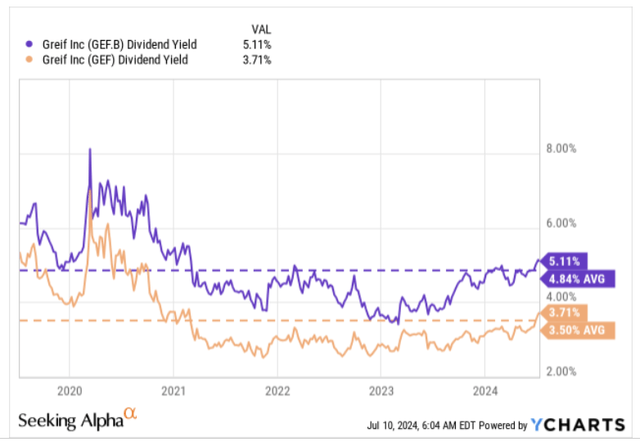
Garnering additional voting rights may not necessarily whet the appetite of the average retail investor, but do also note the more lucrative yield you’re likely to pocket if you pursue GEF.B. Currently that differential works out to 140bps, and a positive differential is always likely to hold, given the way Grief chooses to distribute its dividends.
YCharts
Essentially, as per the company’s statement of incorporation, its annual distribution on its Class B shares should always come at a 50% premium to the annual distribution on its Class A shares. For instance, if Greif decides to distribute $1 per share to GEF holders, GEF.B holders can expect to get paid $1.50 per share.
Despite offering voting rights, and a superior dividend payout of 50% more, note that the percentage differential in the ticket prices of these two classes of shares is just 8% in favor of GEF.B.
Yet also consider that one is unlikely to get a consummate fill on a potential GEF.B order, as volumes in this counter are exceedingly low resulting in potentially large spreads. For context, the weekly volume as a percentage of total shares is just a minuscule 0.02%; whereas with GEF, the corresponding ratio is 15x higher!
Volume Challenges Across Most Regions, Although Sequential Improvements Could Be In Store
YCharts
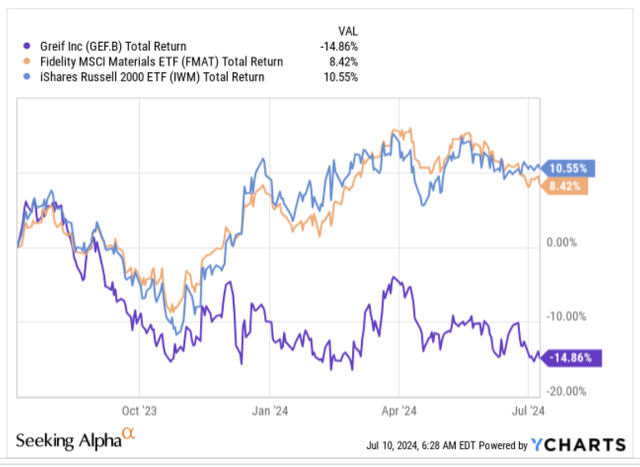
Over the last year when small-caps have managed double-digit returns and Greif’s material peers have eked out high-single-digit returns, our focus stock has floundered, losing 15% of its value.
GEF operates via three divisions, but its largest division – Global Industrial Packaging, which accounts for 56% of group sales, is witnessing volume pressure across multiple regions. For instance, in the most recent quarter, three out of the four regions where GEF sells its industrial packaging experienced volume pressure or no volume growth.
In North America, slow bulk and commodity chemical dynamics saw volumes drop by 5% YoY, in APAC, volume pressure was a lot more pronounced, coming off by -11% YoY because of significant de-stocking effects in China after the Chinese New Year. LatAm was tolerable, posting a flattish performance, but the agriculture chemical market continues to be pressured there. Weakness in the ag-chem LatAm market will also see a much lower contribution from the Ipackchem acquisition for H2-24, which was closed in April (Greif follows an October year ending calendar).
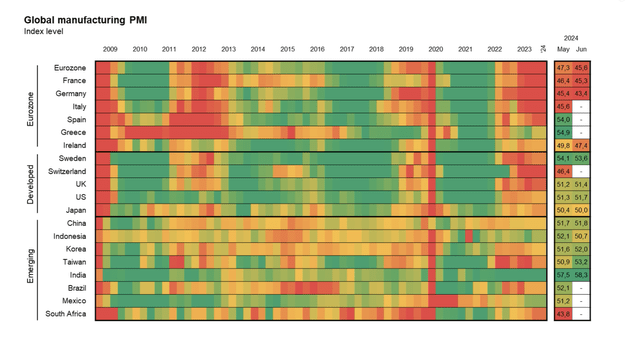
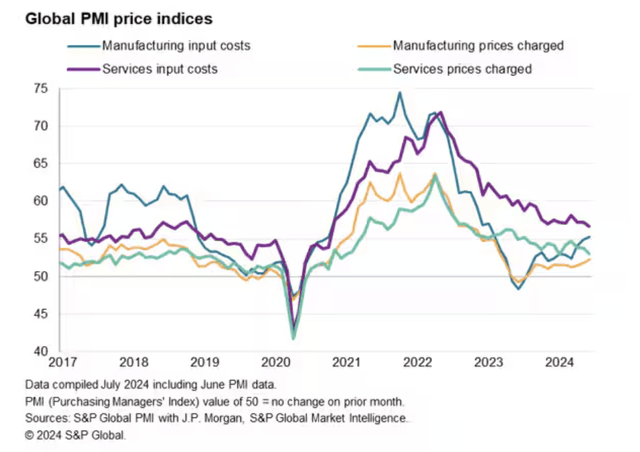
If one is trying to understand GEF’s prospects, the forward-looking global manufacturing PMI tables are a decent enough proxy as they provide some insight into industrial and manufacturing momentum. It looks like besides some of the major economies in the Eurozone, most other key industrial nations are set to have better manufacturing conditions ahead.
JP Morgan
Having said that, manufacturing input costs and prices charged are on the up, and are expected to leave an adverse mark on the cost base of companies across the industrial value chain, including Greif. In fact, Greif management pointed to this on their recent earnings call, and have called out a $ 19m-$39m impact from transport and manufacturing headwinds going forward.
S&P Global
Greif looks set to mitigate some pressures here, particularly in their Paper Packaging & Services (PPS) division, where price increases have been announced (since June 1) to offset rising OCC and other costs. Although the benefits of this are likely to be felt only by August or September, so you could be looking at some stabilization only by Q4-24 (the October quarter, as far as Greif is concerned).
Leverage Spike and Limited FCF Uplift
We previously commended Greif for maintaining a net leverage ratio well below its target range of 2-2.5x, but on account of the Ipackchem acquisition where they’ve ended up spending close to $600m, the level of financial gearing has once again shot up. With pressure on the operating front, and a higher net debt balance, the adjusted net debt to EBITDA ratio has spiked to almost 3.5x.
Greif has a long history of generating consistently solid FCF on an annual basis, and whilst that trend should persist for FY24 as well, note that the cadence of FCF will be markedly lower this year. Over the last two years, GEF has generated average annual FCF to the tune of $450 p.a., but this year’s expected FCF range will be a lot lower, only within the $175m -$225m mark.
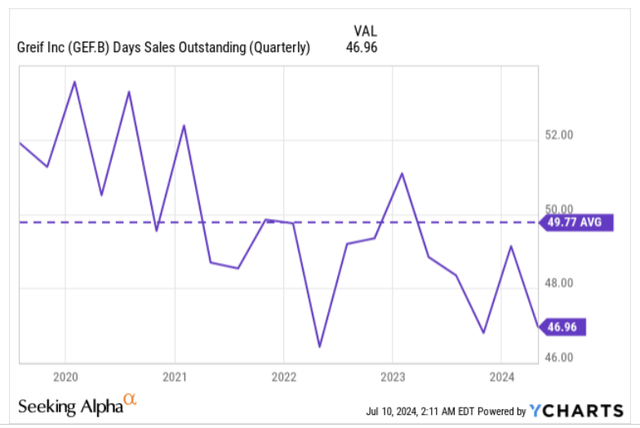
We don’t see much scope for significant working capital improvement, as the days in sales outstanding (DSO) have already fallen below its 5-year average, and typically usually troughs at this level.
YCharts
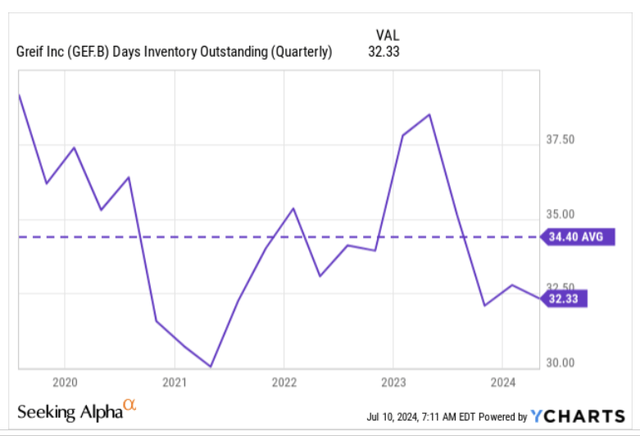
Even the other important component of working capital, inventory days too is at rather subdued levels of 32 days and could start putting pressure on working capital.
YCharts
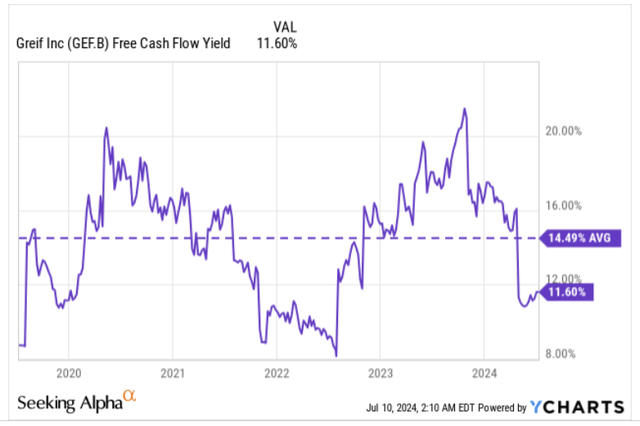
Management has also suggested that they will be spending more on strategic-CAPEX and efficiency-related maintenance projects that will leave a mark on the post-operating cash flow dynamics. All in all, note that the current FCF yield of 11.6% on the GEF.B stock is already below its 5-year average, and given what we’ve mentioned so far, we don’t expect it to cross above-average levels any time soon.
YCharts
Even though GEF.B has been paying dividends for two decades, we don’t think investors should expect any generous dividend hikes any time soon, as most of the sub-par FCF will likely be diverted towards bringing down the elevated leverage position.
Forward Valuations Look Pricey Even As EBITDA Looks Set To Slump
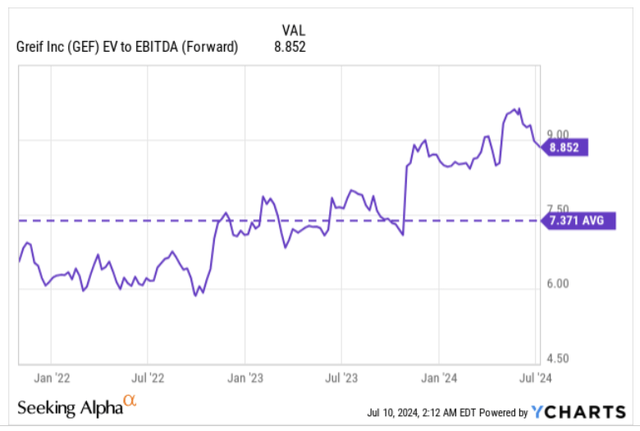
Despite the meaningful correction in the share price over the past year, the stock still looks quite expensive from an EV/EBITDA perspective, relative to its rolling average multiple. We would be open to paying a premium multiple if we were getting healthy EBITDA growth, but that isn’t the case with Greif.
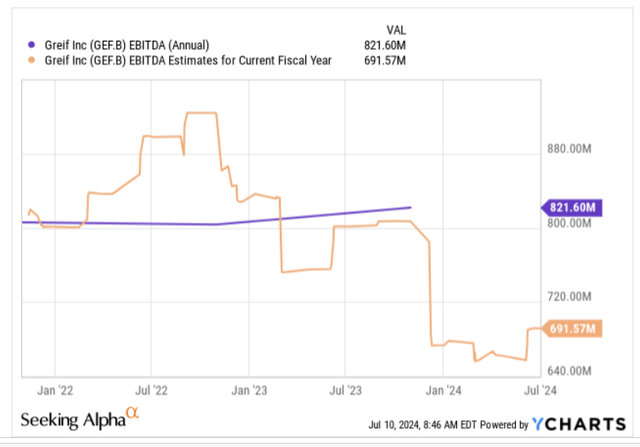
Firstly note that the spike in net debt by 32% YoY in recent quarters has ended up boosting the Enterprise value (market-cap has fallen by a smaller degree); then after delivering EBITDA of $822m last year, this year’s EBITDA will likely drop off by 16% YoY to $692m (as per sell-side consensus). There’s potential for GEF to do even better and hit levels of $725m (which is the top end of management’s guidance) , but even in that best-case scenario, you’d be staring at a 12% decline on the EBITDA front.
YCharts
Considering this outlook, we don’t think it makes a great deal of sense to shed out a multiple of 8.85x which represents a 20% premium over the stock’s long-term average multiple
YCharts
Closing Thoughts- Unappealing Technicals
Investing
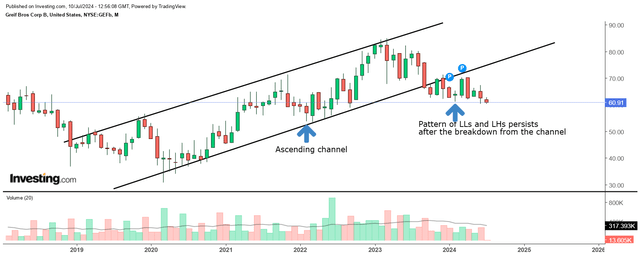
Finally, if we take a look at GEF’s monthly charts, it does not look like this is the best time to dive in. Basically from 2019 until September last year, we saw the stock trend up in an ascending channel; that multi-year channel came to an end by Q4-23 and since then we haven’t quite seen the price action flatten out; rather the ongoing pattern of lower lows (LLs) and lower highs (LHs) continues to linger, suggesting that the force is with the bears. Until we see some stabilization on this front, we don’t believe GEF should be considered.
Credit: Source link