• bitcoinBitcoin(BTC)$86,206.000.05%
  • ethereumEthereum(ETH)$2,742.67-0.08%
  • tetherTether(USDT)$1.000.00%
  • binancecoinBNB(BNB)$787.81-2.03%
  • rippleXRP(XRP)$1.575.06%
  • usd-coinUSDC(USDC)$1.000.00%
  • solanaSolana(SOL)$117.10-0.91%
  • tronTRON(TRX)$0.341352-1.19%
  • zcashZcash(ZEC)$1,549.802.24%
  • Figure HelocFigure Heloc(FIGR_HELOC)$1.01-0.15%
  • HyperliquidHyperliquid(HYPE)$95.011.10%
  • dogecoinDogecoin(DOGE)$0.0996273.31%
  • moneroMonero(XMR)$572.41-0.57%
  • whitebitWhiteBIT Coin(WBT)$86.61-0.04%
  • chainlinkChainlink(LINK)$13.01-0.04%
  • USDSUSDS(USDS)$1.00-0.02%
  • RainRain(RAIN)$0.013429-5.01%
  • cardanoCardano(ADA)$0.2517263.32%
  • leo-tokenLEO Token(LEO)$8.971.86%
  • stellarStellar(XLM)$0.2135991.76%
  • bitcoin-cashBitcoin Cash(BCH)$321.7722.17%
  • nearNEAR Protocol(NEAR)$4.409.01%
  • uniswapUniswap(UNI)$9.133.12%
  • avalanche-2Avalanche(AVAX)$11.07-1.02%
  • Ethena USDeEthena USDe(USDE)$1.00-0.03%
  • litecoinLitecoin(LTC)$61.39-1.55%
  • daiDai(DAI)$1.00-0.03%
  • CantonCanton(CC)$0.115607-1.05%
  • USD1USD1(USD1)$1.00-0.03%
  • hedera-hashgraphHedera(HBAR)$0.0970796.63%
  • suiSui(SUI)$1.01-1.30%
  • the-open-networkGram (prev. Toncoin)(GRAM)$1.43-0.57%
  • BittensorBittensor(TAO)$315.6911.11%
  • shiba-inuShiba Inu(SHIB)$0.0000061.60%
  • crypto-com-chainCronos(CRO)$0.0666643.69%
  • Global DollarGlobal Dollar(USDG)$1.000.00%
  • MemeCoreMemeCore(M)$1.31-13.11%
  • paypal-usdPayPal USD(PYUSD)$1.00-0.01%
  • tether-goldTether Gold(XAUT)$4,341.58-0.22%
  • okbOKB(OKB)$121.63-1.52%
  • Circle USYCCircle USYC(USYC)$1.140.01%
  • Ripple USDRipple USD(RLUSD)$1.000.00%
  • BitwayBitway(BTW)$0.86-5.02%
  • BlackRock USD Institutional Digital Liquidity FundBlackRock USD Institutional Digital Liquidity Fund(BUIDL)$1.000.00%
  • Ondo US Dollar YieldOndo US Dollar Yield(USDY)$1.150.04%
  • aaveAave(AAVE)$143.17-1.18%
  • mantleMantle(MNT)$0.662.40%
  • EthenaEthena(ENA)$0.207623-4.72%
  • OndoOndo(ONDO)$0.429720-2.44%
  • Pump.funPump.fun(PUMP)$0.0044321.95%
TradePoint.io
  • Main
  • AI & Technology
  • Stock Charts
  • Market & News
  • Business
  • Finance Tips
  • Trade Tube
  • Blog
  • Shop
No Result
View All Result
TradePoint.io
No Result
View All Result

GPT-4o Understands Text, But Does It See Clearly? A Benchmarking Study of MFMs on Vision Tasks

July 24, 2025
in AI & Technology
Reading Time: 4 mins read
A A
GPT-4o Understands Text, But Does It See Clearly? A Benchmarking Study of MFMs on Vision Tasks
ShareShareShareShareShare

Multimodal foundation models (MFMs) like GPT-4o, Gemini, and Claude have shown rapid progress recently, especially in public demos. While their language skills are well studied, their true ability to understand visual information remains unclear. Most benchmarks used today focus heavily on text-based tasks, such as VQA or classification, which often reflect language strengths more than visual capabilities. These tests also require text outputs, making it difficult to fairly assess visual skills or compare MFMs with vision-specific models. Moreover, critical aspects such as 3D perception, segmentation, and grouping, which are core to visual understanding, are still largely overlooked in current evaluations. 

MFMs have demonstrated strong performance in tasks that combine visual and language understanding, such as captioning and visual question answering. However, their effectiveness in tasks that require detailed visual comprehension remains unclear. Most current benchmarks rely on text-based outputs, making it difficult to compare MFMs with vision-only models fairly. Some studies attempt to adapt vision datasets for MFMs by converting annotations into text, but this limitation restricts evaluation to language outputs. Prompting strategies have also been explored to help MFMs tackle visual tasks by breaking them into manageable subtasks, though reproducibility remains a challenge in some cases. 

YOU MAY ALSO LIKE

How To Enter VR Mode On Steam

Peloton Has Made A Foldable (Treadmill)

Researchers at EPFL evaluated several popular multimodal foundation models—such as GPT-4o, Gemini 2.0 Flash, and Claude 3.5 Sonnet on core computer vision tasks, including segmentation, object detection, and depth prediction, using datasets like COCO and ImageNet. Since most MFMs are designed to output text and are only accessible via APIs, they developed a prompt-chaining framework to translate these visual tasks into text-compatible formats. Their findings show that while MFMs are competent generalists, they fall short of specialized vision models, especially in geometric tasks. GPT-4o stood out, performing best in 4 out of 6 tasks. The evaluation toolkit will be open-sourced. 

To evaluate MFMs on vision tasks, the study designed a prompt chaining strategy, breaking complex tasks into simpler, language-friendly subtasks. For example, instead of predicting bounding boxes directly, the model first identifies present objects, then locates them through recursive image cropping. For segmentation and grouping, images are divided into superpixels, which are easier to label and compare. Depth and surface normals are estimated using pairwise rankings of superpixel regions. This modular design leverages MFMs’ strength in classification and similarity, while calibration controls ensure fair comparisons. The method is flexible, and performance improves with finer-grained prompting. 

The study evaluates various MFMs, including GPT-4, Gemini Flash, and Claude 3.5, across multiple tasks, such as image classification, object detection, and segmentation. Using datasets like ImageNet, COCO, and Hypersim, results show GPT-4o reaching 77.2% on ImageNet and 60.62 AP50 for object detection, outperformed by specialist models like ViT-G (90.94%) and Co-DETR (91.30%). Semantic segmentation results show GPT-4o at 44.89 mIoU, while OneFormer leads with 65.52. MFMs handle distribution shifts reasonably well but lag on precise visual reasoning. The study also introduces prompt chaining and oracle baselines to evaluate upper-bound performance. 
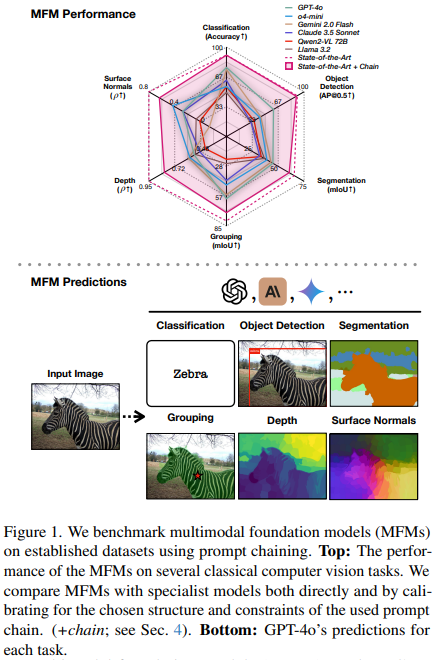
In conclusion, the study introduces a benchmarking framework to assess the visual capabilities of MFMs, such as GPT-4o, Gemini, and Claude, by converting standard vision tasks into prompt-based formats. Findings show MFMs perform better on semantic tasks than geometric ones, with GPT-4o leading overall. However, all MFMs lag significantly behind task-specific vision models. Despite being generalists trained primarily on image-text data, they show promising progress, especially newer reasoning models, such as o3, on 3D tasks. Limitations include high inference cost and prompt sensitivity. Still, this framework provides a unified approach to evaluating MFMs’ visual understanding, laying the groundwork for future advancements. 


Check out the Paper, GitHub Page and Project. All credit for this research goes to the researchers of this project.

Meet the AI Dev Newsletter read by 40k+ Devs and Researchers from NVIDIA, OpenAI, DeepMind, Meta, Microsoft, JP Morgan Chase, Amgen, Aflac, Wells Fargo and 100s more [SUBSCRIBE NOW]


Sana Hassan, a consulting intern at Marktechpost and dual-degree student at IIT Madras, is passionate about applying technology and AI to address real-world challenges. With a keen interest in solving practical problems, he brings a fresh perspective to the intersection of AI and real-life solutions.

Credit: Source link

ShareTweetSendSharePin

Related Posts

How To Enter VR Mode On Steam
AI & Technology

How To Enter VR Mode On Steam

September 22, 2026
Peloton Has Made A Foldable (Treadmill)
AI & Technology

Peloton Has Made A Foldable (Treadmill)

September 22, 2026
OpenAI Faces Lawsuit From British Columbia Over Tumbler Ridge Shooting
AI & Technology

OpenAI Faces Lawsuit From British Columbia Over Tumbler Ridge Shooting

September 22, 2026
NVIDIA Introduces SoL-Pi: Auto-Research Loops That Cut Coding Agent Token Traffic by Up to 49%
AI & Technology

NVIDIA Introduces SoL-Pi: Auto-Research Loops That Cut Coding Agent Token Traffic by Up to 49%

September 22, 2026
Next Post
Coldplay singer Chris Martin’s call-out of a couple during a concert has gone viral

Coldplay singer Chris Martin's call-out of a couple during a concert has gone viral

Leave a Reply Cancel reply

Your email address will not be published. Required fields are marked *

Search

No Result
View All Result
AI’s Safety Debate Meets Silicon Valley FOMO

AI’s Safety Debate Meets Silicon Valley FOMO

September 20, 2026
Still The Best (And It’s Not Close)

Still The Best (And It’s Not Close)

September 18, 2026
Staten Island man struck by lightning and survives

Staten Island man struck by lightning and survives

September 20, 2026

About

Learn more

Our Services

Legal

Privacy Policy

Terms of Use

Bloggers

Learn more

Article Links

Contact

Advertise

Ask us anything

©2020- TradePoint.io - All rights reserved!

Tradepoint.io, being just a publishing and technology platform, is not a registered broker-dealer or investment adviser. So we do not provide investment advice. Rather, brokerage services are provided to clients of Tradepoint.io by independent SEC-registered broker-dealers and members of FINRA/SIPC. Every form of investing carries some risk and past performance is not a guarantee of future results. “Tradepoint.io“, “Instant Investing” and “My Trading Tools” are registered trademarks of Apperbuild, LLC.

This website is operated by Apperbuild, LLC. We have no link to any brokerage firm and we do not provide investment advice. Every information and resource we provide is solely for the education of our readers. © 2020 Apperbuild, LLC. All rights reserved.

No Result
View All Result
  • Main
  • AI & Technology
  • Stock Charts
  • Market & News
  • Business
  • Finance Tips
  • Trade Tube
  • Blog
  • Shop

© 2023 - TradePoint.io - All Rights Reserved!