







































Google DeepMind on October 15, 2026 published a technical walkthrough in which biologists used Google Antigravity, its agentic development platform, to identify a novel antimicrobial peptide candidate in Streptococcus pseudopneumoniae, and the company said the lead is undergoing wet-lab validation.
The walkthrough, authored by Pengfei Tian, Maxwell L Bileschi, Zoi Tsangalidou, Sukhdeep Singh, and Lucy J. Colwell, frames the work against rising antimicrobial resistance, which the post says could result in an estimated 10 million annual deaths globally by 2050. It presents antimicrobial peptides, particularly bacteriocins, as a promising alternative to traditional antibiotics because they have naturally evolved to target fundamental vulnerabilities in competing bacteria, from cell envelopes to essential intracellular machinery. According to the post, genomic and metagenomic sequencing has populated global databases with billions of natural amino acid sequences, a pool that has produced widely used bacteriocins such as Nisin alongside genome-mined discoveries including Darobactin, Dynobactin, and Lariocidin, while millions of sequences in the UniProt database remain functionally uncharacterized. Google developed ProtNLM (Protein Natural Language Model), which the post describes as a deep learning model trained to predict biological function directly from raw amino acid sequences, and DeepMind said it has enriched millions of previously unnamed UniProt entries with high-confidence functional labels.
From UniProt Search to a Computational Candidate
In the walkthrough, the researcher and the AI agent begin with a focused biological goal: find and computationally validate novel antimicrobial peptides in Streptococcus pseudopneumoniae. During an interactive, multi-turn session, the researcher steers the scientific strategy, deciding which questions to ask and what evidence to collect, while the agent handles cross-database orchestration, structural analysis, and literature synthesis. Interface screenshots in the post show the session conducted with the Gemini 3.8 Flash model selected in the Antigravity interface.
The agent queried UniProt and filtered millions of entries down to a shortlist of candidates, identifying a bacteriocin with UniProt ID A0A0U0D591, a peptide 97 amino acids long from the Lactococcin 972 family. The post says the candidate has predicted activity against the pathogens involved in respiratory tract infections. To verify novelty, the researcher directed the agent to interrogate the candidate against curated Swiss-Prot proteins through the EMBL-EBI NCBI-BLAST service, and the walkthrough reports that the check confirmed no meaningful sequence homolog among manually reviewed proteins.
The agent then retrieved the candidate’s predicted 3D model from the AlphaFold Protein Structure Database, ran a Foldseek search against experimentally determined structures to identify remote homologs, and superimposed the models to assess similarity. DeepMind said the structural evidence corroborated ProtNLM’s prediction by showing the candidate’s fold closely matches an experimentally determined bacteriocin. Inspecting the flanking genes, the agent found the candidate sitting 6 base pairs upstream of a tightly coupled operon containing an ABC transporter permease and its potential partner ATP-binding protein, alongside another annotated bacteriocin and an XRE transcriptional regulator, a pattern the post describes as strong contextual evidence that the candidate is part of a working bacteriocin system.
Reviewing existing literature, the agent proposed a mechanism of action targeting bacterial cell division and a predicted potency spectrum spanning several drug-resistant pathogens, according to the post. The agent then translated its in silico findings into a bench protocol spanning protein expression, antimicrobial susceptibility testing, target engagement, and in vitro toxicity testing. DeepMind characterizes the candidate as a biologically plausible lead backed by structural and genomic evidence that still requires wet-lab validation.
Biomolecular Structure Viewer Embedded in Antigravity
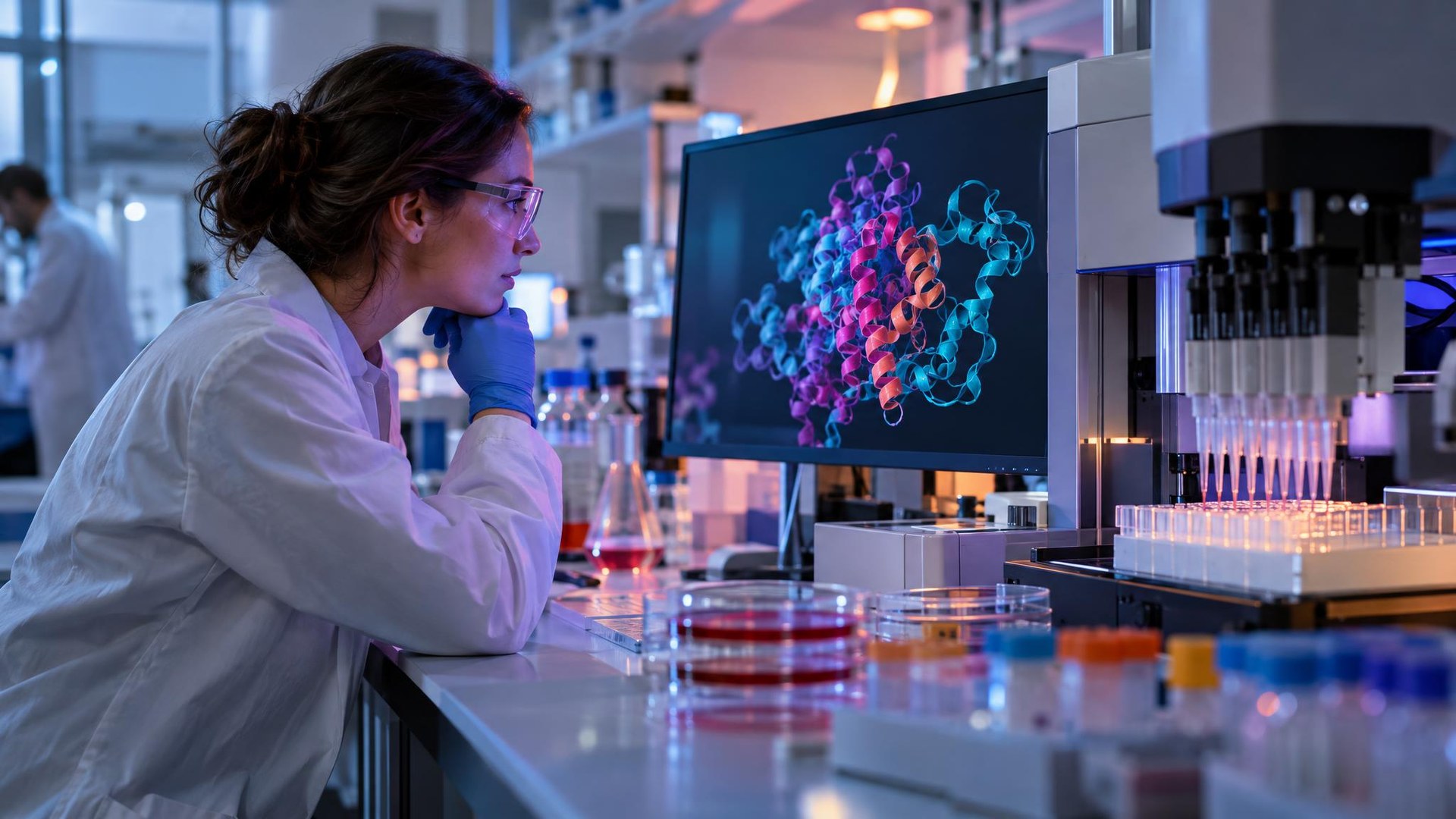
Alongside the walkthrough, DeepMind introduced the Biomolecular Structure Viewer, a 3D visualization tool embedded directly into Antigravity that gives the researcher and the agent a shared visual state. As the agent retrieves structures from the AlphaFold Database or the scientist’s own predictions, it can dynamically drive the viewer, highlighting key functional regions to visually explain its hypotheses. The awareness flows both ways: actions such as highlighting specific residues or pinning notes directly onto a binding pocket are synchronized back to the agent. The post gives the example of a researcher marking a region of interest in 3D space and asking how a β-strand might affect Lipid II binding, allowing the agent to reason over the exact structural context the scientist is viewing.
Antigravity Science Platform and Access Program
The Antigravity science page says agent customizations equip agents with domain-specific plugins, skills, subagents, and hooks for work across more than 30 major life-science databases, including the 1PB AlphaGenome Atlas, UniProt, PubChem, and ChEMBL, with the Science plugin installable in one click from the in-app Customizations marketplace. According to the page, researchers can directly query Google DeepMind frontier models and databases such as AlphaGenome, the AlphaFold Database, and Atlas inside the research workspace, and can produce publication-ready 3D PyMOL structural renderings, reproducible analysis scripts, and verifiable scientific artifacts. The page points to an open-source customizations repository on GitHub, lists desktop availability on macOS, Windows, Linux, and Googlebook, and states that Google is giving 10,000 scientists free access to Gemini 4 Argon in Antigravity at its highest usage tier.
DeepMind describes Antigravity as an agentic science workbench that compresses what used to be a fragmented search across multiple databases into a single session, and said researchers can take the demonstrated conversation in new directions, such as layering in new filtering criteria, exploring different sequence lengths, or targeting other priority pathogens, broadening the search from human commensals to environmental microbes. The candidate featured in the walkthrough, along with several others discovered through the same pipeline, is in wet-lab validation, where DeepMind said experimental results will provide the ultimate test of the agent’s analysis.
Credit: Source link