
GoMirra, an AI companion platform from First Kind AI, is entering the U.S. market with 18 virtual personalities, voice and text conversations, and a memory system designed to carry personal context between sessions. Its central proposition is a more active kind of conversational software: companions that ask follow-up questions, revisit a person’s goals, and bring several perspectives to the same problem.
The company’s launch materials list an $18 monthly subscription covering all 18 companions and the platform’s features. Founded by Tony Nelson and Oliver Rozynski, First Kind AI is positioning GoMirra around personal development, creative exploration, and ongoing conversation. The service is for adults aged 18 and older.
Persistent Memory Behind the Conversation
A chatbot can produce a convincing answer without knowing much about the person asking. Maintaining a useful conversation over weeks or months requires a different kind of context: what someone is working toward, what they have already tried, and which details they want the system to remember.
First Kind AI calls its approach GOTEL, a proprietary “Relational Intelligence” layer. According to the company, it maintains a consent-based Identity Map and Behavioural Map that capture a subscriber’s interests, aspirations, communication preferences, and changing patterns. The aim is to make later conversations build on earlier ones rather than repeatedly starting from an introduction.
GoMirra’s product information describes the system as drawing on foundation models alongside memory scaffolds and guardrails. That places the emphasis on how models receive and use personal context. The public materials do not identify the underlying model providers or detail the storage, retrieval, and evaluation methods behind GOTEL.
The distinction matters because persistent memory is more than retaining a full chat transcript. A useful system must select relevant information, update it when circumstances change, and avoid carrying outdated assumptions into a new conversation. GoMirra says users can see remembered information through the Identity Map and control what the platform remembers or forgets.
One Question, Multiple AI Perspectives
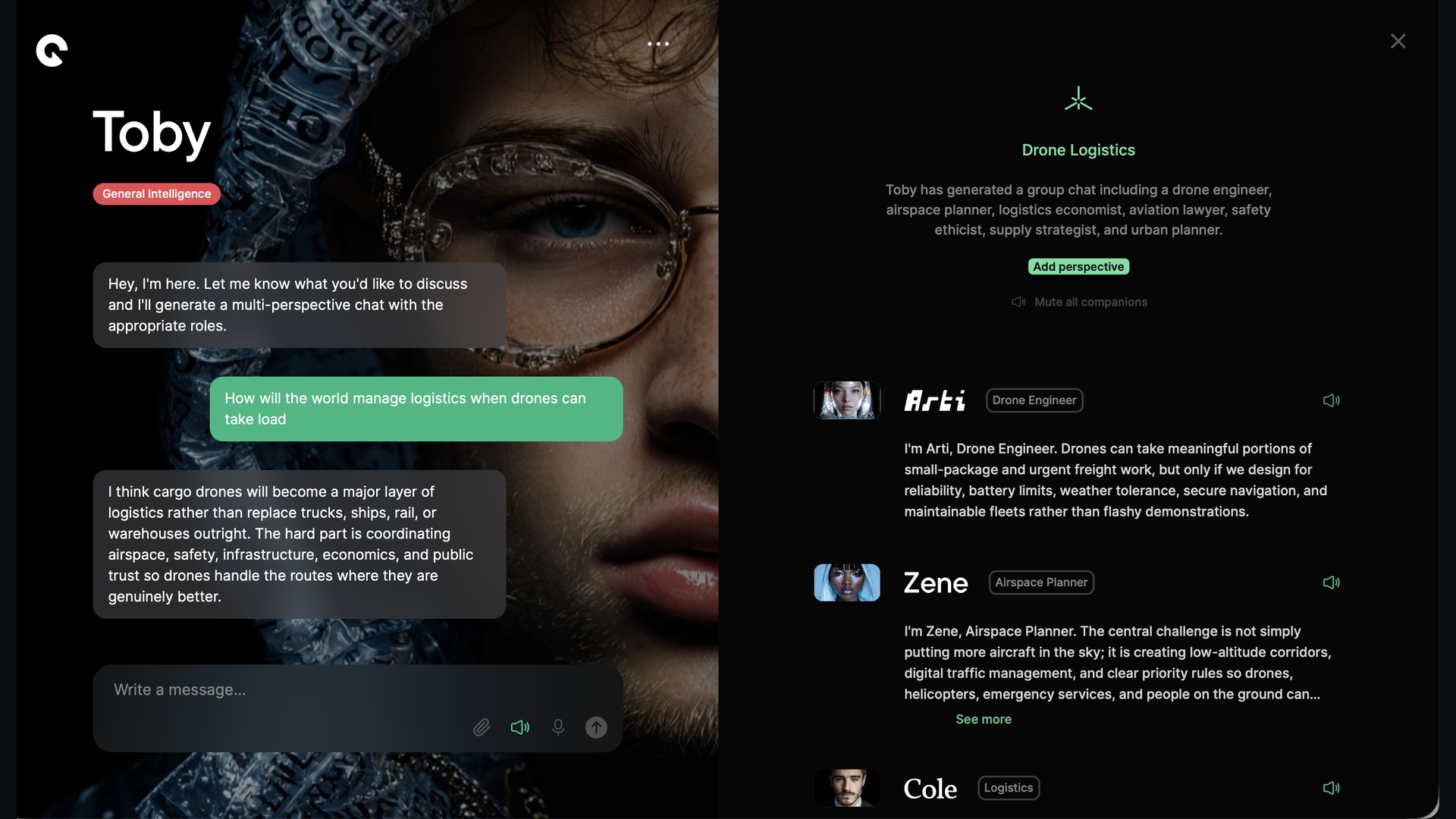
The platform’s Multi-Perspective feature lets subscribers put a question to several companions, or the full roster of 18, to explore different approaches. Each companion has a distinct personality and photorealistic avatar, with different conversational styles and areas of emphasis.
For someone considering a career change, for example, the appeal is a discussion that can move between practical planning, creative possibilities, and challenges to an initial assumption. That is an illustration of the format’s potential, rather than a claim that the software can decide which option is right.
Several AI viewpoints can make brainstorming more useful, but agreement between characters is not independent confirmation of a fact. The value lies in surfacing alternatives and explaining trade-offs. Factual accuracy still depends on the models and information supporting the conversation.
Other modes include Devil’s Advocate, Standup Comedy, and Cosmic Hotline. Together, they make conversational tone part of the product: subscribers can choose whether an exchange should challenge an idea, explore a playful scenario, or help organize their thinking.
Background Research and Daily Briefings
GoMirra also extends its proposition beyond an active chat window. The company says companions can review a user’s stated interests and intentions and perform background research and reasoning to bring back relevant ideas and articles. Daily Briefings are intended to connect new information with a subscriber’s goals and circumstances.
Technically, this introduces a second workflow alongside immediate conversation: work that happens between sessions and returns as a later update. Its usefulness depends on choosing relevant topics and sources, as well as keeping the resulting briefing aligned with what the user actually asked the system to follow.
The launch materials describe voice and text support in dozens of languages. GoMirra is web-first on desktop and mobile, and the company also lists iOS and Android availability. Its website links to an Android app on Google Play.
Personal Context Requires User Control
A service built around remembering personal aspirations also accumulates sensitive context. On its website, GoMirra says conversations are encrypted in transit and at rest, are not sold, and can be deleted by users. Its terms and policies hub includes separate sections for privacy, data deletion, retention, security, and AI use.
The product also includes psychometric assessments intended to inform reflection and conversation. Although the company describes these using clinical terminology, the launch materials do not establish that GoMirra provides clinical assessment or treatment. Readers should understand these features as part of a consumer companion experience.
GoMirra’s broader bet is that personalization can become a continuing interaction: asking better questions, retaining useful context, and returning with something relevant the next day. For users, the practical test will be whether those features make conversations more helpful over time while leaving them in control of the personal information behind them.
Credit: Source link