
Reid Griffith/iStock via Getty Images
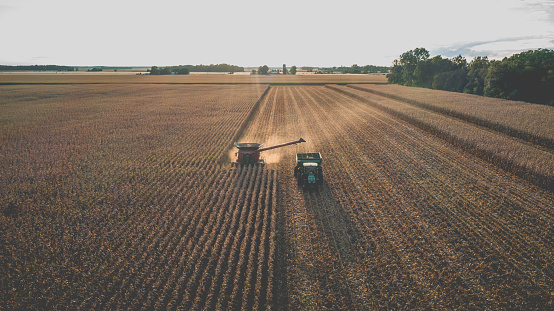
Gladstone Land Corporation (LAND), founded in 1997 and headquartered in McLean, Virginia, is an externally managed agricultural REIT focused on owning and leasing farmland.
As this is a conservatively leveraged and highly profitable landlord with strong liquidity, the 6.00% Series B Cumulative Redeemable Preferred Stock (NASDAQ:LANDO) represents a very good choice for dividend portfolios. What stands out here is the current high dividend yield, as well as the significant discount to liquidation preference.
Business
The REIT currently owns 169 farms, aggregating 115,731 acres, across 15 states, as well as several farm-related facilities.
Its farmland is primarily located in areas that are appropriate for cultivating either fresh produce annual row crops (i.e. vegetables) or permanent crops (like blueberries, almonds, pistachios, wine grapes, etc.)
The company generates its revenue primarily through leasing to independent and corporate farming operations, including sellers who wish to continue farming the land after selling it. Though it may also add to its revenue via property divestitures from time to time, management intends to own the properties for long periods in order to preserve a steady and growing stream of income by leasing them to tenants.
Profitability
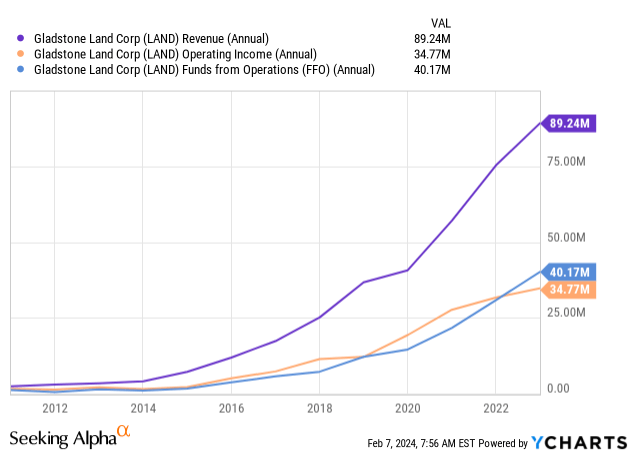
The REIT’s results for the third quarter of 2023 reflected a slight downturn in its operating performance. Despite maintaining profitability, revenue witnessed a modest YoY decrease of 2.8%. Similarly, operating income saw a YoY decline of 2.5%. Last, FFO decreased by 1.26% from the same quarter in 2022.
However, this is not representative of Gladstone’s overall performance. Zooming out a bit, the REIT demonstrated remarkable growth in 2022, outperforming the 2021 figures across key metrics. Revenue surged by 18.5% on a YoY basis, operating income experienced a 7% YoY increase, and FFO marked a 15.08% growth.
Going even further into the past, it’s evident that there is a trend of consistent and exponential growth in this business:
Solvency
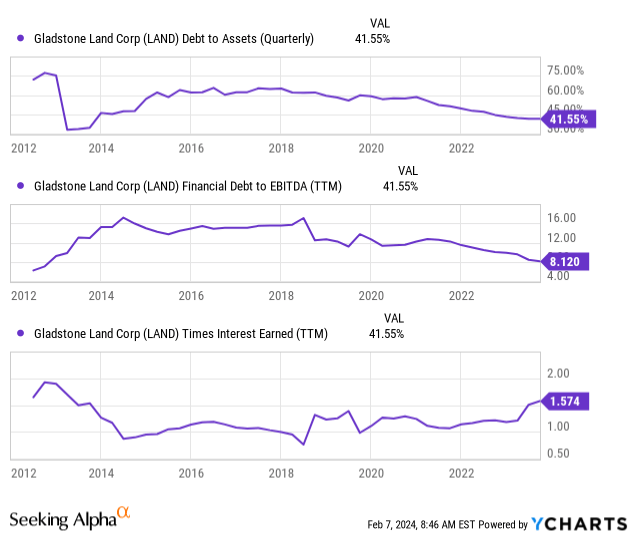
When it comes to investing in preferred stocks, solvency is as much crucial as growth. And this is an area where Gladstone Land also shines. It maintains a debt-to-assets ratio of 41.55%, indicating a low reliance on debt for financing. With a debt-to-EBITDA ratio of 8.1 times, it also demonstrates a decent liquidity level, which is confirmed by the interest coverage of 1.6 times.
The Preferreds
Now, while the common shares may be trading at a historically low level considering the difference between its recent high at the beginning of 2022 and the current price, the dividend yield is still relatively low at 4%.
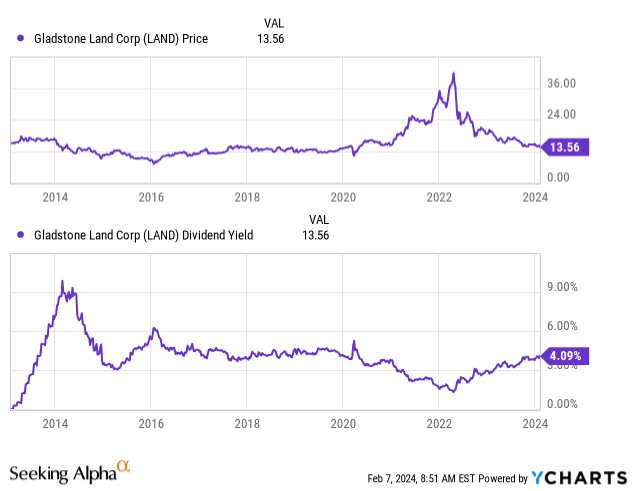
The Series B preferred shares Gladstone issued back on March 9, 2020, seem to be the more attractive option for income-focused portfolios
Owners of the preferreds can receive cumulative dividends at a fixed rate of 6% per annum on a liquidation preference of $25 per share, which implies a $0.125 monthly distribution. The current price currently translates to a dividend yield of 7.32%.
As you can see from the payment record, the REIT hasn’t missed a payment so far:
Seeking Alpha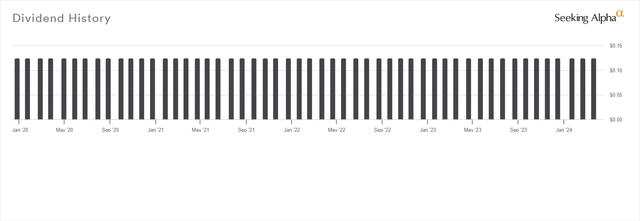
And with a 28.4% payout ratio, indicating more than sufficient dividend coverage, it’s unlikely that it is going to anytime soon (based on FFO available to preferred shareholders and dividends paid to both Series B and C preferred shares, per the 10-K for the year 2022).
Last, the share price currently reflects a 17.72% discount to the liquidation preference which also increases the margin of safety here. You should be aware, however, of the fact that though the company has the right to redeem the shares, it’s unlikely to do so soon based both on the fact that it hasn’t redeemed a significant number of shares so far and that it probably doesn’t need to.
Risks
A margin of safety or not, it’s crucial to consider a couple of risks that are present.
First, keep in mind that potential interest rate increases can apply some pressure on the stock price; even though it is unlikely, it’s best to have an intention to hold for the long term to reduce the possibility of loss due to volatility.
At the same time, long-term investors should be aware that since the shares are callable, there is a risk of having to reallocate funds during unfavorable market conditions; to avoid this, investors may want to consider other income-oriented investment opportunities if they are unsure about their ability to successfully redeploy funds.
Last, despite the operational performance you observed above, short-term profitability setbacks could cause a suspension of the dividends. Surely, cumulative dividends help with this risk, but they may not significantly offset potential opportunity costs while distributions are suspended.
Verdict
All in all, I believe that LANDO is a very good choice for dividend portfolios and I am assigning a buy rating for it. Even if the significant discount to liquidation preference didn’t exist, this is a profitable and conservatively financed REIT that is likely to remain solvent for the long term. Regardless, it’s very good that it does exist; although, I don’t think it makes it a good fit for value portfolios during this particular market environment.
What do you think? Do you own the preferreds or the commons and why? Make sure to let me know below and I’ll respond as fast as I can. Thank you for reading.
Credit: Source link