




Luis Alvarez
Summary
Following my coverage on Gartner, Inc. (NYSE:IT) in May ’23, which I recommended a buy rating as I thought the share price decline was overdone and that there was enough evidence that showed research contract value [RCV] can accelerate sequentially, this post is to provide an update on my thoughts on the business and stock. IT continues to be one of my bullish longs (buy-rated) as growth is accelerating as expected. Underlying demand has apparently improved, and management is capitalizing on this by hiring more employees.
Investment thesis
Yesterday, IT released its 2Q24 earnings, which was music to my ears as my thesis played out nicely. Total revenue grew ~6% to $1.59 billion, beating the street estimates for 5.4%, supported by research revenue growth of ~5%, consulting revenue growth of ~13%, and conference revenue of ~10%. The most important thing is that RCV y/y growth accelerated (as I expected) from 6.9% in 1Q24 to 7.4% in 2Q24, and the strength was across both global technology sales [GTS] and global business sales [GBS], which grew 6.1% and 12%, respectively. Remember that research is 80% of IT’s business, so the acceleration in RCV is a strong validator of IT’s growth story. Down the income statement, IT also beat estimates on both EBITDA margin (26.1% vs. 25.1%) and EPS ($3.22 vs. $3.02).
The growth narrative for IT is building up really well, and I am confident growth will trend back to low teens (as per my previous model) soon. RCV growth acceleration is probably the strongest indicator that underlying demand (i.e., businesses restarting their tech investment engines) is back. Three indicators suggest that demand is recovering, and RCV growth should continue to be strong. Firstly, the average total contract value [TCV] per enterprise is now at an all-time high ($281 million) since 2015 (y/y growth also accelerated from 10.5% in 1Q24 to 10.9% in 2Q24). Secondly, IT saw an inflection to positive growth in tech vendor contract value [CV], which is extremely bullish. Thirdly, new business growth for both GTS and GBS improved meaningfully to 8% y/y and 16%, respectively, in 2Q24 compared to down 1% and up 7% in 1Q24 on greater sales force productivity. Notably, GBS CV growth was particularly robust in the quarter, and management indicated all GBS functional areas saw high-single- to low-double-digit growth (except for marketing, which grew mid-single-digits).
“Our market opportunity is vast. Within our Research business, contract value with enterprise function leaders grew 10%, and our tech vendor clients returned to growth.” 2Q23 earnings results call
With these datapoints, I inferred that: (1) underlying tech investment demand is recovering; (2) IT sales productivity is improving. Which means, for IT to further accelerate growth, it needs to hire more sales employees, and encouragingly, management reaffirmed their target to increase sales force headcount by mid-to-high single-digits in 2024. But hiring would be more back-end-weighted, which means growth could further accelerate as IT moves through the rest of this year, with FY25 very likely seeing higher growth as these new employees become more productive.
What could pull back IT’s growth momentum is that small tech vendors are still facing challenges in getting external financing in the current macro climate, which gives them less dry powder for growth investments. This has resulted in several of these vendors churning away from IT. It is important to note that this is a macro headwind and not a micro one; IT did see tech vendor clients return to growth (recent sales of new tech vendor logos have been strong). The good news is that the pending rate cut (now expected in 2H24) will reduce the overall cost of funding, which should ease the situation.
Overall, research revenue should continue to perform better. The remaining 20% of the business (Conference and Consulting) should also perform better in line with the research segment, as they all benefit from the same recovery story: tech spending coming back online, which drives demand for more conference and consultation.
Valuation
Own calculation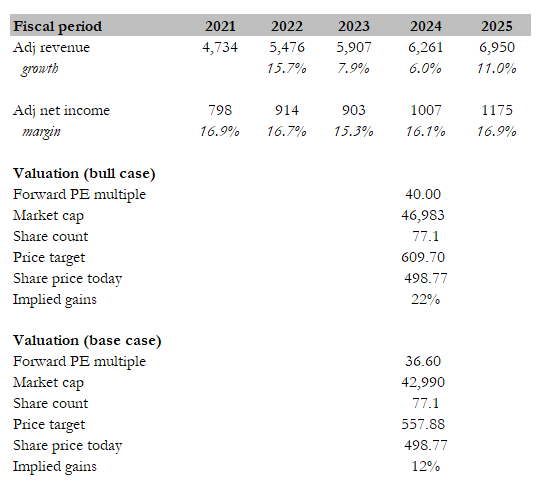
My base target price for IT based on my model is ~$558 (bull case $609). IT pretty much performed in line with my model assumptions, where adj. revenue growth came in at 6.1% with positive acceleration vs. 1Q24. The underlying demand momentum and increase in sales headcount should drive 2H24 to perform better than 1H24, making my FY24 6% growth assumption an easily achievable one. Beyond FY24, I remain confident that growth should inflect back to the low teens. The same trend is seen in IT’s adj net income, where the 2Q24 margin improved vs. 1Q24 by 10bps, and as growth continues to improve through FY24/25, it should not be a difficult task for IT to recover to its FY21 margin of 16.9%.
I laid out two scenarios above to show the potential upside at different exit multiples. The conservative side of me is assuming IT will trade at 36.6x by the end of this year (FY24), as that is the average of IT over the past 5 years. However, looking at how the market reacted to IT’s 2Q24 earnings, if results continue to improve, multiples could stay at the current 40x.
Risk
The increase in sales headcount will be margin dilutive as these new sales employees are less productive, but the fixed cost will surface in the P&L. Depending on how much IT hires in each quarter and how fast the employees mature, the margin could stay lower for longer than expected. Research transaction revenue is expected to decline by 20% in FY24 (500 bps acceleration from mid-teens in FY23). While this is a small part of the business (6%), if the decline happens at a much faster rate, it could modestly impact topline growth.
Conclusion
In conclusion, my rating for IT is a buy rating. The acceleration in RCV is a clear indicator of a rebounding tech investment environment. This, coupled with improved sales productivity, positions IT for further growth improvements. While near-term margin expansion may be tempered by increased sales headcount, I think it is the right decision to step up in hiring. While challenges like a slowing small tech vendor market persist, the overall demand environment is certainly turning more favorable.
Credit: Source link