
Editor’s note: Seeking Alpha is proud to welcome LE Investments as a new contributing analyst. You can become one too! Share your best investment idea by submitting your article for review to our editors. Get published, earn money, and unlock exclusive SA Premium access. Click here to find out more »
jetcityimage
Shares of Five Below (NASDAQ:FIVE) have seen a very large decline in the last two months. I believe this decline, while somewhat warranted, is likely overdone, and long-term investors would be wise to begin accumulating shares of the retailer at current or lower prices. Five Below has several qualities that make it more attractive relative to many of its competitors. These include having a pristine and debt free balance sheet, having a very clear long-term growth runway, and also having a target demographic, tweens and teens, that are not only less sensitive to economic pressure, but also have a higher natural propensity to spend than many others. For these reasons, I have begun building a meaningful stake in Five Below stock, and I would recommend long-term oriented investors use current and future price weakness as an opportunity to do the same.
Company Overview
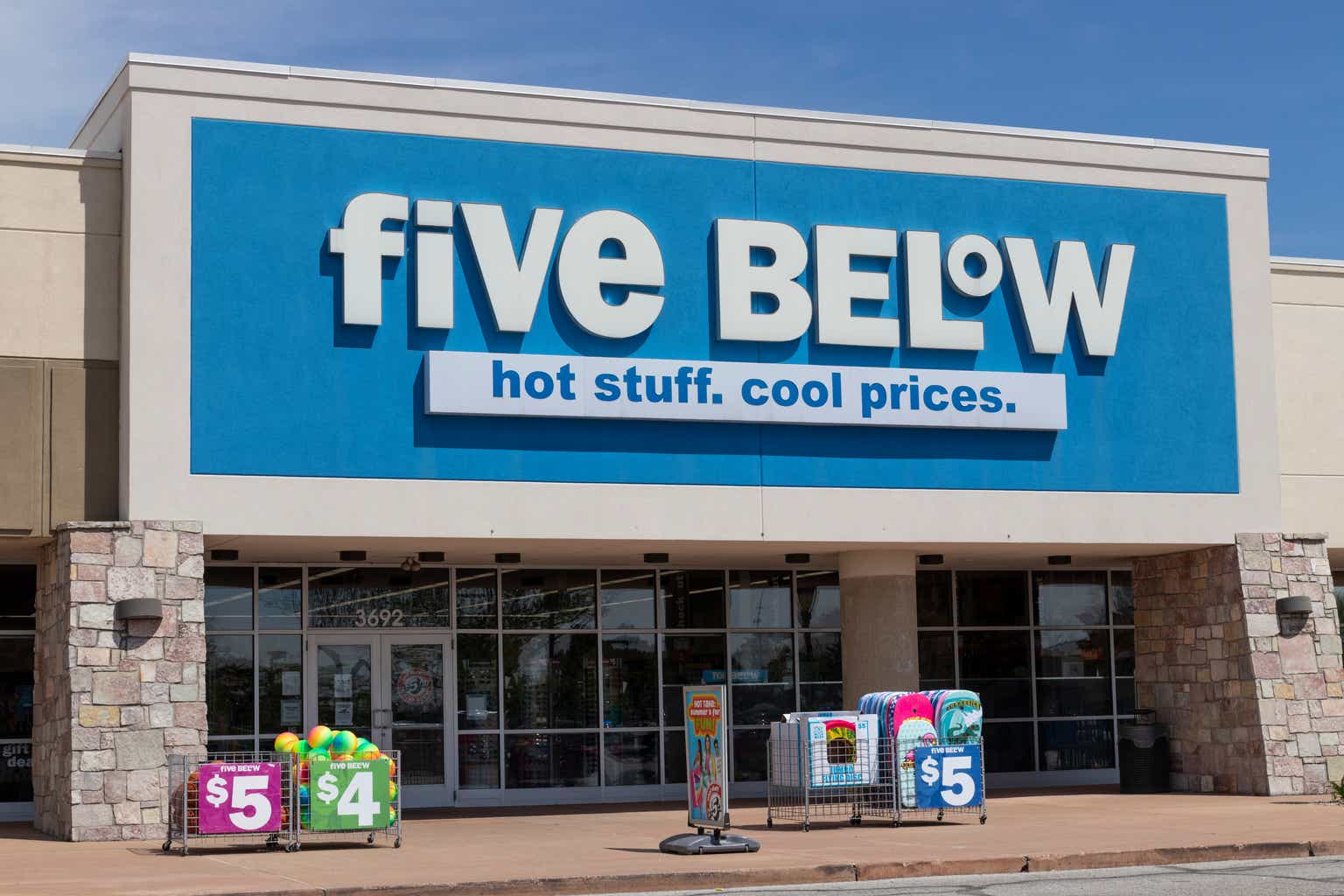
Five Below is a high-growth value retailer that operates with a unique focus on tweens and teen customers. The company opened its first store in 2002 and has grown to 1,544 locations as of today. Stores are typically located in malls, power centers, and lifestyle shopping destinations in the United States. As Five Below continues its rapid growth, it believes it can reach 3,500 stores by 2030.
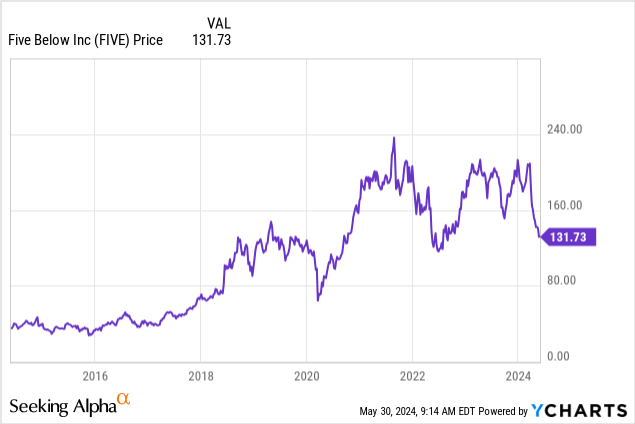
Understanding the 37% decline of the last two months
From March 20th through today, Five Below shares have declined by 37%. Without question, investors have become increasingly concerned that the struggles of lower end consumers will hurt the earnings of Five Below. I have no doubt that this is a legitimate concern, as elevated inflation in essential categories such as food, housing, and utilities leaves many consumers having to decide what they must do without when they reach the end of their paycheck.
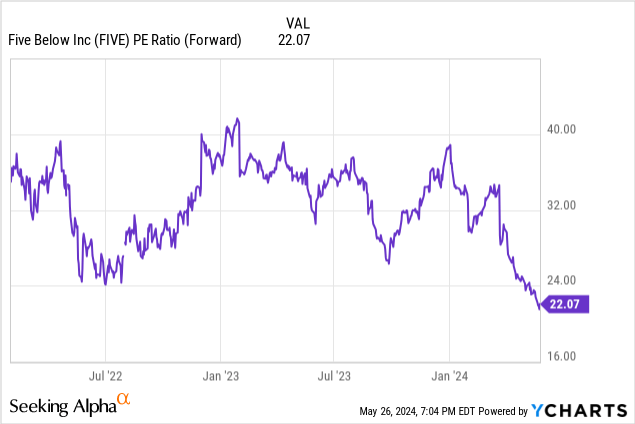
Furthermore, we have seen weak earnings reports from several other competing retailers, such as Dollar General (DG) and Target (TGT) which has put pressure on Five Below stock as investors try to get ahead of any potential earnings weakness. Full-year earnings estimates for Five Below have fallen this year, declining 7% in the last three months. And because Five Below recently traded at a premium valuation of $208/share, or 32 times this year’s consensus earnings estimate, it’s no surprise that the reduction in the earnings estimates has brought about selling by investors.
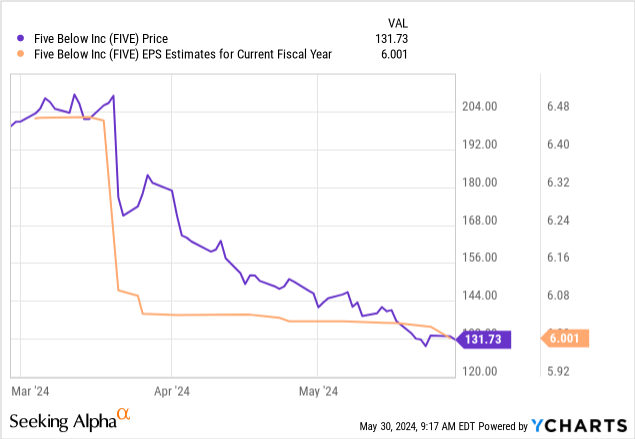
I’m not here to pretend that Five Below is not affected by consumer struggles because they are. Nor am I here to pretend that industry issues such as theft are not impacting Five Below’s because it is. But I do believe that the stock price decline is overdone because, despite these problems, Five Below’s business model is completely intact. Therefore, I believe this 37% price decline presents a great entry for someone who wants to be a part of the growth story without overpaying to do so.
Five Below’s business model and growth potential: “If it ain’t broke, don’t fix it”
Five Below has shown remarkably consistent growth over time. A simple slide from their investor relations webpage shows their store count, sales, net income, and earnings per share compounding by at least 15% annually for the last five years.
Five Below Investor Presentation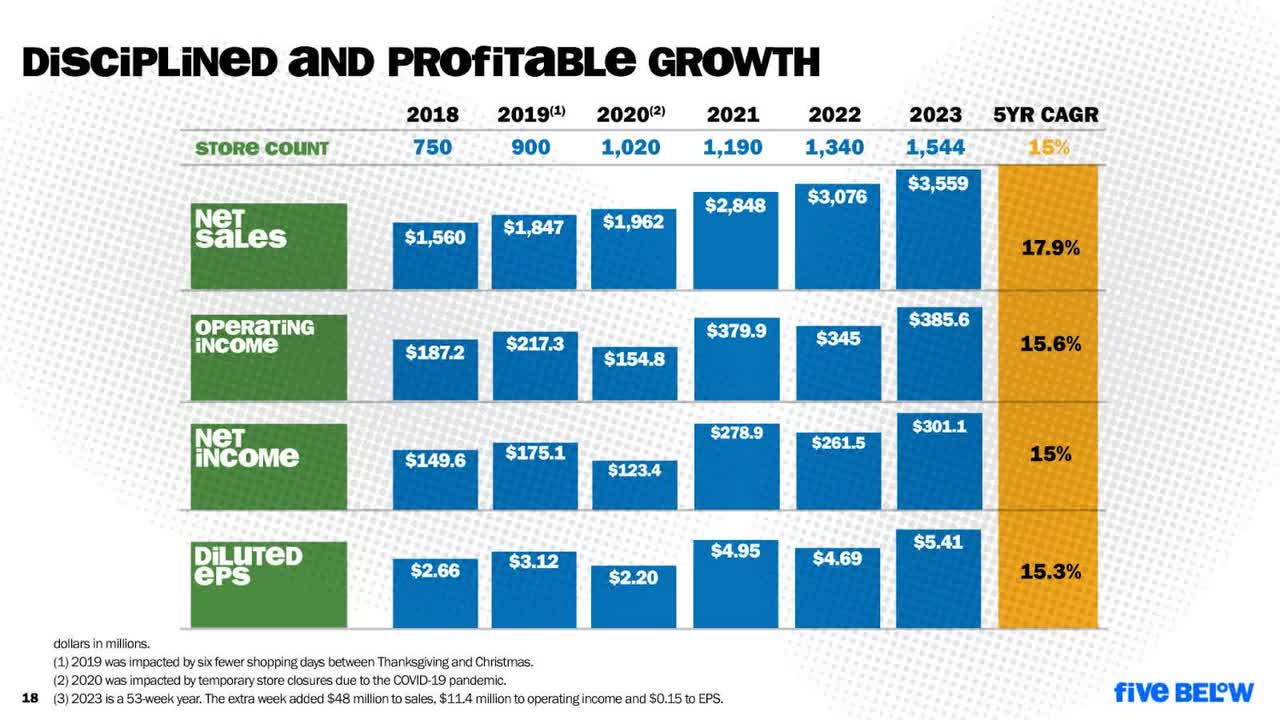
The Five Below concept is remarkably simple and consistent: sell low-priced value merchandise targeted towards tweens and teenagers in a fun environment. If you haven’t been in a Five Below store, think T-shirts, stuffed animals, candy, games, stocking stuffers, and electronics. Most items are priced between $1 and $5, with a section of the store selling higher priced items. Their customer base of tweens and teens tend to be of an age where most of their income is likely discretionary, and they have a high natural propensity to spend their money as they do not have major life obligations such as mortgages, student loans, or 401K plans yet.
The remarkable consistency that Five Below has shown over time gives investors enormous confidence that going forward, growth will continue to follow a similar path. Their business model clearly resonates with customers, and Five Below generates enough cash to self fund their growth without the use of debt. Management has indicated that they believe they could have 3,500 stores by 2030.
A quick note while on the subject of the balance sheet and the growing store base that may be of interest to readers is that Five Below leases all of their locations, and in doing so, they obligate themselves to future rent payments. These operating lease obligations, while not debt (they do not incur interest) can be found on the balance sheet on Form 10K and will continue to grow as Five Below expands. Given the consistency with which net income and operating cash flow continue to grow, as well as the lack of balance sheet debt, I see no issue meeting future operating lease obligations even as Five Below builds towards its goal of 3,500 stores by 2030.
Five Below Investor Presentation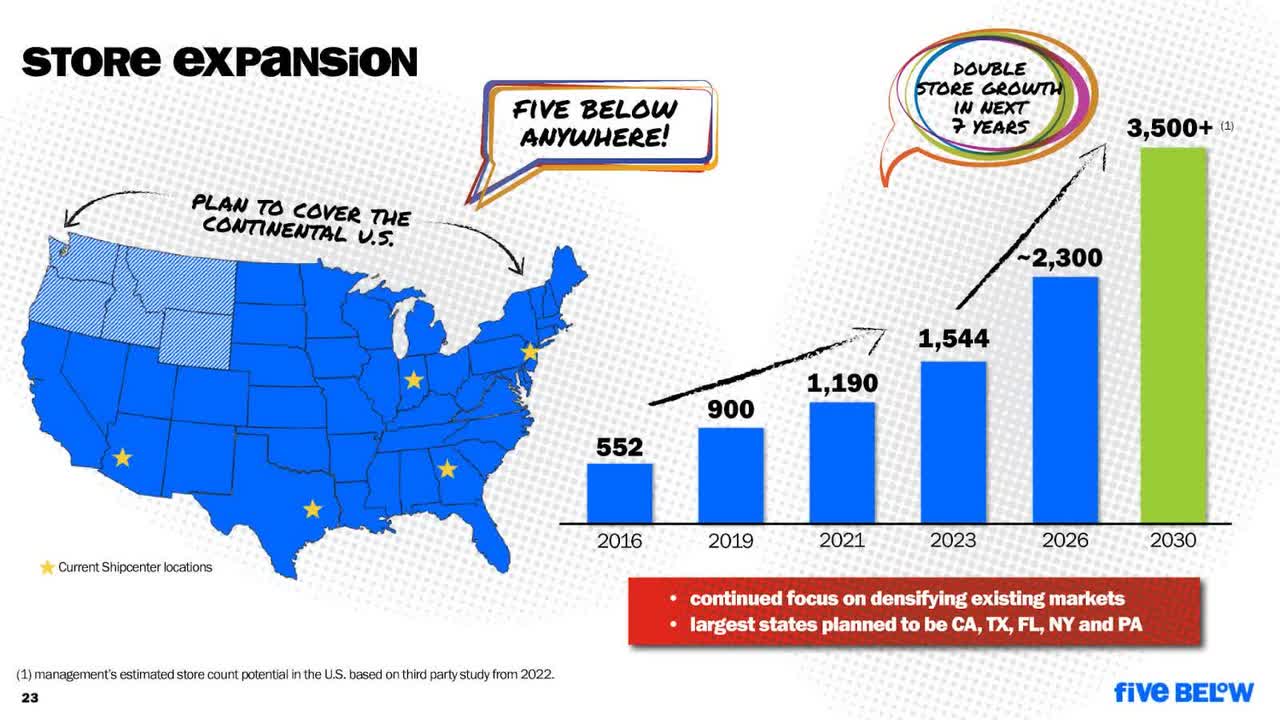
Incidentally, to grow from the current store count of 1,544 to 3,500 by 2030 requires a 15% CAGR, so basically more of the same. And since more of the same continues to work so well, Five Below’s business model and growth potential can be summarized by the old saying “If it ain’t broke, don’t fix it”.
Valuation 101: When is the appropriate time to step in and buy a falling stock?
So the business model is intact, and there’s plenty of runway for growth, but the stock price has been falling for two straight months. How do we know when it’s safe to buy? Generally speaking, most investors will see a stock price that is falling day after day and won’t touch it under any circumstances until it starts going back up. But there is a logical point where stocks should stop going down, and as investors you should aim to buy a stock as close to that point as you can. Some people use technical analysis to help with this decision, but you can really simplify everything by knowing a few simple valuation tools.
First, anytime you have a consistent 15% per year growth company that experiences a 37% drawdown, it should grab your attention. Quite often, with that significant of a price decline, you’re probably going to look back on those moments and regret not buying them. Many years of earnings growth can forgive investors who overpay, but for the ones that are accumulating shares of growing companies during significant price weakness, growth can catapult your returns going forward. And that’s what I am trying to do with Five Below and its 37% price decline.
But just buying because of a large decline in price isn’t enough. We want to be able to estimate the intrinsic value of the company and know that we are buying significantly below it. The golden rule for calculating intrinsic value is to use a discounting calculator to find the present value of a stock.
With this calculator, you can input earnings estimates for Five Below using analysts estimates, or your own. Because we are almost halfway through 2024, and the market tends to be forward looking in nature, I prefer to use a blend of analysts’ 2024 & 2025 estimates, which are currently $6.03 and $7.20 respectively. So starting with $6.61 as my base earnings, I project 15% growth for the next six years. Why? Because Five Below has set a goal of having 3,500 stores by 2030, which again would require a 15% growth rate in the store count.
Using this $6.61 of earnings per share, with 15% earnings growth for the next six years, 4.5% terminal growth, and using a 10% discount rate, we find that the intrinsic value of Five Below is $210.45/share.
Five Below Discounted Earnings Calculation (Moneychimp Calculator, Author Estimates)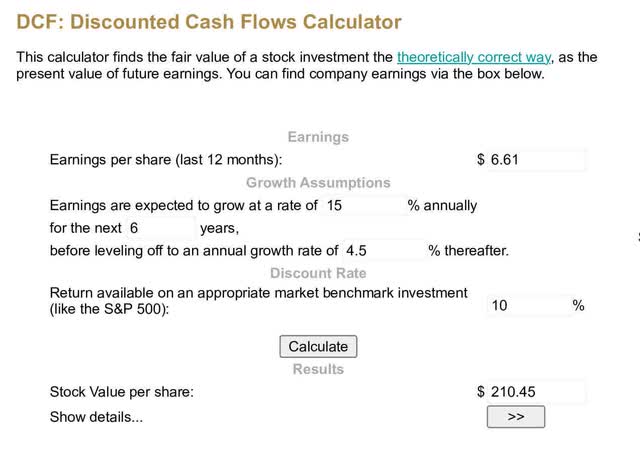
Note: For anyone who is unfamiliar with a discounting calculator, using one allows you to quickly calculate the total combined earnings a company is expected to produce over their lifetime, simultaneously discounting those earnings back to the present day to reflect the fact that earnings in the future are less valuable than earnings today due to inflation, uncertainty, and opportunity cost. Because companies theoretically have an infinite life, the actual math behind it is somewhat tedious as you are both projecting, and discounting, decades into the future. I created the following table to give my readers the ability to see the math behind what the calculator is actually doing, however, in the interest of keeping the article focused and on topic, the table below stops in 2040. If you wish to read more about the methodology, Investopedia has an excellent discussion on the subject.
| Annual EPS growing at 4.5% | EPS discounted by 10% | Present value of cumulative EPS | |
| 2031 | $15.89 | $7.60 |
$58.80 |
| 2032 | $16.60 | $7.15 |
$65.95 |
| 2033 | $17.35 | $6.72 |
$72.67 |
| 2034 | $18.13 | $6.32 |
$78.99 |
| 2035 | $18.95 | $5.95 |
$84.94 |
| 2036 | $19.80 | $5.59 |
$90.53 |
| 2037 | $20.69 | $5.26 |
$95.79 |
| 2038 | $21.62 | $4.95 |
$100.74 |
| 2039 | $22.59 | $4.65 |
$105.39 |
| 2040 | $23.61 | $4.37 |
$109.76 |
| Year | Annual EPS growing at 15% | EPS discounted by 10% per annum | Present value of cumulative EPS |
| 2024 | $6.59 | $6.59 | $6.59 |
| 2025 | $7.57 | $6.81 | $13.40 |
| 2026 | $8.71 | $7.06 | $20.46 |
| 2027 | $10.01 | $7.30 | $27.76 |
| 2028 | $11.51 | $7.55 | $35.31 |
| 2029 | $13.23 | $7.81 | $43.12 |
| 2030 | $15.21 | $8.08 | $51.20 |
There are obviously some who would use a higher terminal growth rate, and I understand their point. This company is highly unlikely to just stop opening new stores after 2030, and a 4.5% growth rate can be achieved simply by repurchasing stock, making it indeed likely that actual earnings will exceed the levels I am using in this calculation. So while you should feel free to use any inputs you want, I prefer to keep the perpetual growth rate at a conservative level, so I don’t get overly confident and end up overpaying for things.
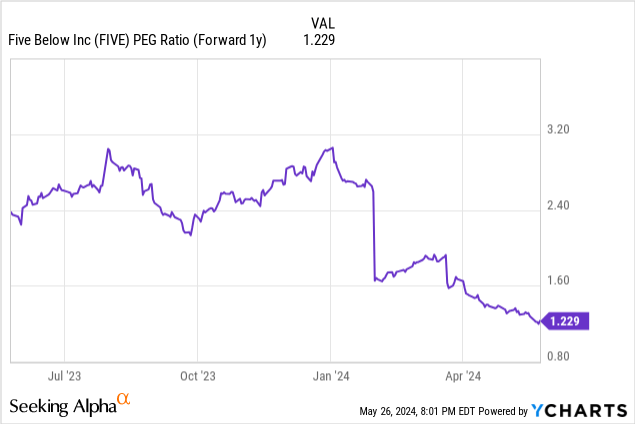
Finally, investors who are familiar with something called a PEG ratio can use that to identify when a stock is trading at an appealing valuation. A PEG ratio is simply the P/E of the stock divided by the expected growth rate of that company’s earnings, and the lower it is, the better. For Five Below, the PEG ratio is approaching 1, which is historically quite low. It’s not uncommon for fast-growing companies to trade at a PEG ratio of 2 or more as investors are showing a willingness to pay up for expected future growth. Typically, when a growth stock trades at a PEG ratio of 1, it’s an excellent buying opportunity. Because Five Below has no debt, I do not believe it will get to a PEG of 1. I believe the stock is going to bottom right about here.
Upcoming earnings have you worried? Buy half now and half later
Everyone has their own level of comfort buying a stock with an earnings report imminent. Five Below will report earnings on June 5th. In three of the last four quarters, Five Below has beaten analyst earnings estimates, with the one exception being last quarter. I, personally, do not put an enormous focus on any single earnings report and tend to focus on long-term potential of the company, but there is always a risk with any earnings report that there could be a negative surprise.
For example, last quarter, Five Below noted there had been a material increase in theft and shrink, something that is becoming more common with all retailers in recent years. I would cite this as my number one concern for potential downside risk in the upcoming earnings report. But it doesn’t stop me from investing now because I feel the stock has declined enough in recent months to account for the possibility of another quarter of continued high shrink.
If shrink and theft continue to be an issue for a long enough period of time, however, myself and other investors will have to take that into consideration in our evaluation of the company. Five Below has attempted to combat theft by adding more associates at the front of the store, as well as limiting self checkout in certain stores. Time will tell if these added measures improve the situation. Resolving this issue of excessive theft would create upside risk to my thesis and make me even more bullish about the stock.
For now, it’s impossible to know precisely what earnings will be, and equally important, how the market will react to them. So something to consider may be to buy half of the amount of shares you want to own now, and if the post earnings market reaction suits you, go ahead and buy more. Always remember, discipline trumps conviction, and no matter how much conviction you have, a stock price can react totally differently than you expect it to.
Conclusion
To summarize, while it may feel uncomfortable to buy Five Below after it has fallen so far so fast, there are logical valuation-based reasons to do so. The company has grown its store count, revenue, net income, and earnings per share by at least 15% consistently over time, and has a clear plan to continue that growth going forward as it expects 3,500 stores by 2030. The company self funds its growth, operates with no debt, and focuses on tweens and teens, a demographic that tends to have minimal sensitivity to the overall economy. I believe whether you are a trader playing for a short-term bounce, or whether you are a long-term investor looking for a great entry point, buying Five Below at current levels will work for either situation.
Credit: Source link