

MoMo Productions
One of the more interesting banks on the market at this point in time has got to be First Foundation (NYSE:FFWM). Over the past couple of years now, the institution has faced some difficulties. A contraction in its net interest margin, combined with high costs, has resulted in a decline in profitability. Debt has risen while deposits have recently declined. Normally, all of this would be a recipe for disaster. However, one thing that the institution does have going for it is that shares are dirt cheap relative to the firm’s net asset value.
Anybody who lived through the banking crisis that began in March of last year can attest to the fact that net asset value at banks can disappear rather rapidly. And in some respects, the fundamental picture for First Foundation has deteriorated. Given just how cheap the stock is, I would normally be optimistic about the business even in spite of these challenges. But because of how much of a bank’s ability to survive is determined by the perception of its health rather than its actual health, I think that this creates a more challenging environment in which to be optimistic.
Those who follow my work closely might see this as a change in my overall sentiment regarding this particular institution. And I would say that is a fairway to characterize it. After all, in October of last year, I ended up rating the institution a ‘buy’, citing how cheap the stock was but acknowledging that the discount came with significant risks. Once interest rates start falling, I think a case could be made that the institution will have an opportunity to turn itself around. But with even more recent deterioration from when I last wrote about it, I have decided that it would be prudent to downgrade the stock to a ‘hold’ for now.
A bit more cautious
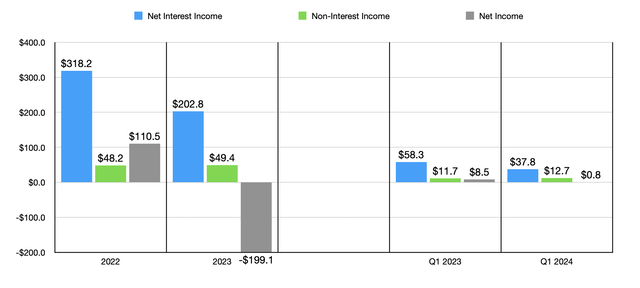
Fundamentally speaking, First Foundation has faced some challenges as of late. As an example, we need only look at the chart below. In it, you can see financial performance for the past couple of years, including through the first quarter of 2024 relative to the same time in 2023. Given that it’s the most recent, our attention should be mostly on results for the first quarter of this year. During that time, net interest income for the institution came in at $37.8 million. That’s a substantial decline from the $58.3 million reported the same time last year. Rising debt and a small decline in the value of the firm’s loans, both of which you will see shortly, played a role in this. However, rising interest rates, particularly when it came to the amount that the institution had to pay on deposits, led to a meaningful contraction in its net interest margin from 1.83% to 1.17%.
Author – SEC EDGAR Data
On the positive side, non-interest income for the institution managed to grow slightly year over year, inching up from $11.7 million to $12.7 million. But that was not enough to stop net income from plummeting from $8.5 million to only $0.8 million. This is not the first year in which the institution has faced trouble. In 2023, for instance, a plunge in net interest income from $318.2 million to $202.8 million, resulted in net income for the bank falling from $110.5 million to negative $199.1 million. As painful as this is, it is worth mentioning that the firm experienced a rather significant impairment charge during that window of time. If we add that back to the picture and use the same effective tax rate as what was seen in 2022, adjusted profits still would have been materially lower at only $11.2 million.
Author – SEC EDGAR Data
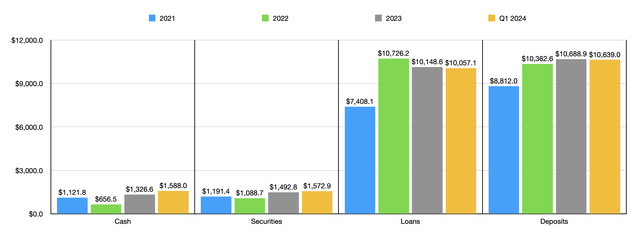
The rise in interest rates has been the biggest problem for the bank. But they haven’t been the only problem. The value of deposits continues to shrink. At the end of 2023, the institution had $10.69 billion worth of deposits. This was admittedly up from the $10.36 billion reported one year earlier. However, it was down from the $10.81 billion that the institution had at the end of the second quarter of 2023. Furthermore, by the end of the first quarter of this year, deposits had fallen to $10.64 billion. The only positive when it came to the deposit picture is the fact that uninsured deposit exposure stands at only 26%. This is below the 30% maximum threshold that I tend to prefer. This does limit the risk of a bank run. But it doesn’t eliminate it entirely.
Author – SEC EDGAR Data
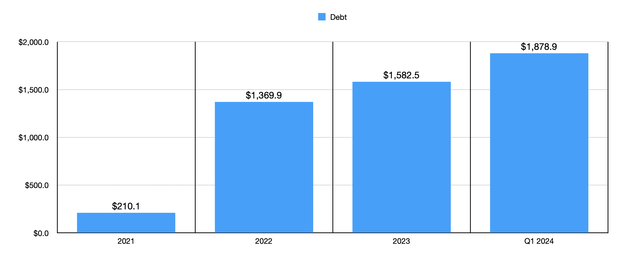
Another area in which the institution has seen some weakness on the balance sheet side of things involves the value of loans on its books. As of the end of the most recent quarter, loans totaled $10.06 billion. That’s down from the $10.15 billion reported at the end of 2023. It’s also a drop from the $10.73 billion that the institution had at the end of 2022. Fortunately, the value of securities has risen from $1.49 billion last year to $1.57 billion this year. Cash and cash equivalents have also grown, rising from $1.33 billion to $1.59 billion. However, this has come at a cost. And that cost is higher debt at a time when interest rates are elevated. Today, First Foundation has debt on its books totaling $1.88 billion. That’s above the $1.58 billion the institution had just three months earlier.
Author – SEC EDGAR Data
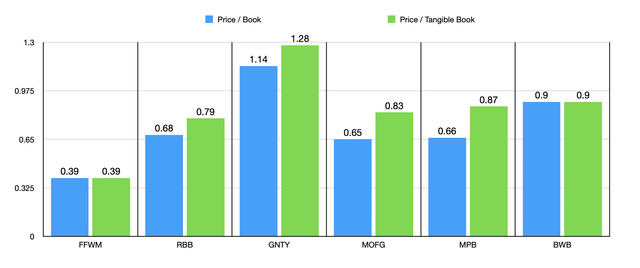
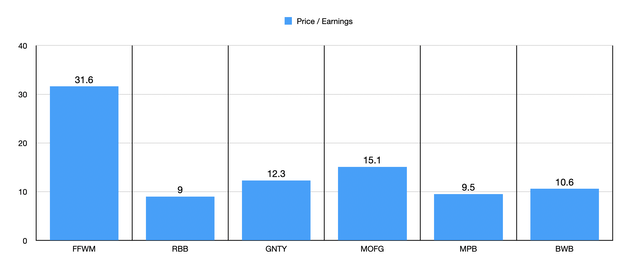
If there’s one thing that investors can latch on to other than the prospect that interest rates should eventually fall, it’s the fact that shares of the business are incredibly cheap relative to their net asset value. As the chart above illustrates, the institution is trading at both a price to book value and a price to tangible book value of only 0.39. That same chart compares the company to five similar firms. And in both cases, our candidate came out as the cheapest. But this is where the good news ends. As the chart below illustrates, if we use the adjusted profits I mentioned for 2023, we can see that First Foundation is by far the most expensive of the six companies I’m looking at in this article when it comes to the price to earnings approach.
Author – SEC EDGAR Data
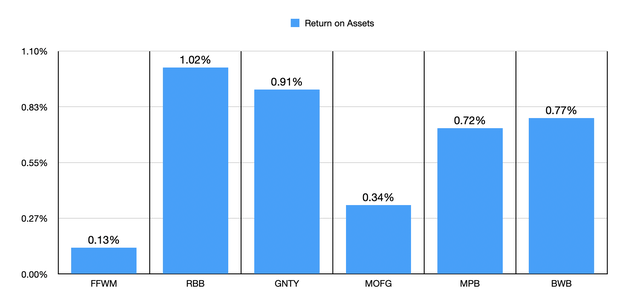
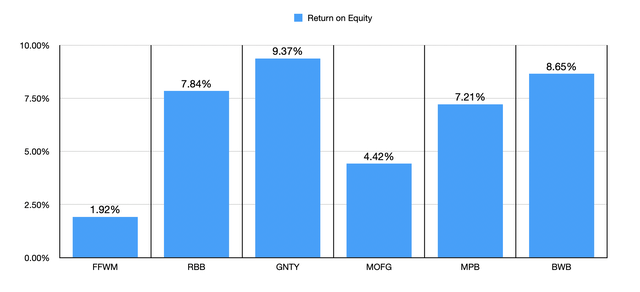
Of course, valuation is not everything. We should also be paying attention to other profitability metrics, metrics that can show the quality of the firm’s assets. In the first chart below, for instance, you can see the return on assets of First Foundation, as well as the return on assets for the same five companies I am comparing it to. Unfortunately, our candidate ended up being the lowest on the totem pole. And that’s saying a lot, since some of these other companies have returned on asset ratings that really aren’t that impressive. In the subsequent chart, I performed the same type of analysis, only this time using the return on equity for each of the institutions. Once again, First Foundation came in at the bottom of the list, and by a rather large margin at that.
Author – SEC EDGAR Data
Author – SEC EDGAR Data
Takeaway
Since I last wrote about First Foundation in October of last year, shares have seen some pretty respectable upside, totaling about 16.1%. Unfortunately, that has fallen short of the 22.2% increase seen by the S&P 500 over the same window of time. In that regard, I consider this a failure on my part, since a ‘buy’ rating indicates that I believe that shares should outperform the broader market for the foreseeable future. But clearly, that’s not what happened. The stock is still cheap relative to book value, and there is an opportunity for things to turn around once interest rates drop. But with debt rising, deposits falling, loans falling, and profitability issues getting worse, not to mention low metrics when it comes to both return on assets and return on equity, I cannot in good faith rate the company any higher than a ‘hold’ right now. And that is a speculative ‘hold’ in the sense that I view this as a very binary play that will either be incredibly profitable or incredibly unprofitable.
Credit: Source link