
Uschools
The securities portfolio of the Federal Reserve System continues to shrink.
To me, this is the most important thing that the Fed is doing right now, and the Fed has been reducing its securities portfolio for the past two years.
Since the Federal Reserve began to reduce the size of its securities portfolio, on March 16, 2022, the securities portfolio has gone down by almost $1.4 trillion.
Here is the graphic picture of what the Federal Reserve has achieved.
Securities Held Outright (Federal Reserve)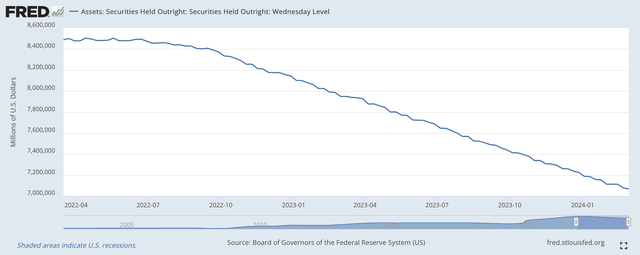
What the Fed has done in this area has been steady, persistent, and very focused.
It is hard to claim that the Federal Reserve has any other goal except this one, the performance is so consistent.
The Federal Reserve has also had to manage the money market during this time in order to maintain the stability of the market.
The Fed has done this through the use of reverse repurchase agreements.
The Fed has wanted to maintain a tight money market in order to keep its policy rate of interest high and rising during this time.
However, the Fed does not want the money market to get “out of control” so it has overseen what is happening in the reverse repo market to keep the Fed’s efforts going.
We can see how this management has proceeded during the past two years.
We can see this “management” in the performance of the balance sheet item, Reserve Balances with Federal Reserve banks. This item I have often referred to as a proxy for the excess reserves in the banking system.
Here is what has happened to commercial bank excess reserves over the past two years.
Reserve Balances With Federal Reserve Banks (Federal Reserve)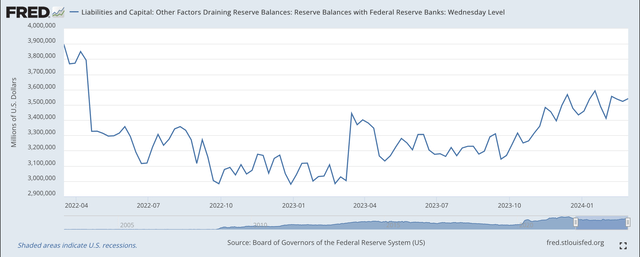
The behavior of “excess reserves” can be divided into two periods. The first, which goes from the middle of March 2022 until March 2023.
This was the initial period of the Fed’s monetary program of quantitative tightening. In this period, the Fed was able to bring down excess reserves in the commercial banking system, tightening up the money markets in order to raise the Fed’s policy rate of interest and continue to raise it.
The second period begins in March 2023 as a couple of commercial banks exhibit monetary difficulties and the Federal Reserve had to move to keep the banking system stable.
As can be seen from the chart, the Fed has continued to allow the excess reserves in the banking system to continue to rise through the rest of the period under review.
The Federal Reserve was able to preserve the stability of the banking system through these bank failures while keeping pressure on the money markets so that the increase in the Federal Reserve’s policy rate of interest could be sustained.
And, so, the Fed was able to keep the policy rate of interest “up” and was able to continue its efforts to keep reducing the size of the Fed’s securities portfolio. A job well done. But, note, that the crucial thing the Federal Reserve continues to maintain is the continued, persistent sales of securities from the Fed’s securities portfolio.
This effort is the foundation of the quantitative tightening program and the ultimate thing that will allow the Federal Reserve to continue to build trust in this particular policy effort.
This trust is the major component of the whole effort of quantitative tightening.
The banking system has plenty of reserves. See the following chart.
Reserves of Depository Institutions (Federal Reserve)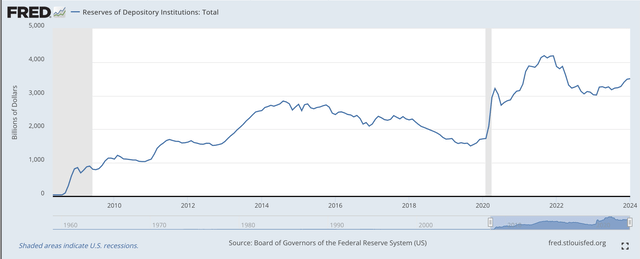
In fact, the amount of “money” the commercial banks could create right now is enormous. But, the banks are aware of the plans of the Federal Reserve and are attempting to “play ball with the Fed” as the Fed would through the present situation.
For one thing, commercial banks are not actively using all the reserves they have. Look at the statistics that picture the turnover of these reserves, and the velocity of their usage.
Velocity of the M2 Money Stock (Federal Reserve)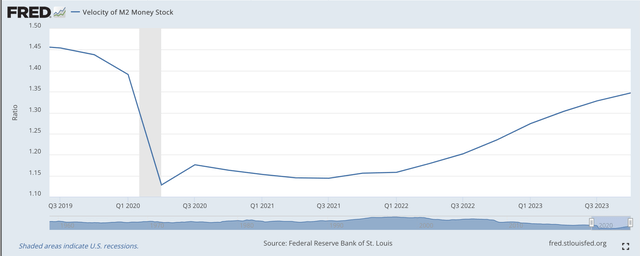
The M2 money stock has been created but, the money is not turning over as fast as it once was late in the 2010s.
Thus, all the “money” that has been put into the banking system through the Covid-19 pandemic, through the following recession, and through the Fed’s efforts to combat inflation.
The money could be spent a lot faster.
And, still, the economy is growing at a fairly strong pace.
So, a lot still rests on the Federal Reserve and how investors “trust” the Fed and react to the Fed.
The Federal Reserve is on a “good” path right now.
Investors seem to be trusting the Fed and what it is doing.
The Federal Reserve must work to preserve this “trust”.
There still is a lot that we have to get through here in 2024, especially with the election taking place and the “politics” that is taking place, disrupting it.
To me, the major thing investors should be watching is how the Federal Reserve is working through the continued reduction in the Fed’s holdings of securities.
This is the “key”.
This is the major component of the Fed’s attempt to continue to build and maintain the “trust” it has generated in the marketplace.
Credit: Source link