





• bitcoinBitcoin(BTC)$80,509.003.56%
  • ethereumEthereum(ETH)$2,425.515.92%
  • tetherTether(USDT)$1.000.06%
  • binancecoinBNB(BNB)$713.292.17%
  • rippleXRP(XRP)$1.312.71%
  • usd-coinUSDC(USDC)$1.000.03%
  • solanaSolana(SOL)$96.043.61%
  • tronTRON(TRX)$0.319259-0.89%
  • Figure HelocFigure Heloc(FIGR_HELOC)$1.051.52%
  • zcashZcash(ZEC)$1,316.875.02%
  • HyperliquidHyperliquid(HYPE)$83.41-1.02%
  • dogecoinDogecoin(DOGE)$0.0765582.68%
  • moneroMonero(XMR)$635.110.41%
  • USDSUSDS(USDS)$1.000.03%
  • whitebitWhiteBIT Coin(WBT)$77.904.25%
  • chainlinkChainlink(LINK)$11.555.05%
  • leo-tokenLEO Token(LEO)$9.350.56%
  • cardanoCardano(ADA)$0.1970223.82%
  • stellarStellar(XLM)$0.1671702.74%
  • bitcoin-cashBitcoin Cash(BCH)$281.922.88%
  • nearNEAR Protocol(NEAR)$4.033.08%
  • uniswapUniswap(UNI)$7.603.90%
  • daiDai(DAI)$1.000.03%
  • Ethena USDeEthena USDe(USDE)$1.000.06%
  • litecoinLitecoin(LTC)$55.913.27%
  • RainRain(RAIN)$0.005927-5.68%
  • CantonCanton(CC)$0.1039265.66%
  • avalanche-2Avalanche(AVAX)$8.742.25%
  • suiSui(SUI)$0.934.01%
  • USD1USD1(USD1)$1.000.03%
  • the-open-networkGram (prev. Toncoin)(GRAM)$1.17-0.82%
  • tether-goldTether Gold(XAUT)$4,107.952.65%
  • hedera-hashgraphHedera(HBAR)$0.0726894.53%
  • quant-networkQuant(QNT)$204.775.74%
  • Global DollarGlobal Dollar(USDG)$1.000.03%
  • shiba-inuShiba Inu(SHIB)$0.0000051.73%
  • BittensorBittensor(TAO)$233.922.85%
  • paypal-usdPayPal USD(PYUSD)$1.000.02%
  • crypto-com-chainCronos(CRO)$0.0521053.51%
  • Ripple USDRipple USD(RLUSD)$1.000.03%
  • EthenaEthena(ENA)$0.180505-0.31%
  • Ondo US Dollar YieldOndo US Dollar Yield(USDY)$1.15-0.04%
  • okbOKB(OKB)$111.423.01%
  • Circle USYCCircle USYC(USYC)$1.140.01%
  • pepePepe(PEPE)$0.0000050.40%
  • aaveAave(AAVE)$132.232.52%
  • OndoOndo(ONDO)$0.4081832.68%
  • Pump.funPump.fun(PUMP)$0.0043060.56%
  • MemeCoreMemeCore(M)$0.83-2.27%
  • BlackRock USD Institutional Digital Liquidity FundBlackRock USD Institutional Digital Liquidity Fund(BUIDL)$1.000.00%
TradePoint.io
  • Main
  • AI & Technology
  • Stock Charts
  • Market & News
  • Business
  • Finance Tips
  • Trade Tube
  • Blog
  • Shop
No Result
View All Result
TradePoint.io
No Result
View All Result

Eliminating Vector Quantization: Diffusion-Based Autoregressive AI Models for Image Generation

June 21, 2024
in AI & Technology
Reading Time: 5 mins read
A A
Eliminating Vector Quantization: Diffusion-Based Autoregressive AI Models for Image Generation
ShareShareShareShareShare

Autoregressive image generation models have traditionally relied on vector-quantized representations, which introduce several significant challenges. The process of vector quantization is computationally intensive and often results in suboptimal image reconstruction quality. This reliance limits the models’ flexibility and efficiency, making it difficult to accurately capture the complex distributions of continuous image data. Overcoming these challenges is crucial for improving the performance and applicability of autoregressive models in image generation.

Current methods for tackling this challenge involve converting continuous image data into discrete tokens using vector quantization. Techniques such as Vector Quantized Variational Autoencoders (VQ-VAE) encode images into a discrete latent space and then model this space autoregressively. However, these methods face considerable limitations. The process of vector quantization is not only computationally intensive but also introduces reconstruction errors, resulting in a loss of image quality. Furthermore, the discrete nature of these tokenizers limits the models’ ability to accurately capture the complex distributions of image data, which impacts the fidelity of the generated images.

YOU MAY ALSO LIKE

OpenAI’s Enterprise Sales Take Majority as Brockman Sees IPO Readiness – Unite.AI

Cat Wu to Lead Product Management for OpenAI’s Core Products – Unite.AI

A team of researchers from MIT CSAIL, Google DeepMind, and Tsinghua University have developed a novel technique that eliminates the need for vector quantization. This method leverages a diffusion process to model the per-token probability distribution within a continuous-valued space. By employing a Diffusion Loss function, the model predicts tokens without converting data into discrete tokens, thus maintaining the integrity of the continuous data. This innovative strategy addresses the shortcomings of existing methods by enhancing the generation quality and efficiency of autoregressive models. The core contribution lies in the application of diffusion models to predict tokens autoregressively in a continuous space, which significantly improves the flexibility and performance of image generation models.

The newly introduced technique uses a diffusion process to predict continuous-valued vectors for each token. Starting with a noisy version of the target token, the process iteratively refines it using a small denoising network conditioned on previous tokens. This denoising network, implemented as a Multi-Layer Perceptron (MLP), is trained alongside the autoregressive model through backpropagation using the Diffusion Loss function. This function measures the discrepancy between the predicted noise and the actual noise added to the tokens. The method has been evaluated on large datasets like ImageNet, showcasing its effectiveness in improving the performance of autoregressive and masked autoregressive model variants.

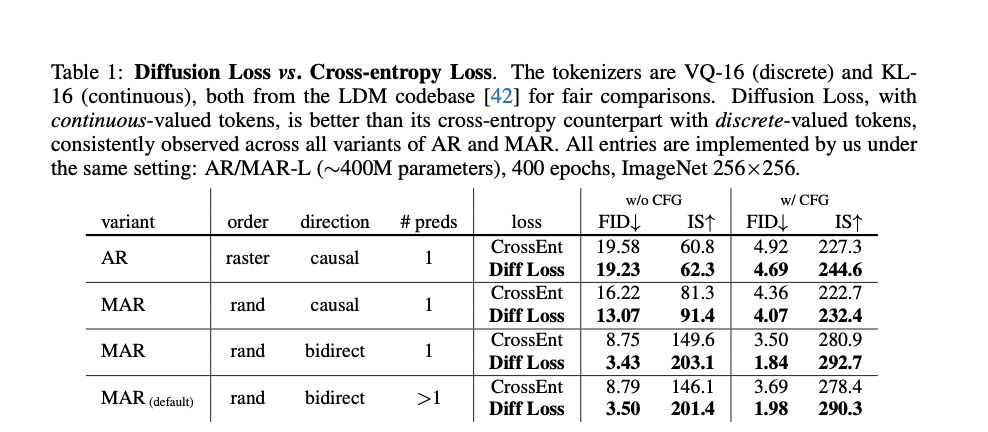
The results demonstrate significant improvements in image generation quality, as evidenced by key performance metrics such as the Fréchet Inception Distance (FID) and Inception Score (IS). Models using Diffusion Loss consistently achieve lower FID and higher IS compared to those using traditional cross-entropy loss. Specifically, the masked autoregressive models (MAR) with Diffusion Loss achieve an FID of 1.55 and an IS of 303.7, indicating a substantial enhancement over previous methods. This improvement is observed across various model variants, confirming the efficacy of this new approach in boosting both the quality and speed of image generation, achieving generation rates of less than 0.3 seconds per image.
In conclusion, the innovative diffusion-based technique offers a groundbreaking solution to the challenge of dependency on vector quantization in autoregressive image generation. By introducing a method to model continuous-valued tokens, the researchers significantly enhance the efficiency and quality of autoregressive models. This novel strategy has the potential to revolutionize image generation and other continuous-valued domains, providing a robust solution to a critical challenge in AI research.


Check out the Paper. All credit for this research goes to the researchers of this project. Also, don’t forget to follow us on Twitter. 

Join our Telegram Channel and LinkedIn Group.

If you like our work, you will love our newsletter..

Don’t Forget to join our 45k+ ML SubReddit


Aswin AK is a consulting intern at MarkTechPost. He is pursuing his Dual Degree at the Indian Institute of Technology, Kharagpur. He is passionate about data science and machine learning, bringing a strong academic background and hands-on experience in solving real-life cross-domain challenges.

🐝 Join the Fastest Growing AI Research Newsletter Read by Researchers from Google + NVIDIA + Meta + Stanford + MIT + Microsoft and many others…


Credit: Source link

ShareTweetSendSharePin

Related Posts

OpenAI’s Enterprise Sales Take Majority as Brockman Sees IPO Readiness – Unite.AI
AI & Technology

OpenAI’s Enterprise Sales Take Majority as Brockman Sees IPO Readiness – Unite.AI

November 5, 2026
Cat Wu to Lead Product Management for OpenAI’s Core Products – Unite.AI
AI & Technology

Cat Wu to Lead Product Management for OpenAI’s Core Products – Unite.AI

November 5, 2026
Snap Has More Than 30 Million Paid Subscribers Across Snapchat+ And Other Plans
AI & Technology

Snap Has More Than 30 Million Paid Subscribers Across Snapchat+ And Other Plans

November 4, 2026
Atmospheric AI Secures M Seed for Procurement Modeling Push – Unite.AI
AI & Technology

Atmospheric AI Secures $10M Seed for Procurement Modeling Push – Unite.AI

November 4, 2026
Next Post
Meet the Press NOW – Nov. 30

Meet the Press NOW – Nov. 30

Leave a Reply Cancel reply

Your email address will not be published. Required fields are marked *

Search

No Result
View All Result
Trump expresses interest in a retreat at his Florida golf course

Trump expresses interest in a retreat at his Florida golf course

October 30, 2026
This Morning’s Top Headlines – Oct. 5 | Morning News NOW

This Morning’s Top Headlines – Oct. 5 | Morning News NOW

November 1, 2026
Dash cam shows bear charge car on dark Japanese road

Dash cam shows bear charge car on dark Japanese road

November 1, 2026

About

Learn more

Our Services

Legal

Privacy Policy

Terms of Use

Bloggers

Learn more

Article Links

Contact

Advertise

Ask us anything

©2020- TradePoint.io - All rights reserved!

Tradepoint.io, being just a publishing and technology platform, is not a registered broker-dealer or investment adviser. So we do not provide investment advice. Rather, brokerage services are provided to clients of Tradepoint.io by independent SEC-registered broker-dealers and members of FINRA/SIPC. Every form of investing carries some risk and past performance is not a guarantee of future results. “Tradepoint.io“, “Instant Investing” and “My Trading Tools” are registered trademarks of Apperbuild, LLC.

This website is operated by Apperbuild, LLC. We have no link to any brokerage firm and we do not provide investment advice. Every information and resource we provide is solely for the education of our readers. © 2020 Apperbuild, LLC. All rights reserved.

No Result
View All Result
  • Main
  • AI & Technology
  • Stock Charts
  • Market & News
  • Business
  • Finance Tips
  • Trade Tube
  • Blog
  • Shop

© 2023 - TradePoint.io - All Rights Reserved!