• bitcoinBitcoin(BTC)$83,710.00-0.41%
  • ethereumEthereum(ETH)$2,681.630.51%
  • tetherTether(USDT)$1.000.01%
  • binancecoinBNB(BNB)$772.40-0.70%
  • rippleXRP(XRP)$1.562.38%
  • usd-coinUSDC(USDC)$1.000.01%
  • solanaSolana(SOL)$120.673.55%
  • tronTRON(TRX)$0.337435-0.94%
  • zcashZcash(ZEC)$1,538.40-0.67%
  • Figure HelocFigure Heloc(FIGR_HELOC)$1.031.21%
  • HyperliquidHyperliquid(HYPE)$91.32-1.86%
  • dogecoinDogecoin(DOGE)$0.0969351.30%
  • moneroMonero(XMR)$550.54-0.21%
  • chainlinkChainlink(LINK)$13.746.87%
  • whitebitWhiteBIT Coin(WBT)$83.60-0.69%
  • USDSUSDS(USDS)$1.000.00%
  • cardanoCardano(ADA)$0.2538163.26%
  • RainRain(RAIN)$0.011829-1.35%
  • leo-tokenLEO Token(LEO)$8.83-0.67%
  • stellarStellar(XLM)$0.2163753.22%
  • bitcoin-cashBitcoin Cash(BCH)$337.880.79%
  • nearNEAR Protocol(NEAR)$4.967.11%
  • uniswapUniswap(UNI)$9.634.53%
  • litecoinLitecoin(LTC)$69.73-3.09%
  • CantonCanton(CC)$0.12591213.46%
  • Ethena USDeEthena USDe(USDE)$1.000.00%
  • avalanche-2Avalanche(AVAX)$10.401.06%
  • daiDai(DAI)$1.000.01%
  • suiSui(SUI)$1.1211.61%
  • USD1USD1(USD1)$1.000.03%
  • hedera-hashgraphHedera(HBAR)$0.0928720.64%
  • the-open-networkGram (prev. Toncoin)(GRAM)$1.42-0.27%
  • shiba-inuShiba Inu(SHIB)$0.0000060.91%
  • BittensorBittensor(TAO)$302.403.89%
  • BitwayBitway(BTW)$1.2231.37%
  • crypto-com-chainCronos(CRO)$0.0656944.82%
  • Global DollarGlobal Dollar(USDG)$1.000.01%
  • MemeCoreMemeCore(M)$1.19-3.07%
  • paypal-usdPayPal USD(PYUSD)$1.000.01%
  • tether-goldTether Gold(XAUT)$4,282.050.47%
  • OndoOndo(ONDO)$0.543.86%
  • EthenaEthena(ENA)$0.25867519.42%
  • okbOKB(OKB)$120.120.51%
  • Ripple USDRipple USD(RLUSD)$1.000.00%
  • Circle USYCCircle USYC(USYC)$1.140.03%
  • aaveAave(AAVE)$153.046.90%
  • BlackRock USD Institutional Digital Liquidity FundBlackRock USD Institutional Digital Liquidity Fund(BUIDL)$1.000.00%
  • Ondo US Dollar YieldOndo US Dollar Yield(USDY)$1.14-0.01%
  • mantleMantle(MNT)$0.66-2.24%
  • polkadotPolkadot(DOT)$1.171.22%
TradePoint.io
  • Main
  • AI & Technology
  • Stock Charts
  • Market & News
  • Business
  • Finance Tips
  • Trade Tube
  • Blog
  • Shop
No Result
View All Result
TradePoint.io
No Result
View All Result

Efficient Quantization-Aware Training (EfficientQAT): A Novel Machine Learning Quantization Technique for Compressing LLMs

July 20, 2024
in AI & Technology
Reading Time: 4 mins read
A A
Efficient Quantization-Aware Training (EfficientQAT): A Novel Machine Learning Quantization Technique for Compressing LLMs
ShareShareShareShareShare

As LLMs become increasingly integral to various AI tasks, their massive parameter sizes lead to high memory requirements and bandwidth consumption. While quantization-aware training (QAT) offers a potential solution by allowing models to operate with lower-bit representations, existing methods often require extensive training resources, making them impractical for large models. The research paper addresses the challenge of managing the significant memory requirements of large language models (LLMs) in natural language processing and artificial intelligence. 

Current quantization techniques for LLMs include post-training quantization (PTQ) and quantized parameter-efficient fine-tuning (Q-PEFT). PTQ minimizes memory usage during inference by converting pre-trained model weights to low-bit formats, but it can compromise accuracy, especially in low-bit regimes. Q-PEFT methods, like QLoRA, allow for fine-tuning on consumer-grade GPUs but require reverting to higher-bit formats for additional tuning, necessitating another round of PTQ, which can degrade performance. 

YOU MAY ALSO LIKE

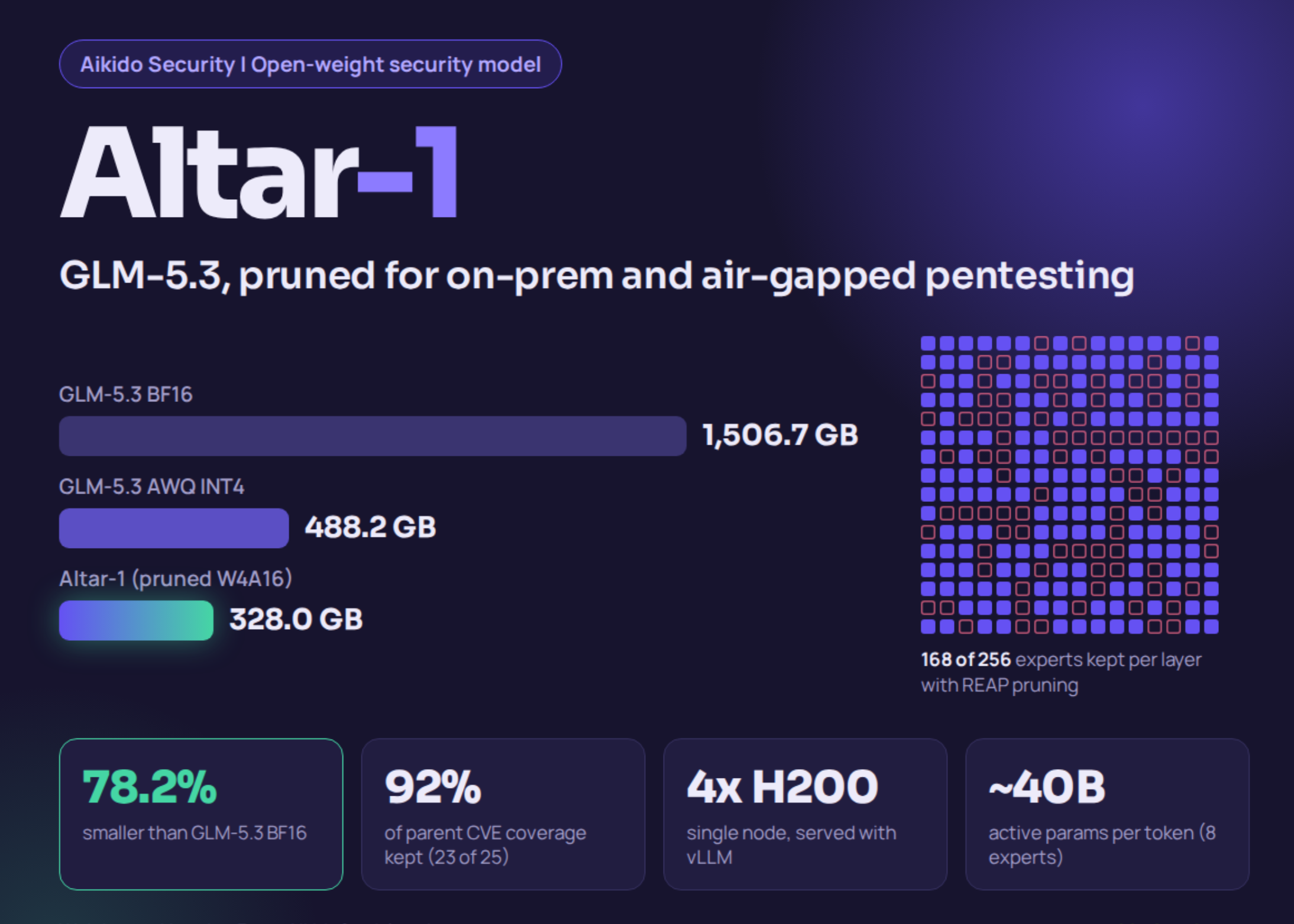
Aikido Security Releases Altar-1: An Open-Weight Security Model Pruned From GLM-5.3 to 328 GB

Microsoft’s Copilot App Adds Office, Natural Coding And Automation

The researchers propose Efficient Quantization-Aware Training (EfficientQAT) to address these limitations. The EfficientQAT framework operates through its two main phases. In the Block-AP phase, quantization-aware training is performed on all parameters within each transformer block, utilizing block-wise reconstruction to maintain efficiency. This approach circumvents the need for full model training, thus preserving memory resources. Following this, the E2E-QP phase fixes the quantized weights and trains only the quantization parameters (step sizes), which enhances the model’s efficiency and performance without the overhead associated with training the entire model. This dual-phase strategy improves convergence speed and allows for effective instruction tuning of quantized models.

The Block-AP phase of EfficientQAT begins with a standard uniform quantization method, quantizing and then dequantizing weights in a block-wise manner. Inspired by BRECQ and OmniQuant, this method allows for efficient training with less data and memory compared to traditional end-to-end QAT approaches. By training all parameters, including scaling factors and zero points, Block-AP ensures precise calibration and avoids the overfitting issues typically associated with training the entire model simultaneously.

In the E2E-QP phase, only the quantization parameters are trained end-to-end while keeping the quantized weights fixed. This phase leverages the robust initialization provided by Block-AP, allowing for efficient and accurate tuning of the quantized model for specific tasks. E2E-QP enables instruction tuning of quantized models, ensuring memory efficiency as the trainable parameters constitute only a small fraction of the total network.

EfficientQAT demonstrates significant improvements over previous quantization methods. For instance, it achieves a 2-bit quantization of a Llama-2-70B model on a single A100-80GB GPU in just 41 hours, with less than 3% accuracy degradation compared to the full-precision model. Additionally, it outperforms existing Q-PEFT methods in low-bit scenarios, providing a more hardware-efficient solution.

The EfficientQAT framework presents a compelling solution to the challenges posed by large language models in terms of memory and computational efficiency. By introducing a two-phase training approach focusing on block-wise training and end-to-end quantization parameter optimization, the researchers effectively reduce the resource demands of quantization-aware training while maintaining high performance. This method represents a significant advancement in the field of model quantization, providing a practical pathway for deploying large language models in resource-constrained environments.


Check out the Paper and GitHub. All credit for this research goes to the researchers of this project. Also, don’t forget to follow us on Twitter. 

Join our Telegram Channel and LinkedIn Group.

If you like our work, you will love our newsletter..

Don’t Forget to join our 46k+ ML SubReddit


Shreya Maji is a consulting intern at MarktechPost. She is pursued her B.Tech at the Indian Institute of Technology (IIT), Bhubaneswar. An AI enthusiast, she enjoys staying updated on the latest advancements. Shreya is particularly interested in the real-life applications of cutting-edge technology, especially in the field of data science.

🐝 Join the Fastest Growing AI Research Newsletter Read by Researchers from Google + NVIDIA + Meta + Stanford + MIT + Microsoft and many others…


Credit: Source link

ShareTweetSendSharePin

Related Posts

Aikido Security Releases Altar-1: An Open-Weight Security Model Pruned From GLM-5.3 to 328 GB
AI & Technology

Aikido Security Releases Altar-1: An Open-Weight Security Model Pruned From GLM-5.3 to 328 GB

September 25, 2026
Microsoft’s Copilot App Adds Office, Natural Coding And Automation
AI & Technology

Microsoft’s Copilot App Adds Office, Natural Coding And Automation

September 25, 2026
SpaceX Starship’s First Orbital Flight Test On Track After Successful Launch Rehearsal
AI & Technology

SpaceX Starship’s First Orbital Flight Test On Track After Successful Launch Rehearsal

September 25, 2026
Google Adds Creepy Avatars To Gemini 3.8 Live’s Agents
AI & Technology

Google Adds Creepy Avatars To Gemini 3.8 Live’s Agents

September 25, 2026
Next Post
X is working on a way to block links in replies

X is working on a way to block links in replies

Leave a Reply Cancel reply

Your email address will not be published. Required fields are marked *

Search

No Result
View All Result
Psychiatrist clashes with Clancy attorney on definition of postpartum psychosis

Psychiatrist clashes with Clancy attorney on definition of postpartum psychosis

September 25, 2026
Nepal flash floods seen from bus

Nepal flash floods seen from bus

September 23, 2026
I Gave GPT-6 & Claude ,000 Each to Trade on Kalshi

I Gave GPT-6 & Claude $1,000 Each to Trade on Kalshi

September 22, 2026

About

Learn more

Our Services

Legal

Privacy Policy

Terms of Use

Bloggers

Learn more

Article Links

Contact

Advertise

Ask us anything

©2020- TradePoint.io - All rights reserved!

Tradepoint.io, being just a publishing and technology platform, is not a registered broker-dealer or investment adviser. So we do not provide investment advice. Rather, brokerage services are provided to clients of Tradepoint.io by independent SEC-registered broker-dealers and members of FINRA/SIPC. Every form of investing carries some risk and past performance is not a guarantee of future results. “Tradepoint.io“, “Instant Investing” and “My Trading Tools” are registered trademarks of Apperbuild, LLC.

This website is operated by Apperbuild, LLC. We have no link to any brokerage firm and we do not provide investment advice. Every information and resource we provide is solely for the education of our readers. © 2020 Apperbuild, LLC. All rights reserved.

No Result
View All Result
  • Main
  • AI & Technology
  • Stock Charts
  • Market & News
  • Business
  • Finance Tips
  • Trade Tube
  • Blog
  • Shop

© 2023 - TradePoint.io - All Rights Reserved!