
aluxum
Investment thesis
We cover a few of BlackRock iShares ETFs here on Seeking Alpha, with our main focus on ETFs for Asian markets, where we have lived and worked for more than thirty years.
It has been nearly one year since we covered iShares Emerging Markets Dividend ETF (NYSEARCA:DVYE). At that time, our stance was a Hold, as we felt the ETF carried too much risk.
However, the price of the ETF is up almost 10%, and the total return when you include the quarterly dividends is as much as 19.6%.
That is nearly as good as the performance of the S&P 500 which is up 27% in the same period. It is important to note that the S&P 500 has been outperforming most countries’ equity indexes over a long period.
An investment of $10,000 made on September 20, last year, would today be worth $11,960. But if you had invested the same amount 10 years ago, it would only be worth $9,859 today.
Investing in emerging markets in the past ten years has generally not been a good place to be, despite all the “experts” coming out each year saying that “this is going to be the year” that the emerging markets will turn around.
Characteristics of DVYE
The fund’s net asset value increased from $618 million as of 30th of June 2023 to $679 million as of 22nd of August 2024. It has good liquidity, with an average daily volume over the last 30 days of about 75,000 shares.
The fund is benchmarked towards the Dow Jones emerging markets select dividend index.
Its net expense ratio remains at 0.49%.
There have been some major changes to this ETF’s portfolio since last year. One year ago, financials were only 14% of the portfolio. It is now the largest with 22.5%.
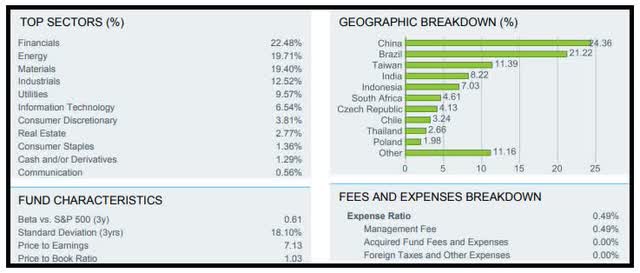
DVYE sector and geographical diversification (Blackrock iShares)
Real Estate has been cut in half from 5.45% to just 2.77%
This change is most likely done on the back of the effect of higher interest rates, which typically favors financials and is a burden for borrowers like real estate companies.
We were surprised to find Singapore on the list of countries last year, as it was not on the list of 20 countries categorized by the IMF as emerging markets. There is no definition of what an emerging market is.
Dividends are paid out quarterly and have been quite stable.
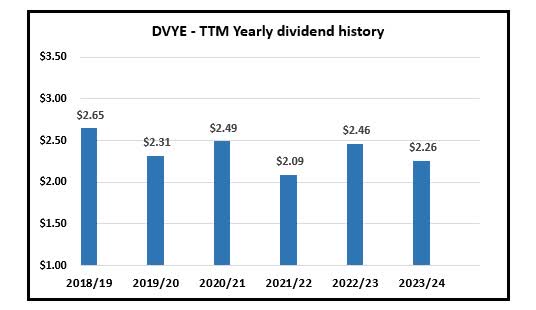
DVYE – TTM yearly dividend history (Data from Blackrock. Graph by author)
DVYE presently has a dividend yield of 8.2%.
When we look at the ten largest components of DVYE, we see that many of the companies offer high dividend yields.
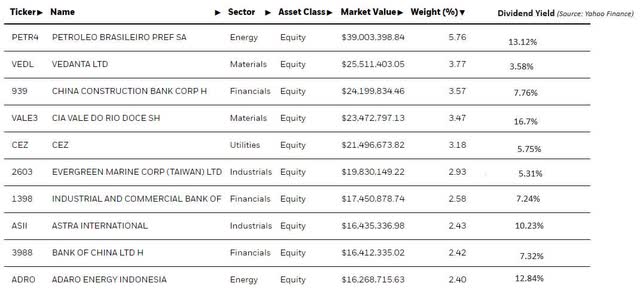
Top 10 companies in DVYE’s portfolio (Blackrock. (forward dividend yields from Yahoo Finance))
When companies trade at such low price levels that their dividend yield becomes double digits, we have to ask ourselves why that is the case.
This leads us to risks and a conclusion.
Risk to Thesis and Conclusion
Emerging markets could see some sustainable traction in terms of investor interest, but it is not going to outperform developed economies, such as that of the U.S.
We do still believe that the risks involved with the companies in DVYE in terms of corporate governance, especially the risk of corruption, are higher than our tolerance level.
There are also three large state-owned Chinese banks on the list.
Financials is the second-largest sector in our portfolio, but we have not invested in any bank in China. The reason is that we are not comfortable with their accounting standards. It is hard to determine what is in the balance sheets, and what liabilities are outside of the balance sheets.
From many years working with Indonesian coal miners, shipping their coal, we are reluctant to invest in these companies too, and Evergreen shipping company was bankrupt and had to be bailed out by the Taiwanese government in the past.
As investors, we try to focus on investing in companies that, we believe, are of good quality. If it passes that litmus test, we start to assess other parameters like valuations and solid balance sheets.
At this moment in time, DVYE does not pass our test, hence our stance is a Sell.
Credit: Source link