
Wirestock/iStock Editorial via Getty Images
Dollar General (NYSE:DG) is not a sexy company. It hasn’t been written about on Seeking Alpha in a couple of months, and performance since the last time I wrote on the company has been pretty putrid:
Seeking Alpha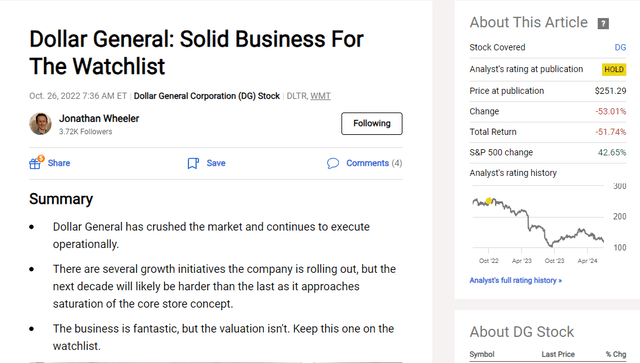
I rated the stock as a hold because I don’t generally recommend selling a good compounder. However, it was pretty apparent (and I discussed it in the article) the valuation was stretched while the outlook for the company left a lot to be desired. However, Dollar General has easily outstripped the market over the long-term:
FAST Graphs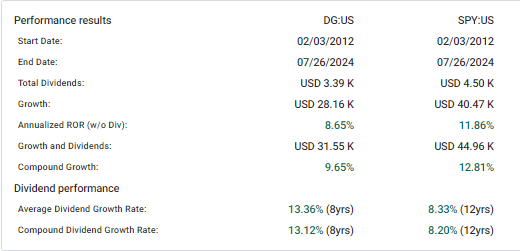
The purpose of my article today is to lay out the case that Dollar General could continue to beat the market from here. The valuation has de-risked with the sell-off over the past year and change. Although the next decade will not be as easy for management as the past decade was, the company is a strong operator. They have enough irons in the fire for growth and a solid grasp on what needs to be done to maintain their edge. The stock looks like a buy to me today.
2023 Annual Report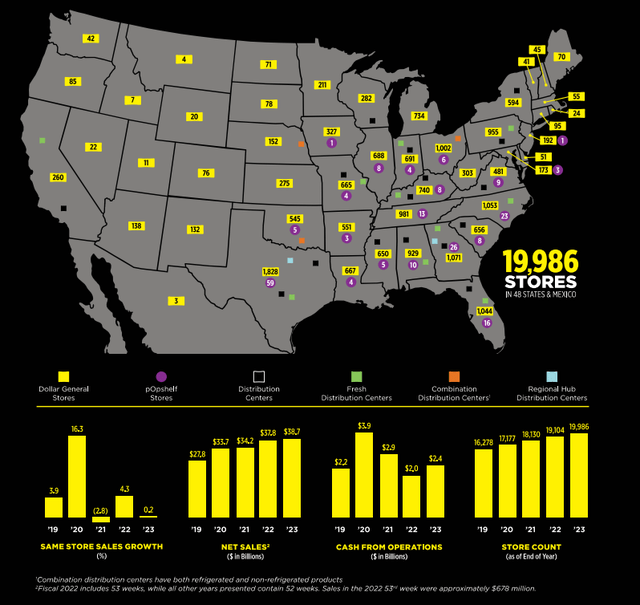
Dollar General is the leading retailer in the country by store number. With over 20,000 stores, 75% of the country is within 5 miles of a location. The company’s sweet spot stays out of the way of larger retailers, selling 80% consumable goods in typically more rural locations to an customer with an average income of around $40,000 per year.
A common misconception I see is the comparisons to Dollar Tree (NYSE:DLTR). DG’s new pOpShelf concept sells fewer consumables and more home good type items, which I think more directly competes with DLTR. However, a typical DG store is more geared toward household essentials and junk food. With that, a growing concern is how DG will continue to find profitable locations to roll out new stores. The pOpShelf concept is concerning to me. Walmart (NYSE:WMT) failed to compete effectively with DG on their turf with smaller concept Express stores. I’m not convinced DG will maintain their edge entering the urban arena with pOpShelf. However, this is one of the directions the company can move to continue their store growth runway.
Separately, it’s still early days on the Mexico expansion. I don’t understand the market well enough to say whether DG could effectively operate in the country, but it’s something that bears watching. None of the metrics are specifically broken out, but I’m interested to see if they can work towards achieving a similar store payback of ~2 years ($300K initial investment against $160k operating profit).
Ultimately, I think there’s still plenty of runway for DG to continue trucking along with their current model. Some analysts project around another 5,000 stores in the next decade, which seems reasonable. However, it will not move the needle to the same level as the past decade’s store growth.
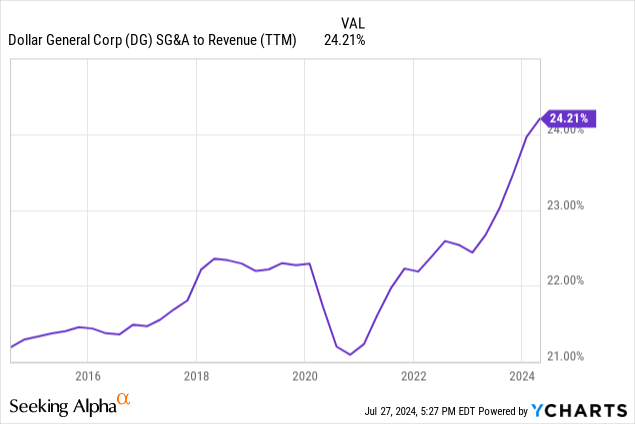
One of the more concerning trends for the company discussed on recent earnings calls is shrink (customer theft). If you’ve never been into a DG store, it’s not all that surprising to me the company has to wrestle with this. I’ve more than once had to find and flag down an employee after a decent wait to get them to come to the front so I can pay for my basket. In many of the stores I’ve been to (as a shareholder, I’ve tended to want to stop by when I see one), I would describe the interior of the store as chaotic.
With that in mind, I’m interested in the path from here. Between shrink and capex for supply chain improvements and store remodels, there’s a material impact to SG&A. Management quoted a 59 bp rise in shrink on the most recent call, attributing it to a 145 bp impact to gross profit. That’s substantial.
I assess management is halfway there on the answer. Firstly, they’re ripping self-checkout out of all but a small selection of stores. This will negatively impact SG&A from a labor perspective, but if it can improve shrink it seems like a necessary band-aid to rip off. Separately, the company is streamlining SKU’s, minimizing updates to end caps, and improving the overall mix of straight-to-shelf products to lower the overall workload of store employees. This seems like an important initiative. Labor complaints continue to plague the company, and are one of the reasons you’re able to buy the stock on sale today. However, I’m not entirely convinced this by itself will fix the shrink problem, so I won’t hold my breath. It could just as easily be cyclical, and DG isn’t the only retailer affected. If TGT and ULTA are feeling the pain, I’m not sure one cashier at the front of a DG store is going to fix it.
I won’t take too much away from just one question, but when an analyst asked for some additional perspective on shrink on the most recent earnings call, the answer didn’t impress me:
On shrink, I just want to make sure we referenced back to last quarter as we rolled out our back to basics program in earnest over the last few months. We talked about last quarter that some areas will take a little longer to manifest itself in a real positive manner. We called out shrink as being one of those because shrink has the longest tail to it. And quite frankly, we have many levers on shrink that we watch.
And we look at each and every quarter. In saying that, the great thing here is that what we’re seeing on the shrink front right now is what we thought we would. And that is of the shrink indicators that we watch. And by the way, we use a proprietary predictive model to look at this. We’ve had this for many years and as you know, over the years, our shrink indicators will would have indicated and have performed in a pretty good manner up until recently.
And these predictive models are now flashing green or positive with the majority of the items that we look at for shrink. So in saying that, in a nutshell, we feel pretty good about what that would indicate for the back half of the year, and what that will indicate hopefully for ’25 and beyond, just like we thought it would. It would come together a little softer in Q1, but again, green shoots, which is really great to see starting to perform. And Kelly, you may want to just mention how it affects the margin overall.
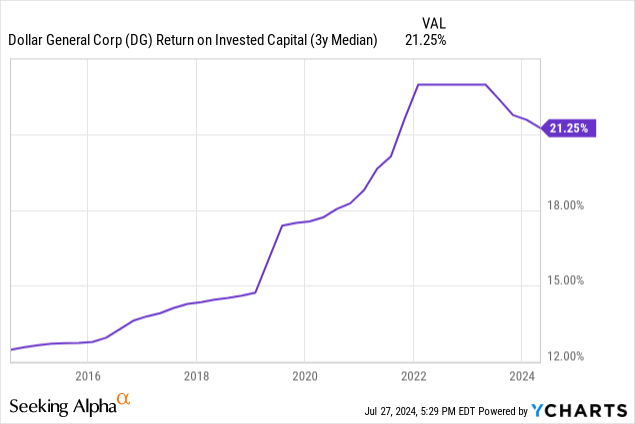
I have laid out some of the negatives so far, but it’s not all doom and gloom. DG has a massive store footprint, and continually pumps money into store relocations, remodels, and opening new stores. In the most recent quarter, the company opened 197 new stores, and as I mentioned above, the hurdle rate for these new openings is a 2 year payback from operating profit. That’s apparent when looking at returns on invested capital. The company definitely puts a considerable amount into buybacks and dividends, but other investments show through here as creating shareholder value over time.
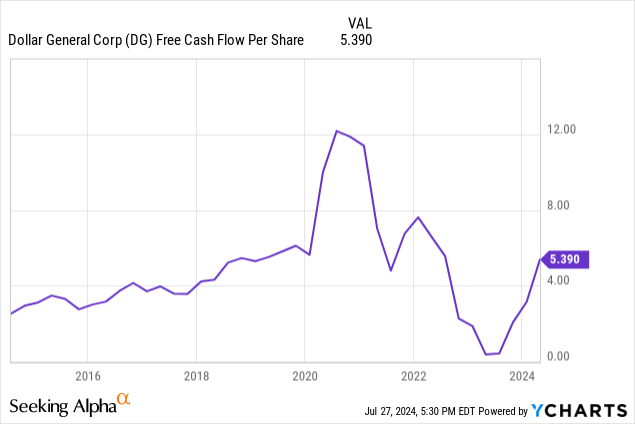
FCF/share is one of my favorite metrics to look at to determine a company’s overall quality, or ability to compound investor capital over time. After a hiccup in 2023 metrics, I’d say DG has done a solid job stacking FCF over time. Alot of this could be attributed to the company’s share cannibal nature, where 30% of the shares outstanding have been retired in the past decade. Buybacks are on hold for now as the company looks at other areas to deploy capital, but I’d like to see this FCF/share metric on an upward trajectory again, especially if store openings start to slow down (you would want to see a decrease in capex).
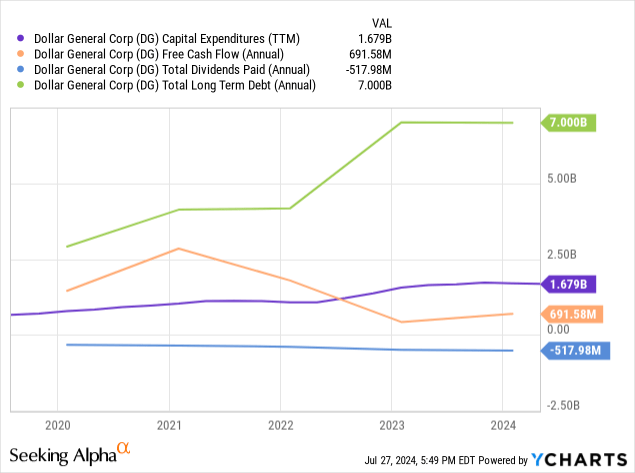
Like I mentioned above, the company’s capex outlays are significant considering the store footprint. Management maintains continuous store remodels, refreshing and upgrading to add coolers, self-checkout (no longer), etc.
We also continue to anticipate capital spending in the range of $1.3 billion to $1.4 billion as we invest to drive ongoing growth. We continually evaluate and seek to optimize the use of this capital, and as a result we have updated our expectations for real estate projects in 2024. We now expect to remodel approximately 1,620 stores this year compared to our previous expectation of 1,500 remodels.
To facilitate this increase in remodels, we’re reducing the number of planned new stores to 730 compared to our previous expectation of 800 new stores. We continue to expect to relocate 85 stores. In total, this increases our expected total real estate project count from 2,385 to approximately 2,435. We’re excited about this increase in projects and the expanded investment in our mature stores, and we believe this is an appropriate reallocation of our capital.
The dividends are still covered by free cash flow, but there isn’t a ton left over for the generous buybacks we have all grown accustomed to. Monitoring capex directionally moving forward is a good idea for DG investors. However, ultimately they need to spend what it takes to keep SSS growth pumping. Fixing shrink would help some with operating cash flow, but either way I wouldn’t count on the amount of capex needed to drastically reduce in the near term.
FAST Graphs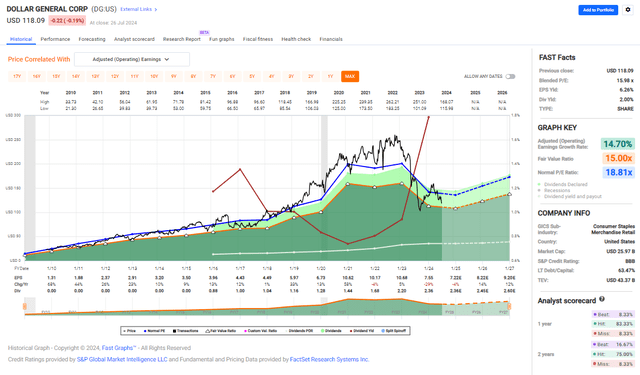
The market appears to have digested the risks I’ve discussed above, and the stock has been punished. I think it was a little out over its skis coming off COVID, and we are looking at more of a normalization of the company’s valuation.
FAST Graphs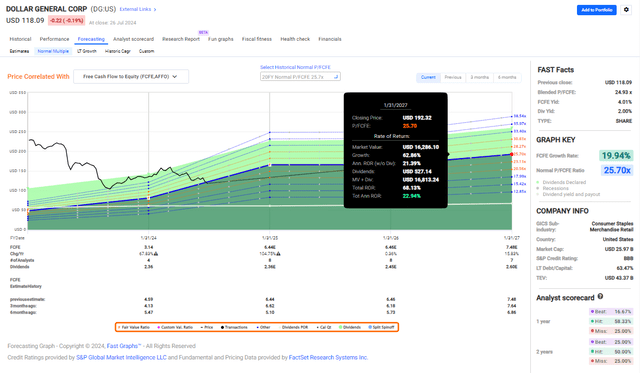
Based on analyst expectations of FCF growth and a return to the long-term average valuation of around 26X FCF, an investment today could yield around 23% annualized.
FAST Graphs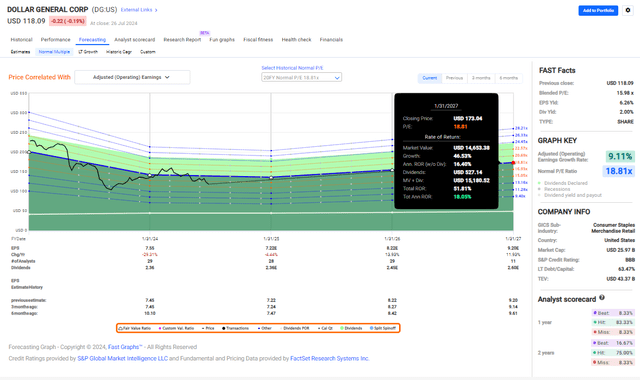
Based on earnings growth and a ~19X multiple, an investment today could net close to 19% annualized.
The graphs show a representation of what could happen, but obviously take that with a grain of salt. What I want to show here is DG management has a strong track record and I think they are aware of and working on the right issues. I don’t think shrink is fixed overnight, but if the rest of the business is humming along, I won’t lose sleep over it as an investor. Labor remains a concern, and again will likely continue to be a major item management has to work on over the medium term. The valuation appears fair, and I think the risks are well baked into the price. DG is a buy here.
Credit: Source link