
davidfillion/iStock via Getty Images
Introduction
In a previous article, I argued dentalcorp Holdings Ltd. (TSX:DNTL:CA) (OTCPK:DNTCF) should be looked at from a free cash flow perspective. There are numerous (non-cash) elements that weigh on the company’s net income, and I argued that some of the acquisitions (where non-cash amortizations had and still have a negative impact on the earnings profile) are a sunk cost and new shareholders could benefit from those investments.
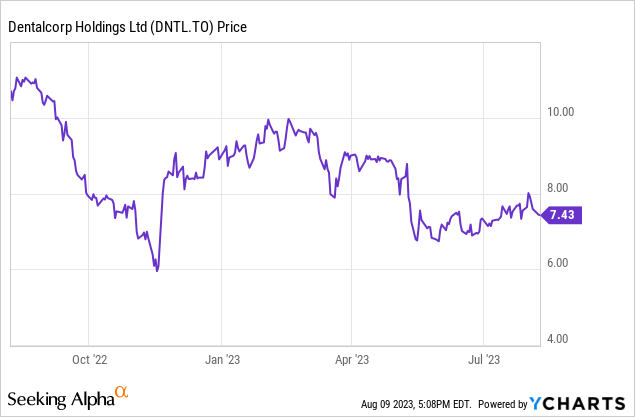
A net loss isn’t surprising, the cash flow is what matters
This article is meant as an update to my previous article on dentalcorp. I’d recommend you to read the April article to get a better understanding of the company’s business model. The strategic review has been completed and as no buyer has been found, we should continue to look at dentalcorp and determine if the company is currently attractive on a standalone basis.
During the second quarter of the year, dentalcorp reported a total revenue of C$368M resulting in a gross profit of just over C$175M. The finance costs obviously increased (I’ll discuss that later in this article) but the company was also able to record a C$21M gain from derivatives. Unfortunately this wasn’t sufficient to ensure the company would be profitable as the increase in SG&A expenses weighed on the result.
dentalcorp Investor Relations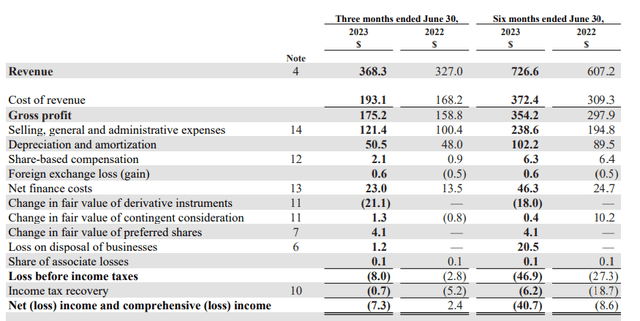
As you can see above, dentalcorp reported a net loss of C$7.3M (or C$0.04 per share), which brought the total net loss in the first semester to almost C$41M.
As explained in my previous article, I think it makes sense to focus on the free cash flow result of dentalcorp, as the sustaining capex is much lower than the C$50M quarterly depreciation and amortization expenses.
That is very clearly visible in the cash flow statement. The reported operating cash flow was almost C$87M, and after deducting the net working capital release of almost C$17M the adjusted operating cash flow in the first half of the year was approximately C$70M, and roughly C$57M after including the lease payments.
dentalcorp Investor Relations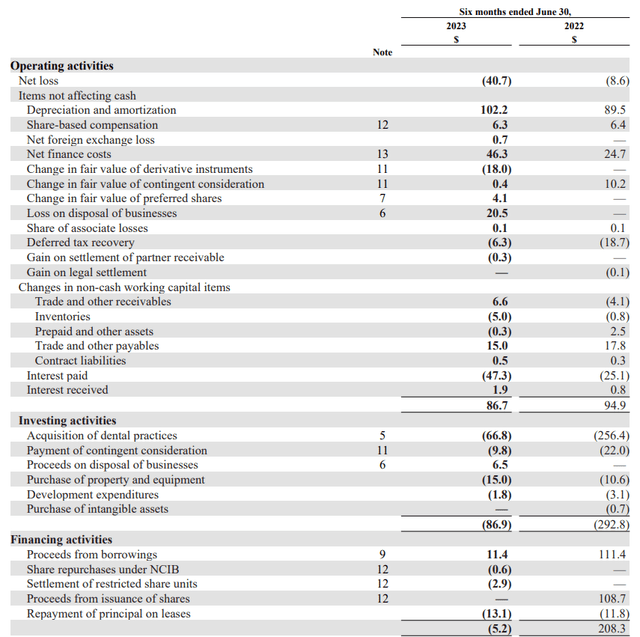
The investing cash flows can be split up in three elements: Cash M&A, the payment of contingent consideration for previous deals and the “real” capex. The latter was just C$17M in the first half of the year, and the C$30M combination of capex + lease payments was just a fraction of the C$102M in depreciation and amortization expenses. While the contingent consideration and acquisition related cash outflow are of course still cash outflows, they are not related to operating the business but to the M&A activities. Also keep in mind the real maintenance capex is estimated at less than 1% of the revenue, which means the C$17M capex (or 2.3% of the revenue) in the first semester indicates the company was spending more than just the sustaining capex.
dentalcorp Investor Relations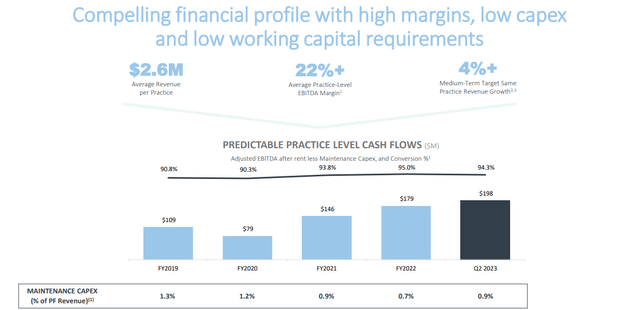
This means the underlying free cash flow result in the first semester was C$40M and divided over the 188M shares outstanding, the underlying free cash flow came in at C$0.21 per share.
While that’s less than I had hoped for, let’s not forget the cost of debt has increased by quite a bit in the first semester. The company paid about C$47M in interest expenses versus C$25M in the first semester of last year. The gross debt level has stabilized (it increased by just C$12M in H1 2023 despite M&A and thanks to the working capital contribution), so I expect the interest expenses to be very close to their peak levels as the cost of debt is currently roughly 8%. The main credit facilities have a variable interest rate of the CDOR + 2.75%. With the 3-month CDOR at 5.49%, the cost of debt of the main facility is now 8.25%.
Investment thesis
As the company continues to work towards improving its free cash flow (“FCF”) result, it is a pity the sharp increase in interest expenses is still “hiding” the relatively strong underlying results somewhat. The company is currently trading at a free cash flow yield of approximately 6%, and about 7.2% if you’d only take the sustaining capex into consideration. I now doubt the company will be able to increase its C$87M FCF result from last year by a double-digit percentage, but as the interest expenses shouldn’t increase by too much from here on, I expect the strong cash flow result to really start to be visible next year.
While the high debt level is an issue, the net debt level of C$968M (excluding lease liabilities) represents about 4 times the TTM Adjusted EBITDA (also adjusted for lease payments). The company is currently trading at an EV/EBITDA multiple of approximately 9.7, and this ratio should decrease as the EBITDA expands while the net debt decreases.
I’m still looking for a good entry point for dentalcorp Holdings Ltd., and I think somewhere in the low-7 range would work well.
Editor’s Note: This article discusses one or more securities that do not trade on a major U.S. exchange. Please be aware of the risks associated with these stocks.
Credit: Source link